Size of Business (Cambridge (CIE) A Level Business): Exam Questions

Exam code: 9609

2 hours7 questions
1
3 marks

Case Study

Child Play (CP)

Su is a sole trader who started a business called CP which operates a play area for children. The play area is inside a building and includes toys and other play equipment. Customers book on CP’s website for each hour that they would like to use the play area. CP is two kilometres away from the nearest city which has a large population.

Su does not pay for any promotion and she relies on recommendations and reviews from previous customers. Su currently charges a price of $10 an hour for a group of up to 5 children. Only one group can book CP for each hour. Demand is greater than supply so Su may increase the price to $15 per hour. She has completed some market research to see if this is a good idea. Her findings are in Table 1.1.

Table 1.1: Market research about prices for CP

Price

Quantity (hours) demanded per day

$10

10

$15

6

Su is also thinking about expanding the business by opening a café targeted at parents with children.

The café would be located at the entrance to CP’s play area. There are many other cafés in the city centre two kilometres away. Su believes that product differentiation is essential for the profitability of the café.

Su plans to use CP’s working capital as the source of finance to open the new café. The café will need to earn revenue quickly, so she plans to open it in four weeks. She will need quick and low‑cost promotion methods if the café is to succeed.

Explain one way in which the size of CP can be measured.

1
8 marks

Case Study

Braid Runner (BR)

Lewis is a hairdresser. He rents a small shop which he uses as a hairdressers called Braid Runner (BR). Lewis is a sole trader and he set up BR 25 years ago.

BR is the smallest of all the hairdressers in city Y. Lewis works on his own. He has repeat customers who have been using BR for many years. However, there are many large franchises in city Y which offer a much cheaper haircut than BR.

Lewis is considering increasing the price of a haircut, and he has outlined the costs and revenue of the business in Table 2.1.

Table 2.1: Costs and revenue of BR

Variable costs per customer

$3.50

Fixed costs per week

$675

Price

$8

Lewis would like to employ another hairdresser so that he can work fewer hours in BR. The new employee would have to be able to work in BR on their own. They would be responsible for taking bookings, dealing with customers and some financial transactions. Lewis has drawn up a person specification (see Fig. 2.1) that will be placed on a job website.

Characteristic

Essential

Desirable

Qualifications

  • Hairdressing qualification

  • A-Levels or high school standards in Mathematics and Business

Physical

  • Must be between 18 and 30 years old

  • Female

Experience

  • None r

  • equired

  • Experience of dealing with customers/consumers

  • Experience of working alone

Personal qualities

  • Able to work in a team

  • Good communication

  • Friendly

Fig. 2.1: Person specification created by Lewis

Analyse one advantage and one disadvantage for Lewis of operating as a small business.

1
12 marks

Case Study

Super Heroes (SH)

SH is a leisure (theme) park aimed at 10–18 year olds. It is owned by two companies, X and Y, which started SH as a joint venture. Company X owns many leisure centres and swimming pools. Company Y owns many brands based on superheroes.

SH employs 200 full-time workers and an extra 50 seasonal workers during the busiest times of the year. The park has 10 large rides which take up 2km2 of land. There are also many smaller rides, restaurants, toilets and shops. The price of an entrance ticket is $11 per customer. Table 1.1 shows the costs for SH in 2019.

Table 1.1: SH costs for 2019

Total fixed costs (per year)

$12m

Variable costs (per customer)

$3

Total costs

$42m

One of the larger rides at SH is the Iron Blaster. The number of customers who use this ride has decreased each year for the last three years. This has led the management of SH to consider its options for internal growth.

Option 1 – A new virtual reality (VR) ride
This option would involve developing the Iron Blaster into a VR ride. Most of the structure of the Iron Blaster could be used, but customers would be given a VR headset to wear during the ride. The cost of developing the VR ride would be $2m. The Iron Blaster ride would be closed for a three-month period during the off-peak season for the development to be carried out. No employees would be made redundant or dismissed.

Option 2 – A new hotel
SH does not currently have a hotel. It could demolish the Iron Blaster to provide the space to build one. Many of the competitors of SH have a hotel near or within their leisure parks. Hotel customers would pay a high price for a room but have free access to the leisure park’s facilities. Market research suggests that the average hotel customer would spend twice as long in the leisure park than a non-hotel customer. The cost of developing the hotel would be $15m and take a year to build. All of the employees currently working on the Iron Blaster ride would face redundancy or dismissal.

Recommend which one of the two options SH should choose for internal growth. Justify your recommendation.

2
12 marks

Read the following extract (opens in a new tab)before answering

Recommend whether the directors of HD should accept MW’s joint venture offer. Justify your recommendation.

3
20 marks

Case Study

Ryan’s Farm (RF)

RF was set up in Australia in 2001 when John Ryan bought a farm, equipment and inventory for $1.5m. He financed the purchase with a bank loan which was fully repaid by 2008. Initially, RF produced sugarcane, pineapples and mangoes.

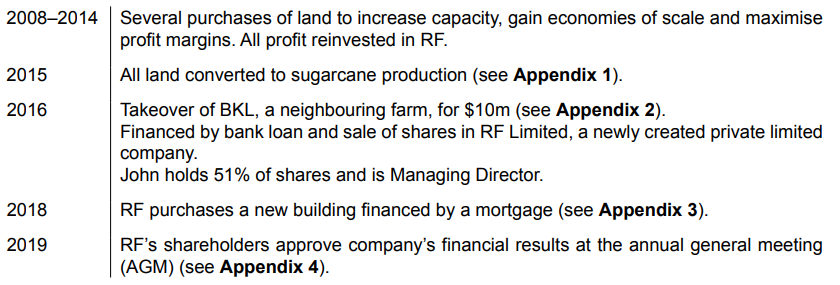
Timeline of RF’s strategy for growth

Timeline of RF business events 2008–2019, including land purchases, sugarcane conversion, BKL takeover, new company shares, mortgage building and AGM approval

Developing a new business strategy

In 2020 a fire destroyed all RF’s buildings and its inventory of recently harvested sugarcane. RF was unable to continue operations. John Ryan has chosen to retire and has left his controlling share of the company to his daughter, Sue.

Sue is determined to create a successful new farming business called RF2. She has adopted the following mission and aims as the basis of a business strategy.

Mission

  • Profitability through sustainability

Aims

  • Develop business options for farming the land

  • Identify market opportunities

  • Develop core competencies

  • Operate efficiently within a dynamic environment

  • Choose appropriate finance

Sue would now like advice on which approaches she should use to develop a new business strategy.

Appendix 1: Sugarcane production in Australia (2015)

  • Large profit margins

  • 80% of Australian sugarcane is exported. The main export markets include Russia, China, Indonesia and the United States

  • Australia does not subsidise sugarcane production. However, European and American producers are subsidised

  • Brazilian sugarcane farmers are more efficient than Australian sugarcane farmers

  • Global demand for sugarcane and sugarcane products is forecast to continue growing

  • There is pressure on the industry to make production more sustainable, e.g. using less water

Appendix 2: HR Director’s report summary following RF’s takeover of BKL (2016)

The two farms had very different corporate cultures. RF uses hard HRM whereas BKL used soft HRM. Most of the BKL employees were on flexi-time contracts

RF employees have annualised contracts. RF moved BKL employees onto annualised contracts, but half of them chose to leave. Recruitment is difficult. Productivity is forecast to fall

Appendix 3: Data on the new building (2018)

Increases RF’s inventory capacity by 300%. Allows RF to hold high levels of inventory for several months to take advantage of price changes

Computerised inventory control system

Links with enterprise resource planning (ERP) system used by all the major sugar factories

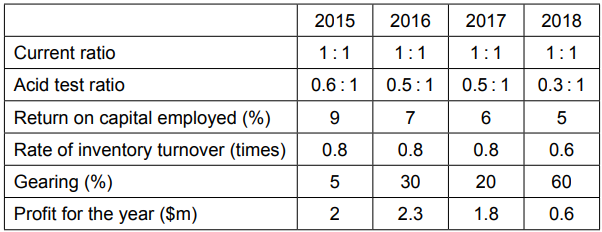
Appendix 4: Analysis of RF’s financial accounts between 2015 and 2018

Table of financial ratios 2015–2018 showing constant current ratio, falling acid test and ROCE, changing inventory turnover, rising gearing, and declining profit.

Evaluate RF’s strategy for growth between 2008 and 2019.

4
20 marks

Case Study

Luxury Hampers (LH)

In 2015 Loretta bought LH, an established food hamper business. A hamper is a gift box or basket containing food and drink. Loretta purchased the business for $500000 using a combination of personal savings and venture capital. Loretta set a short-term objective of profit maximisation and planned for rapid expansion within a five-year period.

LH buys high-quality food and drink products directly from manufacturers and packages the products into hampers to sell as luxury gifts.

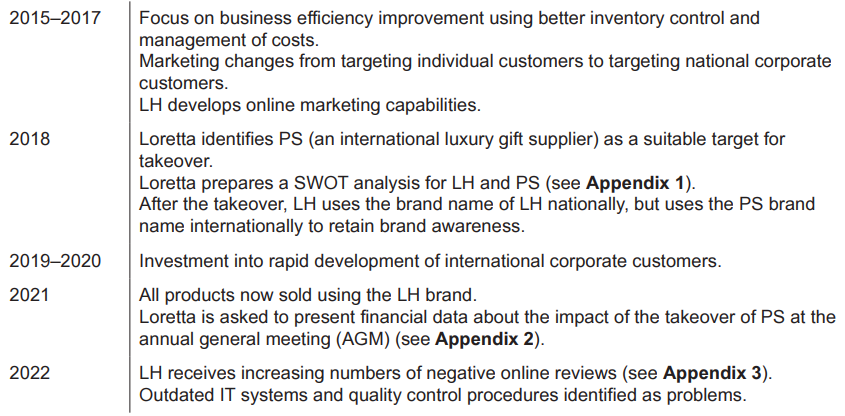
Timeline of LH

Timeline from 2015–2022 showing LH’s efficiency drive, takeover of PS, rebranding, international expansion, and later IT, quality and review problems

Developing an operations strategy

In 2023, a cyber-attack corrupted 75% of LH’s IT systems and data. Incomplete supplier data was recovered. However, all customer data was lost. This led to cancelled orders and LH experienced considerable damage to its reputation.

LH’s shareholders called an extraordinary general meeting (EGM) and Loretta was replaced as Managing Director by Sanjay, the Operations Director.

Sanjay has identified several problems which need to be solved in both the short and long-term. He considers there are several opportunities to improve LH’s operational efficiency.

Sanjay knows a new operations strategy must be developed with an appropriate budget. The strategy will have clear objectives to increase data security and improve customer service.

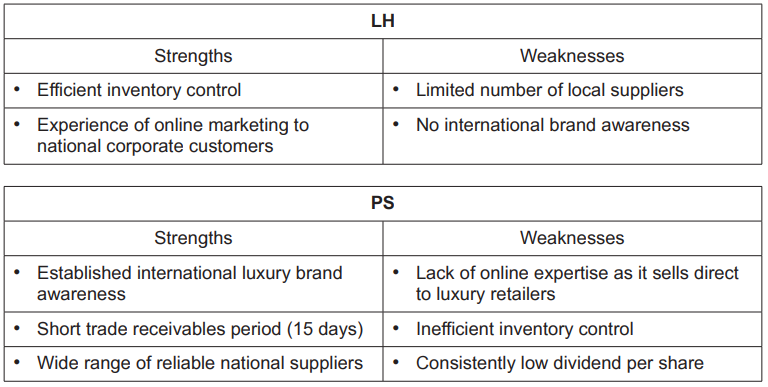
Appendix 1: Extracts from 2018 SWOT analysis for LH and PS

Table comparing LH and PS: each firm’s key strengths and weaknesses listed, including inventory control, online marketing, suppliers and brand awareness

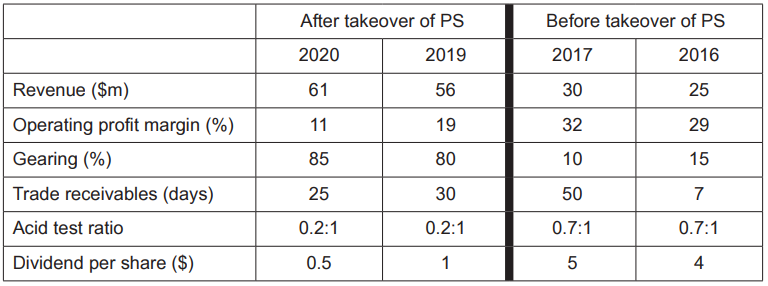
Appendix 2: Extracts from LH’s financial data presented 2021

Table comparing PS’s financial ratios before and after takeover from 2016–2020, including revenue, profit margin, gearing, receivables, acid test and dividends

Appendix 3: Extracts from online reviews in 2022

‘Although the packaging was excellent and the hamper was delivered on time, the contents were not what I ordered! Not happy and not using LH again!’

‘LH over-promised on delivery times. I wanted to provide New Year hampers for all of my senior managers across Europe and they were delivered after the festival period.’

‘Impossible to contact LH customer service. Ordered from someone much better!’

Evaluate whether LH made the correct strategic decision to take over PS.

5
20 marks

‘Marketing is the most important factor for the success of small businesses.’

Discuss the extent to which you agree with this view.