Political Parties (Edexcel A Level Politics): Exam Questions

Exam code: 9PL0

7 hours14 questions
1
30 marks

The following two articles seek to explain if the established political parties are defined by their historical origins or rather now characterised by new policies and ideas. Article 1 claims that nothing much has changed in the established parties’ policies and ideas. Article 2 argues that previous policies and ideas are no longer relevant today

Article 1

To understand the established political parties in the UK we have to appreciate how they evolved. The Conservative Party remains influenced by the One Nation and New Right ideas. This has delivered Thatcherism and also policies set in the One Nation mould. Liberal Democrats’ policy contains elements of classical liberalism and attributes of modern liberalism reflecting its ideas and policies. Finally, the Labour Party is a mixture of Old Labour and New Labour which means the policy of the party looks in two opposing directions and allows it to shape its agenda by application of both privatisation and nationalisation.

Therefore the established parties continue on a left- or right-wing basis in line with their original ideas.

Article 2

Descriptions of the established parties in the UK can no longer be defined by their historical origins. The Conservative Party has claimed both the title of One Nation and a link to the New Right but neither title fits any longer. The Conservative Party in recent years has been shaped by its attitude to Europe and immigration. The Liberal Democrat Party is not defined by the ideas of classical liberals or modern liberals but strives to be as independent as possible on policy and on ideas from the other two established parties – taking the party in multiple directions: quite often being strong on green policies. Finally, for the Labour Party, the influence of Old Labour is now irrelevant as recent revisions on policy show.

The established parties aim to catch as many votes as possible from as wide an audience as they can, they crave success and no longer feel any sense of duty to their historical roots, ideas and policies. The left- and right-wing bases no longer apply

Using the source, evaluate the view that the policies and ideas of the established political parties have now radically changed from their historical origins.

In your response you must:

  • compare and contrast the different opinions in the source

  • examine and debate these views in a balanced way

  • analyse and evaluate only the information presented in the source.

2
30 marks

Evaluate the view that the current funding of political parties in the UK requires reform.

You must consider this view and the alternative to this view in a balanced way.

3
30 marks

Allister Heath discusses the view that parties have now abandoned their traditional Left-wing or Right-wing policies in response to changing voter demands; as voters behave more like consumers, parties become more like shops, adopting a ‘pick and mix’ approach to policy choices and this leads to political party divisions.

The choice facing the electorate remains simple: you support the ‘Left’ or the ‘Right’: each offering a distinct, consistent view of society with debates surrounding equality remaining central. On many issues there is a ‘Left-Right’ divide, although a few like the EU and the environment cloud the issue.

But now voters feel empowered as consumers demanding a pick-and-mix approach to politics that they are used to as purchasers. Voters want to simultaneously back rail nationalisation and cut the top rate of income tax – or perhaps slash welfare but spend more on the NHS.  The old, Left-Right Westminster world is dead. As Mayor of Tees Valley Ben Houchen says, ‘Left and right have no meaning in politics any more, it’s simply a matter of getting things done.’ This policy fragmentation makes the established parties unstable and internally split: Labour is split between hard-left and liberal-left, having lost some working-class support while new parties try to replace it.

However, many feel that Left-Right ideology is still relevant, with most policy fitting the ‘Left-Right’ model. The established parties remain united in opposing each other and still dominate Westminster. Although internal party factions quarrel, they still play by the ‘Left-Right’ rules.

(Source: adapted from Allister Heath 25th January 2017 at https://www.telegraph.co.uk/ (opens in a new tab) news/2017/01/25/voters-used-netflix-have-no-time-left-right-entering-age-pick/)

Using the source, evaluate the view that ‘pick-and-mix’ politics is replacing ‘Left-Right’ politics and political parties are becoming more internally divided than ever.

In your response you must:

  • compare and contrast different opinions in the source

  • examine and debate these views in a balanced way

  • analyse and evaluate only the information presented in the source

4
30 marks

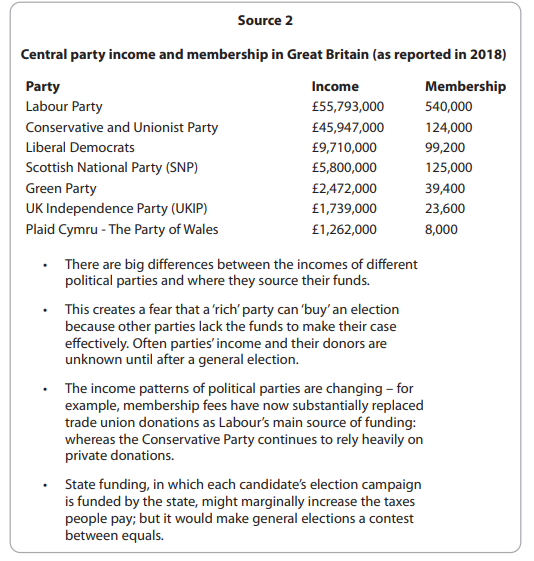
This source shows information published by the House of Commons on the income and membership of political parties in Great Britain. The source then reflects on the significance of this data and questions its implications.

Table of central party income and membership in Great Britain, 2018. Labour Party leads in income and membership; Plaid Cymru ranks lowest in both. Bullet points discuss funding sources and implications.

Using Source 2, evaluate the view that state funding of political parties would be preferable to a situation in which a party can win a general election because it has more members and income than other parties.

In your response you must:

  • compare and contrast different opinions in the source

  • examine and debate these views in a balanced way

  • analyse and evaluate only the information presented in the source.

5
30 marks

Evaluate the view that the only political parties that matter in our political system are the Labour and Conservative parties.

You must consider this view and the alternative to this view in a balanced way.

6
30 marks

Evaluate the view that UK political parties are failing to perform their core functions in a democracy.

You must consider this view and the alternative to this view in a balanced way.

7
30 marks

Evaluate the view that the quality of its leader is the most important factor in determining a political party's electoral success.

You must consider this view and the alternative to this view in a balanced way.

8
30 marks

Evaluate the view that the Conservative Party has abandoned One Nation conservatism.

You must consider this view and the alternative to this view in a balanced way.

9
30 marks

Evaluate the view that Reform UK poses a greater threat to the established parties than any other minor party has done.

You must consider this view and the alternative to this view in a balanced way.

10
30 marks

Evaluate the view that the way UK political parties select their leaders and candidates is undemocratic.

You must consider this view and the alternative to this view in a balanced way.

11
30 marks

The following two extracts consider what the long-term decline in political party membership means for UK democracy. Article 1, written in 2013 by a former MP, argues that the collapse of membership has damaged both the funding and the representativeness of British politics. Article 2, from a 2015 parliamentary briefing, sets out how participation has moved into informal forms rather than disappearing. Both extracts were written before the general elections of 2017, 2019 and 2024, so their comments on individual parties describe the position at the time of writing.

Article 1

One of the central facts of recent British politics has been the decline of the political party. Fewer people are voting for them, memberships have collapsed, and strength of attachment has fallen away. The only party currently prospering, UKIP, is doing so because it has successfully exploited the prevailing 'none of the above' sentiment. Why has this decline happened? Does it matter? And what, if anything, might be done about it?

The result is a problem of party funding, as big donors displace mass memberships; but even more crucially a problem of representation, as party politicians increasingly become a political class without a popular base. This in turn nourishes varieties of anti-politics (or non-politics). The parties continue as the monopolists of access to political careers and to political office, but in a context in which 99 per cent of citizens now do not belong to a political party. This is a recipe for a crisis of legitimacy.

Source: extract taken from Tony Wright, 'The decline of the political party: what comes after?', LSE British Politics and Policy blog, 29 July 2013.

Article 2

Informal political expression, such as through the arts, demonstrations and boycotts has a long history. New informal political practices tend to build on these forms, but are frequently enabled or mediated by the internet and social media. This has reduced the cost of organising and participating in protest and decreased the need for activists to be physically together in order to act together. Informal participation is often focused around single issues and personal identities, rather than on party politics or traditional ideological groups.

Younger people are more likely to take part in informal activities than previous generations, but without necessarily considering their participation to be political. It is difficult to assess the impact of informal activities on decision-making processes in the public, private or third sector, in part because many are relatively recent, and there is a lack of data. The impact of informal politics is also difficult to quantify because activities are aimed at enabling expressions of dissatisfaction with formal politics, rather than seeking clear and specific political change.

Source: extract taken from POSTnote 498, 'Trends in Political Participation', Parliamentary Office of Science and Technology, June 2015. Contains Parliamentary information licensed under the Open Parliament Licence v3.0.

Using the source, evaluate the view that the decline in party membership has seriously damaged UK democracy.

In your response you must:

  • compare and contrast the different opinions in the source

  • examine and debate these views in a balanced way

  • analyse and evaluate only the information presented in the source.

12
30 marks

The following two extracts consider how the UK party system should now be described. Article 1, written shortly before the 2015 general election, sets out evidence that the effective number of parties competing has risen sharply since the 1950s. Article 2, written in 2019, argues that structural barriers keep the two largest parties entrenched however the votes fall. Neither extract could take account of the 2024 general election, so their examples describe the position at the time of writing.

Article 1

The decline in support for Britain's two traditional parties over the past two decades is now common knowledge. Over 90 per cent of people voted either Conservative or Labour in the 1950s, yet less than two-thirds voted for these two parties in 2010 and perhaps even fewer will support them in May 2015. What is also recognised is that this change is not simply a result of growing support for the Liberal Democrats, particularly in 2010, but also a result of growing support for the nationalist parties in Scotland and Wales, and two relatively new entrants in British politics: UKIP on the right, and the Greens on the Left.

The effective number of parties at the national level has increased from just above 2 in the 1950s to over 3.5 in 2010. Looking at the constituency level, though, the increase is not quite as significant: from just below 2 in the 1950s to 2.9 in 2010. What this difference suggests is that party competition across constituencies has become increasingly heterogeneous. For example, the Conservatives and Labour were the top 2 parties in fewer than 45 per cent of constituencies in 2010.

Source: adapted from Jack Blumenau and Simon Hix, 'Britain's evolving multi-party system(s)', LSE British Politics and Policy blog, 31 March 2015.

Article 2

Historically, anyway, it's been somewhere between difficult and impossible for any party that can't manage to score around 30% of the nationwide vote here to break through — unless, like the Scottish and Welsh nationalists or the Northern Ireland parties, they can claim to speak for a particular part of the country with a particularly strong identity. Nigel Farage, in offering the Tories some kind of electoral pact with the Brexit Party, isn't so much doing them a favour as trying to prevent a re-run of 2015 when Ukip won nearly four million votes and only one solitary seat.

Britain's big two [parties] have been so dominant for so long that they are more or less dug in in a slew of safe seats. That means that, unlike their competitors, they can actually afford to slip some way below the magic 30% and still win a reasonably respectable (and often fairly proportional) haul of constituencies.

Infrastructure keeps them in place too. They hold significant capital, whether it be physical (such as constituency offices), financial (assets and the ability to raise loans and donations), or human (members, know-how, experience, and even cosy relationships with the print and broadcast media).

Source: adapted from Tim Bale, 'A dire warning for our old political system', UnHerd, 12 September 2019.

Using the source, evaluate the view that the UK can no longer be described as having a two-party system.

In your response you must:

  • compare and contrast the different opinions in the source

  • examine and debate these views in a balanced way

  • analyse and evaluate only the information presented in the source.

13
30 marks

The following two articles disagree about the Green Party's place in UK politics. Article 1 argues that its influence far exceeds its size at Westminster. Article 2 argues that its influence has been overstated.

Article 1

Counting Green MPs is the wrong way to measure the Green Party. It quadrupled its representation in 2024, rising from one seat to four, and drew close to two million votes, but its real achievement lies elsewhere. Every major party now competes on environmental policy, and the UK's commitment to reach net zero by 2050 was legislated in 2019 with cross-party support. Ideas once dismissed as fringe are now the common ground of British politics.

The Greens also matter where seats are not the currency. They hold hundreds of council seats and run or share power in local authorities, and their advance into urban seats forces Labour to defend its left flank. A party that changes what its rivals must promise has more power than its seat count admits.

Article 2

Four seats out of 650 is not influence, it is decoration. The Greens cannot amend a bill, defeat a government or extract a concession, and no government has ever needed their votes to survive.

The claim that they drove environmental policy also inverts the evidence. Climate commitments came from international agreements and from a shift in public opinion that the main parties read for themselves, not from a party with a single MP for most of that period. When the political weather changed, those commitments were weakened regardless: in September 2023 the government delayed the ban on new petrol and diesel cars to 2035, and the Greens could do nothing whatever about it.

Setting an agenda you cannot enforce is not power. It is commentary.

Using the source, evaluate the view that the Green Party's influence on UK politics is far greater than its representation at Westminster suggests.

In your response you must:

  • compare and contrast the different opinions in the source

  • examine and debate these views in a balanced way

  • analyse and evaluate only the information presented in the source.

14
30 marks

The following two articles consider how well political parties perform their function of recruiting the people who become MPs. Article 1, written in 2017, argues that educational and financial barriers keep candidates from ordinary backgrounds out of Parliament. Article 2 argues that the parties have made real progress and that the charge misjudges what representation requires. Note that Article 1 was written before the 2024 general election that Article 2 discusses.

Article 1

How can we get more state school pupils into politics? Improving political education in comprehensive schools, and improving access to extracurricular activities which develop skills sought after in politics, such as public speaking and debating, could all help close the gap. Too often comprehensive pupils do not have access to these activities. However, we still know relatively little about why people educated in comprehensives are so much less likely to become MPs. People on low and middle incomes may find it difficult to get experience in politics, with reports of MPs offering unpaid internships and concerns that candidates may be put off by the high cost of living in London. The cost of running as an MP may also be too high for many, with one estimate putting the cost of becoming a candidate, running a campaign, and lost earnings during the process at roughly £34,000 of personal expenses. Political parties must do more to ensure candidates from all backgrounds can gain experience and afford to run for office.

Knowing the backgrounds of our MPs really does matter. The social backgrounds of MPs are still considerably different to those of the population, which means that the worries and concerns of all parts of society are unlikely to be adequately represented by parliament. And importantly, MPs are ultimately responsible for national education policy, and may allow their own experiences to guide the decisions they make. Indeed, the attempted resurrection of grammar schools was driven by a Prime Minister and close advisor (Nick Timothy) who both attended grammar schools themselves. The schools, Theresa May said, would “make this country a true meritocracy” – despite a wealth of evidence that grammar schools under-represent people from disadvantaged backgrounds.

Source: 'Over half of MPs went to comprehensives – but a career in politics is still far from accessible' by Rebecca Montacute, first published on LSE British Politics and Policy (https://blogs.lse.ac.uk/politicsandpolicy/mps-background-and-educational-inequality/), licensed under CC BY 4.0. Edited for length.

Article 2

This is a description of the past presented as a verdict on the present. The Parliament elected in 2024 was the most diverse in British history, returning record numbers of women MPs and record numbers of MPs from ethnic minority backgrounds. That did not happen by accident. It followed deliberate action by the parties themselves, including Labour's use of all-women shortlists from 1997 and sustained efforts by the Conservatives to widen their candidate lists.

The deeper error is the assumption that an MP can only represent people who resemble them. Constituents are served by MPs who take up their cases and defend their interests, and there is no reason why that requires a shared background. Parties are also voluntary organisations that can only choose from those who come forward. Blaming them for the composition of that pool confuses a symptom with a cause.

Source: written for this question.

Using the source, evaluate the view that UK political parties fail to recruit a political class that represents the country.

In your response you must:

  • compare and contrast the different opinions in the source

  • examine and debate these views in a balanced way

  • analyse and evaluate only the information presented in the source.