Experimental Design & Analysis (College Board AP® Physics 1: Algebra-Based): Exam Questions

1 hour6 questions
1a
Sme Calculator
2 marks
A spring projectile launcher consisting of a coiled spring attached to a flat plate. Three pin positions A, B, and C are marked along the barrel where the plate can be held in place when the spring is compressed.

Figure 1

A group of students are given a projectile launcher which consists of a spring with an attached plate, as shown in Figure 1. When the spring is compressed, the plate can be held in place by a pin at any of three positions A, B, or C.

The same spring launcher with a steel sphere placed against the plate, which is held by the pin at position C with the spring fully compressed.

Figure 2

Figure 2 shows a steel sphere of known mass placed against the plate, which is held in place by a pin at position C. The sphere is launched upon release of the pin.

The students have access to the projectile launcher and equipment usually found in a school laboratory. The students are asked to take measurements to create a graph that could be used to determine the spring constant of the spring.

i) Indicate the measurements the students could make that would allow them to determine the spring constant of the spring.

ii) Briefly describe a method to reduce experimental uncertainty for the measured quantities.

1b
Sme Calculator
2 marks

i) Indicate what quantities the students could graph on the horizontal and vertical axes to create a linear graph that could be used to determine the spring constant k of the spring.

ii) Briefly describe the relationship between the spring constant k and a feature of the graph from part b)i).

1c
Sme Calculator
4 marks

The students perform another experiment using the projectile launcher, where they measure the range of spheres of different masses and their time of flight. The spring constant of the spring is k equals 6 space straight N divided by straight m. Table 1 shows the horizontal range R of each sphere and its time of flight t.

Table 1

Position

Compression distance, ∆ x (m)

Time of flight, t (s)

Range, R (m)

A

0.02

1.00

0.69

B

0.04

1.01

1.40

C

0.06

1.02

2.12

The students create a graph with k \left(∆ x\right)^{2} plotted on the vertical axis.

i) Label the horizontal axis of Figure 3 with a measured or calculated quantity. Include units, as appropriate. The graphed quantities should yield a linear graph that can be used to determine an experimental value for the mass of the sphere.

ii) On the grid in Figure 3, create a graph of the quantities indicated in part c)i).

  • Clearly label the horizontal axis with a numerical scale

  • Plot the corresponding data points on the grid

  • Any columns added to Table 1 for scratch work will not be scored
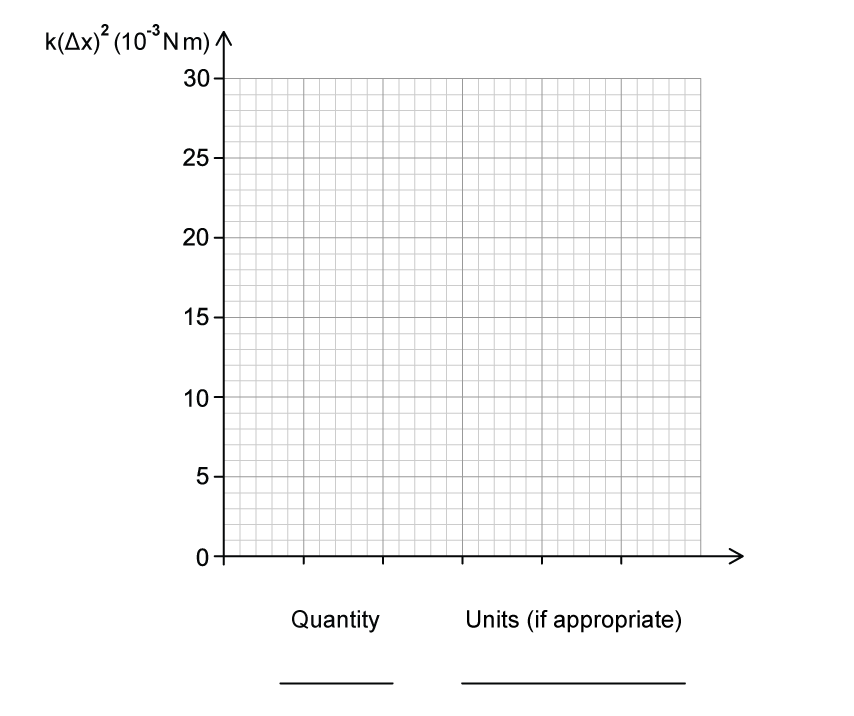
Blank graph with vertical axis labelled k(Δx)² in units of 1 × 10⁻³ N·m, ranging from 0 to 30 with evenly spaced gridlines. Horizontal axis is blank with spaces for "Quantity" and "Units (if appropriate)" labelled.

Figure 3

iii) Draw a best-fit line to the data graphed in part c)ii).

1d
Sme Calculator
2 marks

Calculate an experimental value for the mass of the sphere using the best-fit line that you drew in part c)iii).

2a
Sme Calculator
2 marks
Cylindrical container is half-filled with liquid. The container rests on a table.

Figure 1

A group of students are given a cylindrical container half filled with a liquid of unknown density \rho. The students have access to an additional container with more of the same liquid, meter sticks, and a pressure sensor. They do not have access to a scale.

i) Indicate quantities that could be measured by the students that would allow them to determine the density of the liquid using a linear graph.

ii) Briefly describe a method to reduce experimental uncertainty for the measured quantities.

2b
Sme Calculator
2 marks

i) Indicate what quantities students could graph on the horizontal and vertical axes to create a linear graph that can be used to determine the density of the liquid.

ii) Briefly describe the relationship between the density of the liquid and a feature of the graph from part b)i). Your answer may include an equation that relates the density of the liquid and the chosen feature of the graph.

2c
Sme Calculator
4 marks
Diagram showing water flowing horizontally from a tank on a table, with height marked as "h" and initial velocity marked as "v₀" as it exits.

Figure 2

Students perform an experiment with a cylinder which is filled with water, as shown in Figure 2. The students make a small hole in the side of the cylinder and measure the speed v at which water exits the hole. The students plug the first hole, make another one at a different height, and repeat this procedure. Table 1 shows the height h of each hole relative to the top of the water, and the corresponding water speed v.

Table 1

Height, h (m)

Speed, v (m/s)

0.25

2.2

0.20

2.0

0.15

1.8

0.10

1.4

0.05

1.1

The students correctly determine that the relationship between h and v is given by

v space equals space square root of 2 g h end root

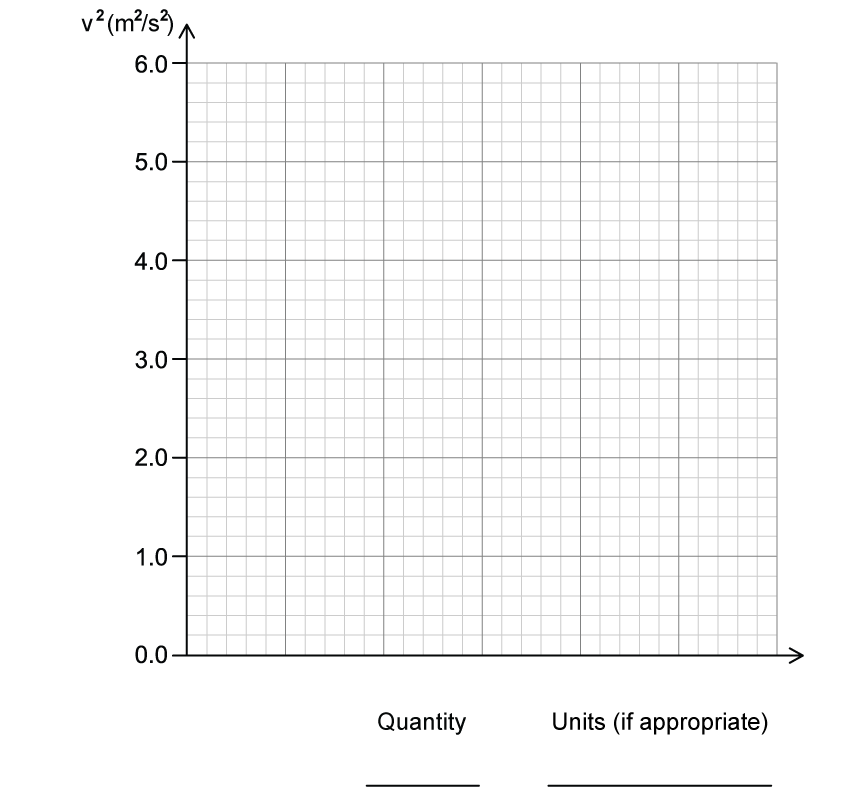
The students want to determine an experimental value for the acceleration due to gravity. The students create a graph with v squared plotted on the vertical axis.

i) Label the horizontal axis of Figure 3 with a measured or calculated quantity. Include units, as appropriate. The graphed quantities should yield a linear graph that can be used to determine the acceleration due to gravity.

ii) On the grid provided in Figure 3, create a graph of the quantities indicated in part c)i).

  • Clearly label the horizontal axis with a numerical scale

  • Plot the corresponding data points on the grid

  • Any columns added to Table 1 for scratch work will not be scored.

Blank graph with vertical axis labelled v² in units of m²/s², ranging from 0.0 to 6.0 with evenly spaced gridlines. Horizontal axis is blank with spaces for "Quantity" and "Units (if appropriate)" labelled.

Figure 3

iii) Draw a best fit line for the data plotted in part c)ii).

2d
Sme Calculator
2 marks

Calculate an experimental value for the acceleration due to gravity using the best-fit line that you drew in part c)iii).

3a
Sme Calculator
2 marks

A student is investigating the relationship between the length of a simple pendulum and its period of oscillation. The student has access to a stopwatch, a meter rule, a pendulum bob, a retort stand with a clamp, and a protractor.

The student hypothesizes that the period of the pendulum is proportional to the square root of the length of the pendulum.

i) Indicate quantities that could be measured by the student that would allow them to determine the relationship between the period of the pendulum and its length, using a linear graph.

ii) Briefly describe a method to reduce experimental uncertainty.

3b
Sme Calculator
2 marks

i) Indicate what quantities the student could graph on the horizontal and vertical axes to create a linear graph that can be used to determine the relationship between the period of the pendulum and its length.

ii) Briefly describe how the graph could be analyzed to test the student's hypothesis. Your answer may include an equation that relates the measured or calculated quantities and the chosen feature of the graph.

3c
Sme Calculator
4 marks

In a similar experiment, the student investigates the forces acting on the pendulum bob as it moves in a vertical circle. The student uses a pendulum bob of mass m space equals space 0.15 space kg and a string of unknown length L. A force sensor is used to measure the tension T in the string, and a motion sensor is used to measure the speed v of the bob as it passes through the lowest point of the swing. The recorded data is shown in Table 1.

Table 1

Velocity, v (m/s)

Tension, T (N)

1.0

2.4

1.5

3.9

2.0

5.4

2.5

7.9

3.0

10.4

The student correctly determines that the relationship between T and v at the lowest point is given by:

T space minus space m g space equals space fraction numerator m v squared over denominator L end fraction

The student wants to determine an experimental value for the length L of the string.

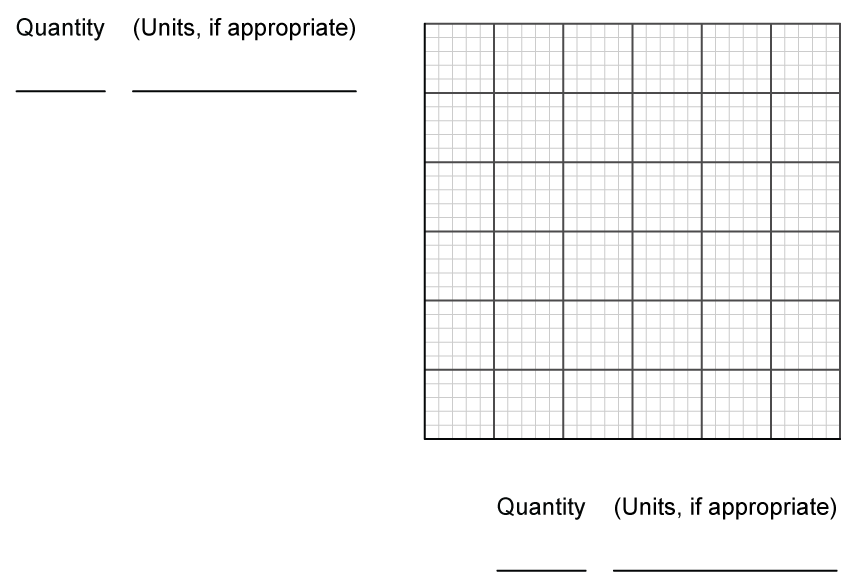
i) Label the axes of Figure 1 with measured or calculated quantities. Include units, as appropriate. The graphed quantities should yield a linear graph that can be used to determine L.

ii) On the grid provided in Figure 1, create a graph of the quantities indicated in part c)i).

  • Clearly label the horizontal and vertical axes with numerical scales.

  • Plot the corresponding data points on the grid

  • Any columns added to Table 1 for scratch work will not be scored.

Blank graph with spaces for "Quantity" and "Units (if appropriate)" labelled on both axes.

Figure 1

iii) Draw a best fit line for the data plotted in part c)ii).

3d
Sme Calculator
2 marks

Calculate an experimental value for the length of the string using the best-fit line that you drew in part c)iii).

4a
Sme Calculator
2 marks

A student has a rubber ball of known mass m which they release from rest from height h. The student hypothesizes that the impulse exerted on the ball upon impact with the ground is equal to the change in its momentum, and wants to collect data to test this hypothesis. The student has access to a force sensor, a motion sensor, and other standard laboratory equipment.

i) Indicate quantities that could be measured by the student that would allow them to determine the relationship between the impulse exerted on the ball and the change in its momentum.

ii) Briefly describe a method to reduce experimental uncertainty for the measured quantities.

4b
Sme Calculator
2 marks

i) Indicate what quantities the student could graph on the horizontal and vertical axes to create a linear graph that can be used to determine the relationship between the impulse exerted on the ball and the change in its momentum.

ii) Briefly describe how the graph could be analyzed to test the student's hypothesis. Your answer may include an equation that relates the measured or calculated quantities and the chosen feature of the graph.

4c
Sme Calculator
4 marks

In a later experiment, the student uses the same experimental setup with a clay ball of mass m space equals space 50 space straight g. The clay ball is dropped from a vertical height h above a force sensor and sticks to it upon impact. For each h, the student records the average force F_{a v g} recorded by the force sensor and the amount of time ∆ t that the force was applied. The student's measurements are shown in Table 1.

Table 1

h (m)

F_{a v g} (N)

∆ t (s)

0.15

4.0

0.023

0.30

5.7

0.021

0.45

7.9

0.019

0.60

10.0

0.017

0.75

12.6

0.015

0.90

17.5

0.012

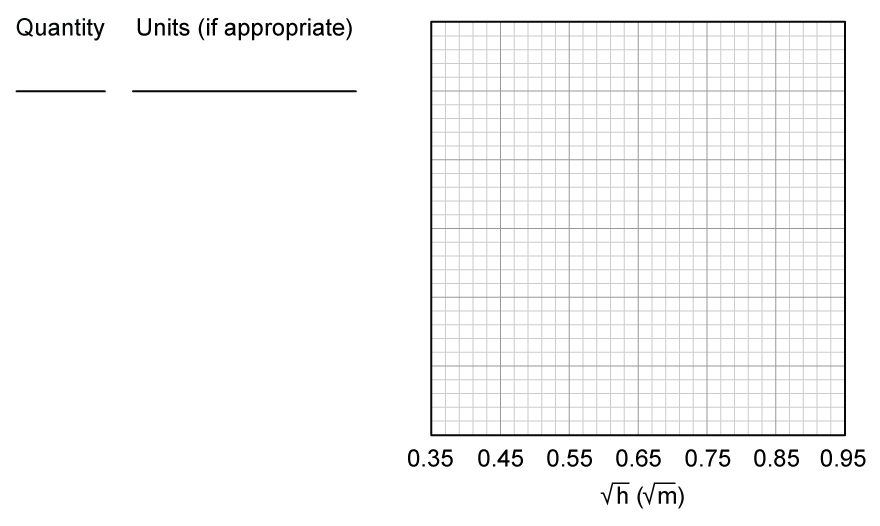
The student wants to determine an experimental value for the acceleration due to gravity. The student creates a graph with \sqrt{h} plotted on the horizontal axis.

i) Label the vertical axis of Figure 1 with a measured or calculated quantity. Include units, as appropriate. The graphed quantities should yield a linear graph that can be used to determine the acceleration due to gravity.

ii) On the grid provided in Figure 1, create a graph of the quantities indicated in part c)i).

  • Clearly label the vertical axis with a numerical scale

  • Plot the corresponding data points on the grid

  • Any columns added to Table 1 for scratch work will not be scored

Blank graph with horizontal axis labelled √h in units of √m, ranging from 0.35 to 0.95 with evenly spaced gridlines. Vertical axis is blank with spaces for "Quantity" and "Units (if appropriate)" labelled.

Figure 1

iii) Draw a best-fit line to the data graphed in part c)ii).

4d
Sme Calculator
2 marks

Calculate an experimental value for the acceleration due to gravity using the best-fit line that you drew in part c)iii).

5a
Sme Calculator
2 marks
Two carts with mass M. Cart 2 contains a plunger-spring system. Before recoil: carts at rest next to each other, spring compressed within Cart 2. After recoil: carts move apart, spring extended.

Figure 1

A group of students have two carts, Cart 1 and Cart 2, each of identical, unknown mass M. The carts are initially at rest and placed next to each other on a horizontal track. Cart 2 contains a compressed spring which can be released by pressing a switch on top of the cart. When the switch is pressed, the spring expands and pushes a plunger outward, causing the two carts to recoil, as shown in Figure 1. Blocks of different known masses can be attached to each cart.

The group of students is asked to determine whether the total momentum of the system is conserved. The students have access to equipment that can be found in a typical school physics laboratory.

i) Indicate quantities that could be measured by the students that would allow them to determine whether the total momentum of the system is conserved during the recoil.

ii) Briefly describe a method to reduce experimental uncertainty for the measured quantities indicated in part a)i).

5b
Sme Calculator
2 marks

i) Indicate what quantities the students could graph on the horizontal and vertical axes to create a linear graph that can be used to determine whether the total momentum of the system is conserved.

ii) Briefly describe how the graph will be analyzed to determine whether the total momentum of the system is conserved.

5c
Sme Calculator
4 marks
Two carts, 1 and 2, of mass M on a track. Cart 2, with a spring and a block on top, is against a wall to the left. Cart 1 is to the right of Cart 2, with 4 blocks on top.

Figure 2

In a later experiment, Cart 2 is placed next to a wall. When the switch is pressed, the spring expands and the plunger pushes on the wall, causing Cart 2 to move towards Cart 1, as shown in Figure 2. Cart 1 is initially at rest. After the collision, the two carts stick together and move along the track with speed v. Blocks of identical, known mass can be attached to Cart 1 and Cart 2, as long as the total mass of the system remains constant. The spring constant k of the spring in Cart 2 is unknown. When the spring is contained within the cart, it is compressed by a fixed distance x from its equilibrium position.

The students are asked to determine the value of the spring constant of the spring. The students measure the combined mass M_{1 , B} of Cart 1 and the blocks, the combined mass M_{2 , B} of Cart 2 and the blocks, and the final speed of the two-cart-block system.

The students measure the fixed value x space equals space 0.062 space straight m. The students repeat the experiment using different numbers of blocks on each cart and collect the data shown in Table 1.

Table 1

Combined mass of Cart 1 and blocks, M subscript 1 comma B end subscript (kg)

Combined mass of Cart 2 and blocks, M subscript 2 comma B end subscript (kg)

Final speed of the two-cart-block system, v (m/s)

1.750

0.500

0.410

1.500

0.750

0.505

1.250

1.000

0.585

1.000

1.250

0.650

0.750

1.500

0.720

0.500

1.750

0.775

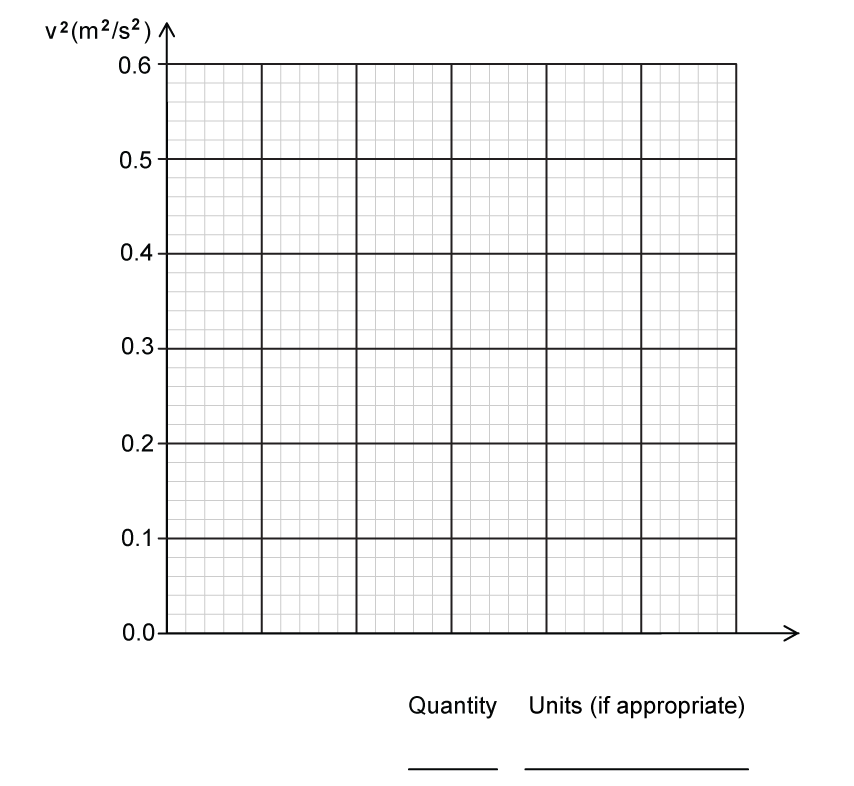
The students create a graph with v^{2} plotted on the vertical axis.

i) Label the horizontal axis of Figure 3 with a measured or calculated quantity. Include units, as appropriate. The graphed quantities should yield a linear graph that can be used to determine the spring constant k of the spring.

ii) On the grid provided in Figure 3, create a graph of the quantities indicated in part c)i).

  • Clearly label the horizontal axis with a numerical scale

  • Plot the corresponding data points on the grid

  • Any columns added to Table 1 for scratch work will not be scored

Blank graph with vertical axis labelled v² in units of m²/s², ranging from 0.0 to 0.6 with evenly spaced gridlines. Horizontal axis is blank with spaces for "Quantity" and "Units (if appropriate)" labelled.

Figure 3

iii) Draw a best-fit line to the data graphed in part c)ii).

5d
Sme Calculator
2 marks

Using the line drawn in part c)iii) and the measured value x space equals space 0.062 space straight m as needed, calculate the spring constant k of the spring.

6a
2 marks
A wheel mounted on an axle at its center with a block hanging from a string wound around the wheel. The block hangs from a height above the floor below.

Figure 1

A group of students have a wheel mounted on a horizontal axle and a small block of known mass attached to one end of a light string. The other end of the string is attached to the wheel's rim and wrapped around it several times, as shown in Figure 1. When the block is released from rest and begins to fall, the wheel begins to rotate with negligible friction.

The students hypothesize that the decrease in the gravitational potential energy of the block-Earth system is equal to the increase in the block's translational kinetic energy from when the block starts moving to immediately before it reaches the floor, and want to collect data to test this hypothesis.

i) Indicate quantities that could be measured by the students that would allow them to determine the decrease in gravitational potential energy of the block-Earth system and the increase in the translational kinetic energy of the block as it falls.

ii) Briefly describe a method to reduce experimental uncertainty for the measured quantities.

6b
Sme Calculator
2 marks

i) Indicate what quantities the students could graph on the horizontal and vertical axes to create a linear graph that can be used to determine whether the decrease in gravitational potential energy is equal to the increase in translational kinetic energy.

ii) Briefly describe how the graph will be analyzed to determine whether the decrease in gravitational potential energy is equal to the increase in translational kinetic energy.

6c
Sme Calculator
4 marks

The students are asked to determine the rotational inertia I of the wheel. The students measure the angular velocity \omega of the wheel as the block falls a distance d and determine the translational kinetic energy K_{T} of the block immediately before it reaches the floor.

The mass of the block is m space equals space 0.2 space kg. The student's measurements for different falling distances are shown in Table 1.

Table 1

d (m)

\omega (rad/s)

K_{T} (J)

0.10

2.4

0.08

0.30

3.8

0.16

0.50

5.1

0.36

0.70

6.0

0.47

0.90

6.7

0.59

1.10

7.5

0.72

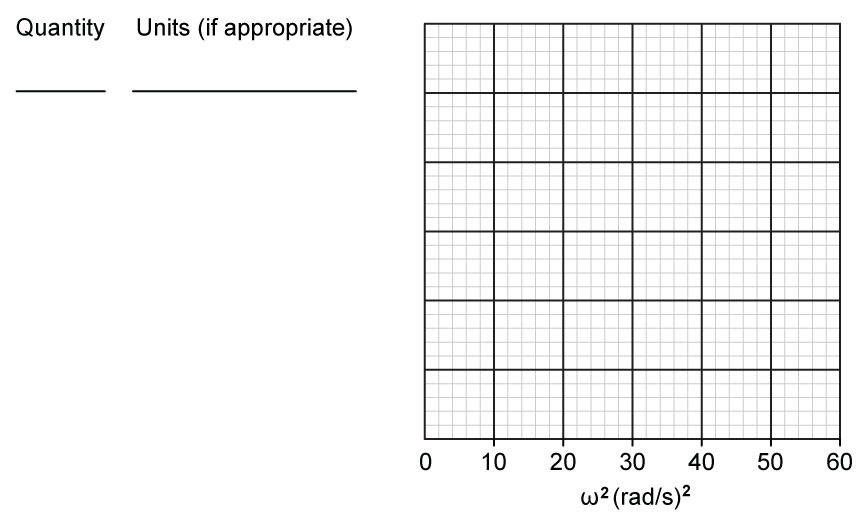
The students create a graph with \omega^{2} plotted on the horizontal axis.

i) Label the vertical axis of Figure 2 with a measured or calculated quantity. Include units, as appropriate. The graphed quantities should yield a linear graph that can be used to determine the rotational inertia I of the wheel.

ii) On the grid provided in Figure 2, create a graph of the quantities indicated in part c)i).

  • Clearly label the vertical axis with a numerical scale

  • Plot the corresponding data points on the grid

  • Any columns added to Table 1 for scratch work will not be scored

Blank graph with horizontal axis labelled ω² in units of (rad/s)², ranging from 0 to 60 with evenly spaced gridlines. Vertical axis is blank with spaces for "Quantity" and "Units (if appropriate)" labelled.

Figure 2

iii) Draw a best-fit line to the data graphed in part c)ii).

6d
Sme Calculator
2 marks

Calculate an experimental value for the rotational inertia of the wheel using the best-fit line that you drew in part c)iii.