Gravitational Force (College Board AP® Physics 1: Algebra-Based): Exam Questions

1 hour25 questions
1a
2 marks

State the relationships described by the equation for Newton's law of gravitation.

1b
2 marks

Newton's universal law of gravitation applies in specific conditions.

i) State the location required of the two bodies for Newton's law of universal gravitation to apply.

ii) State the requirement for the separation distance between two bodies for Newton's law of universal gravitation to apply.

1c
2 marks

State the simplification that can be used for the mass of a uniform sphere and the type of gravitational field it produces.

1d
4 marks

State the equation for Newton's universal law of gravitation. Define the terms, including their units of measurement.

2a
2 marks

State the nature of the gravitational force between two objects and explain your answer.

2b
2 marks

i) Describe the range of the gravitational force around an object.

ii) Describe the relationship between the mass of an object and the magnitude of its gravitational force.

2c
2 marks

State two conditions that would change the relative position between the centers of mass of two systems located outside of a uniform gravitational field.

2d
2 marks

State the conditions required for the gravitational force around a planet to be considered constant.

3a
3 marks

Define a gravitational field.

3b
2 marks

i) State the name of the force experienced by a mass in a gravitational field.

ii) State the visual representation that shows the direction of the gravitational force.

3c
2 marks

A moon is in orbit around a planet.

State and give a reason for the direction of the planet's gravitational force.

3d
3 marks

Explain how the strength of a gravitational field is represented visually.

4a
2 marks

i) State the condition required for the observed acceleration of an object to be numerically equal to the magnitude of the gravitational field strength.

ii) State the name of the gravitational field strength when expressed in m/s2.

4b
2 marks

Define the term vacuum, and explain the significance of a vacuum for falling objects.

4c
6 marks

State the value of acceleration due to gravity at Earth's surface in a vacuum. Justify your answer quantitively.

4d
3 marks

Describe the role of air resistance on an object in free fall.

5a
4 marks

State the two equations and the variables used to calculate gravitational field strength.

5b
2 marks

State the conditions required for an object to appear weightless.

5c
2 marks

Explain the meaning of the term apparent weight.

5d
4 marks

Define the terms inertial mass and gravitational mass.

1
3 marks
A moon orbiting a planet in a circular path.

Figure 1

A moon of mass mM is moving clockwise in a circular orbit around a planet of mass M and radius R, as shown in Figure 1.

Figures 2, 3, and 4 each show the planet and a portion of the moon's orbit.

Three identical diagrams labelled Figure 2, 3, 4, showing a portion of the circular orbit of the moon around the planet.

i) On the diagram in Figure 2, draw an arrow to indicate the direction of the moon's velocity. If the velocity is zero, write "v = 0" next to the dot.

ii) On the diagram in Figure 3, draw an arrow to indicate the direction of the moon's acceleration. If the acceleration is zero, write "a = 0" next to the dot.

iii) On the diagram in Figure 4, draw an arrow to indicate the direction of the net force exerted on the moon. The force must be represented by a distinct arrow starting on and pointing away from the dot.

2a
3 marks

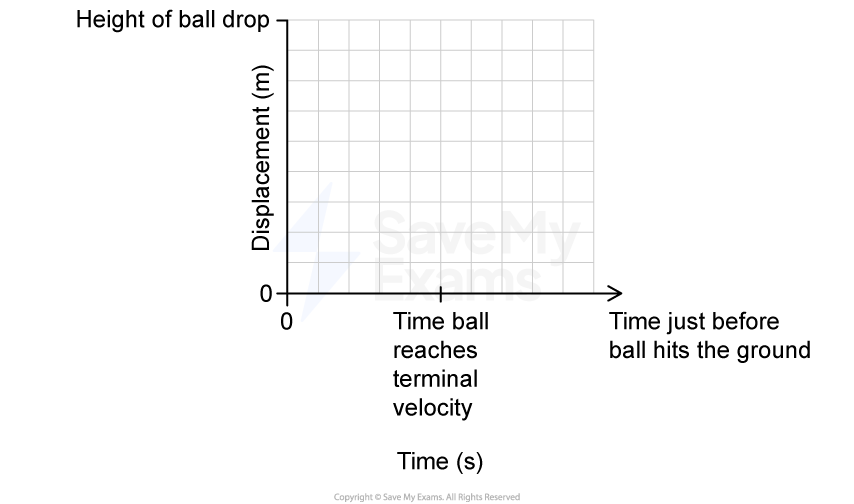
A ball is dropped from rest from a height habove the ground. Air resistance is found to be non-negligible.

On the axis provided in Figure 1, sketch a graph of the displacement of the ball as a function of time from its release to the time just before it hits the ground.

Graph with labelled axes; vertical is displacement in metres, horizontal is time in seconds. Notes: height of ball drop, terminal velocity, ground impact.

Figure 1

2b
3 marks

Figure 2 shows the free-body diagram of the forces acting on the ball during its fall. The diagram has been drawn by a student. 

Diagram of a force diagram on graph paper, showing a dot with two opposing arrows labelled "Fn" upwards and "Fg" downwards, representing normal and gravitational forces.

Figure 2

A student sketches the free-body diagram in Figure 2 and makes the following claim:

"The free body diagram shows the forces acting on the ball for the entire time the ball falls."

Indicate whether the student’s sketch (Figure 2) and claim are or are not consistent with the graph of displacement as a function of time you sketched in part a). Justify your reasoning.

3
3 marks

A satellite of mass m orbits a planet of mass M in a circular orbit at an altitude h above the planet’s surface. The radius of the planet is R.

Derive an expression for the orbital velocity of the satellite in terms of M, r, and physical constants as appropriate. Begin your derivation by writing a fundamental physics principle or an equation from the reference information.

4
3 marks
A spacecraft orbiting the Earth in a circular path of radius R from the Earth's center.

Figure 1

A spacecraft of mass m is in a clockwise circular orbit of radius R around Earth, as shown in Figure 1. The mass of Earth is ME.

i) On the diagram in Figure 2, draw and label arrows that represent the forces (not components) that act on the spacecraft. Each force on your diagram must be represented by a distinct arrow starting on, and pointing away from, the spacecraft.

Spacecraft orbiting the Earth with a curved dashed line indicating the circular path and a straight dashed line passing from the Earth's center to the spacecraft.

Figure 2

ii) Determine an equation for the net gravitational force on the spacecraft due to the Earth in terms of m, ME, R and physical constants as appropriate.

1a
2 marks

Two identical moons, each with mass m, orbit a planet of mass M. At one instant, Moon A is twice as far from the planet as Moon B.

Draw and label force vectors acting on each moon.

1b
3 marks

Moon B suddenly falls out of its orbit and begins to fall towards the planet.

Starting with conservation of energy, derive an equation for the final velocity of Moon B upon impact with the planet.