Vectors & Motion in Two Dimensions (College Board AP® Physics 1: Algebra-Based): Revision Note

Analyzing motion in two dimensions
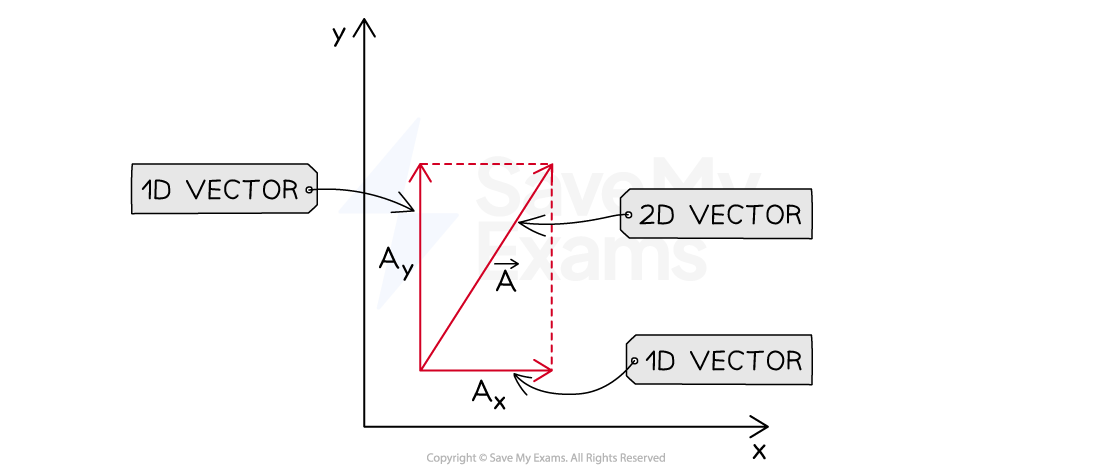
The same kinematic equations can be used to analyze motion in two dimensions
The individual equations are covered in more detail in the study guide Kinematic equations
Two-dimensional motion can be separated into one-dimensional components
The kinematic equations can be used on each component
Worked Example
A carrier jet is an aircraft that takes off from a large boat called an aircraft carrier. The jet is catapulted from the aircraft carrier to reach the velocity required for takeoff on such a short runway.
At the moment of takeoff, a jet has a horizontal acceleration of and a vertical acceleration of . The jet's initial velocity is in the horizontal direction and in the vertical direction.
Calculate the resultant final velocity of the jet after .
Answer:
Step 1: Analyze the scenario
To find the resultant final velocity, the component final velocities must first be calculated
Step 2: List the known quantities
Taking forward and upward to be positive
Horizontal acceleration,
Horizontal initial velocity,
Vertical acceleration,
Vertical initial velocity,
Time interval,
Step 3: Select a suitable kinematic equation to calculate the final velocity components
Displacement is not required
Step 4: Calculate the magnitude of the resultant final velocity
Step 5: Calculate the direction of the resultant final velocity
from the horizontal
Step 6: State the resultant final velocity

Unlock more, it's free!
Join the 100,000+ Students that ❤️ Save My Exams
the (exam) results speak for themselves:

Was this revision note helpful?
Build on this topic
