Kinetic Energy & Potential Energy of SHM (College Board AP® Physics 1: Algebra-Based): Revision Note

Kinetic energy & potential energy of SHM
Energy changes in SHM
Graph of potential and kinetic energies
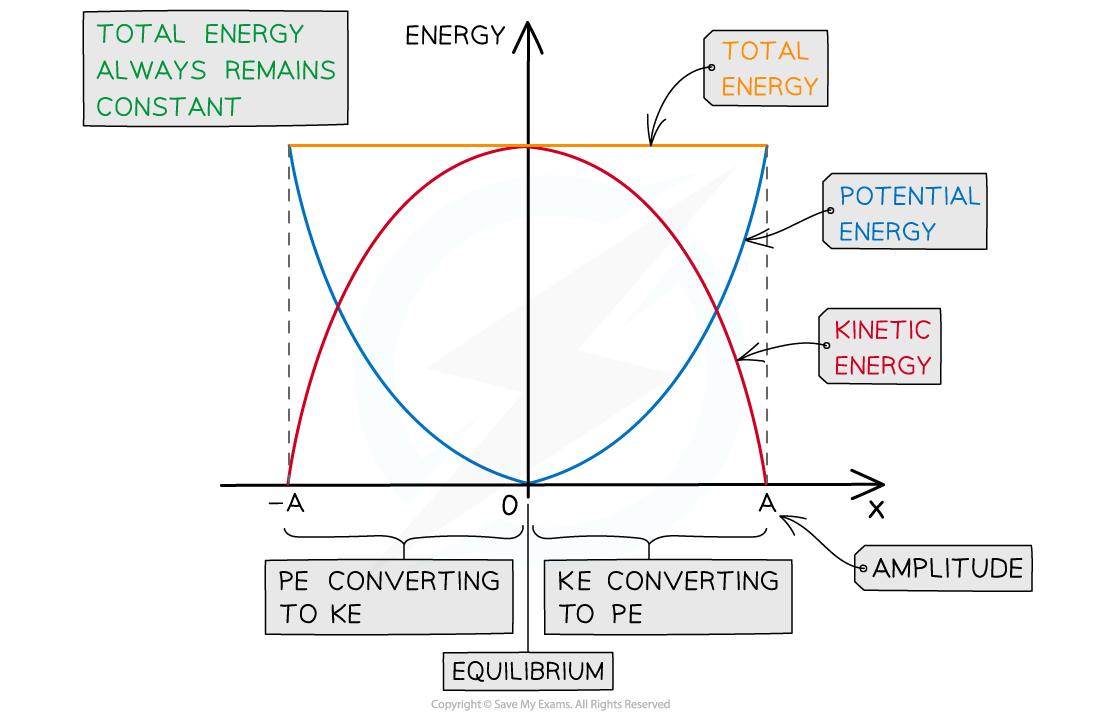
Kinetic energy and potential energy vary throughout a cycle for a system displaying SHM
However, unlike displacement, velocity and acceleration, kinetic and potential energies only vary from zero to a maximum
Energy is a scalar quantity and cannot have negative values
Where potential energy is at a maximum, kinetic energy is zero
Where kinetic energy is at a maximum, potential energy is zero
Variation in kinetic energy
Recall that kinetic energy is proportional to velocity squared
At the amplitude positions:
Velocity is zero as the object changes direction
At these points, kinetic energy is zero
Kinetic energy cannot have a value lower than zero
At the equilibrium position travelling in the positive direction:
Velocity has a maximum positive value
Kinetic energy has a maximum positive value
At the equilibrium position travelling in the negative direction:
Velocity has a minimum negative value
Kinetic energy still has a maximum positive value, as squaring the velocity negates its negative sign
Variation in potential energy
Work done by the restoring force in the opposite direction to displacement goes into the potential store
When the magnitudes of the restoring force and displacement are greatest, the potential energy has a maximum value
At the equilibrium position:
Displacement from equilibrium is zero
No work is done against the restoring force
Potential energy of the system is zero
At the amplitude positions:
The magnitudes of displacement and the restoring force are both maximum
Potential energy has a maximum value
Potential and kinetic energies at different positions
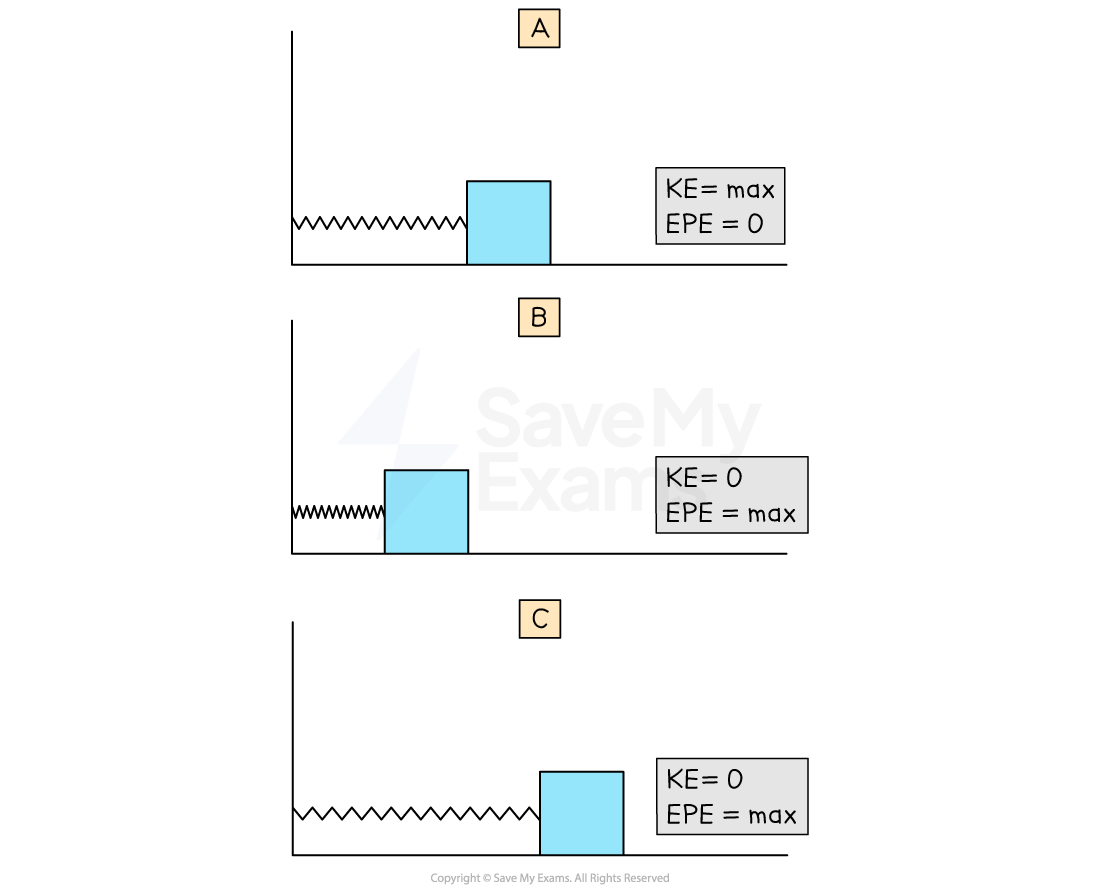
Total energy
The total energy in SHM remains constant
At every value of displacement, the sum of potential and kinetic energies is constant
This means when potential energy is zero (at equilibrium), maximum kinetic energy is equal to the total energy
Similarly, when kinetic energy is zero (at amplitude),maximum potential energy is equal to the total energy
Amplitude and total energy
Increasing the amplitude of oscillations increases the total energy in the system
The potential store of the SHM system is filled when the object moves against the restoring force, doing work
If the amplitude of oscillations is increased, more work is done so the maximum potential energy also increases
If maximum potential energy increases, the total energy of the system increases
Total energy of an object-ideal spring system
Recall that the elastic potential energy stored in a spring is:
Where:
= elastic potential energy stored in the spring, measured in
= spring constant measured in
= displacement, measured in
When displacement is equal to amplitude, , potential energy is at a maximum:
Maximum potential energy is equal to total energy of the system:
Worked Example
A vertical spring with a spring constant of 80 N/m is suspended from a pole. A 0.4 kg block is connected to its lower end.
If the block is pulled 0.3 m from its equilibrium position and is released, what is its maximum speed?
Answer:
Step 1: Analyze the system
This is an object-ideal spring system displaying simple harmonic motion
The block is displaced 0.3 m from its equilibrium position, this is the amplitude of oscillations
Step 2: Apply the specific conditions
The total energy of the system is the sum of kinetic and potential energies
The potential energy of this system is in the form of elastic potential energy
At the amplitude positions, kinetic energy is zero
When kinetic energy is zero, potential energy is at a maximum
At equilibrium, potential energy is zero
When potential energy is zero, kinetic energy is at a maximum
Step 3: Consider the amplitude positions
At the amplitude positions, potential energy is equal to total energy
Displacement is equal to amplitude,
Step 4: Substitute the known quantities
Spring constant is 80 N/m
Amplitude is 0.3 m
Total energy is therefore:
Step 5: Consider the equilibrium position
At equilibrium, kinetic energy is equal to total energy
Velocity is at a maximum here:
Step 6: Rearrange for maximum velocity and substitute known quantities
Rearrange for :
Mass is 0.4 kg
Total energy is 3.6 J
Substitute these values into the rearranged equation:

Unlock more, it's free!
Join the 100,000+ Students that ❤️ Save My Exams
the (exam) results speak for themselves:

Was this revision note helpful?
Build on this topic
