Newton's Second Law (College Board AP® Physics 1: Algebra-Based): Revision Note

Newton's second law
Newton’s second law of motion states:
The acceleration of a system’s center of mass has a magnitude proportional to the magnitude of the net force exerted on the system and is in the same direction as that net force
Newton's second law of motion is defined by the equation:
Where:
= acceleration of the system's center of mass, measured in
= net force exerted on the system, measured in
= mass of the system, measured in
Newton's second law states that:
acceleration is directly proportional to the net external force
acceleration is inversely proportional to the mass of the system
The velocity of a system’s center of mass will only change if a nonzero net external force is exerted on that system
Remember that a system can be modeled as a singular object with a center of mass at the center of the system
Mass and net external force
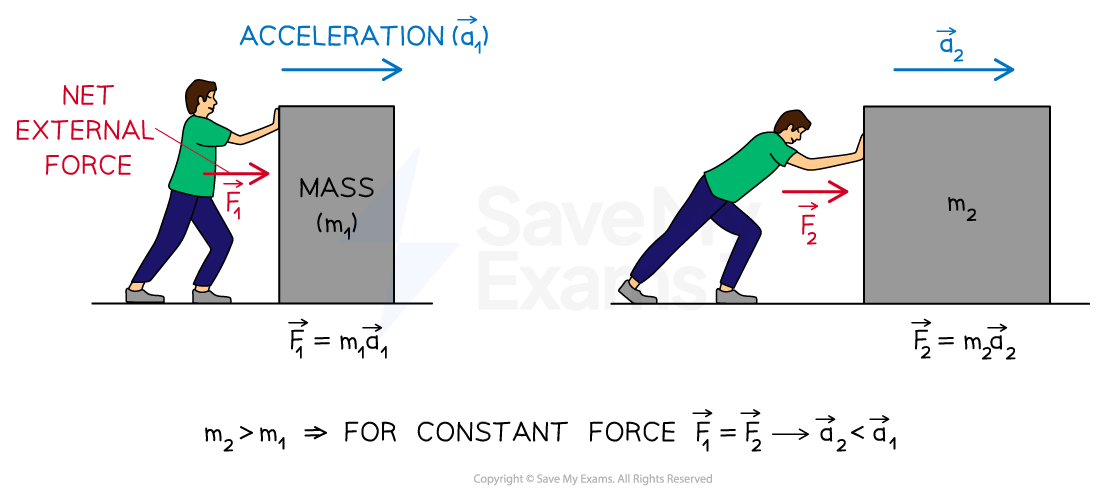
Forces can combine to produce:
balanced forces when the net external force is zero
unbalanced forces when the net external force is nonzero
Newton's second law in two dimensions
Motion can be investigated in one or two-dimensional planes, such as along the ground or on a slope
One-dimensional planes involve just up and down or left and right (on the ground)
Two-dimensional planes involve both up and down and left and right (on an inclined plane)
Forces may be balanced in one dimension but unbalanced in another
The system’s velocity will change only in the direction of the unbalanced force
On an inclined plane, one dimension is parallel to the plane of the slope and the other dimension is perpendicular to the plane of the slope
An object can have:
unbalanced forces acting down the slope causing it to accelerate down the slope
balanced forces acting perpendicular to the slope so there is no motion away from or into the inclined plane of the slope
Worked Example
A rocket of mass produces an upward thrust of and has a weight of . When in flight, the force due to air resistance is .
What is acceleration of the rocket?
A
B
C
D
The correct answer is C
Answer:
Step 1: Analyze the scenario
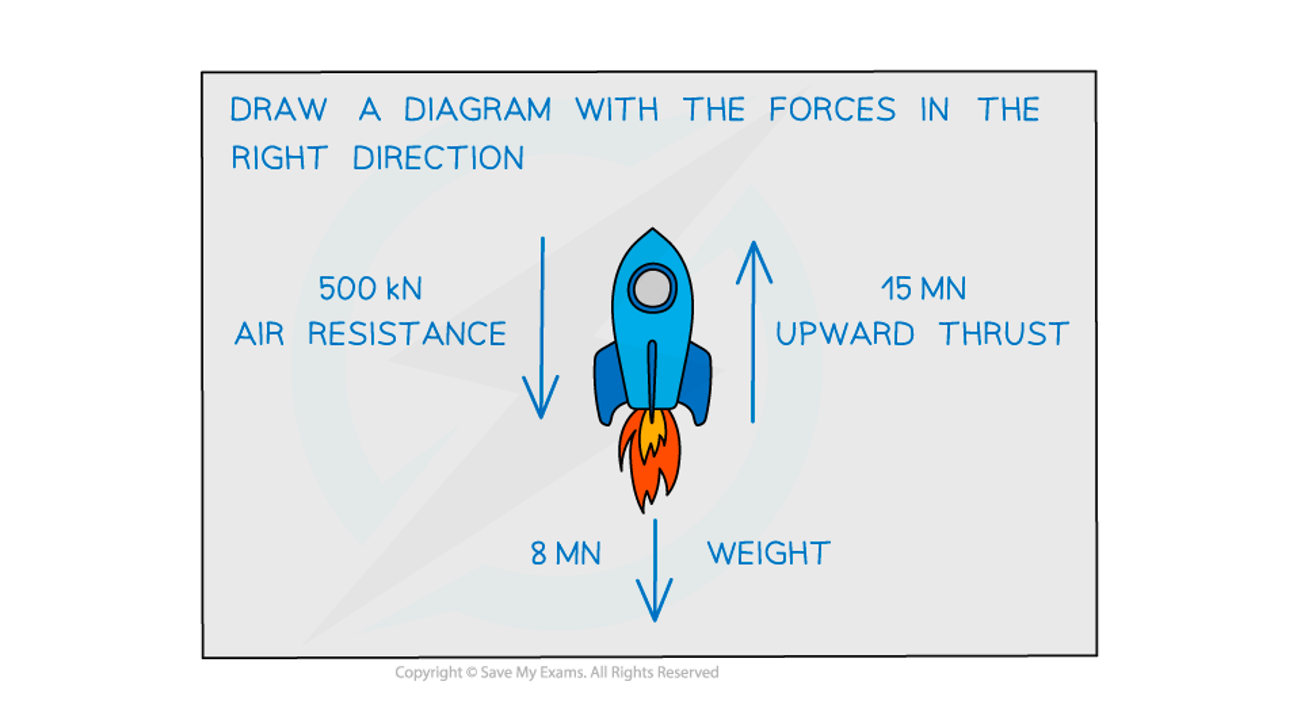
The direction of motion is upwards, therefore upwards is the positive direction
Air resistance (downward acting),
Weight (downward acting),
Thrust (upward acting),
Step 2: Calculate the net external force
The positive value indicates that the resultant force acts in the direction of motion, i.e. upwards
Step 3: State the equation for Newton's second law
Step 4: Calculate the acceleration and state the direction
upwards
The answer is therefore C
Worked Example
A car windscreen makes an angle of to the horizontal. The weight of a water drop accelerating down the windscreen is . The normal contact force on the water drop is .
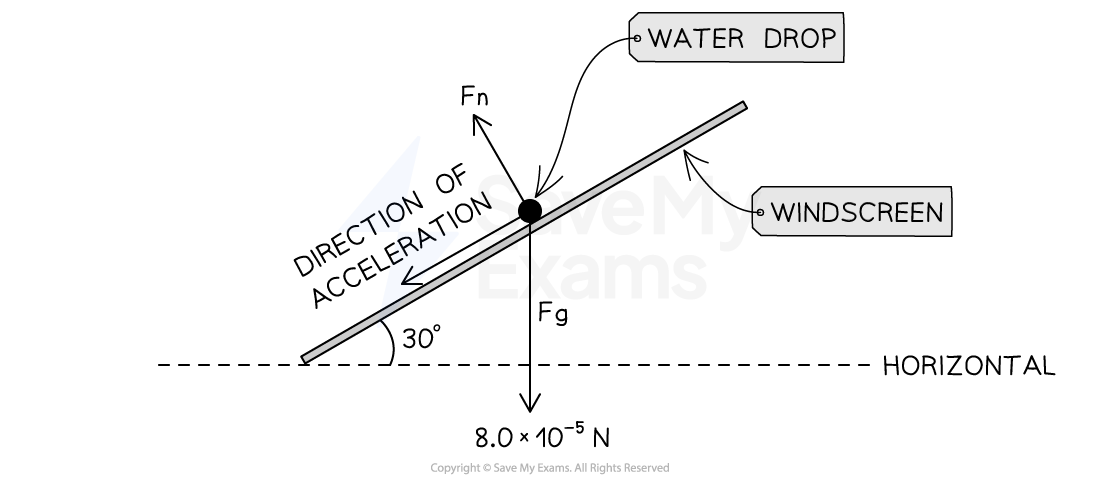
Which of the following shows the correct magnitude of the acceleration of the water drop, assuming that the friction between the windscreen and the drop is negligible?
A
B
C
D
The correct answer is D
Answer:
Step 1: Analyze the scenario
The water drop is accelerating downward, parallel to the line of the slope
So there is a net external force acting down parallel to the line of the slope
The water drop has no motion perpendicular to the line of the slope
So there is a zero net external force perpendicular to the line of the slope
Therefore, only the motion of the water drop parallel to the line of the slope should be considered
Step 2: Draw a diagram to show the component acting parallel to the inclined plane
The water drop moves down the windscreen as a result of its weight component parallel to the slope of the windscreen
Draw a diagram to show the correct component
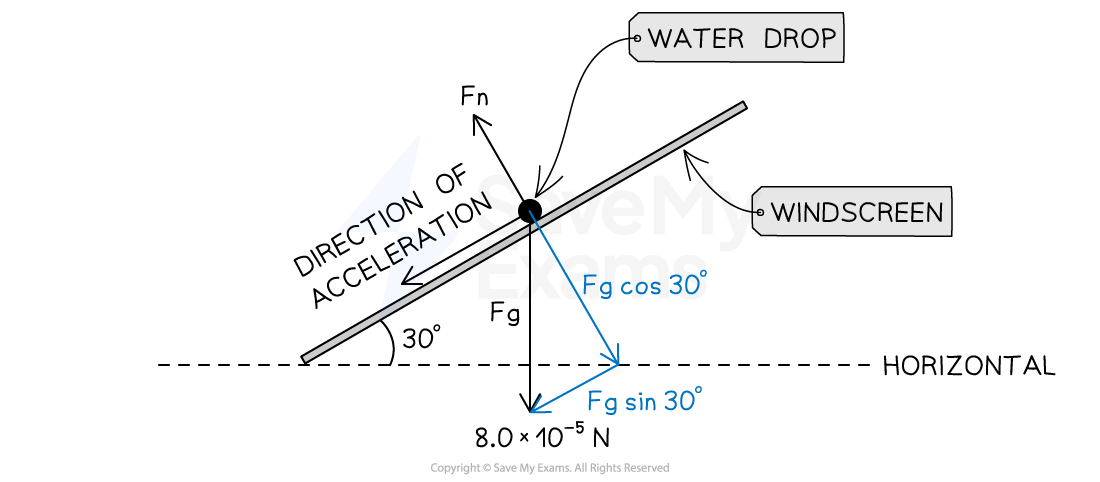
Step 3: Determine the net external force of the water drop moving down the windscreen
Step 4: Determine the mass of the water drop
Recall the equation for calculating the weight of an object
Rearrange the equation to make mass, the subject:
Calculate the mass of the water drop:
Step 5: Calculate the acceleration of the water drop moving down the windscreen
Recall the equation for Newton's second law of motion:
Calculate the acceleration of the water drop:
The answer is therefore D

Unlock more, it's free!
Join the 100,000+ Students that ❤️ Save My Exams
the (exam) results speak for themselves:

Was this revision note helpful?
Build on this topic
