The Principle of Conservation of Momentum (College Board AP® Physics 1: Algebra-Based): Revision Note

The principle of conservation of linear momentum
Momentum, like energy, is conserved in all interactions
This is known as the principle of conservation of momentum, which states that:
The total linear momentum of an isolated system remains constant unless acted on by a net external force
Therefore, for an interaction between objects in an isolated system:
The total momentum before the interaction is equal to the total momentum after the interaction
Mathematically, this can be written as:
Where:
= initial momentum (before the interaction), in
= final momentum (after the interaction), in
Since momentum is a vector quantity, the vector sum of the momenta of the components of the system remains constant
Where:
= mass of object 1, in
= mass of object 2, in
= initial velocity of object 1, in
= initial velocity of object 2, in
= final velocity of object 1, in
= final velocity of object 2, in
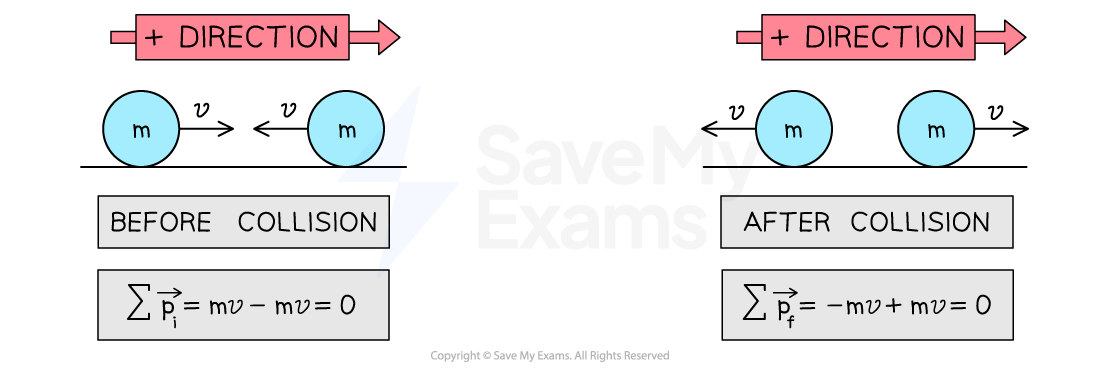
Example 1: two identical objects colliding
When two identical objects of mass travel towards each other at the same speed
the object moving in the positive direction has velocity
the object moving in the negative (opposite) direction has velocity
Applying the principle of conservation of momentum gives:
The momentum vectors are equal in magnitude and opposite in direction
Therefore, they cancel each other out, resulting in a net momentum of zero
Conservation of momentum between identical spheres
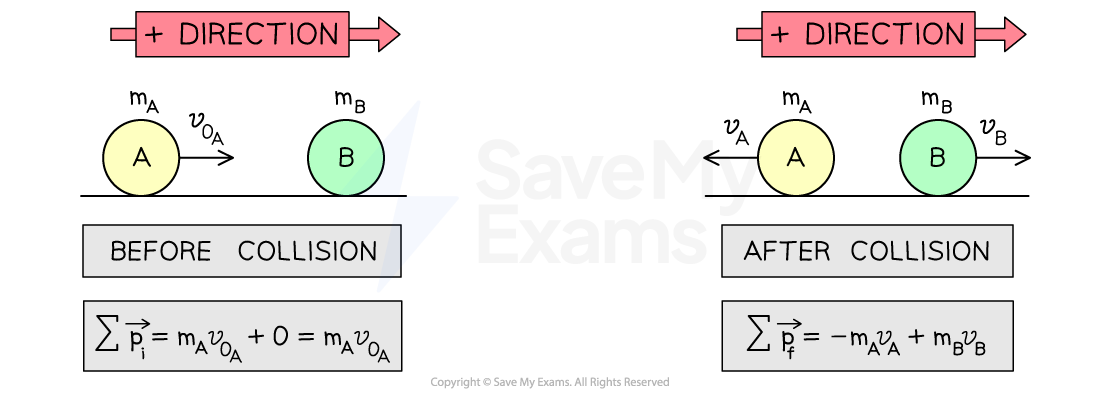
Example 2: two objects rebounding
When moving object A collides with stationary object B and rebounds
object A has an initial velocity of and a final velocity of
object B has an initial velocity of and a final velocity of
Applying the principle of conservation of momentum gives:
Taking the direction of the initial motion of object A as the positive direction:
Object A has a positive momentum before the collision and a negative momentum after
Object B has zero momentum before the collision and positive momentum after
Therefore, the net momentum of the system is:
Conservation of momentum between non-identical spheres
Worked Example
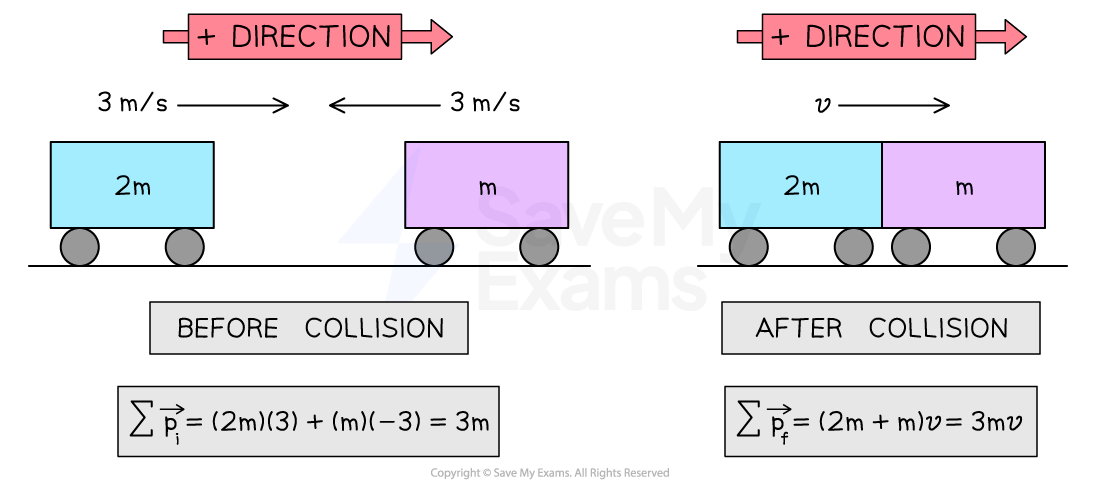
A trolley of mass and a trolley of mass approach each other, both trolleys have a speed of 3 m/s, as shown in the diagram.

When the trolleys collide head-on, they stick together and move away as one trolley.
Assuming positive momentum is to the right, which of the following is the best representation of the momentum of the trolleys as a function of time?
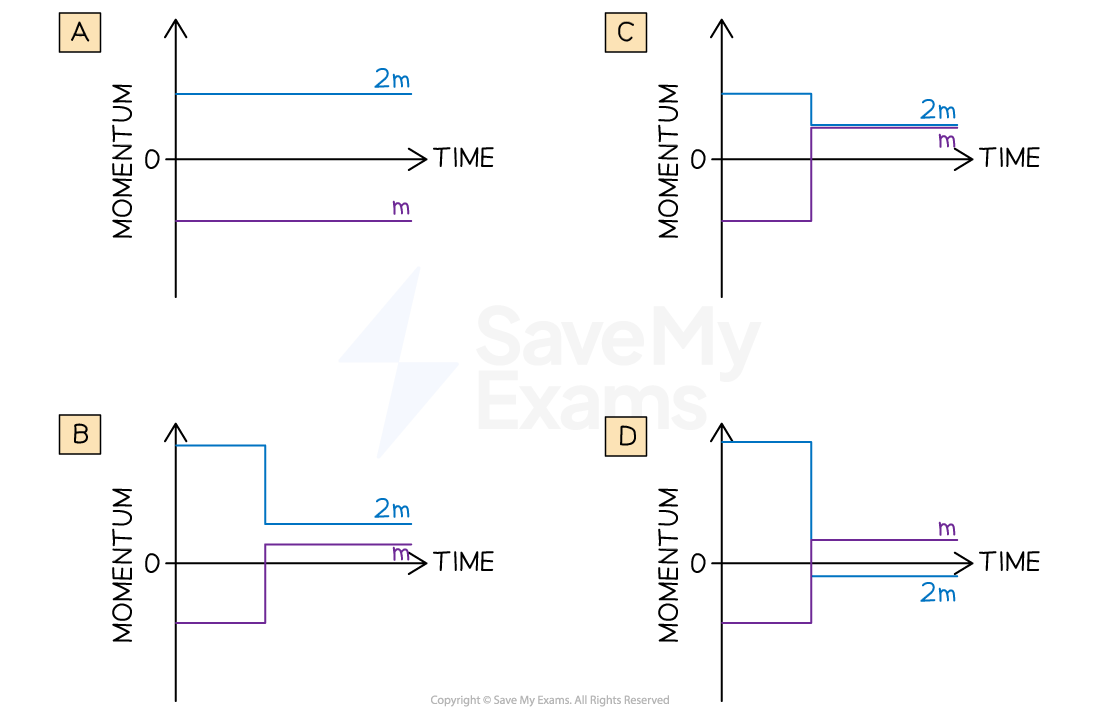
The correct answer is B
Answer:
Step 1: Analyze the scenario
Before the collision, the trolleys move toward each other at the same speed, so one of the velocities will be negative
The positive direction is defined to the right, or in the direction the trolley with mass moves initially, so
the trolley with mass has a positive velocity of
the trolley with mass has a negative velocity of
When the trolleys collide, they stick together and become a single trolley of mass with final velocity
The trolleys move off together in the direction of the largest initial momentum, logically this must be the trolley with mass
Step 2: Apply the principle of conservation of momentum
Conservation of momentum: the total momentum before the collision is equal to the total momentum after
Therefore, the final velocity of the trolleys is
Step 3: Sketch the momentum-time graph for each trolley
Before the collision:
the trolley of mass has a momentum of
the trolley of mass has a momentum of
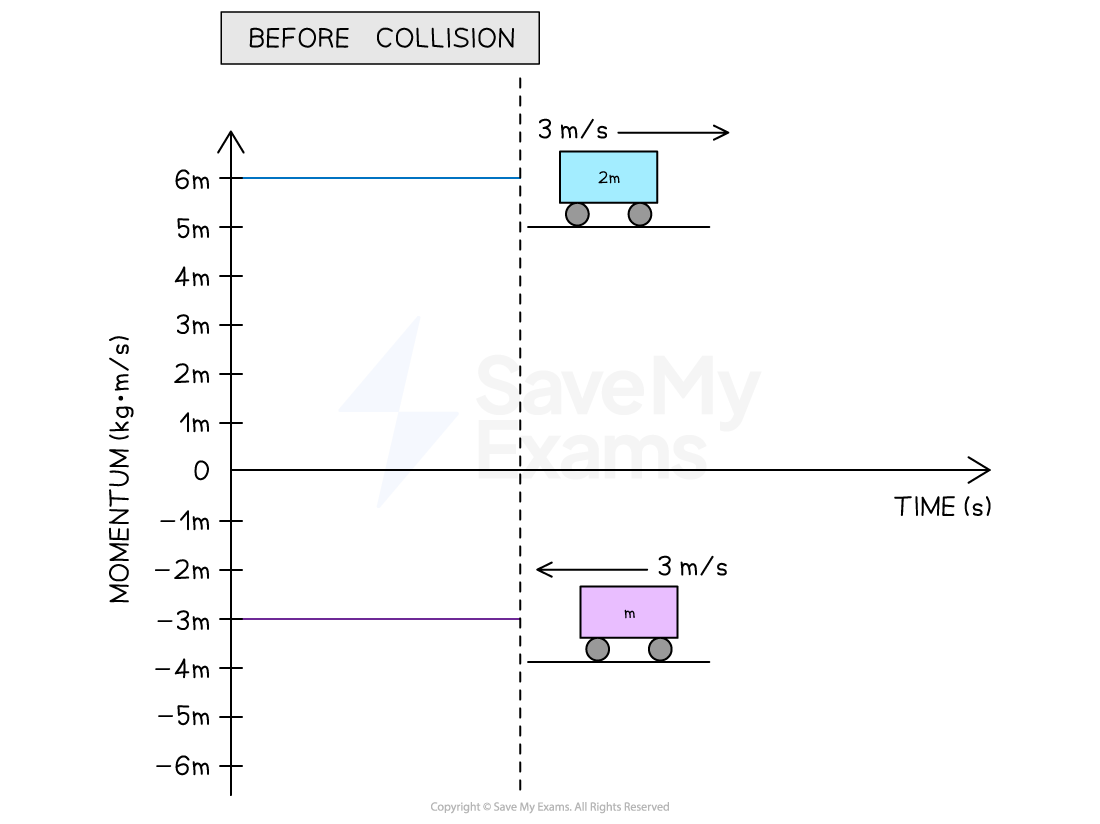
After the collision:
the trolley of mass has a momentum of
the trolley of mass has a momentum of
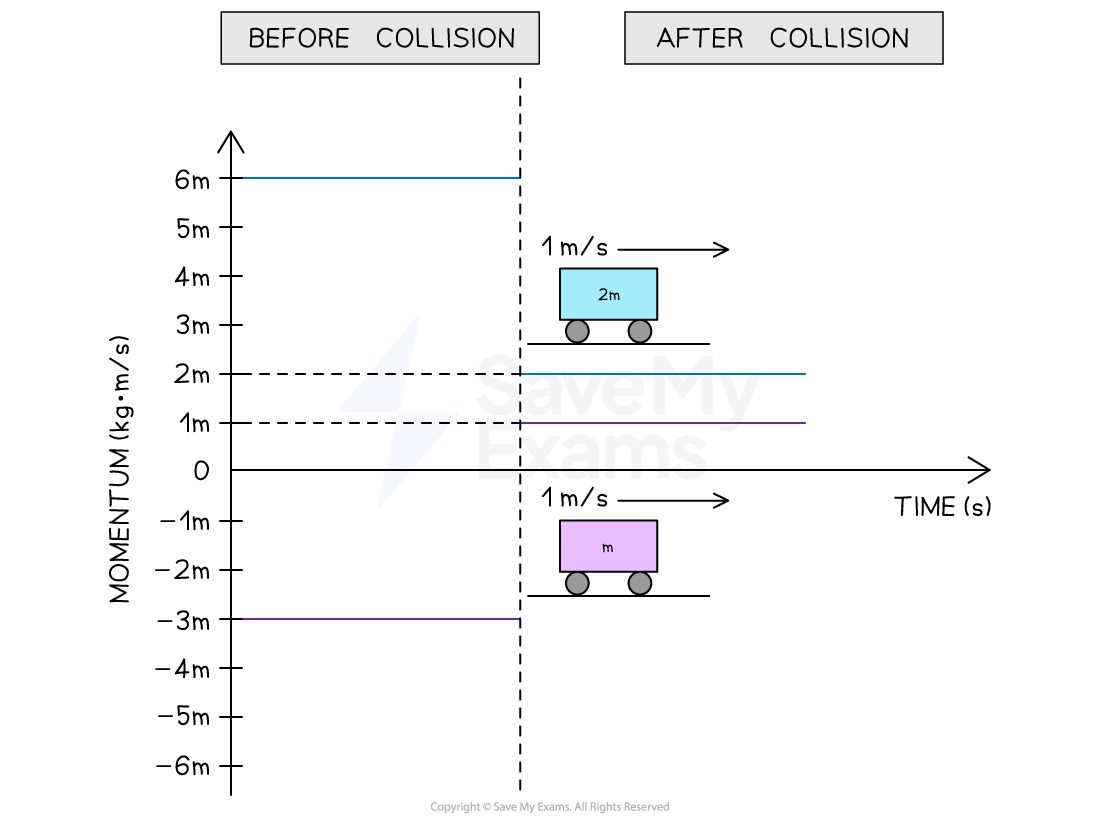
Step 4: Connect the lines to show the change in momentum
The finished graph shows that the change in momentum (vertical line) is the same for both trolleys
This is not seen in graphs A, C, or D

Therefore, option B is correct
Worked Example
A person of mass holds a box while riding a skateboard of mass toward the west at a speed of . The person throws the box to the east, giving it a speed of .
What is the person's final velocity after throwing the box?
Answer:
Step 1: Analyze the scenario
Initially, the system (the person, skateboard, and box) moves to the west with the same speed
Before the person throws the box, the system has:
a combined mass of
an initial velocity of (we can define this as the positive direction)
After the person throws the box to the east:
the person and the skateboard (total mass = ) continue to move west (positive direction) with final velocity
the box has a velocity of (negative direction)
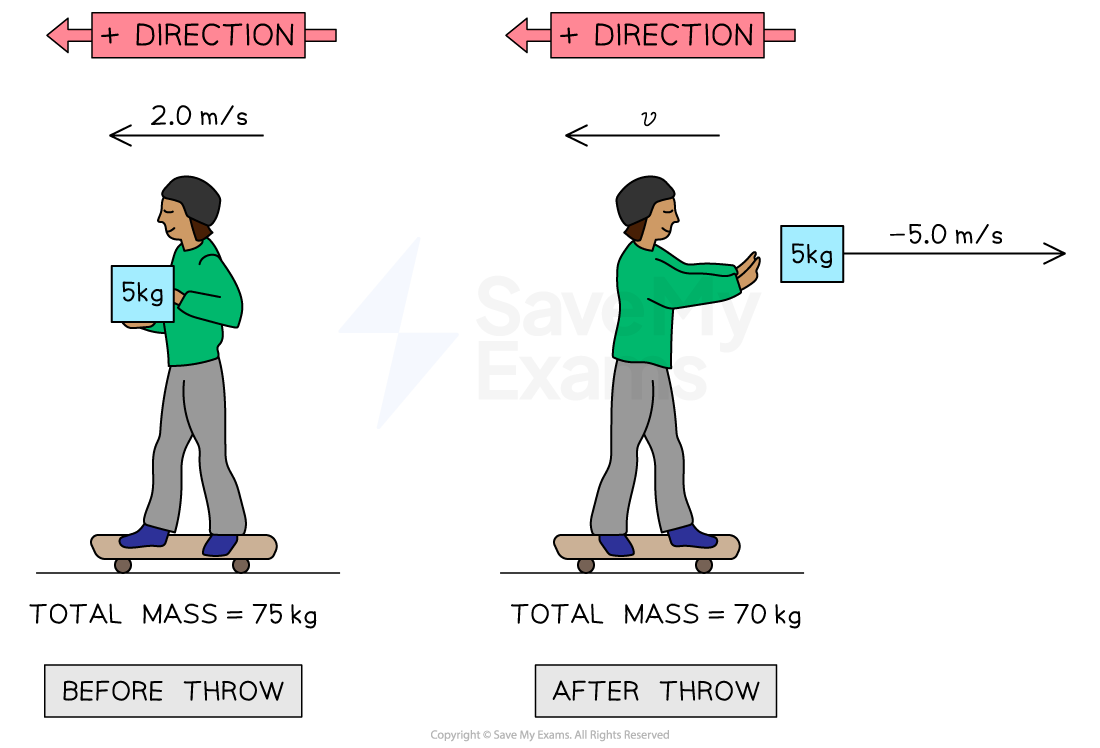
Step 2: Apply the principle of conservation of momentum
Conservation of momentum: the total momentum before the throw = the total momentum after the throw
Therefore, the final velocity of the person is
Examiner Tips and Tricks
Using representations to analyze physical situations is a crucial skill in AP Physics 1. Furthermore, drawing momentum graphs or charts can be particularly useful for solving momentum conservation problems which involve determining the final states of objects involved in collisions.
Impulse & total momentum
Conservation of momentum is a direct result of Newton's third law, which states:
The impulse exerted by object A on object B is equal and opposite to the impulse exerted by object B on object A
If the total momentum of a system changes, that change is equivalent to the impulse exerted on the system
Where:
= impulse exerted on the system, in
= change in momentum of the system, in
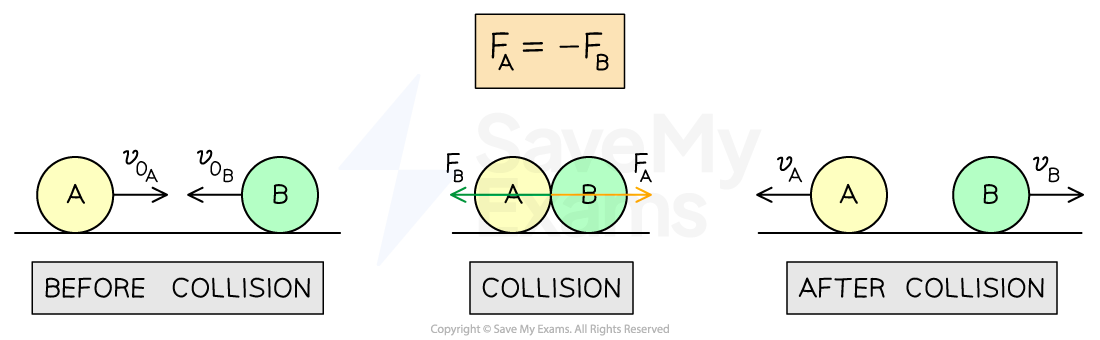
When two objects, A and B, collide:
object A exerts a force on object B of magnitude
object B exerts a force on object A of magnitude
the forces are equal in magnitude and opposite in direction
the forces, and therefore impulses, act for the amount of time the objects are in contact
This results in an alternative form of the principle of conservation of momentum which states:
The change in momentum of object A is equal and opposite to the change in momentum of object B
Mathematically, this can be written as:
Where:
= change in momentum of object A, in
= change in momentum of object B, in
Third law force pair during a collision
Worked Example
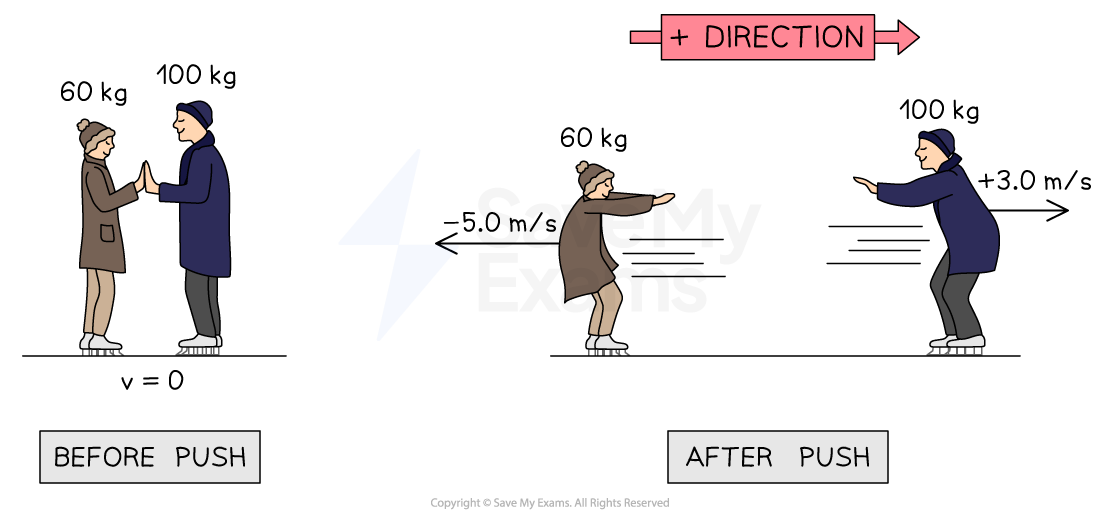
Two ice skaters of mass and are initially stationary on a frictionless, horizontal ice surface. They push against each other simultaneously with a force of magnitude for . One of the skaters moves to the left at a velocity of and the other skater moves to the right at a velocity of .
(A) Determine which skater has a final velocity of .
(B) Calculate the final velocity of the other skater.
(C) Describe the initial positions of the skaters relative to each other.
Answer:
Part (A)
Step 1: Analyze the scenario
Initially, the two skaters are at rest, so the initial momentum is zero
When they push against each other, the impulse they exert on one another is equal and opposite and causes a change in momentum
Step 2: Determine the change in momentum
The impulse exerted by the skaters is equal to the change in momentum
The average force exerted by each skater is for a period of , so the change in momentum is
Step 3: Determine the mass of the skater with a final velocity of 5.0 m/s
Since the initial velocity of each skater is zero, the change in momentum is equal to the product of their mass and final velocity
The mass of the skater with a final velocity of is:
Part (B)
Step 1: Analyze the scenario
After the push, the skaters move away from each other, so one of the velocities will be negative
The skater moves to the left at a speed of
Therefore, the skater moves to the right at a speed of
We can define the direction of the skater as the positive direction
Step 2: Apply the principle of conservation of momentum
Conservation of momentum: the total momentum before the push is equal to the total momentum after
Therefore, the final velocity of the skater is:
Part (C)
Step 1: Analyze the scenario
After the push:
the skater moves to the right (positive direction) at a velocity of
the skater moves to the left (negative direction) at a velocity of
Step 2: Deduce the initial positions of the skaters
Before the push:
the skater is to the right of the skater
the skater is to the left of the skater

Unlock more, it's free!
Join the 100,000+ Students that ❤️ Save My Exams
the (exam) results speak for themselves:

Was this revision note helpful?
Build on this topic