Circular Motion in a Vertical Loop (College Board AP® Physics 1: Algebra-Based): Revision Note

Circular motion in a vertical loop
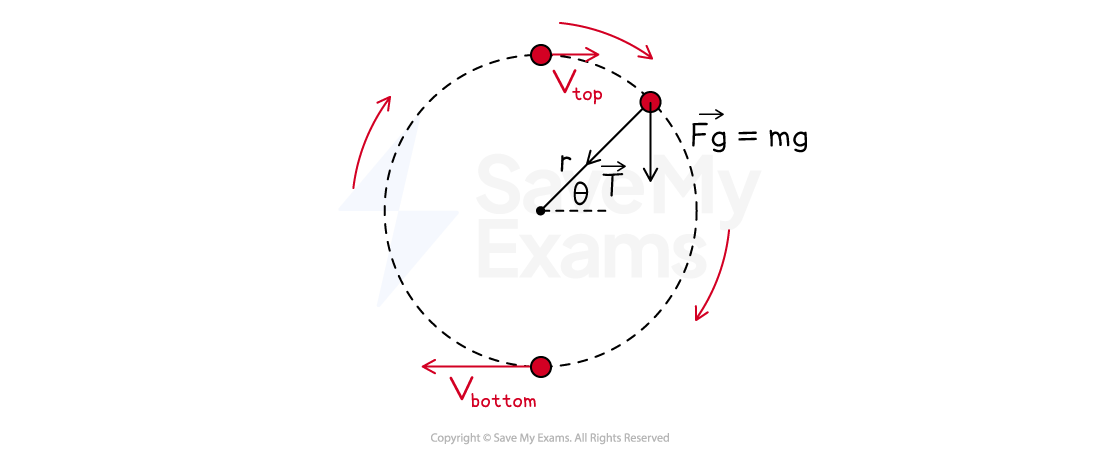
An object such as a ball on a string is an example of circular motion in a vertical loop
The forces acting on the ball are:
tension in the string
gravitational force acting straight downwards
As the ball moves around the circle:
the direction of the tension will change continuously
the magnitude of the tension will change continuously, reaching:
a maximum value at the bottom
a minimum value at the top
The direction of the gravitational force on the ball never changes
Therefore, the resultant centripetal force on the ball changes depending on its position as it rotates around the circle
Forces in a vertical circle
Minimum speed
At the top of a vertical, circular loop, an object requires a minimum speed to maintain circular motion
The tension in the string is zero at the top of the circular loop
At the top of the loop at this minimum speed, the gravitational force is the only force that causes the centripetal acceleration
So,
Forces at the top of a vertical circle

Derived equation
The minimum speed required to maintain circular motion at the top of the circular loop is given by:
Where:
minimum speed at the top of the vertical circular loop, measured in
acceleration due to gravity at Earth's surface, measured in
radius of circle, measured in
Derivation:
Step 1: Identify the fundamental principles
Where:
= net centripetal force exerted on the object
= mass of the object
= centripetal acceleration of the object
The net force in this case is the gravitational force or the weight force
The acceleration in this case is the acceleration due to gravity at the Earth's surface
Therefore:
Where:
= gravitational force exerted on the object
= mass of the object
= acceleration due to gravity
The magnitude of the centripetal acceleration of an object moving in a circular path is given by:
Where:
= magnitude of the centripetal acceleration
= tangential or linear speed
= radius of circular path
Step 2: Apply the specific conditions
When an object is moving in a circular loop, the net centripetal force is calculated using the tangential speed and the radius of the circular loop
Substitute the centripetal acceleration into Newton's second law
At the top of a vertical circular loop, the gravitational force is the only force that causes the centripetal acceleration
The tension in the string is zero
Step 3: Rearrange to obtain an equation for the minimum speed at the top of a vertical circular loop
Worked Example
A bucket of mass 8.0 kg is filled with water and is attached to a string of length 0.5 m.
What is the minimum speed the bucket must have at the top of the circle so no water spills out?

A
B
C
D
The correct answer is A
Answer:
Step 1: Draw the forces on the bucket at the top

Although tension is in the rope, at the very top, the tension is 0
Step 2: Recall the equation for minimum speed at the top of the vertical loop
Step 4: Substitute in values to calculate

Unlock more, it's free!
Join the 100,000+ Students that ❤️ Save My Exams
the (exam) results speak for themselves:

Was this revision note helpful?
Build on this topic
