Momentum of a System (College Board AP® Physics 1: Algebra-Based): Revision Note

Calculating velocity of a system's center of mass
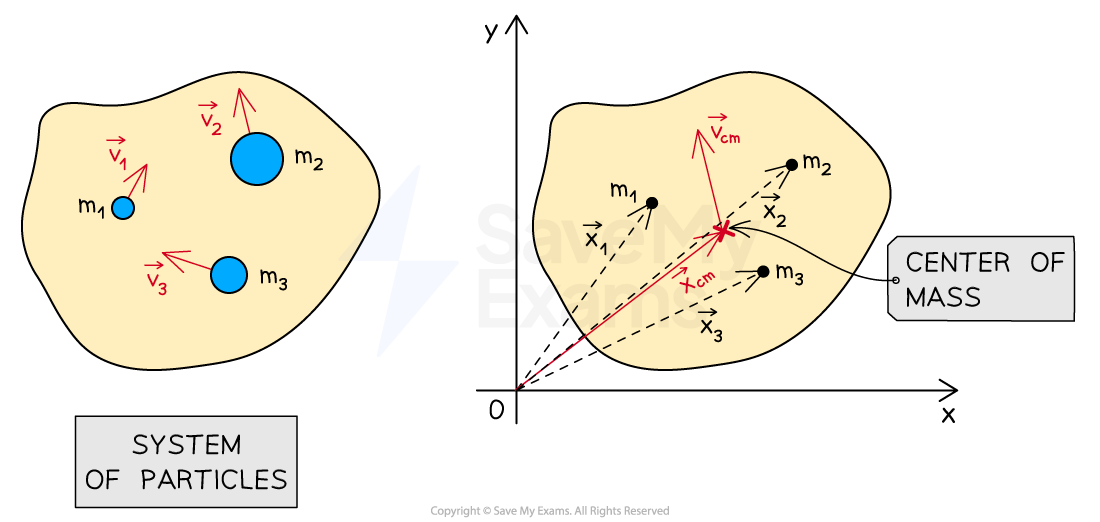
For a system of multiple objects, it can be useful to consider them as point particles with a common center of mass
Consider a system of three objects, each with individual masses and velocities
The position of the system's center of mass can be determined using:
Where:
= position of the system's center of mass, in
= mass of each object, in
= position of each object, in
Similarly, the velocity of the system's center of mass can be determined using:
Where:
= velocity of the system's center of mass, in
= velocity of each object, in
Velocity of the center of mass of a system of particles
Total momentum of a system
The total momentum of a system is equal to the sum of the momenta of the system’s constituent parts
Consider a system of objects:
Therefore, a collection of objects with individual momenta can be described as one system with one center-of-mass velocity:
We can also re-write the expression for the total momentum of the system as:
Where:
= total momentum of the system, in
= total mass of the system, in
= velocity of the center of mass of the system, in
Worked Example
A rocket of mass and shuttle of mass are initially traveling together to the right with velocity , as shown in the diagram.

The shuttle separates from the rocket and continues to travel to the right with velocity while the rocket continues to travel to the right with velocity , where , as shown in the following diagram.

Which of the following is true for the velocity of the center of mass of the system after the shuttle and rocket separate?
A
B
C
D
The correct answer is B
Answer:
Step 1: Analyze the scenario
When traveling together, the velocity of the center of mass of the rocket and shuttle is
During the separation, no external forces act on the system, so there is no impulse on the system
Step 2: Eliminate incorrect options
Since no external forces act on the system, the total momentum of the system must be constant
The velocity of the center of mass was before the separation
Therefore, it cannot be greater than after the separation
This eliminates option D
It also cannot be less than after the separation
This eliminates option C
After the separation, the velocity of the rocket was greater than
Therefore, the velocity of the shuttle must be less than
This eliminates option A
Step 3: Deduce the correct option
As the center of mass was moving with velocity before the separation, it will continue to move with velocity
Therefore, option B is correct
Worked Example
The masses and velocities of three objects in a system are given in the table below.
Particle | Mass (kg) | Velocity (m/s) |
|---|---|---|
1 | 1 | 1 |
2 | 3 | 2 |
3 | 2 | 3 |
The positions of the three objects in an xy plane are shown in the diagram.
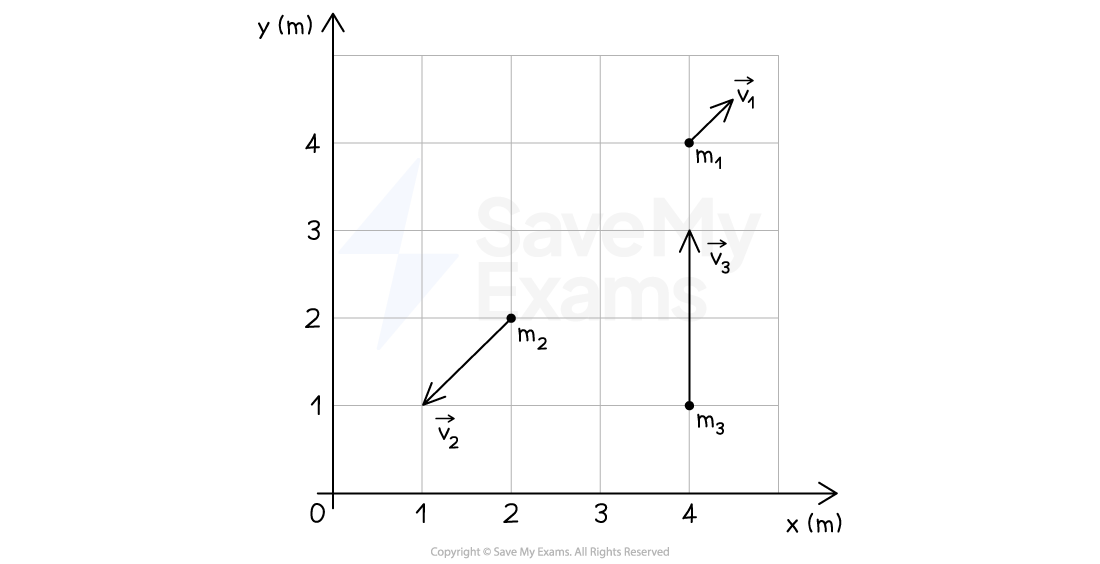
For the system of three objects, determine:
(A) the position of the center of mass, .
(B) the velocity of the center of mass, .
Answer:
Part (A)
Step 1: Determine the xy coordinates of the positions of each object
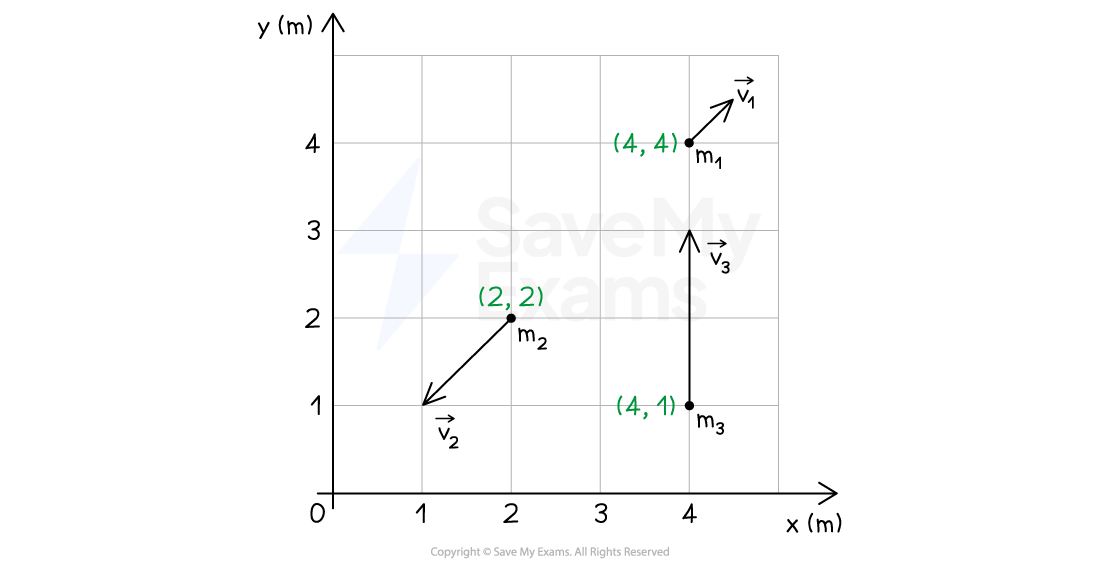
Object 1 has coordinates , so and
Object 2 has coordinates , so and
Object 3 has coordinates , so and
Step 2: Determine the x-component of the position of the center of mass
Step 3: Determine the y-component of the position of the center of mass
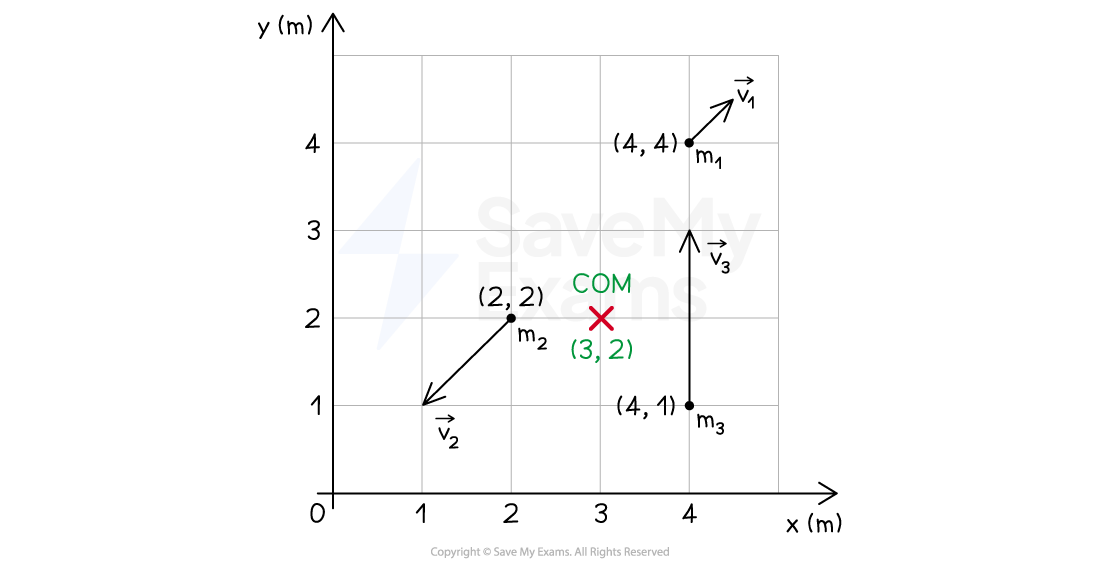
Step 4: Determine the position of the center of mass
The xy coordinate of the position of the center of mass is
Part (B)
Step 1: Determine the xy velocity components of each object
The velocity vectors of and are in opposite directions
Using their position coordinates, we can determine the angle between their velocity vectors and the x-axis
This angle can be found using
The positions of and are and respectively, therefore:
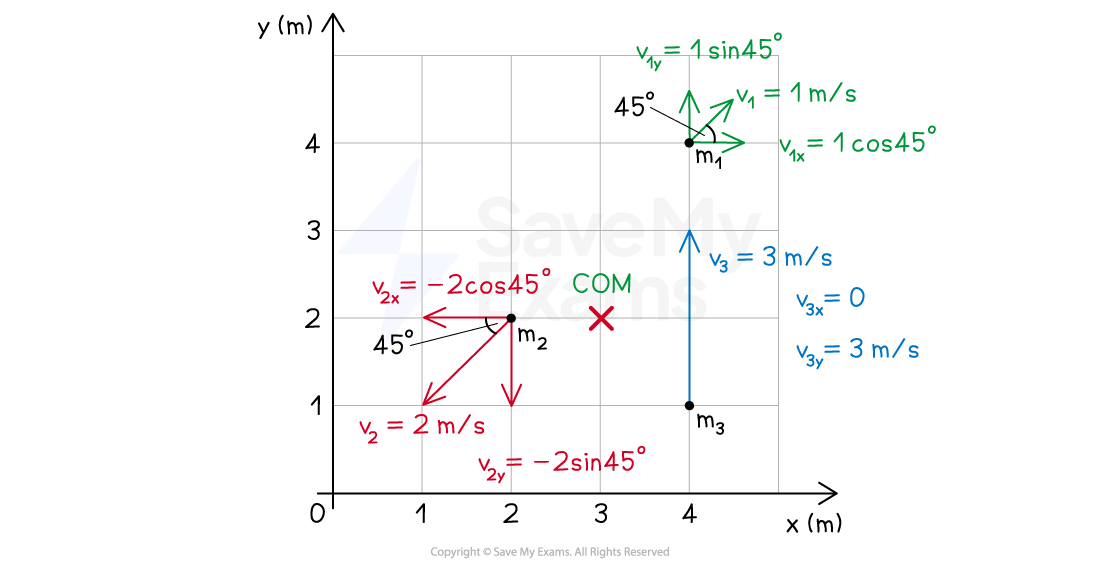
The x- and y- velocity components of object 1 are:
The x- and y- velocity components of object 2 are:
The x- and y- velocity components of object 3 are:
Step 2: Determine the x-component of the velocity of the center of mass
Step 3: Determine the y-component of the velocity of the center of mass
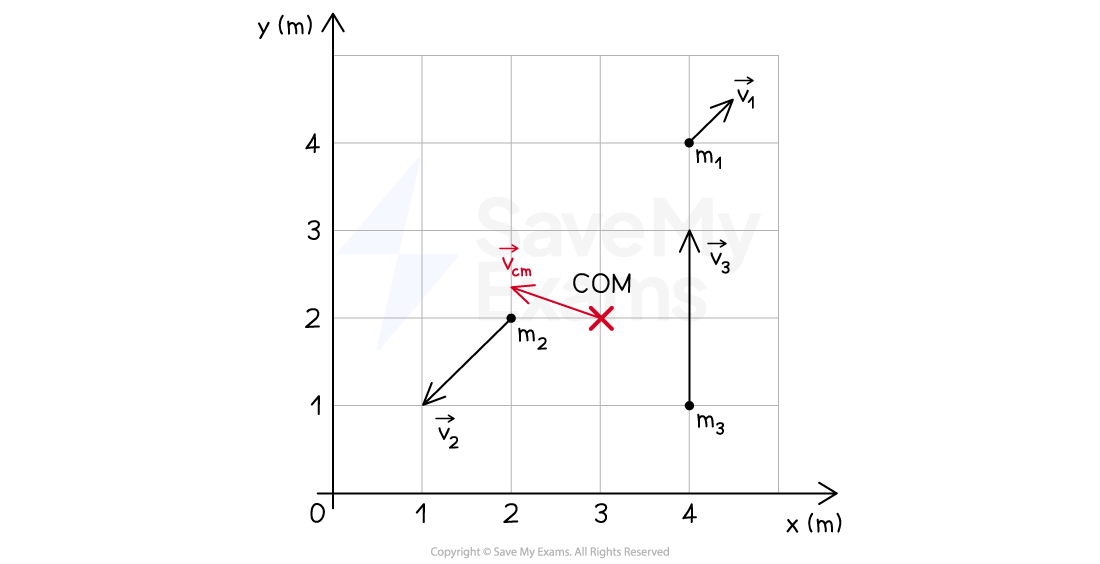
Step 4: Determine the velocity of the center of mass
Using Pythagoras theorem, the magnitude of the velocity is:
Using trigonometry, the direction of the velocity is:
The magnitude and direction of the velocity of the system's center of mass can be represented on the xy plane as:
Examiner Tips and Tricks
Make sure you understand the position and velocity of a center of mass:
is not necessarily at the geometric center of a system
does not change regardless of what the objects in a system do
Conditions for the transfer of momentum
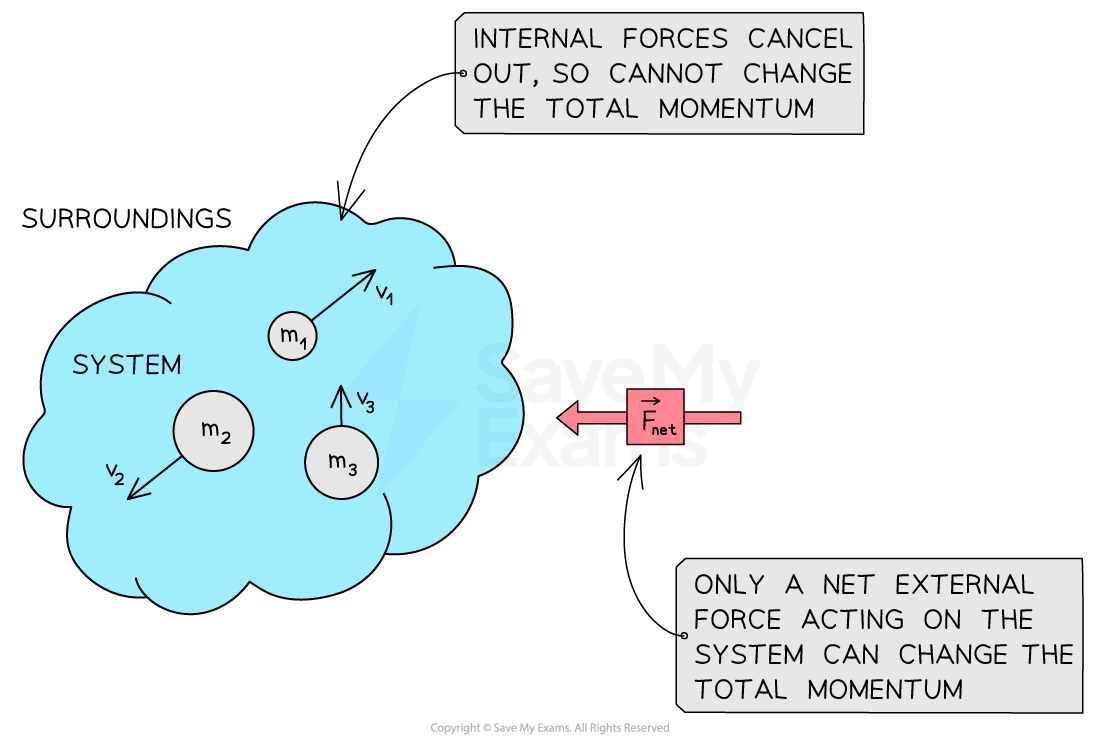
A system may be selected so that the total momentum of that system is constant
The system can be defined as the objects involved in the interaction
The surroundings can then be defined as anything outside of the chosen system
The total momentum of a system can be changed only by a net external force
When the net external force is nonzero:
any change to the momentum of a system is due to a transfer of momentum between the system and its surroundings
the conservation of momentum principle is not valid
When the net external force is zero (i.e. in an isolated system):
the total momentum of the system is constant
the velocity of the system’s center of mass is constant
any change to the momentum of an object within the system must be balanced by an equal and opposite change of momentum elsewhere within the system
the conservation of momentum principle is valid
Transfer of momentum by a net external force
Worked Example
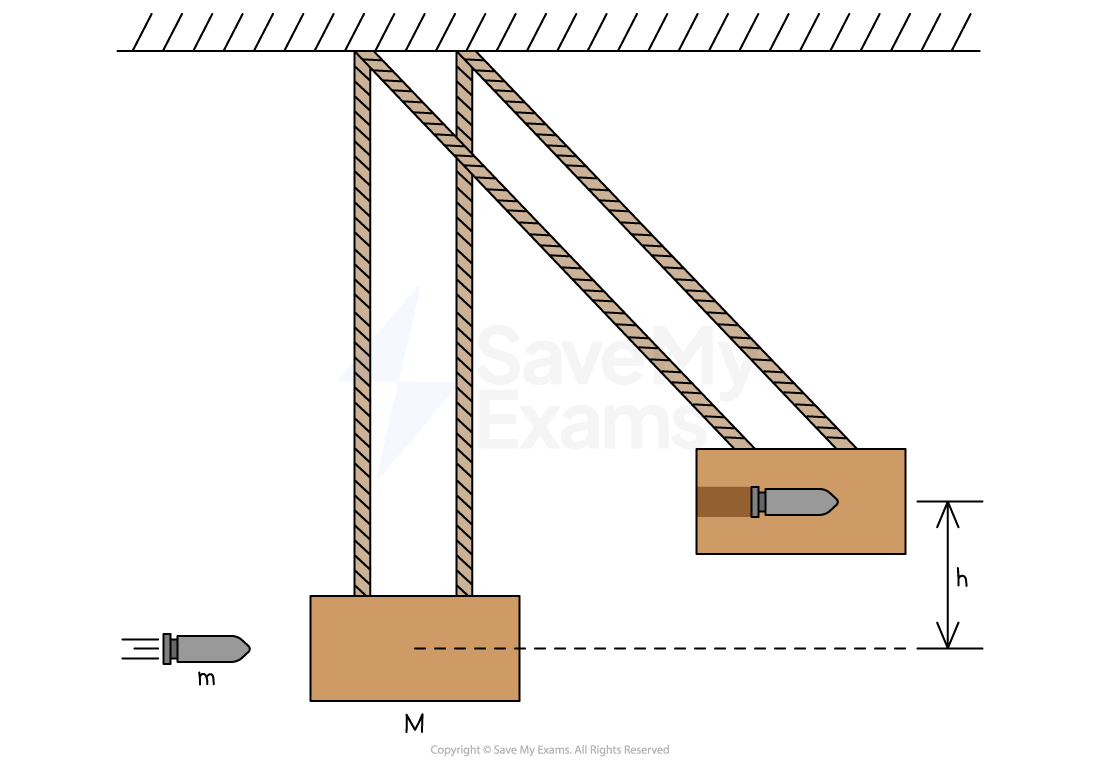
A dart of mass moving horizontally with constant speed becomes embedded in a block of mass , as shown in the diagram. The dart and block move together with speed immediately after the collision. The block is suspended from two light strings and swings up to a maximum height above the block’s initial position.
In which of the following systems is linear momentum conserved?
A The dart-block system in the horizontal direction
B The dart-block-string system
C The dart-block-Earth system
D The dart-block-string-Earth system
The correct answer is A
Answer:
Step 1: Analyze the scenario
This scenario, known as the Ballistic Pendulum, can be analyzed in three stages
Stage 1: before the collision
Stage 2: after the collision
Stage 3: at the maximum height
According to the Impulse-Momentum Theorem, external forces cause an impulse to act which results in a change in momentum
Therefore, linear momentum will only be conserved in a system where there are no external forces acting
Step 2: Eliminate incorrect options
The Earth exerts an external (gravitational) force when there is a change in height, so conservation of momentum cannot be used
This eliminates options C and D
The strings are described as light, so they can be ignored in calculations of momentum
This eliminates option B
Step 3: Deduce the correct option
Before the collision, the dart is moving horizontally, and just after the collision, the dart and the block continue to move horizontally momentarily
Therefore, the conservation of momentum principle can be applied to the dart-block system in the horizontal direction only
Therefore, option A is correct
Examiner Tips and Tricks
You must not perform conservation of momentum calculations when the net external force on a system is nonzero, as the conservation of momentum principle is not valid in this situation. However, you will be expected to select systems appropriately so that the net external force on the system is zero. Often in AP Physics 1, the system will be chosen for you, so you must read the question carefully and analyze the system you are given.

Unlock more, it's free!
Join the 100,000+ Students that ❤️ Save My Exams
the (exam) results speak for themselves:

Was this revision note helpful?
Build on this topic
