Torricelli’s Theorem (College Board AP® Physics 1: Algebra-Based): Revision Note

Torricelli’s theorem
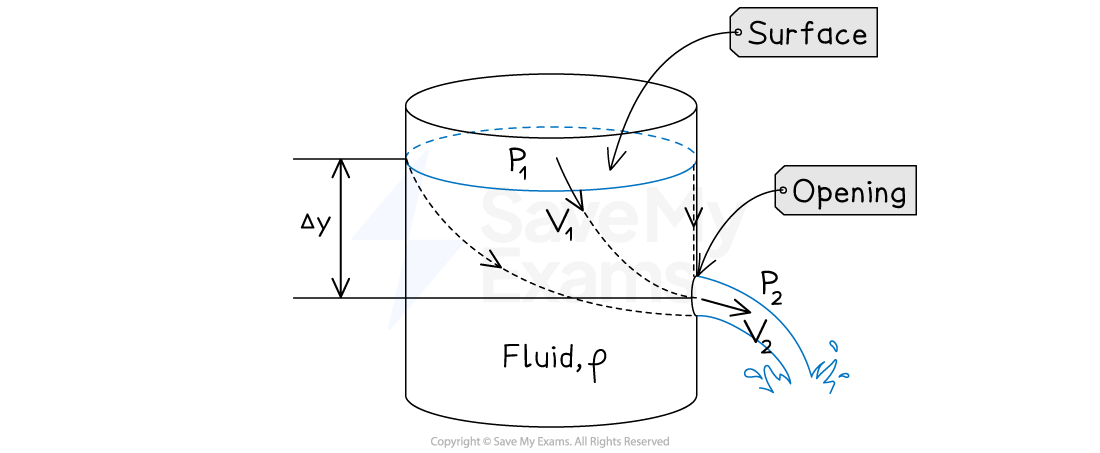
Consider a container filled with fluid
An opening is cut into the container at a given depth below the fluid's surface
This could be in the side of the container or the base, as pressure only depends on depth below the surface, not orientation
Torricelli's theorem predicts the speed of fluid exiting the hole
It assumes that the surface and opening are both open to the same environment and therefore have matching pressures
Derived equation
The speed of fluid leaving an opening in a container is described by the equation:
Where:
= the fluid speed leaving the opening, measured in
= acceleration due to gravity, measured in
= distance from the opening to the fluid's surface, measured in
Interestingly, this equation shows that the speed depends only on depth
Container with fluid leaving an opening
Derivation
Step 1: Identify the fundamental equations
Recall Bernoulli's equation:
Where:
= pressure at point 1, measured in
= fluid density, measured in
= height of point 1 above reference level, measured in
= fluid speed at point 1, measured in
= pressure at point 2, measured in
= height of point 2 above reference level, measured in
= fluid speed at point 2, measured in
This compares quantities at the surface (point 1) and the opening (point 2)
Step 2: Apply the specific conditions
At the surface, speed is zero, as no fluid is passing through that point, therefore, it can be inferred that:
The reference height can be defined at the same level as the opening, therefore, it can be inferred that:
Assume that both the fluid's surface and the opening are open to the same atmosphere, therefore, it can be inferred that:
Step 3: Combine the specific conditions
Applying these conditions to Bernoulli's equation gives:
The density terms can be canceled out on each side:
Rename as and rearrange for fluid speed at the opening:
This is Torricelli's theorem
Examiner Tips and Tricks
Understanding the assumptions behind this theorem is as important as the equation itself.
You may be presented with a situation where the pressures are not equal, for example, and just reproducing the above derivation without thought would not score points.

Unlock more, it's free!
Join the 100,000+ Students that ❤️ Save My Exams
the (exam) results speak for themselves:

Was this revision note helpful?
Build on this topic