Defining Simple Harmonic Motion (College Board AP® Physics 1: Algebra-Based): Revision Note

Defining simple harmonic motion
What is simple harmonic motion?
Simple harmonic motion (SHM) is a special case of periodic motion
In SHM, an object oscillates regularly around an equilibrium position:
An equilibrium position is a location at which the net force exerted on an object is zero
The equilibrium position will often be labeled with
Displacement, , is measured from the equilibrium position
Examples of systems that exhibit SHM:
An object attached to a spring oscillating horizontally across a frictionless surface (often called an object-ideal spring system)
A pendulum (object suspended from a string) with a small angular displacement
Systems in simple harmonic motion
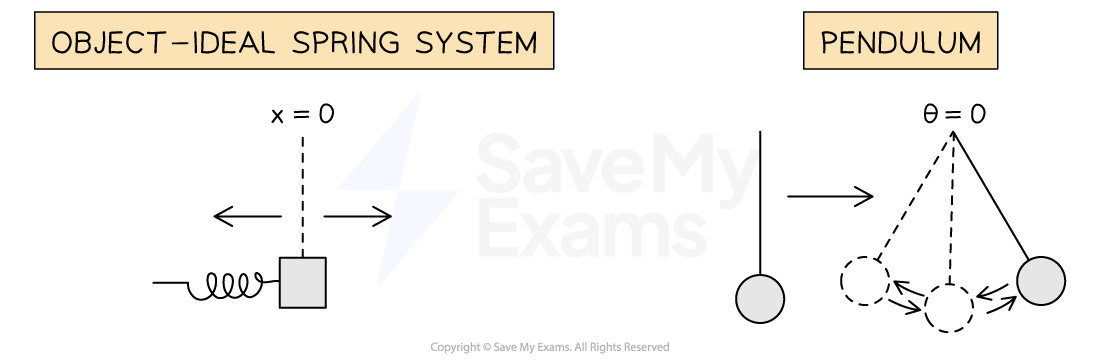
Conditions for simple harmonic motion
A restoring force is required for SHM:
A restoring force always acts in a direction opposite to the object’s displacement from an equilibrium position
The condition for SHM is that the restoring force is proportional to the displacement of the object from the equilibrium position but in the opposite direction
Conditions for a pendulum in SHM
A linear system, such as an object-ideal spring system, requires a restoring force in the opposite direction to linear displacement
A pendulum, however, is better described as moving through angular displacement
This means that, for a pendulum to undergo SHM, a restoring torque must be proportional to angular displacement but act in the opposite direction
These quantities are only proportional for small angular displacements
A pendulum can only be modeled as SHM when the angle is small
SHM in a pendulum

Derived equation
Simple harmonic motion of an object-ideal spring system can be characterized by the equation:
This shows that the acceleration of the object is proportional to the displacement and acts in the opposite direction
Object-ideal spring system
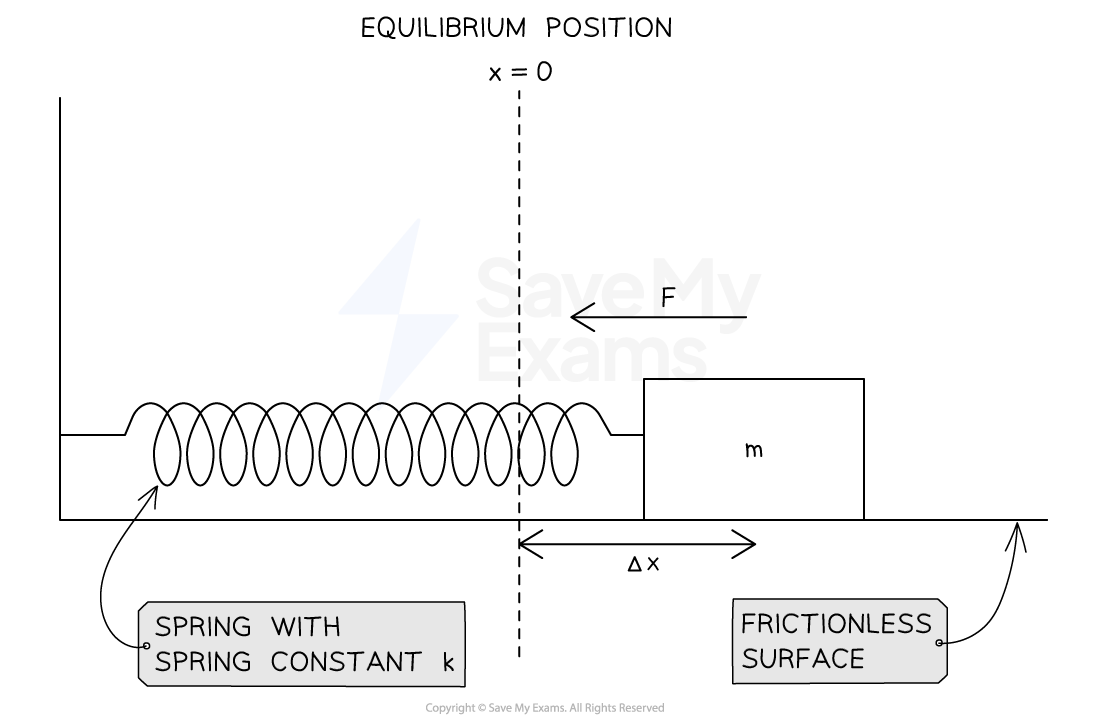
Derivation
Step 1: Identify the fundamental equations
Recall Hooke's law:
Where:
= spring's force measured in
= spring constant of the spring, measured in
= displacement of the object from the equilibrium position, measured in
This describes the restoring force, as it acts in the opposite direction to the displacement vector
Recall Newton's second law, which relates the force on an object with its mass and acceleration:
Where:
= net force on the mass, measured in
= the object's mass, measured in
= the object's acceleration, measured in
Step 2: Apply the specific conditions
The spring's restoring force is the only force that acts, therefore:
Additionally, all forces act in the x direction so Hooke's law and Newton's second law can be rewritten as:
Where:
is the acceleration in the x direction, measured in
Substituting Hooke's law and Newton's second law into the above gives:
This is the derived equation and does not appear on the equation sheet
Examiner Tips and Tricks
The derived equation applies specifically to the system described. To derive a similar equation for a different system you must identify the restoring force, apply the conditions for simple harmonic motion and combine these with Newton's second law.

Unlock more, it's free!
Join the 100,000+ Students that ❤️ Save My Exams
the (exam) results speak for themselves:

Was this revision note helpful?
Build on this topic
