An Inspector Calls (WJEC Eduqas GCSE English Literature): Exam Questions

Exam code: C720

6 hours178 questions
1
40 marks

Write about Mr Arthur Birling in An Inspector Calls and how he is important to the play as a whole.

In your response you should:

  • refer to the extract and the play as a whole

  • show your understanding of characters and events in the play.

5 of this question’s marks are allocated for accuracy in spelling, punctuation and the use of vocabulary and sentence structures.
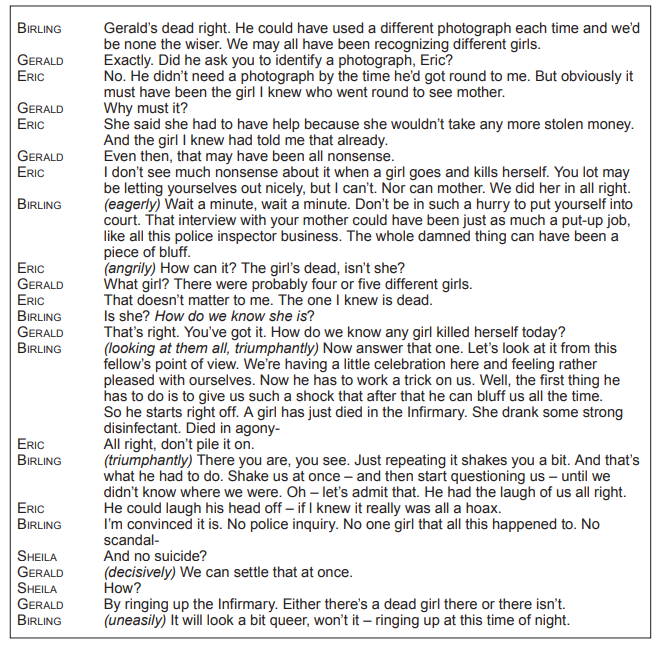
A dialogue excerpt from a play featuring characters Birling, Gerald, Eric, and Sheila discussing the possibility of multiple girls involved in a death mystery.
2
40 marks

In An Inspector Calls characters react to the discovery of truths in different ways. Write about some of these reactions and how they are presented at different points in the play.

In your response you should:

  • refer to the extract and the play as a whole

  • show your understanding of characters and events in the play.

5 of this question’s marks are allocated for accuracy in spelling, punctuation and the use of vocabulary and sentence structures.

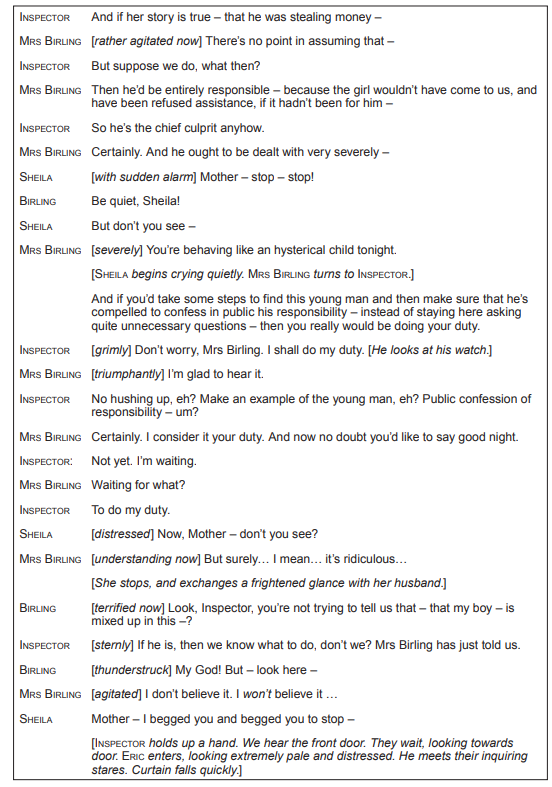
Scene from a play script with dialogue among Inspector, Mrs Birling, Sheila, and Birling, expressing tension and urgency in a dramatic moment.
3
40 marks

Write about Eric Birling and how he is presented at different points in the play.

In your response you should:

  • refer to the extract and the play as a whole

  • show your understanding of characters and events in the play

5 of this question’s marks are allocated for accuracy in spelling, punctuation and the use of vocabulary and sentence structures.

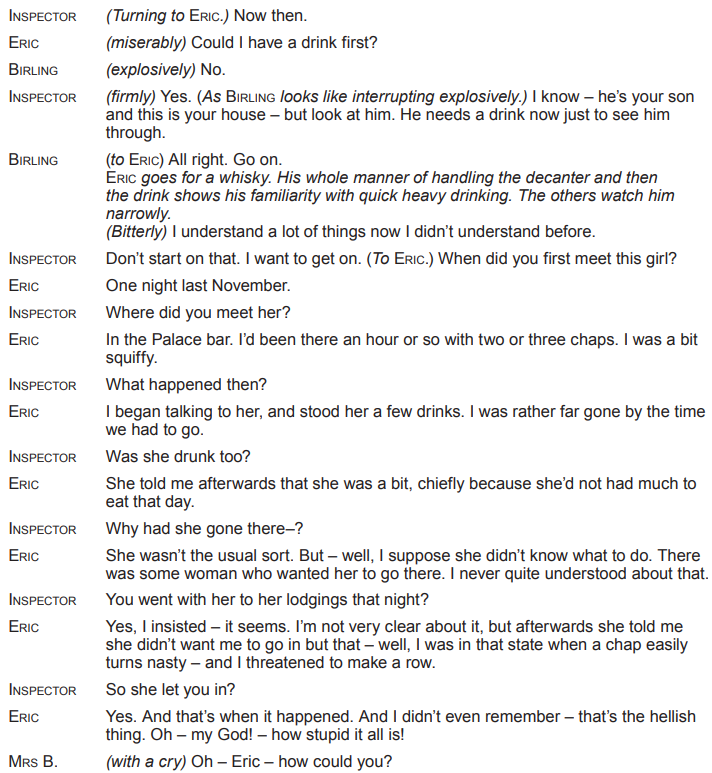
Text from a play script with dialogue between characters: Inspector, Eric, Birling, and Mrs B., discussing a woman Eric met at a bar.
4
40 marks

Read the following extract from Act 3 of An Inspector Calls and then answer the question that follows.

Inspector

Just used her for the end of a stupid drunken evening, as if she was an animal, a thing, not a person. No, you won’t forget. [He looks at Sheila.]

Sheila

[bitterly]: I know. I had her turned out of a job. I started it.

Inspector

You helped – but didn’t start it. [Rather savagely, to Birling] You started it. She wanted twenty-five shillings a week instead of twenty-two and sixpence. You made her pay a heavy price for that. And now she’ll make you pay a heavier price still.

Birling

[unhappily]: Look, Inspector – I’d give thousands – yes, thousands –

Inspector

You’re offering the money at the wrong time, Mr Birling. [He makes a move as if concluding the session, possibly shutting up notebook, etc. Then surveys them sardonically.] No, I don’t think any of you will forget. Nor that young man, Croft, though he at least had some affection for her and made her happy for a time. Well, Eva Smith’s gone. You can’t do her any more harm. And you can’t do her any good now, either. You can’t even say ‘I’m sorry, Eva Smith.’

Sheila

[who is crying quietly]: That’s the worst of it.

Inspector

But just remember this. One Eva Smith has gone – but there are millions and millions and millions of Eva Smiths and John Smiths still left with us, with their lives, their hopes and fears, their suffering, and chance of happiness, all intertwined with our lives, with what we think and say and do. We don’t live alone. We are members of one body. We are responsible for each other. And I tell you that the time will soon come when, if men will not learn that lesson, then they will be taught it in fire and blood and anguish. Good night.

‘We are responsible for each other.’ Write about some of the times responsibility is shown and how Priestley presents this in the play.

In your response you should:

  • refer to the extract and the play as a whole

  • show your understanding of characters and events in the play. [40]

5 of this question’s marks are allocated for accuracy in spelling, punctuation and the use of vocabulary and sentence structures.