13 marks
Where and when you live can define if a behaviour is seen as a crime or not.
Using an example, explain how the role of culture can affect the way criminal behaviour is defined.
Was this exam question helpful?
Exam code: J203
Where and when you live can define if a behaviour is seen as a crime or not.
Using an example, explain how the role of culture can affect the way criminal behaviour is defined.
Was this exam question helpful?
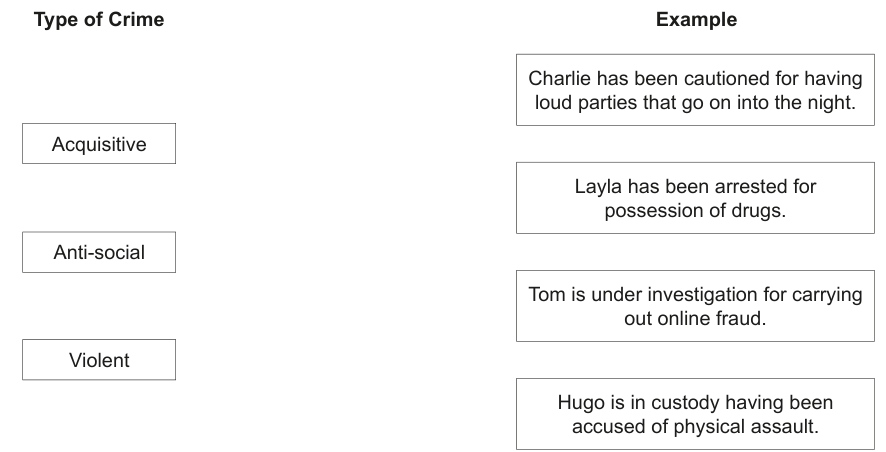
Draw a line to match each type of crime with the appropriate example.
Was this exam question helpful?
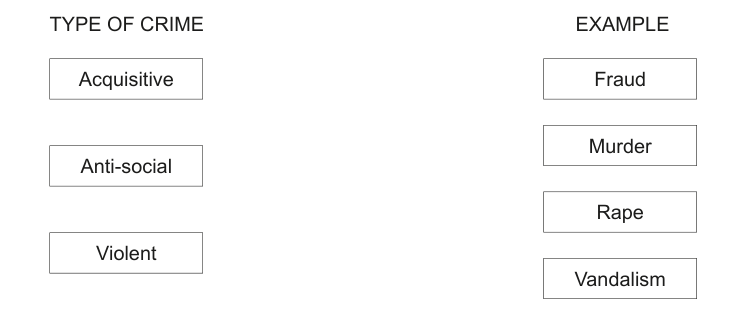
There are a number of types of crime.
Look at the following diagram.
Draw lines to match the type of crime to its correct example.
Was this exam question helpful?
Identify which of the following types of crime is associated with murder.
anti-social
drug related
sexual
violent
Identify which of the following is an example of acquisitive crime.
assault
graffiti
rape
robbery
Identify which of the following would be the best evidence that crime is a social construct.
an increase in crime rate
criminals responding to punishment
different cultures identifying different behaviours as criminal
people often not reporting certain crimes
Was this exam question helpful?
Findings from a recent survey of victims of crime suggest that young adults are the most likely age group to encounter crime. However, the survey also showed that people in this age group do not always view criminal behaviour in the same way as older people and see certain types of crime as quite normal.
The mean number of crimes experienced by young adults in the space of one year was 4.1 compared to a mean of 2.2 for all other age groups. The most common type of crime experienced was acquisitive crime which made up 32% of all crimes reported.
From the source:
Identify how crime was measured in this research.
Give one phrase that relates to the idea that crime is a social construct.
Was this exam question helpful?
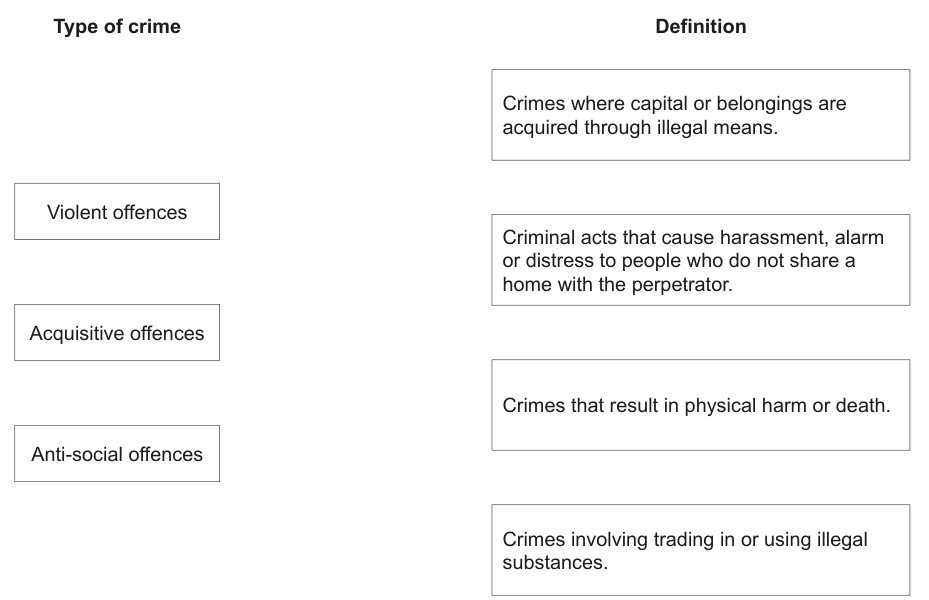
There are many different types of crime.
Draw lines to match the type of crime with the correct definition.
Was this exam question helpful?
Crime is often measured using questionnaires. Outline one problem with measuring crime in this way.
Was this exam question helpful?