Designing Research Methods (OCR GCSE Psychology): Exam Questions

Exam code: J203

2 hours19 questions
1a
1 mark

A psychologist wanted to investigate whether working from home made employees more productive than working in an office. All participants worked for the same company. 10 participants were asked to complete a set of tasks at home, and 10 participants were asked to complete a different set of tasks in their office at their place of work. Participants were given a maximum of 8 hours to complete their tasks and were asked to record how long it took them.

The results of the experiment are shown in the table below.

Table to show the amount of time (in hours) each participant took to complete their tasks (maximum time allowed: 8 hours)

Participant number

Working from home

Participant number

Working in the office

1

6.5

11

4.25

2

6.75

12

5.5

3

5

13

4

4

5.25

14

5.25

5

7.5

15

4

6

6.75

16

4.5

7

7

17

3.75

8

7.5

18

4.75

9

6

19

4.5

10

6.25

20

4.5

Identify the type of experiment used in this study.

  • field

  • laboratory

1b
2 marks

Explain why the psychologist used an independent measures design in this study.

2a
2 marks

You have been asked to carry out a correlation to investigate whether there is a relationship between how much exercise people do and how happy they are. The theory is that the more exercise people do, the happier they are.

Identify the two co-variables in your investigation.

2b
1 mark

You have been asked to carry out a correlation to investigate whether there is a relationship between how much exercise people do and how happy they are. The theory is that the more exercise people do, the happier they are.

Based on the theory you are investigating, give the direction of correlation you would predict.

  • negative

  • positive

  • zero

2c
3 marks

Outline the procedure you would use in your investigation.

2d
3 marks

Explain one weakness of using a correlation for this investigation.

3a
1 mark

A psychologist wanted to investigate how useful digital technology is to support students’ learning. They asked a colleague if they could attend one of their lessons and whilst pretending to be another teacher, observed how the students used their tablets and mobile phones in the lesson. The psychologist was trying to find out if male and female students were distracted by technology by using social media or texting, or if they used the technology to support their learning.

As the psychologist co-taught the lesson, they observed the students’ use of digital technology by recording each time the students used digital technology and what purpose they used it for.

The results are shown in the table below.

Use of digital technology for:

Males

Females

Learning purposes

12

29

As a distraction – social media/texting

9

13

After the observation had finished, the psychologist interviewed one male and one female student and asked them questions about their use of digital technology for learning.

Identify the type of observation the psychologist used in the source.

  • covert non-participant observation

  • covert participant observation

  • overt non-participant observation

  • overt participant observation

3b
2 marks

Outline one strength of the type of observation the psychologist used in the source.

4a
1 mark

A psychologist investigated whether the length of a school lesson affects how well students concentrate. She observed a number of classes across local secondary schools where the length of lesson varied from 40 minutes to 60 minutes. Lessons were observed via a secret camera which the teachers had consented to but the students were not aware of. Every lesson was observed by the psychologist and her assistant who both rated each lesson for how well a class concentrated, with 10 indicating very high levels of concentration and 1 indicating very low levels. They were based in a separate room in the school when they did this.

The results from the study are shown in the table below.

Lesson duration (mins)

40

45

50

55

60

Median rating for concentration

6

6.5

7.5

6

5

Using the source:

What type of observation was used to collect the data?

  • controlled observation

  • natural observation

4b
2 marks

Explain whether the observation was participant or non-participant.

4c
2 marks

Explain why the observation was an example of a covert observation.

4d
4 marks

Explain one strength and one weakness of using a covert observation for this study.

5a
1 mark

Adeline has difficulty sleeping, so she stays awake playing computer games until late at night to try and tire herself out. But instead she just finds it harder to get to sleep. Adeline shares a room with her sister who sometimes snores, this often wakes her during the night. Adeline kept a diary for a week noting how long she played computer games until she settled to sleep.

Table showing how long Adeline played computer games before she settled to sleep.

Day

Length of time (in minutes) before sleeping

Sunday

96

Monday

121

Tuesday

87

Wednesday

42

Thursday

12

Friday

38

Saturday

60

Using the source:

Identify one cause of Adeline’s sleep onset insomnia.

5b
1 mark

Identify one cause of Adeline’s sleep maintenance insomnia.

5c
1 mark

Identify the day which Adeline took the longest to settle to sleep.

5d
3 marks

Calculate, as a percentage of the week, the length of time Adeline took before she settled to sleep on Sunday. Express your answer to two decimal places.

Show your workings.

5e
2 marks

Explain one benefit of sleep to Adeline.

5f
2 marks

Adeline designs a questionnaire to investigate what techniques people use to improve their sleep hygiene. She decides to use open questions.

Give one open question that Adeline could include in her questionnaire.

6a
1 mark

A company hires a psychologist to write a survey to see how satisfied its customers are with its service. The psychologist includes a variety of questions in the survey such as:

a) How much did you like our service, was it excellent or good?

b) Would you use our service again, yes or no?

c) How do you feel about the service you received?

Using the source:

Identify the leading question.

6b
2 marks

Explain how leading questions could lead to memory distortion of how satisfied customers are with the company’s service.

6c
1 mark

Identify the question which collects qualitative data.

6d
2 marks

The psychologist decides to use a rating scale to measure how satisfied customers are overall with the company’s service.

Give an example of a suitable question using a rating scale the psychologist could use.

1a
1 mark

You have been asked to carry out an interview to investigate why teenagers in the UK decide to vape. The theory is that the main reason teenagers vape is because it looks cool.

Identify the type of interview you will use in your investigation.

1b
2 marks

Outline how you would use the type of interview you have identified in your investigation.

1c
3 marks

Explain one strength of using an interview in this investigation.

1d
3 marks

Other than social desirability, explain one weakness of using an interview in this investigation.

2a
2 marks

A psychologist investigated if the type of reward received affects learning motivation. The psychologist went to a local school and invited 20 students to a science laboratory to take part in the study.

The students were asked to solve maths problems. 10 of the students received stickers while the other 10 students received verbal praise each time they solved a maths problem successfully. The psychologist recorded the number of maths problems solved as a measure of learning motivation.

Explain one weakness of a laboratory experiment as used in this study.

2b
2 marks

The psychologist used an independent measures design in this experiment.

Explain one strength of this experimental design as used in this study.

3a
4 marks

You have been asked to carry out a correlation to investigate whether there is a relationship between how much confidence someone has and the number of words they use. The theory is that the more words a person uses the more confidence they have.

Use this space to plan your investigation.

Outline the procedure you would use in your investigation.

3b
3 marks

Explain one strength of using a correlation for this investigation.

4a
2 marks

A psychologist used a laboratory experiment to investigate if watching a movie alone or watching a movie with friends led to increased happiness. The psychologist recruited 30 students using the self-selected sampling method. 15 of the students then watched a movie alone and the other 15 students watched a movie with their friends. After watching the movie, all students completed a questionnaire.

The questionnaire used a rating scale of 1–7 (1 = very unhappy, 7 = very happy) to assess levels of happiness.

The happiness ratings for participants who watched the movie with friends are shown in the table below.

Participant

Happiness rating (1–7)

1

3

2

4

3

5

4

7

5

6

6

7

7

6

8

4

9

6

10

6

11

5

12

7

13

6

14

7

15

5

Outline one strength of using a laboratory experiment in this study.

4b
2 marks

Outline one strength of using a rating scale in this study.

4c
2 marks

The psychologist could have conducted an observation of the students’ happiness instead of using a questionnaire to measure happiness.

Explain the difference between overt observation and covert observation.

4d
2 marks

Describe one strength of using a covert observation in this study.

5a
1 mark

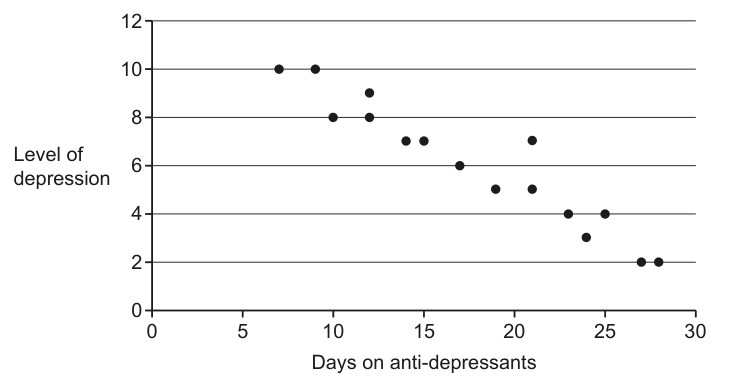
A psychologist investigated the correlation between how long people had been on anti-depressants and how severe their depression was, where the higher the score, the more depressed they were.

Their results are shown in the graph below.

[Figure: Scatter graph. The x-axis is "Days on anti-depressants", running from 0 to 30 in steps of 5. The y-axis is "Level of depression", running from 0 to 12 in steps of 2. There are 16 plotted points showing a downward trend from top left to bottom right: (7, 10), (9, 10), (10, 8), (12, 9), (12, 8), (14, 7), (15, 7), (17, 6), (19, 5), (21, 7), (21, 5), (23, 4), (24, 3), (25, 4), (27, 2) and (28, 2).]

Name the type of graph used to display the data.

5b
2 marks

Give the two co-variables in this investigation.

5c
1 mark

Using the graph, state the type of correlation shown.

5d
1 mark

Using the graph, state what the psychologist would conclude about the correlation between how long people had been on anti-depressants and how severe their depression was.

6a
2 marks

You have been asked to carry out a questionnaire to investigate how much bullying happens in the workplace. The theory is that people who work in large organisations will experience more bullying than people who work in small organisations.

Use this space to plan your investigation.

Outline one strength of using a questionnaire in your investigation.

6b
1 mark

Write an example of an open question that could be used in your investigation.

6c
2 marks

Explain whether this question would give you primary or secondary data.

6d
1 mark

Write an example of a closed question that could be used in your investigation.

6e
1 mark

Name a measure of central tendency you could use to analyse responses to this question.

6f
2 marks

Explain how you would use this measure of central tendency on your data.

7a
1 mark

A psychologist wants to replicate Williams et al.’s (1992) study. They decide to interview their participants asking them questions to investigate the content of their dreams. They choose to use an unstructured interview.

State one open question the psychologist could use in the interviews.

7b
3 marks

Explain how using an unstructured interview will affect the construct validity of the investigation.

8a
1 mark

You have been asked to carry out an experiment to investigate whether there is a difference in participants’ ability to concentrate on a written task when they are listening to music with lyrics and music without lyrics. The theory is that the lyrics from songs will interfere with people’s ability to process the information needed to write something.

Use this space to plan your investigation.

Identify the experimental design you would use in your investigation.

8b
2 marks

Outline one strength of using this experimental design in your investigation.

8c
2 marks

Outline one weakness of using this experimental design in your investigation.

9a
1 mark

A psychologist wanted to investigate whether there is a relationship between wellbeing and sleeping patterns. The psychologist advertised the study in a local health centre using a poster in the waiting area. The psychologist left contact details for participants who wanted to take part to contact them. Ten participants were asked to record how many hours they slept for each night, for 7 nights. The psychologist also asked the participants to complete a short questionnaire each day asking them questions about their general wellbeing.

Examples of questions taken from the questionnaire include:

Question 1: On a scale of 1–10 (with 1 being extremely unhappy and 10 being extremely happy) how happy do you feel today?

Question 2: What sleep hygiene methods do you use to help you get a good night’s sleep?

Question 3: How often do you wake up on average each night?

The psychologist found a positive correlation between the number of hours slept at night and overall happiness.

Identify one open question the psychologist used in the questionnaire on wellbeing in this study.

9b
2 marks

Explain one strength of using open questions in this study.

9c
1 mark

A psychologist wanted to investigate whether there is a relationship between wellbeing and sleeping patterns. The psychologist advertised the study in a local health centre using a poster in the waiting area. The psychologist left contact details for participants who wanted to take part to contact them. Ten participants were asked to record how many hours they slept for each night, for 7 nights. The psychologist also asked the participants to complete a short questionnaire each day asking them questions about their general wellbeing.

Examples of questions taken from the questionnaire include:

Question 1: On a scale of 1–10 (with 1 being extremely unhappy and 10 being extremely happy) how happy do you feel today?

Question 2: What sleep hygiene methods do you use to help you get a good night’s sleep?

Question 3: How often do you wake up on average each night?

The psychologist found a positive correlation between the number of hours slept at night and overall happiness.

The psychologist also found that as participants got older, they tended to sleep fewer hours each night.

Identify what type of correlation this is.

  • positive correlation

  • negative correlation

  • zero correlation

9d
2 marks

The psychologist could have carried out interviews with participants instead of using questionnaires.

Explain how structured and unstructured interviews are different.

10a
1 mark

You have been asked to carry out an experiment to investigate whether people drive more safely depending on whether they are talking to someone or not. The theory is that talking will distract drivers so that they are not paying full attention to their driving.

Name the experimental design you would use in your investigation.

10b
2 marks

Outline one strength of using this experimental design in your investigation.

10c
2 marks

Outline one weakness of using this experimental design in your investigation.

10d
4 marks

Evaluate how useful an experiment is for carrying out this investigation.

11
2 marks

You have been asked to carry out an experiment to investigate whether learning is affected by time of day. The theory is that people will take longer to learn new things at different times of the day.

Describe one weakness of using an experiment for your investigation.

12a
1 mark

A psychologist wanted to investigate the meaning of dreams. To do this, she carried out a study using a series of interviews in which she had conversations with people about their common dreams and their recent experiences. She concluded that what actually happened in dreams was a symbol of deeper emotions the person was feeling. For example, one of her participants, named David, often dreamt about walking around naked. The psychologist related this to an anxiety the person had about letting out a secret he had been trusted with.

Using the source:

Name the type of interview used in the study.

12b
1 mark

Identify the phrase that explains the manifest content of dreams.

12c
1 mark

Identify the example of latent content in David’s dreams.

12d
1 mark

Write an open question that the psychologist could have used in her study.

12e
2 marks

Outline one strength of collecting qualitative data in this study.

1
13 marks

Use your knowledge and understanding from across the psychology course to explain how far you agree with the following statement:

"Research using correlations is not useful."

In your answer, you should refer to Blackwell et al.’s (2007) study into fixed and growth mindsets and at least one other study from another area of psychology.