Functions & Features of Sleep (OCR GCSE Psychology): Exam Questions

Exam code: J203

33 mins12 questions
1a
1 mark

Identify which of the following describes sleep onset insomnia.

  • struggle to fall asleep

  • struggle to stay asleep

  • struggle to stay awake

  • struggle to wake up from sleep

1b
1 mark

Identify which of the following describes sleep maintenance insomnia.

  • struggle to fall asleep

  • struggle to stay asleep

  • struggle to stay awake

  • struggle to wake up from sleep

1c
1 mark

Identify the approximate percentage of a sleep cycle that adults spend in REM sleep.

  • 20%

  • 40%

  • 60%

  • 80%

2
2 marks

Explain the difference between endogenous pacemakers and exogenous zeitgebers.

3a
1 mark

Identify the stage of sleep during which dreaming mainly occurs.

  • REM sleep

  • Stage 1

  • Stage 2

  • Stage 3

3b
1 mark

Identify the accurate statement about sleep.

  • Sleep increases bacteria in the body.

  • Sleep increases stress and anxiety.

  • Sleep plays a role in emotional stability.

  • Sleep prevents physical repair of the body.

3c
1 mark

Identify the role of the pineal gland in sleep.

  • activates the limbic system

  • produces blood

  • produces melatonin

  • stimulates the hypothalamus

4a
1 mark

Casey has difficulty getting to sleep. They keep their bedroom light on due to a fear of the dark. Casey makes sure to eat a large meal right before going to bed, so they do not feel hungry while they are asleep. They also take a tablet each night to increase the level of melatonin in their blood.

Name the type of insomnia Casey is experiencing.

4b
2 marks

State two exogenous zeitgebers that may be negatively affecting Casey’s sleep.

5a
1 mark

Identify which of the following is an exogenous zeitgeber.

  • light

  • melatonin

  • pineal gland

  • suprachiasmatic nucleus (SCN)

5b
1 mark

Identify the number of stages in a complete sleep cycle.

  • 3

  • 4

  • 5

  • 6

5c
1 mark

Identify which of the following statements is correct.

  • Melatonin levels are high at night and low in the morning.

  • Melatonin levels are high in the morning and low at night.

  • Melatonin levels go up and down during the night.

  • Melatonin levels remain the same all day and all night.

6
2 marks

Explain what REM sleep is.

7
2 marks

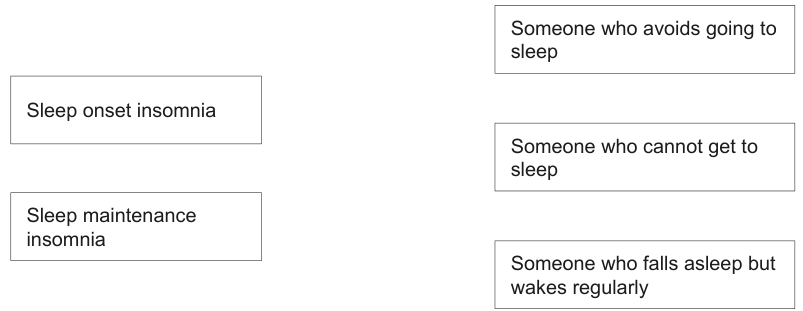
Match the terms to their correct definitions of sleep disorders.

Draw one line from each sleep disorder to the correct definition.

[Figure: Matching diagram with two columns. Left column contains two boxes: "Sleep onset insomnia" and "Sleep maintenance insomnia". Right column contains three boxes, from top to bottom: "Someone who avoids going to sleep", "Someone who cannot get to sleep" and "Someone who falls asleep but wakes regularly". Students draw one line from each sleep disorder to the correct definition.]
8a
1 mark

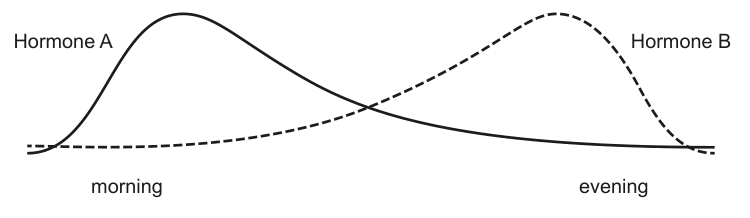
The following diagram shows the role of two hormones in the sleep-wake cycle.

Line graph with a horizontal time axis labelled "morning" at the left and "evening" at the right. Hormone A (solid line) rises to a peak early in the morning and then falls gradually to a low level through the day and evening. Hormone B (dashed line) stays low through the morning and day, rises to a peak in the evening and then falls sharply.

Identify which of the two hormones is melatonin.

  • Hormone A

  • Hormone B

8b
2 marks

Outline the role of the pineal gland in sleep.

9a
1 mark

Ali cannot get to sleep. Their doctor says that Ali needs to make their bedroom darker as exposure to light tells our brain that we should be alert. The doctor prescribes sleeping tablets to help regulate Ali’s sleep hormones.

Using the source:

Name the type of insomnia Ali is suffering from.

9b
1 mark

State the hormone Ali’s doctor is trying to regulate using sleeping tablets.

9c
3 marks

Explain the role of light as an exogenous zeitgeber in Ali’s sleep cycle.

10
2 marks

Outline the role of melatonin in sleep.

11
2 marks

Give two functions of sleep.

12
3 marks

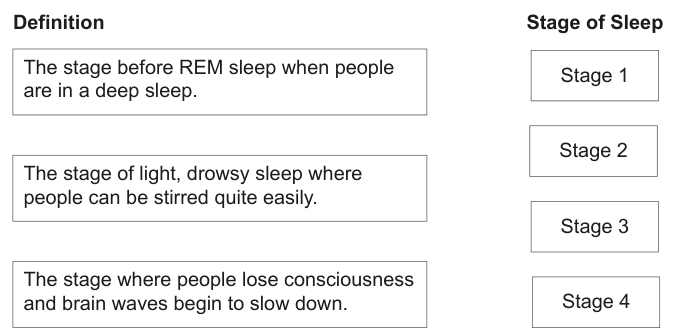
There are a number of stages of sleep.

Look at the following diagram.

Draw lines to match the definition to its correct stage of sleep. One stage does not have a matching definition.

[Figure: Matching diagram with two columns. Left column headed "Definition" contains three boxes: "The stage before REM sleep when people are in a deep sleep.", "The stage of light, drowsy sleep where people can be stirred quite easily." and "The stage where people lose consciousness and brain waves begin to slow down." Right column headed "Stage of Sleep" contains four boxes: "Stage 1", "Stage 2", "Stage 3" and "Stage 4". Students draw one line from each definition to its stage of sleep; one stage has no matching definition.]