Obtaining & Using Metals (Edexcel GCSE Combined Science: Chemistry): Flashcards
Exam code: 1SC0
1/660Still learning
Know0
- FrontReactivity of Metals
Define the term salt.

Was this flashcard helpful?
Cards in this collection (66)
Define the term salt.
A salt is the ionic compound produced when a metal reacts with an acid.
What is the general equation for a metal reacting with an acid?
The general equation for a metal reacting with an acid is:
metal + acid → salt + hydrogen
True or False?
Only metals above hydrogen in the reactivity series will react with dilute acids.
True.
Only metals above hydrogen in the reactivity series will react with dilute acids.
Give the balanced symbol equation for the reaction of calcium with water.
The equation for the reaction of calcium with water is:
Ca (s) + 2H2O (l) → Ca(OH)2 (aq) + H2 (g)
State the meaning of the observation vigorous for a metal-acid reaction.
If a metal-acid reaction is described as vigorous, it means the reaction is rapid and intense.
True or False?
Copper is more reactive than hydrogen.
False.
Copper is less reactive than hydrogen.
What is observed when a more reactive metal displaces a less reactive one from a solution?
When a more reactive metal displaces a less reactive one, the less reactive metal coats the surface or falls out as a solid.
True or False?
Magnesium reacts rapidly with cold water.
False.
Magnesium reacts very slowly with cold water.
Define the reactivity series.
The reactivity series is a list of metals arranged in order from the most reactive at the top to the least reactive at the bottom, based on their tendency to lose electrons.
True or False?
Sodium is more reactive than potassium.
False.
Potassium is more reactive than sodium.
Metals that are .......... than hydrogen in the reactivity series will react with dilute acids to produce a .......... and hydrogen gas.
Metals that are more reactive than hydrogen in the reactivity series will react with dilute acids to produce a salt and hydrogen gas.
True or False?
Potassium reacts violently with water and acid.
True.
Potassium reacts violently with water and acid.
What is displacement?
Displacement occurs when a more reactive substance takes the place of a less reactive substance.
True or False?
Reactivity is determined by the tendency of the metal atoms to gain electrons.
False.
Reactivity is determined by the tendency of the metal atoms to lose electrons.
Give two observations made when copper sulfate solution reacts with magnesium.
Observations made when copper sulfate solution reacts with magnesium:
The blue colour of the solution fades
Copper forms at the bottom of the beaker
True or False?
Magnesium can displace copper from copper sulfate solution.
True.
Magnesium can displace copper from copper sulfate solution.
Define oxidation in terms of electrons.
Oxidation is the loss of electrons.
Give the balanced symbol equation for the displacement of copper from copper(II) sulfate by zinc, including state symbols.
The balanced symbol equation is:
Zn (s) + CuSO4 (aq) → ZnSO4 (aq) + Cu (s)
In a metal displacement reaction, the more reactive metal is .......... and the less reactive metal ion is .......... .
In a metal displacement reaction, the more reactive metal is oxidised and the less reactive metal ion is reduced.
Define reduction in terms of electrons.
Reduction is the gain of electrons.
What is a redox reaction?
A redox reaction is one where oxidation and reduction occur simultaneously.
True or False?
In the following reaction, magnesium has been oxidised:
Mg (s) + CuSO4 (aq) → MgSO4 (aq) + Cu (s)
True.
In the reaction, magnesium has been oxidised as it has lost electrons.
In the following reaction, which species has been reduced?
Zn (s) + CuSO4 (aq) → ZnSO4 (aq) + Cu (s)
The species which has been reduced is copper as it has gained electrons.
Write the half equation for the oxidation of zinc atoms to form zinc ions, Zn2+.
(Higher Tier Only)
The half equation for the oxidation of zinc atoms is:
Zn ⟶ Zn2+ + 2e-
Write a half equation for the reduction of copper ions, Cu2+.
(Higher Tier Only)
A half equation for the reduction of copper ions is:
Cu2+ + 2e- ⟶ Cu
Define the reactivity series.
The reactivity series orders metals from most reactive to least reactive.
Metals that are .......... carbon in the reactivity series cannot be extracted by reduction with carbon and must instead be extracted by .......... .
Metals that are above carbon in the reactivity series cannot be extracted by reduction with carbon and must instead be extracted by electrolysis.
State the method of extraction for metals above carbon in the reactivity series.
Metals above carbon in the reactivity series are extracted by electrolysis.
True or False?
The most reactive metals are at the bottom of the reactivity series.
False.
The most reactive metals are at the top of the reactivity series.
What determines the extraction method for a metal?
The position of the metal on the reactivity series determines the extraction method.
Which metals must be extracted by electrolysis?
Metals that must be extracted by electrolysis are higher up the reactivity series (above carbon) and include aluminium, sodium, potassium, calcium, lithium and magnesium.
True or False?
Iron is extracted by electrolysis.
False.
Iron is extracted by reduction with carbon / in the blast furnace.
What is the extraction method for metals below carbon in the reactivity series?
Metals below carbon in the reactivity series are extracted by reduction with carbon.
True or False?
The higher a metal is on the reactivity series, the more resistant it is to oxidation.
False.
Metals higher up are less resistant to oxidation than the metals placed lower down, which are more resistant to oxidation.
In the extraction of metals by heating with carbon, does the metal undergo an oxidation or reduction reaction?
When extracted by heating with carbon, the metal undergoes a reduction reaction.
What is a low grade ore?
A low grade ore is an ore with a lower quantity of metal than a high grade ore.
Define bioleaching.
Bioleaching is a technique that uses bacteria to extract metal ions from low-grade ores by producing an acidic leachate solution containing the metal.
What is the environmental concern with bioleaching?
Bioleaching produces toxic substances that need to be treated to avoid environmental contamination.
What is the leachate?
A leachate is an acidic solution containing significant quantities of metal ions.
True or False?
Bioleaching is often used to extract metals from sulfides
True.
Bioleaching is often used to extract metals from sulfides (e.g. CuS or Fe2S).
What is phytomining?
Phytomining is a process that uses plants to absorb metals from the soil.
What are the four stages of phytomining?
The four stages of phytomining are:
The plants are grown in areas known to contain metals
Plants take up metals as they grow
The plants are harvested, dried and burned
Displacement or electrolysis is used to extract the metals from the ash
What happens to the plants in phytomining?
The plants are harvested, dried, and burned. The metal compounds in the ash are then extracted by displacement or electrolysis.
In phytomining, plants absorb .......... from the soil as they grow, and the metal is then recovered from the plant .......... after harvesting and burning.
In phytomining, plants absorb metal compounds from the soil as they grow, and the metal is then recovered from the plant ash after harvesting and burning.
State two metals that have ores that are becoming less available.
Copper and nickel have ores that are becoming less available.
State two advantages of using bioleaching and phytomining to extract metals from ores.
Two advantages of using bioleaching and phytomining to extract metals from ores are:
Can be used to extract metals from low grade ores
Avoid the significant environmental damage caused by traditional mining methods
What are the economic benefits of recycling metals?
Recycling metals provides employment and is economically beneficial, especially for costly metals like aluminium.
What is the environmental impact of mining and extraction?
Mining and extraction can cause the destruction of habitats.
True or False?
Recycling decreases the amount of waste produced and therefore space at landfill sites
True.
Recycling decreases the amount of waste produced and therefore space at landfill sites.
State two disadvantages of recycling metals.
Two disadvantages of recycling metals include:
Materials need to be collected and transported which requires energy and fuel
Workers, vehicles and worksites need to be organised and maintained
Materials need to be sorted before they can be recycled
Products made from recycled materials may not always be of the same quality
Define the term sustainability
Sustainability is the ability to maintain ecological and resource balance over time.
Recycling metals is more .......... efficient than extracting new metals because it requires less .......... to melt and re-mould the metal.
Recycling metals is more energy efficient than extracting new metals because it requires less energy to melt and re-mould the metal.
How can iron be recycled?
Iron can be recycled together with waste steel by adding both to a blast furnace.
How does recycling impact the use of fossil fuels?
Recycling reduces the use of fossil fuels.
True or False?
It is much more energy efficient to recycle metals than it is to extract them as melting and re-moulding requires less energy.
True.
It is much more energy efficient to recycle metals than it is to extract them as melting and re-moulding requires less energy.
What can make metals always worthwhile to recycle?
When metals are very scarce, they are all worthwhile to recycle.
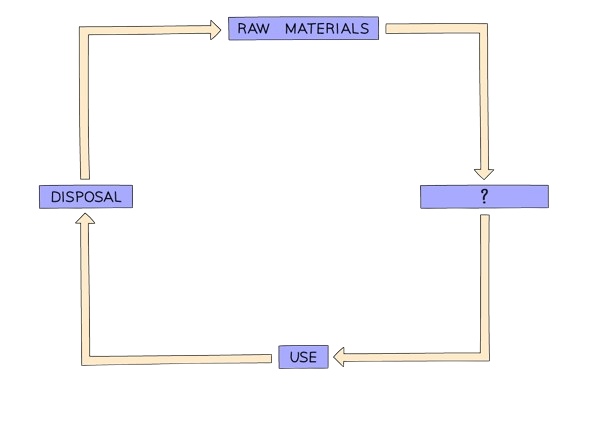
What is the missing label in the life cycle assessment flow diagram?
The missing label is manufacture.
Define life cycle assessment (LCA).
A life cycle assessment (LCA) is an analysis of the overall environmental impact of a product throughout its entire lifetime, from obtaining raw materials to disposal.
State what impact obtaining raw materials can have on the environment.
The impact of obtaining raw materials on the environment is using up limited resources and damaging habitats.
State what impact the manufacturing process can have on the environment.
The impact the manufacturing process can have on the environment is using up land for factories and the use of fossil fuelled machines for production and transport.
True or False?
Extracting new metals requires more energy than recycling metals.
False.
Sometimes the costs and energy used in collecting, transporting and recycling metals can be more expensive than extracting new metals.
Which product will have a less damaging impact on the environment? A car or a bicycle?
A bicycle will have a less damaging impact on the environment.
A life cycle assessment evaluates the environmental impact at every stage of a product's life, from obtaining .......... to manufacturing, use, and .......... .
A life cycle assessment evaluates the environmental impact at every stage of a product's life, from obtaining raw materials to manufacturing, use, and disposal.
State what impact disposing of products can have on the environment.
The impact that disposing of products can have on the environment is using up space in landfill sites.
True or False?
Iron is a renewable resource.
False.
Iron ore is a finite source which requires a lot of energy to process.
What are two disposal options for metals?
Two disposal options for metals are recycling or storing in a landfill.

Sign up to unlock flashcards
or