Bonding, Structure & Properties (WJEC GCSE Science (Double Award): Chemistry): Exam Questions

Exam code: 3430

2 hours16 questions
1a
3 marks

(i) The box below contains the names of some common types of smart material.

photochromic pigment hydrogel shape memory alloy

shape memory polymer thermochromic pigment

Choose from the box the type of smart material that is used in:

I. disposable nappies,

..........................................................................................................................................

[1]

II. lenses for sunglasses.

..........................................................................................................................................

[1]

(ii) What must be done to a thermochromic pigment for it to change colour?

Tick (✓) the box next to the correct answer.

heat it

□

add water

□

place it in sunlight

□

[1]

1b
4 marks

The following diagram shows a giant ionic structure.
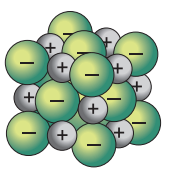
Figure: Close-packed 3D structure of a giant ionic lattice, showing alternating positive and negative ions (green and yellow spheres) regularly arranged and closely packed together

Giant ionic structures have high melting points and conduct electricity when dissolved or molten.

(i) Use the diagram and your knowledge to draw one line from each property to its correct explanation.
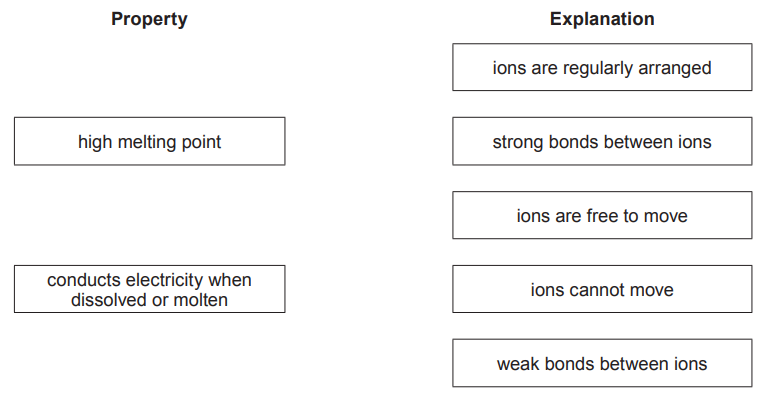
Figure: A matching exercise — two property boxes on the left ("high melting point", "conducts electricity when dissolved or molten") to be linked by drawn lines to four explanation boxes on the right ("ions are regularly arranged", "strong bonds between ions", "ions are free to move", "ions cannot move")

[2]

(ii) The following diagram shows a simple covalent structure.
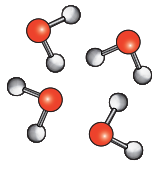
Figure: Four separate small covalent molecules (each with one central red atom double-bonded to two grey/white atoms, similar to CO2), scattered apart from each other with gaps between them, showing weak forces between separate molecules

Simple covalent structures have low melting points and do not conduct electricity.

Use the diagram and your knowledge to draw one line from each property to its correct explanation.
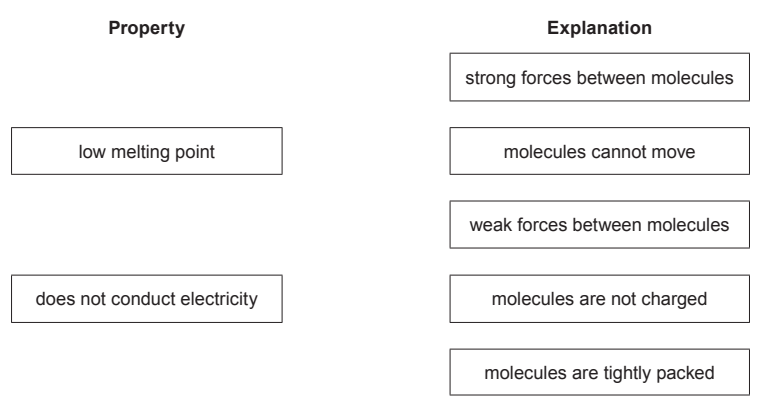
Figure: A matching exercise — two property boxes on the left ("low melting point", "does not conduct electricity") to be linked by drawn lines to five explanation boxes on the right ("strong forces between molecules", "molecules cannot move", "weak forces between molecules", "molecules are not charged", "molecules are tightly packed")

[2]

1c
2 marks

Diamond and graphite have giant covalent structures. Diamond is commonly used in drill tips, whereas graphite is used in pencils.
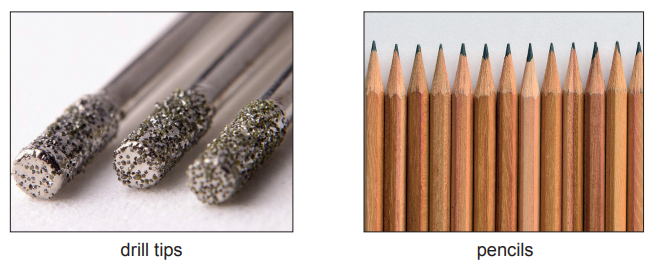
Figure: Two photographs side by side — drill tips coated with diamond grit, and a row of sharpened pencils

Use your knowledge of the properties of diamond and graphite to underline the correct word in the brackets to complete each sentence.

Diamond is used in drill tips because it is ( hard / soft / malleable ) and has a high melting point.

Graphite is used in pencils because the layers of atoms are held together weakly and are able to slide ( through / into / over ) each other.

2
3 marks

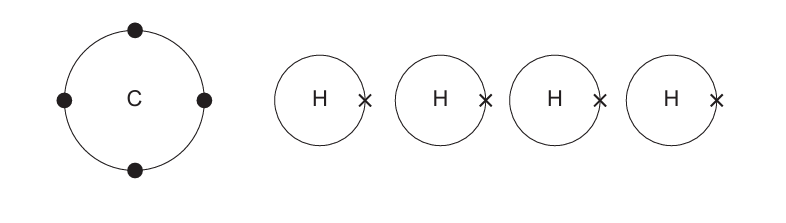
Methane has the formula CH4. Its molecules consist of one carbon atom and four hydrogen atoms bonded together.

(i) Draw a diagram in the box to show how the atoms bond to form a methane molecule.

Blank box for the student to draw a dot-and-cross (or similar) bonding diagram of methane, CH4, showing one central carbon atom covalently bonded to four surrounding hydrogen atoms.

[2]

(ii) Give the name of this type of bonding.

...................................................................................

[1]

3a
3 marks

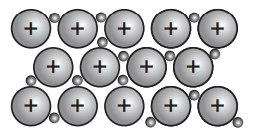
The following diagram can be used to represent the structure of silver.

Figure: Diagram representing the structure of silver as a metallic lattice — a regular grid of positive silver ions, shown as rows of '+' symbols, surrounded by a uniform sea of delocalised electrons filling the spaces between them.

Select the correct words from the box to complete the sentences that follow.

electrons tightly protons

malleable neutrons brittle

ductile irregularly loosely

Silver is a solid because the metal ions are .............................................................. packed.

Silver is a good conductor of electricity because the .............................................................. are delocalised and free to move.

Silver dents when hammered because it is .............................................................. .

3b
3 marks

Silver can also exist as nano-sized particles. These are used in plasters, socks and deodorant sprays.

(i) Underline the correct word in the brackets to complete each sentence.

Nano-sized silver particles range from ( 1-100 mm / 1-100 nm / 1-100 cm ) in size.

Nano-sized silver particles have ( the same / different / stronger ) properties compared to bulk silver.

[2]

(ii) Give the property of nano-sized silver particles that allows them to be used in plasters, socks and deodorants.

..................................................................

[1]

4a
3 marks

Calcium reacts with fluorine to form calcium fluoride.

Showing the outer electrons only, draw dot and cross diagrams to show how bonding takes place during the formation of calcium fluoride.

Include the electronic structures and the charges of the ions formed.

calcium 2,8,8,2 fluorine 2,7

4b
2 marks

Potassium chloride and calcium oxide are both ionic compounds with high melting points.

The table gives information about the ions that make up each compound.

Ionic compound

Ions present

potassium chloride

potassium and chloride

calcium oxide

calcium and oxide

Calcium oxide has a higher melting point than potassium chloride.

Explain this difference.

4c
2 marks

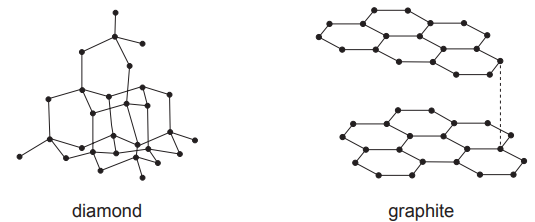
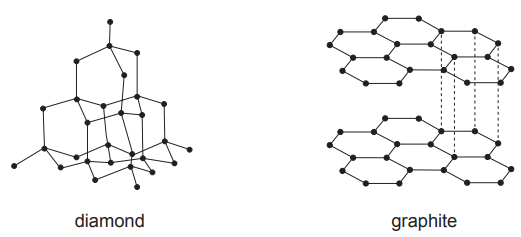
The diagrams show the structures of diamond and graphite.

Figure: Two 3D ball-and-stick structural diagrams side by side. "Diamond" shows a rigid tetrahedral lattice where every carbon atom is bonded to four neighbouring carbon atoms in a continuous 3D network. "Graphite" shows two separate flat hexagonal layers of carbon atoms (each carbon bonded to three neighbours within its layer), stacked one above the other with a dashed line indicating the larger gap/weak connection between the layers

Both structures have covalent bonds between carbon atoms.

Give two differences between the structures of diamond and graphite.

5a
2 marks

Give the numbers of protons and electrons in a calcium ion, Ca2+, and a bromide ion, Br-.

Ion

Number of protons

Number of electrons

Ca2+

.......................................

.......................................

Br-

.......................................

.......................................

5b
2 marks

Calcium nitrate solution reacts with sodium carbonate solution to form a precipitate of calcium carbonate.

Ca(NO3)2(aq) + Na2CO3(aq) → CaCO3(s) + 2NaNO3(aq)

Write an ionic equation for the formation of the calcium carbonate precipitate.

6
1 mark

The electronic structures of carbon and hydrogen are shown in the table.

Element

Electronic structure

carbon

2,4

hydrogen

1

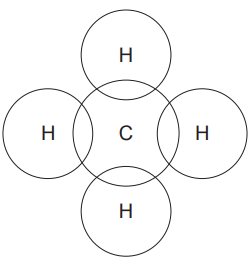
Use this information to complete the diagram to show how the atoms bond in a molecule of methane, CH4.

Figure: Dot-and-cross-style bonding diagram template for methane — a central circle labelled C overlapping with four surrounding circles labelled H (above, below, left, right), each overlap region left blank for the candidate to add the shared pair of electrons
7
1 mark

State whether you agree with the following statement. Give a reason for your answer.

'Copper is a good electrical conductor whereas brass and bronze are not'

Agree Yes / No

Reason ................................................................................................................

8
6 marks

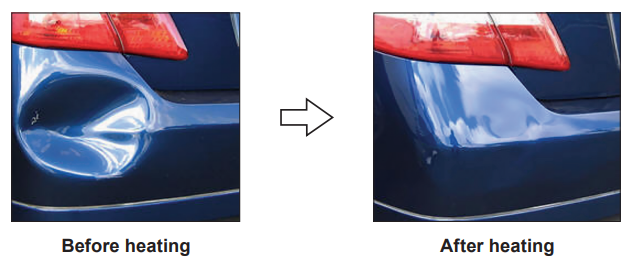
Shape-memory polymers are a type of smart material that can regain their original shape when heated. They are commonly used in car bumpers as shown in the photographs.

Figure: Two photographs of a car bumper showing a dent "Before heating" and the same bumper with the dent removed "After heating", demonstrating shape-memory recovery

Other types of smart materials include thermochromic pigments, photochromic pigments and hydrogels (polymer gels).

Describe the properties and uses of these three types of smart materials.

9a
4 marks

The table gives the electronic structures of sodium and oxygen.

Element

Electronic structure

sodium

2,8,1

oxygen

2,6

(i) Sodium reacts with oxygen to give sodium oxide.

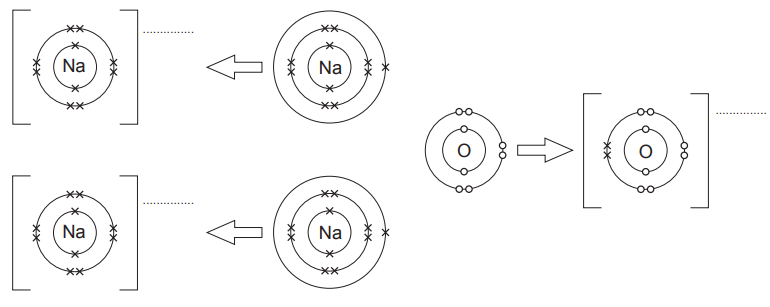
The diagram below can be used to show the electronic changes that occur as sodium oxide is formed.

Figure: Dot-and-cross diagram template showing two separate sodium atoms (each with electronic structure 2,8,1 shown as shells of crosses) each with an arrow pointing towards an empty square-bracketed ion outline (charge to be filled in), and one oxygen atom (electronic structure 2,6 shown as shells of circles) with an arrow pointing towards an empty square-bracketed ion outline (charge to be filled in)

Complete the diagram by

  • drawing arrows to show the movement of electrons between the sodium and oxygen atoms,

  • giving the charges of the sodium and oxide ions that are formed.

[2]

(ii) Draw a dot and cross diagram to show the bonding in an oxygen molecule, O2.

[2]

9b
3 marks

(i) Diamond and graphite are both made from carbon atoms. Their structures are shown below.

Figure: Two 3D ball-and-stick structural diagrams side by side, labelled "diamond" (a rigid tetrahedral lattice where every carbon atom bonds to four neighbours) and "graphite" (flat hexagonal layers of carbon atoms, each bonded to three neighbours within its layer, with the layers stacked with larger gaps between them)

I. State which structure is able to conduct electricity. Give a reason for your answer.

[1]

II. State which structure is used as a lubricant. Give a reason for your answer.

[1]

(ii) Give the name of another form of carbon that is used in drug delivery systems.

.........................................................................................

[1]

10a
2 marks

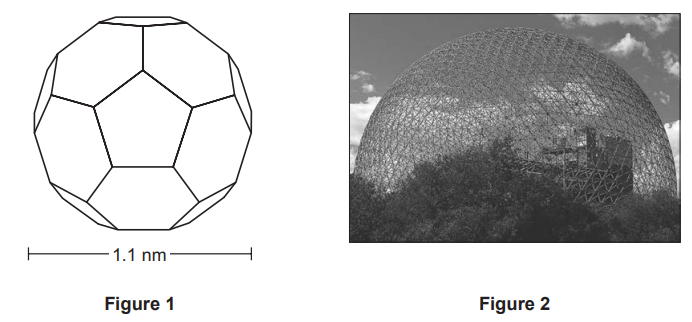
In 1985, a new allotrope of carbon was discovered and named buckminsterfullerene. This allotrope consists of sixty carbon atoms joined together to resemble a shape similar to that of a football (Figure 1), only ten septillion (10,000,000,000,000,000,000,000,000) times smaller.

This form of carbon was named after the architect Buckminster Fuller, famous for designing geodesic domes, as shown in Figure 2.

Figure: Figure 1 shows a ball-and-stick or space-filling model of buckminsterfullerene (C60), a spherical cage of 60 carbon atoms resembling a football pattern of hexagons and pentagons, labelled with a diameter of 1.1 nm. Figure 2 shows a geodesic dome building, a spherical lattice structure of triangular/hexagonal panels, illustrating the architectural inspiration for the molecule's name.

The structure of buckminsterfullerene is a truncated icosahedron, consisting of 20 hexagons and 12 pentagons that intersperse to form a spherical structure. Within the structure, each carbon atom is bonded to three other carbon atoms and no pentagon has a joining edge with another pentagon.

Other spherical allotropes of carbon, called fullerenes, have since been made. These include balls consisting of seventy, seventy-six and eighty-four carbon atoms. Together, they have become known as 'Buckyballs'.

Fullerenes have high melting points and boiling points. They also have a high density and a large surface area for their size.

Today, fullerenes are at the heart of nanotechnology – the study of atomic scale structures and devices. This provides many exciting new research possibilities for scientists including their potential uses in catalysts, lubricants and in nano-tubes for strengthening materials and as a way of delivering drugs into the body.

Nano-tubes are fullerenes that are used to reinforce graphite in tennis rackets because they are very strong. They are also used as semiconductors in electrical circuits.

The nano-tube's structure also allows it to be used as a container for transporting a drug in the body. A molecule of the drug can be placed inside the nano-tube cage. This keeps the drug 'wrapped up' until it reaches the site where it is needed. In this way, a dose that might be damaging to other parts of the body can be delivered safely to, for example, a tumour.

Tick (✓) all the statements that correctly describe buckminsterfullerene.

its structure has 32 faces

□

it has a relative molecular mass of 60

□

it is an allotrope of carbon

□

it has a giant ionic structure

□

it is a hydrocarbon compound

□

it is a smart material

□

it is 1×1025 times smaller than a football

□

10b
5 marks

(i) Use the following formula to calculate the number of edges that a molecule of buckminsterfullerene has.

number of edges=total number of sides of all pentagons and hexagons2

Number of edges = ..........................................

[2]

(ii) Calculate, in m3, the approximate volume of a buckminsterfullerene molecule.

Write your answer to three significant figures and in standard form.

Volume=43πr3

π=3.14    r=radius    1 nm=1×10⁻⁹ m

Volume = ............................................... m3

10c
1 mark

Give the main reason why the structure of fullerenes has resulted in there being an interest in developing their use as catalysts.

10d
1 mark

State why some people might oppose the use of fullerenes in drug delivery systems in the body.

10e
2 marks

One student said that Buckyballs should be good electrical conductors but her friend disagreed.

Use your knowledge of bonding and structure to give one reason that each student could use to support their argument.

11a
1 mark

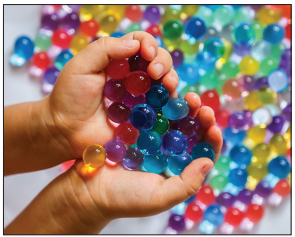
Hydrogels are macromolecules, meaning they contain very large numbers of atoms.

Photograph of two hands cupping a handful of small, translucent hydrogel beads in red, blue, green, yellow and purple, with many more colourful beads scattered across the background.

They are polymers made from hydrophilic polymer chains. This means that they readily mix with water.

Cross-links between the polymer chains enable hydrogels to form their three-dimensional shape.

The cross-links that join the individual polymer chains together are formed by small reactive molecules that contain one or more double bonds.

The interesting feature of hydrogels is their ability to swell and shrink, depending on their surroundings. When in contact with water, hydrogels are able to absorb water and swell to many times their original size and weight, whilst maintaining the same shape.

Being able to absorb water like this has enabled hydrogels to be used in a wide range of applications. For many of these applications it is important to understand how the properties of hydrogels change with temperature.

Table 1 and Table 2 show how temperature affects the properties of hydrogel beads in water over time.

Table 1 — the effect of temperature on the mass of hydrogel beads

Time (hours)

Mass of bead (g)

10 °C

20 °C

40 °C

0

0.035

0.035

0.035

2

1.305

2.980

4.280

4

2.512

3.681

5.904

6

3.613

4.389

6.760

8

4.298

5.195

8.101

10

5.120

5.572

8.101

12

5.400

5.980

8.101

Table 2 — the effect of temperature on the diameter of hydrogel beads

Time (hours)

Diameter of bead (mm)

10 °C

20 °C

40 °C

0

3.56

3.56

3.56

2

10.30

13.00

18.10

4

13.40

16.50

21.70

6

16.20

18.50

23.60

8

17.80

19.60

25.24

10

19.50

20.80

25.24

12

20.50

22.00

25.24

Tick (✓) the statement that best describes the molecules that form the cross-links within hydrogels.

they are macromolecules

□

they are unsaturated

□

they contain hydrophilic groups

□

they are polymers

□

11b
1 mark

Give the phrase in the passage that shows the change the hydrogel undergoes is a physical rather than a chemical change.

11c
2 marks

Calculate the percentage increase in mass of a hydrogel bead when placed in water at 20 °C for 6 hours.

Percentage increase = ........................................................ %

11d
2 marks

Write a conclusion for the effect of temperature on the diameter of hydrogel beads in water over time.

12
6 marks

Magnesium chloride is a solid with a high melting point. It conducts electricity only when molten or dissolved.

Describe the electronic changes that take place in the formation of magnesium chloride and explain its properties in terms of the bonding and structure. You may use diagrams as part of your answer.

13a
3 marks

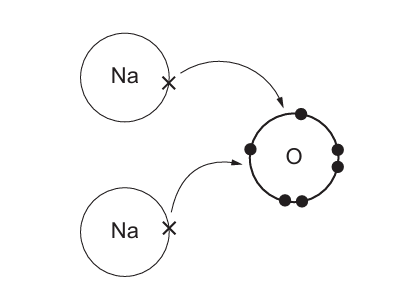
The diagram shows the transfer of electrons that takes place during the formation of sodium oxide.

Dot-and-cross electron transfer diagram. Two separate sodium atoms, each labelled Na with one cross (electron) at its edge, each have a curved arrow leading from their cross to a central oxygen atom labelled O. The oxygen atom is drawn as a circle with 6 dots already around it (its own outer-shell electrons) plus the two incoming arrows bringing in one cross each from the two sodium atoms, giving 8 electrons (6 dots + 2 crosses) around the oxygen in its outer shell.

(i) Name the type of bonding present in sodium oxide.

...................................................................................

[1]

(ii) State what must be done to sodium oxide so that it will conduct electricity.

Explain your answer.

.............................................................................................

[2]

13b
4 marks

(i) Draw a dot and cross diagram to show the bonding in a molecule of tetrafluoromethane, CF4.

carbon (C) 2,4 fluorine (F) 2,7

[2]

(ii) Tetrafluoromethane is a simple covalent substance and is a gas at room temperature.

Explain why it has a low boiling point.

..................................................................................................

[2]

13c
2 marks

Nanoparticles are extremely small particles that have different properties to the same material at bulk size.

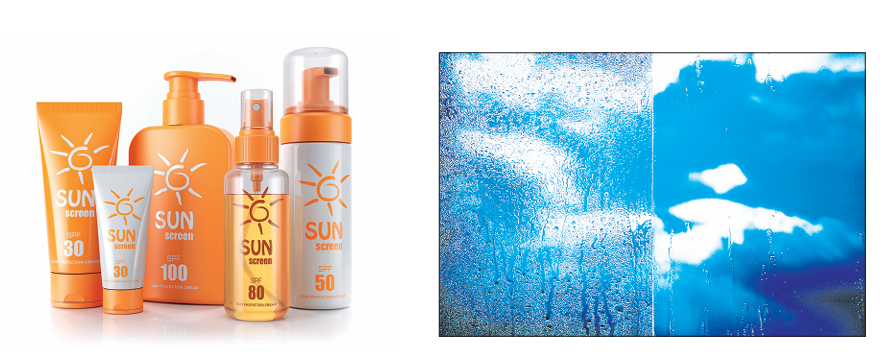
Nano-scale titanium dioxide is commonly used in sunscreen and in self-cleaning windows.

Photographs show a range of sunscreen products labelled SPF 30, 50, 80 and 100, alongside a window with a wet, dirty side and a clear side showing blue sky and clouds.

Give the reason why nano-scale titanium dioxide is effective in each of these uses.

Sunscreen

...............................................................................................

Self-cleaning windows

..................................................................................................

[2]

14
4 marks

(i) Methane gas, CH4, contains the elements carbon and hydrogen.

Element

Electronic structure

carbon

2,4

hydrogen

1

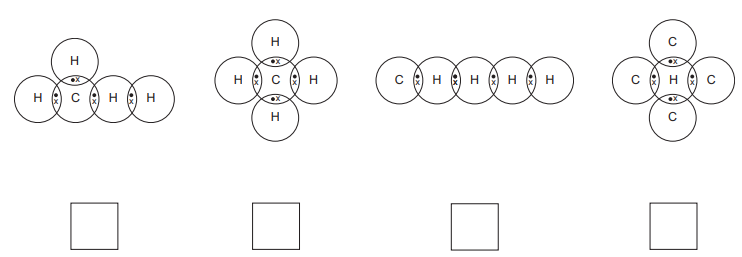
I. Put a tick (✓) in the box below the diagram which shows how the atoms are bonded in one molecule of methane.

Figure: Four dot-and-cross diagrams of methane, each with a tick-box beneath. Diagram 1: a central carbon atom bonded to only two hydrogen atoms via shared electron pairs (incomplete/incorrect structure). Diagram 2: a central carbon atom correctly bonded to four hydrogen atoms, each C–H bond shown as a shared pair of one dot (from carbon) and one cross (from hydrogen), giving carbon a full outer shell of 8 electrons — this is the correct structure. Diagram 3: two carbon atoms bonded together with hydrogen atoms attached (incorrect — shows an ethane-like structure, not methane). Diagram 4: a central carbon atom bonded to four hydrogen atoms, but with an incorrect number or arrangement of dots/crosses (incorrect electron distribution).

[1]

II. Circle the name given to the type of bonding found in methane.

covalent ionic giant covalent metallic

[1]

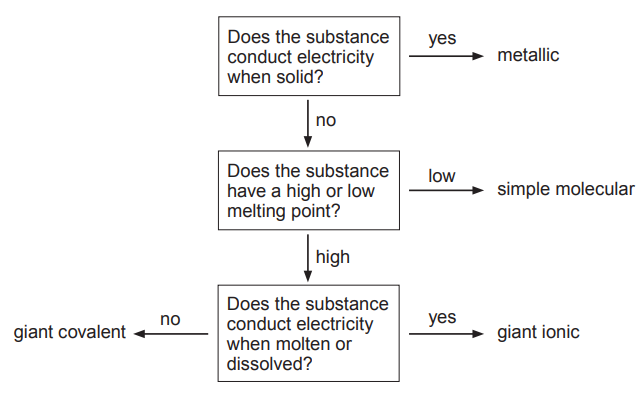
(ii) The flow chart below can be used to identify the type of structure found in different substances.

Figure: Flow chart starting with "Does the substance conduct electricity when solid?" — if yes, leads to "metallic"; if no, leads to "Does the substance have a high or low melting point?" — if low, leads to "simple molecular"; if high, leads to "Does the substance conduct electricity when molten or dissolved?" — if yes, leads to "giant ionic"; if no, leads to "giant covalent".

I. Use the flow chart to complete the table.

Substance

Melting point (°C)

Electrical conductivity

Type of structure

A

2072

conducts only when molten

.................................................................

B

-182

does not conduct electricity

.................................................................

C

1610

does not conduct electricity

.................................................................

[1]

II. Give the letter of the substance, A, B or C, that is most likely to be methane.

Substance ................................................................................

[1]

15a
3 marks

Magnesium reacts with oxygen to form magnesium oxide.

Using the electronic structures below, draw dot and cross diagrams to show how bonding takes place during the formation of magnesium oxide. Include the electronic structures of the ions formed.

magnesium = 2,8,2 oxygen = 2,6

15b
2 marks

The melting points of magnesium oxide and sodium chloride are given below.

Substance

Melting point (°C)

sodium chloride

801

magnesium oxide

2852

Explain why there is a difference in their melting points even though they are both ionic substances.

15c
2 marks

Using the electronic structures below, draw a dot and cross diagram to show the bonding in a molecule of carbon dioxide, CO2.

carbon = 2,4 oxygen = 2,6

16a
3 marks

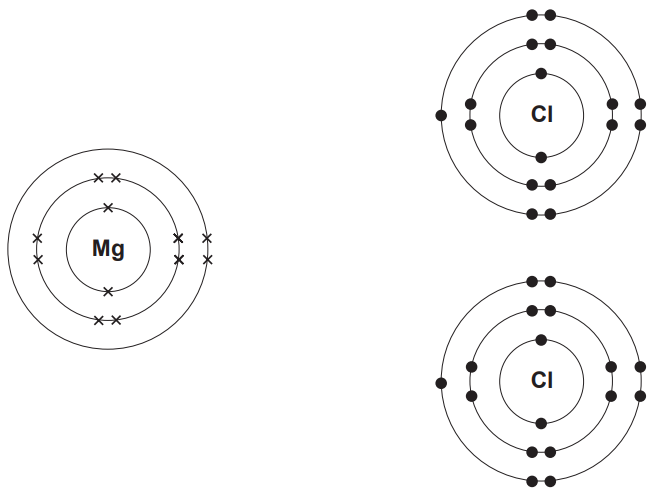
Magnesium reacts with chlorine to form magnesium chloride.

The following diagram shows the electronic structures of magnesium and chlorine atoms.

Figure: Electronic structure diagrams of one magnesium atom and two chlorine atoms, each shown with their nucleus and electron shells populated according to their electronic structures.

(i) Draw arrows on the diagram to show how electrons are transferred between the magnesium and chlorine atoms during the formation of magnesium chloride.

[1]

(ii) Complete the table giving information about the charge and electronic structure of the magnesium and chloride ions that are formed.

Ion

Charge

Electronic structure

magnesium

+2

...............................

chloride

............................

2,8,8

[2]

16b
2 marks

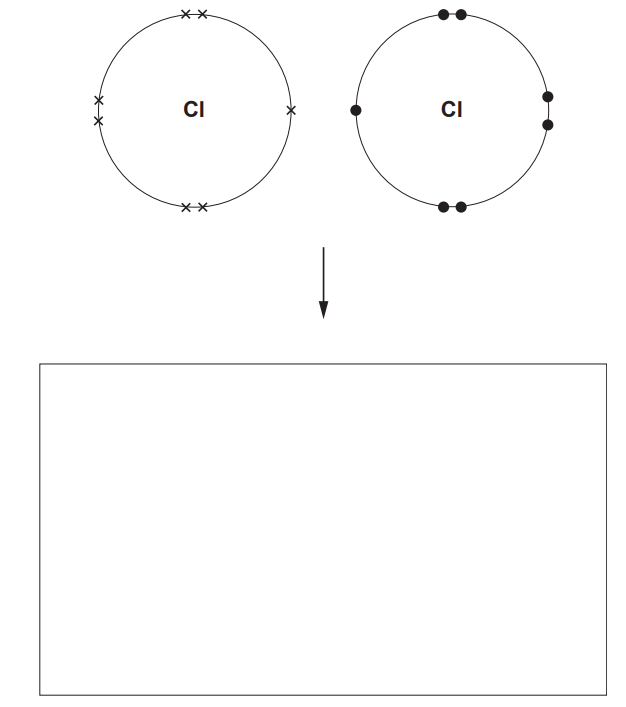
Chlorine gas, Cl2, consists of two chlorine atoms bonded together.

(i) Draw a diagram in the box to show how the atoms bond to form a chlorine molecule.

Figure: Blank box for the candidate to draw a dot-and-cross diagram of a chlorine molecule, showing the outer shells of two chlorine atoms overlapping with one shared pair of electrons between them.

[1]

(ii) Give the name of this type of bonding.

……....................…...................................…

[1]