Chemical Reactions & Energy (WJEC GCSE Science (Double Award): Chemistry): Exam Questions

Exam code: 3430

22 mins4 questions
1a
4 marks

Propane gas is commonly used as a fuel. The burning of propane gas is represented by the following equation.
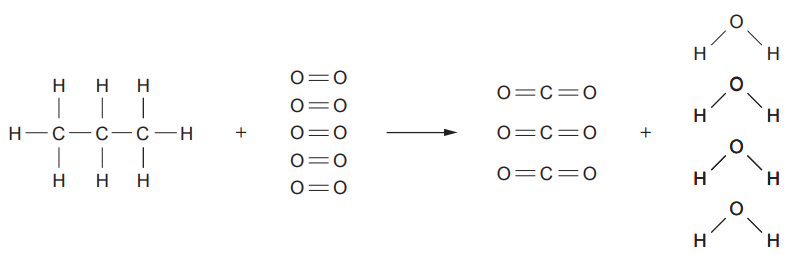
Figure: Displayed structural equation for the combustion of propane — propane (C3H8, a three-carbon chain with all C-H and C-C bonds shown explicitly) plus five O=O oxygen molecules, reacting to form three O=C=O carbon dioxide molecules and four H-O-H water molecules, with all bonds drawn out explicitly

The relative amounts of energy needed to break some of the bonds are given in the table.

Bond

Bond energy (kJ)

C—H

413

C—C

348

(i) The total energy needed to break all of the bonds in the reactants is 6 490 kJ.

Calculate the energy needed to break one O=O bond.

Energy needed = ........................................................ kJ

[3]

(ii) The energy released when all of the bonds in the products are formed is 8 542 kJ.

Tick (✓) the correct overall energy change for this reaction.

2 052 kJ taken in

□

15 032 kJ taken in

□

15 032 kJ given out

□

2 052 kJ given out

□

[1]

1b
2 marks

The energy profile diagram for the combustion of propane is given below.
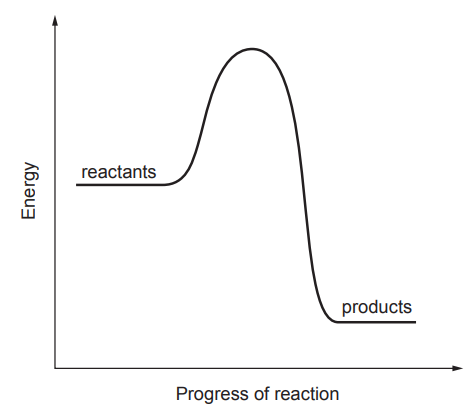
Figure: Energy profile diagram with axes labelled "Energy" (vertical) and "Progress of reaction" (horizontal). A flat line labelled "reactants" rises steeply into a curved peak, then drops down steeply to a lower flat line labelled "products", showing an exothermic reaction

(i) Draw an arrow (↕) on the diagram to show the activation energy.

Label this A.

[1]

(ii) Draw an arrow (↕) on the diagram to show the overall energy change.

Label this B.

[1]

2a
4 marks

Hannah and Evan investigated the temperature increase when sodium hydroxide solution was added to dilute hydrochloric acid.

The method they used to collect their results is given below.

  1. Measure 25 cm³ of hydrochloric acid into a polystyrene cup.

  2. Record the temperature of the hydrochloric acid.

  3. Measure 25 cm³ of sodium hydroxide and add it to the hydrochloric acid.

  4. Record the highest temperature of the mixture.

  5. Calculate the temperature increase for the reaction.

(i) Choose apparatus from the box to complete the following sentences.

balance

Bunsen burner

thermometer

measuring cylinder

test tube

stopwatch

tongs

beaker

Hannah and Evan used a ................................................................................... to measure 25 cm³ of hydrochloric acid accurately.

Hannah and Evan used a ................................................................................... to measure the temperature of the mixture.

[2]

(ii) Give one way that Hannah and Evan could check that the method produces consistent results.

...................................................................................

[1]

(iii) Hannah and Evan calculated a temperature increase of 17 °C.

Give the term used to describe a reaction that gives a temperature increase.

...................................................................................

[1]

2b
5 marks

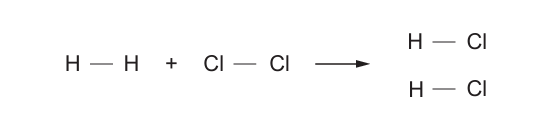
When chlorine reacts with hydrogen, hydrogen chloride is formed.

Displayed structural diagram showing one H–H molecule plus one Cl–Cl molecule reacting to form two H–Cl molecules

The bond energies are given in the table.

Bond

Bond energy (kJ)

H—H

436

Cl—Cl

243

H—Cl

432

(i) The energy needed to break the bonds in the hydrogen and chlorine molecules is 679 kJ. Show how this value is calculated.

[1]

(ii) Calculate the energy released when two molecules of hydrogen chloride are formed.

Energy released = ........................................................ kJ

[2]

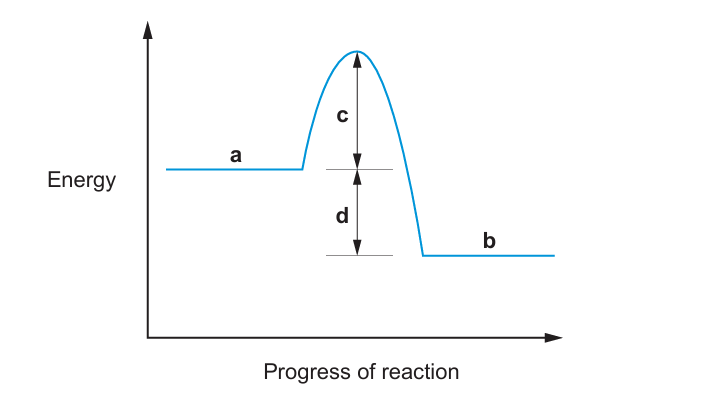
(iii) The energy profile diagram for the reaction between hydrogen and chlorine is given below.

Energy profile (reaction) diagram. The y-axis is labelled "Energy" and the x-axis "Progress of reaction". A curve rises from the reactants' energy level, up over a labelled hump, then down to a lower energy level for the products (an exothermic reaction). Letter a labels the top of the hump (the peak). Letter b labels the reactants' energy level at the start of the curve. Letters c and d label two vertical spans on the right-hand side: one spans from the reactants' energy level up to the peak, the other spans from the reactants' level down to the products' leve

Give the letter that shows:

the activation energy ...........................................

the overall energy change for the reaction ...........................................

[2]

3a
2 marks

A group of students were investigating the temperature changes during four reactions, A, B, C and D.

Two chemicals were mixed together for each reaction and the temperature change calculated.

The results of their experiment are shown in the table.

Reaction

Temperature before mixing (°C)

Temperature after mixing (°C)

Temperature change (°C)

A

21

31

+10

B

19

37

+18

C

19

....................................

−4

D

21

16

−5

(i) Complete the table by giving the temperature after mixing for reaction C.

[1]

(ii) Give the letters, A, B, C or D, of the two exothermic reactions. Give the reason for your choice.

Reactions ................................................. and .................................................

Reason .................................................................................[1]

3b
1 mark

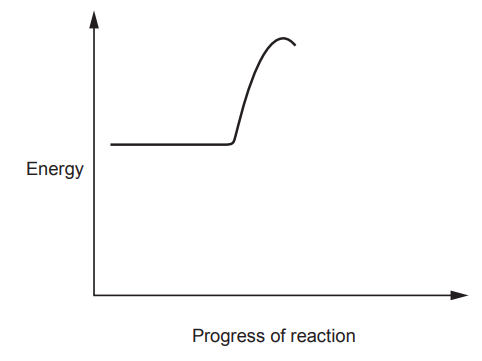
Complete the energy profile diagram to show an exothermic reaction.

Figure: Energy profile diagram with axes labelled "Energy" (vertical) and "Progress of reaction" (horizontal). A flat line at a starting energy level rises steeply into a curved peak (representing the activation energy hump) and then stops at the top of the peak, not yet drawn back down to a final level — the candidate must complete the curve by drawing it back down to end at a final energy level
4
4 marks

Chromium is one of the metals found in stainless steel. The equation shows how chromium is produced industrially by reacting chromium oxide with aluminium.

chromium oxide + aluminium → chromium + aluminium oxide

(i) The reaction is highly exothermic.

Give the meaning of the term exothermic.

[1]

(ii) During the reaction, oxidation and reduction happens.

I. Name the substance which is oxidised.

[1]

II. State what is meant by reduction.

[1]

(iii) State what the equation tells you about the relative reactivities of chromium and aluminium.

[1]