Crude Oil, Fuels & Organic Chemistry (WJEC GCSE Science (Double Award): Chemistry): Exam Questions

Exam code: 3430

2 hours17 questions
1a
6 marks

The structural formulae of seven organic compounds, A-G, are shown below.
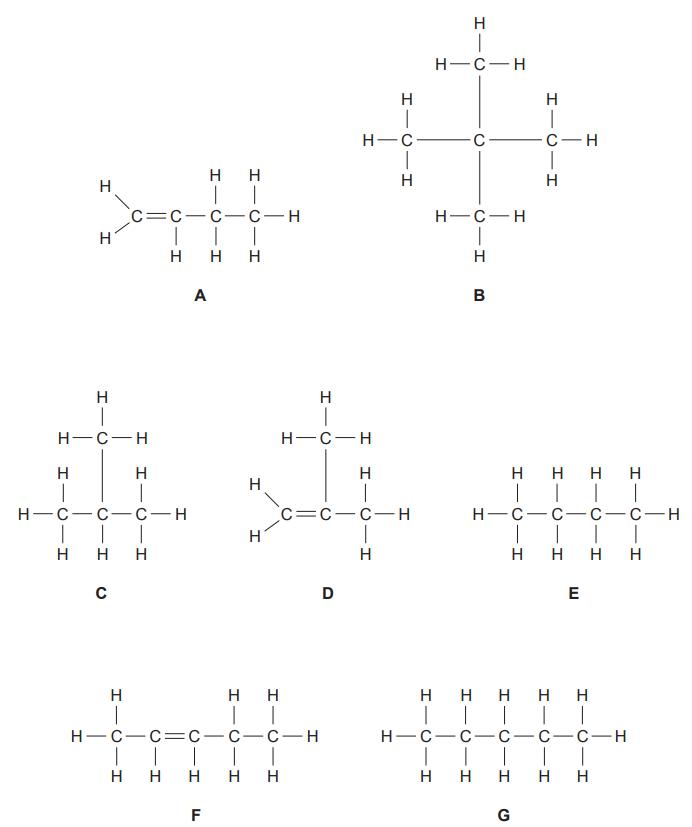
Figure: Seven displayed structural formulae, labelled A to G. A: CH2=CH-CH2-CH3 (but-1-ene, 4 carbons, C=C between carbons 1 and 2). B: a central carbon bonded to four CH3 groups (above, below, left, right) — 2,2-dimethylpropane (neopentane), 5 carbons. C: a three-carbon chain with a CH3 branch on the middle carbon — 2-methylpropane (isobutane), 4 carbons, all single bonds. D: CH2=C(CH3)-CH3 (2-methylpropene, 4 carbons, C=C between carbons 1 and 2, with a methyl branch on carbon 2). E: a straight chain of 4 carbons, all single bonds — butane. F: a straight chain of 5 carbons with a C=C double bond between carbons 2 and 3 — pent-2-ene. G: a straight chain of 5 carbons, all single bonds — pentane

(i) Give the letters of the three compounds that have the general formula CnH2n.

.........................................................................................

[1]

(ii) State the number of compounds that are saturated.

.........................................................................................

[1]

(iii) Give the letter of the compound that is but-1-ene.

.........................................................................................

[1]

(iv) Draw the structural formula of the isomer of C5H12 not shown.

[1]

(v) Describe the chemical test that can be used to distinguish between compounds C and D.

Give the expected observation for both compounds.

[2]

1b
3 marks

The structural formula of vinyl chloride is shown below.
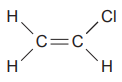
Figure: Displayed structural formula of vinyl chloride — two carbon atoms joined by a C=C double bond; the left carbon bonded to two H atoms, the right carbon bonded to one H atom and one Cl atom

Vinyl chloride can undergo a reaction known as polymerisation to produce polyvinyl chloride, commonly known as PVC.

Explain what happens to vinyl chloride molecules during the formation of PVC. Draw the repeating unit of PVC.

1c
1 mark

PVC is widely used in everyday life and has replaced many traditional materials.

Apart from cost, suggest two reasons why PVC has replaced iron for making drainpipes and guttering.

Reason 1 ....................................................................................

Reason 2 ...................................................................................

2a
6 marks

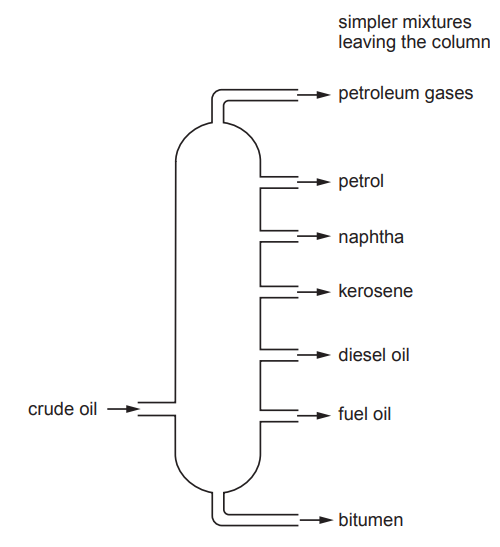
The diagram shows a fractionating column where crude oil is separated into simpler mixtures.

Figure: Vertical fractionating column diagram. Crude oil enters near the bottom. Output pipes exit the column at different heights, from top to bottom: petroleum gases (very top), petrol, naphtha, kerosene, diesel oil, fuel oil (decreasing height down the column), and bitumen (bottom). Each pipe is labelled with the simpler mixture leaving the column at that point

(i) Underline the correct word in the brackets to complete each sentence about the separation process.

I. Before the crude oil mixture enters the column it must be ( boiled / melted / filtered ).

[1]

II. Inside the column, the simpler mixtures ( evaporate / condense / solidify ).

[1]

III. The simpler mixtures that leave the fractionating column are called ( monomers / polymers / fractions ).

[1]

IV. The reason the simpler mixtures are separated from one another is that they have different ( masses / densities / boiling points ).

[1]

(ii) The table shows some information about the simpler mixtures obtained from crude oil.

Simpler mixture

Number of carbon atoms in the compounds

Use

petroleum gases

1–4

cooking

petrol

4–12

cars

naphtha

7–14

making chemicals

kerosene

11–15

aircraft

diesel oil

15–19

lorries

fuel oil

20–30

power stations

bitumen

more than 30

roads

I. Give the name of a mixture not used as a fuel.

.........................................................................................

[1]

II. Give the names of the two mixtures that contain compounds with 13 carbon atoms.

.............................................. and ............................................

[1]

2b
2 marks

One of the compounds found in petrol is octane, C8H18.

Ar(C) = 12

(i) Give the total relative mass of the carbon atoms in one molecule of octane.

Mass = .......................................................

[1]

(ii) The relative molecular mass of octane is 114. Use your answer to part (i) to calculate the percentage by mass of carbon in octane.

Percentage = ............................................... %

[1]

2c
3 marks

Fuel, heat and oxygen are the three factors needed to start and maintain a fire.

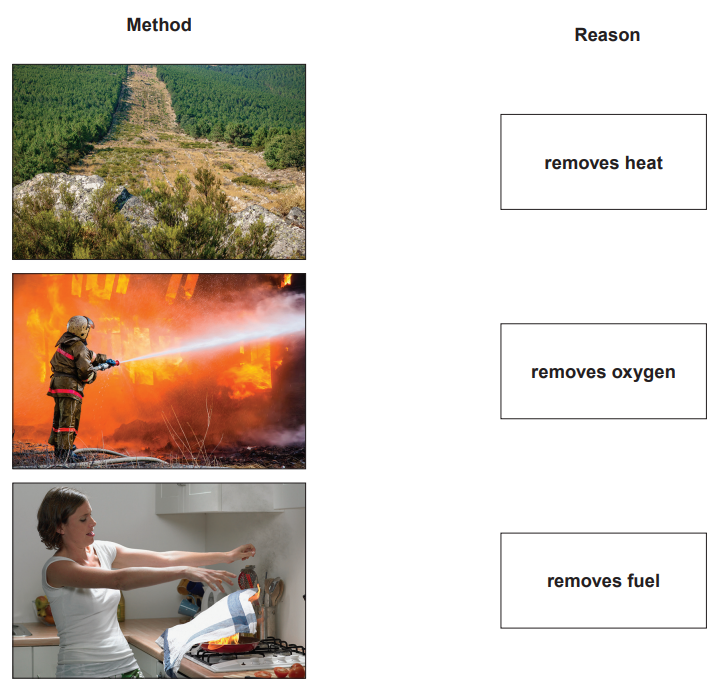
The photographs show three different methods used to put out fires or stop them from spreading.

Figure: Three photographs, each showing a different fire-fighting method. Photo 1 shows a cleared strip of land (a firebreak) cutting through a forest. Photo 2 shows a firefighter spraying a hose of water onto a large burning building. Photo 3 shows a woman in a kitchen smothering a small pan fire with a damp cloth.

(i) Draw one line from each method to the reason it puts out a fire.

[2]

(ii) Underline the type of fire that would be unsafe to put out using water.

bonfire electrical fire forest fire

[1]

3a
3 marks

The molecular formulae of five carbon compounds, A, B, C, D and E are shown below.

C3H6

C2H5OH

C4H8

C2H6

C3H8

A

B

C

D

E

(i) Alkanes are compounds with the general formula CnH2n+2.

Give the letters of the two compounds that are alkanes.

....................................................... and .......................................................

[1]

(ii) Give the name for compound A.

............................................................................................................................

[1]

(iii) Draw the structural formula of compound E.

[1]

3b
4 marks

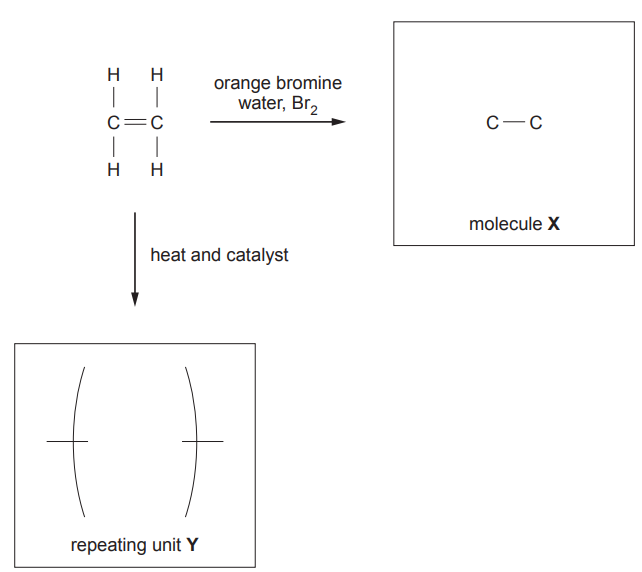
The following diagram shows two reactions of ethene.

Figure: Displayed structural formula of ethene (C=C double bond, each carbon bonded to two H atoms) with two reaction arrows leading from it: one labelled "orange bromine water, Br2" leading to a blank box labelled "molecule X" (showing a partial C-C single bond skeleton to be completed); another labelled "heat and catalyst" leading to a blank box labelled "repeating unit Y" (showing partial bracket ends with two dashes for bonds extending outward, to be completed)

(i) Complete the structural formulae for molecule X and repeating unit Y.

[2]

(ii) Describe the change that would be seen in the orange bromine water when molecule X is formed.

............................................................................................................................

[1]

(iii) Name the type of reaction that takes place to form repeating unit Y.

.................................................................................................

[1]

3c
8 marks

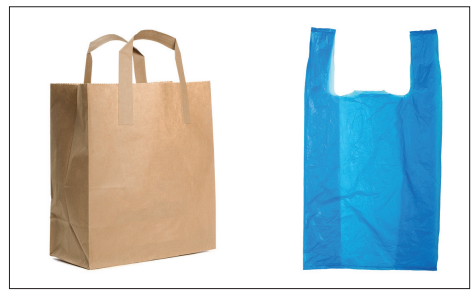
Paper and plastic are both used to make disposable shopping bags.

Photograph comparing a brown paper shopping bag with handles on the left and a blue plastic carrier bag on the right.

The table compares the percentages of disposable paper and plastic bags used by consumers in a Welsh town between 1988 and 2018.

Type of bag

Percentage of disposable bags used (%)

1988

1993

1998

2003

2008

2013

2018

paper

73

63

31

12

8

13

21

plastic

27

37

69

88

92

87

79

(i) In 2003, the consumers of the town used a total of 1.25 million disposable bags.

Use the information in the table to calculate the number of paper bags used.

Number of paper bags = ....................................................... million

[2]

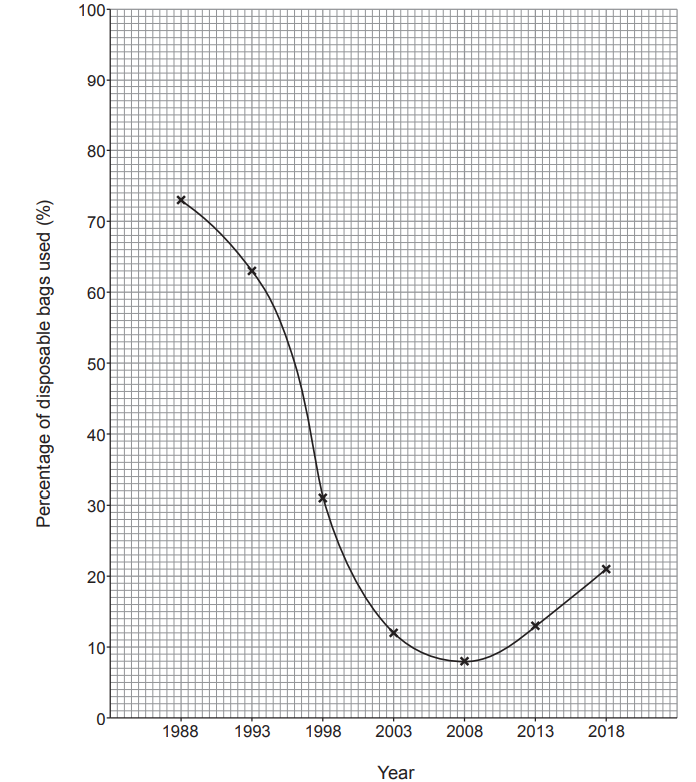
(ii) The graph below shows the percentage of paper bags used between 1988 and 2018.

Figure: Grid with x-axis "Year" showing 1988, 1993, 1998, 2003, 2008, 2013, 2018, and y-axis "Percentage of disposable bags used (%)" from 0 to 100 in steps of 10. A curve for paper bags is already plotted and drawn, passing through (1988, 73), (1993, 63), (1998, 31), (2003, 12), (2008, 8), (2013, 13), (2018, 21)

Plot on the same grid the percentage of plastic bags used between 1988 and 2018. Draw a suitable line.

[3]

(iii) Use the graph to answer the following questions.

I. Give the year when equal numbers of plastic bags and paper bags were used.

Year .......................................................

[1]

II. Circle the simplest ratio that compares the use of paper bags to plastic bags in 2000.

2 : 8 1 : 4 4 : 1 8 : 2 20 : 80

[1]

(iv) Give one reason that explains the change seen in plastic bag usage in Wales between 2008 and 2018.

......................................................................................................

4a
3 marks

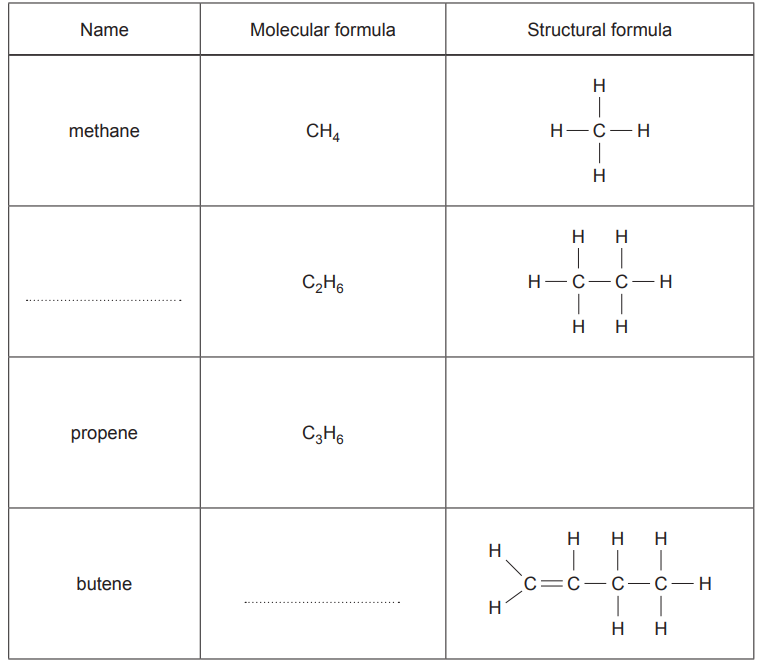
The table shows the names, molecular formulae and structural formulae of some alkanes and alkenes.

Revision worksheet table headed “Name”, “Molecular formula” and “Structural formula”; methane is complete, ethane shows C₂H₆ and its two-carbon structure, propene shows C₃H₆, and butene shows its four-carbon structure, with three cells blank.

Complete the table by filling in the missing name, molecular formula and structural formula.

4b
3 marks

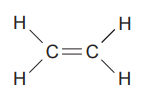
The structure of ethene, C2H4, is shown below.

Figure: Displayed structural formula of ethene — two carbon atoms joined by a C=C double bond, each carbon also single-bonded to two H atoms

(i) Underline the correct word in brackets to complete the sentence.

When orange bromine water is added to ethene, the solution becomes ( darker / milky / colourless ).

[1]

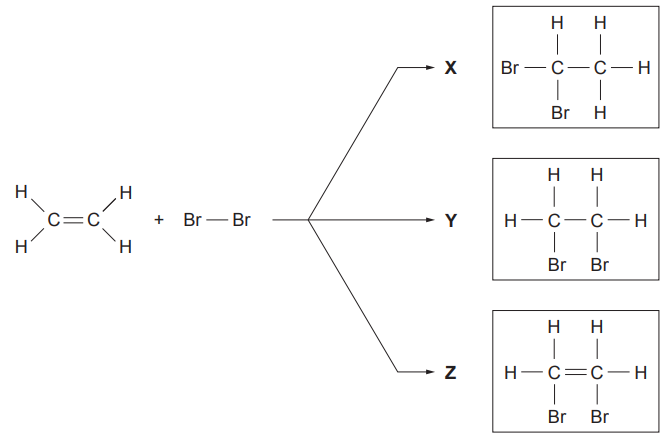
(ii) I. Give the letter, X, Y or Z, that shows the product formed when bromine reacts with ethene.

Figure: Reaction scheme showing ethene (displayed structural formula) + Br-Br reacting to form three possible product options, each a displayed structural formula: X shows a two-carbon chain with Br, H, H, H on one carbon and H, Br on the other (asymmetric substitution); Y shows a two-carbon chain with one Br and one H on each carbon (symmetric, one Br per carbon, all single bonds); Z shows a two-carbon chain retaining a C=C double bond with one Br substituted on each carbon

Letter .................................................

[1]

II. Give the reason why the product of the reaction between bromine and ethene is not a hydrocarbon.

.........................................................................................................

[1]

5
1 mark

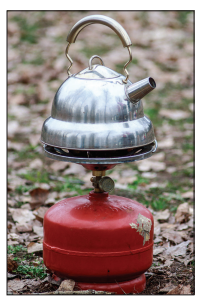
Propane gas is commonly used in camping stoves.

Figure: Photograph of a camping stove with a pan of water being heated on it

The photograph shows a camping stove being used to heat 750 g of water.

When heated for 10 minutes, 220 kJ of energy was transferred to the water.

Use the following equation to calculate the temperature rise of the water.

temperature rise (°C)=energy transferred (J)4.2×mass of water (g)

Temperature rise = ........................................................ °C

6a
4 marks

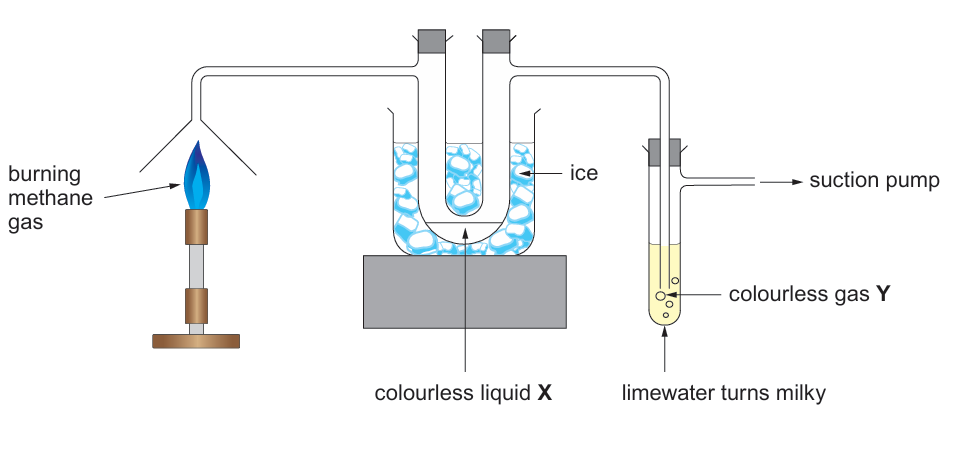
The diagram shows apparatus that can be used to investigate the products formed when methane gas burns. Methane has the formula CH4.

Apparatus diagram showing burning methane gas from a Bunsen burner, with the fumes drawn through a U-shaped tube standing in an ice bath (labelled "ice"), where a colourless liquid X collects at the bottom of the U-tube, then on through a test tube containing limewater (labelled "limewater turns milky"), producing a colourless gas Y as bubbles, connected to a suction pump that draws the gases through the apparatus

(i) Name the gas present in the air that is needed for methane to burn.

...................................................................................

[1]

(ii) Name the products formed.

Colourless liquid X ...................................................................................

Colourless gas Y ...................................................................................

[2]

(iii) Tick (✓) the box that gives the name of the group of substances that methane belongs to.

[1]

alkenes

□

monomers

□

polymers

□

alkanes

□

6b
2 marks

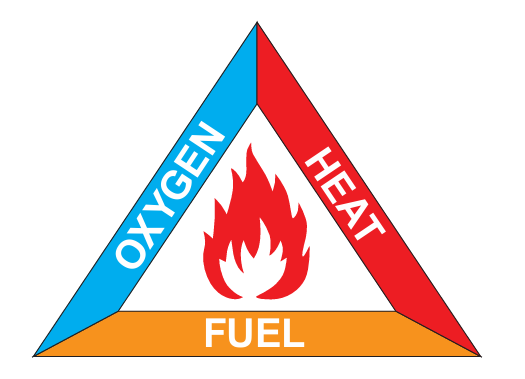
The fire triangle can be used to explain how fires are extinguished.

Fire triangle diagram — a triangle with its three sides labelled OXYGEN, HEAT and FUEL, showing that a fire needs all three to burn

The following table gives information about three different types of fire and the methods used to extinguish them.

Fire

Type of fire

Firefighting method

How method works

1

chip pan fire

tea towel

removes the heat

2

bonfire

fire blanket

removes the heat

3

electrical fire

fire breaks

removes the fuel

However, each of the three fires has an error in one of the columns.

Circle the errors for fires 1 and 2 and then correct them in the table below.

The error for fire 3 has already been circled and the correction given.

Fire

Correction

1

2

3

Fire breaks are used to extinguish a forest fire

7
6 marks

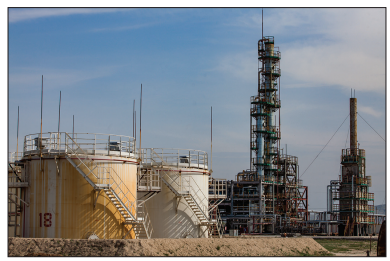
The photograph shows an oil refinery where fractional distillation of crude oil takes place.

Figure: Photograph of an industrial oil refinery at dusk, showing distillation towers, pipework and storage tanks illuminated by site lighting

Explain the process of fractional distillation of crude oil.

8a
5 marks

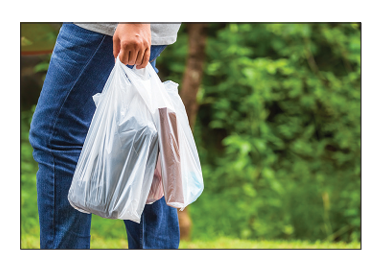
Supermarkets across the UK now charge customers a minimum of 5p for every plastic carrier bag supplied.

Photograph of a person's hand carrying two white plastic carrier bags outdoors, with green foliage in the background

The reason for the charge is to reduce the number of plastic carrier bags used by consumers and therefore reduce waste and litter.

Since the introduction of the charge for plastic carrier bags in Wales, the number of these bags used by consumers has fallen by over 70%.

Similarly, reports in England claim that supermarkets have issued 83% fewer bags since the charge was introduced.

It is estimated that every person in the UK currently uses around 25 plastic carrier bags per year, compared to around 140 before charges were introduced.

The majority of the money retailers generate from sales of carrier bags is donated to good causes. A survey of retailers across England and Wales reported that £87 million had been donated to good causes since the introduction of the 5p charge, amounting to 4p for every bag sold.

(i) Use the information in the passage to decide whether the following statements are true or false.

Put a tick (✓) in the correct column for each statement.

Statement

True

False

The number of plastic bags used in Wales and England has reduced since charging for them

□

□

Retailers donate all the money generated from the sale of plastic bags to good causes

□

□

Plastic bags are no longer used

□

□

The charge for plastic bags has totally stopped their use in Wales

□

□

The use of plastic bags leads to environmental problems

□

□

The charge for plastic bags is beneficial to good causes

□

□

(ii) How many fewer plastic bags will each person in the UK use over a 5-year period, based on the estimated number of bags used per person before and after the charge was introduced?

Number of bags = ................................................

[2]

8b
2 marks

More than half of all consumers still regularly buy plastic bags.

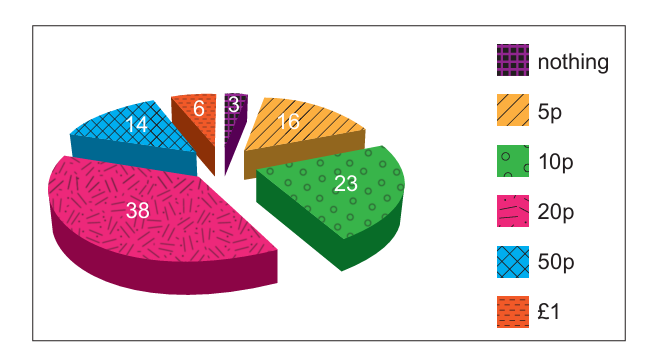
The pie chart shows the results of a survey where 100 consumers were asked what is the most they would pay for a plastic bag.

3D pie chart divided into six segments, each labelled with a number of consumers and a legend showing the amount: "nothing" = 3, "5p" = 16, "10p" = 23, "20p" = 38, "50p" = 14, "£1" = 6

Give the number of consumers that would be prepared to pay more than 5p for a plastic bag.

Number of consumers = ................................................

8c
1 mark

Give one property of plastics which leads to long-term environmental problems.

......................................................................................................................

9
6 marks

Discuss what is meant by isomerism in alkanes and alkenes using compounds with the molecular formulae C4H10 and C4H8 to illustrate your answer.

10a
2 marks

Polymer gels are commonly used in disposable nappies.

A company that manufactures disposable nappies was investigating the effect of temperature on the mass of water the polymer gel in their nappies is able to absorb.

The results collected using water at 40 °C are given below. The initial mass of the polymer gel bead was 0.035 g.

Time (hours)

Mass of bead (g)

Mass of water absorbed by bead (g) (to 1 decimal place)

0

0.035

0.0

2

4.048

4.0

4

6.030

6.0

6

7.280

7.2

8

7.891

7.9

10

8.181

8.1

12

8.181

8.1

(i) The percentage increase in the mass of the bead is calculated using the following equation.

percentage increase=mass of water absorbedinitial mass of bead×100

Calculate the percentage increase in the mass of the bead after 2 hours. Give your answer to the nearest whole number.

Percentage increase = ................................................ %

[1]

(ii) What property of polymer gels does the figure calculated in part (i) demonstrate?

......................................................................................................

[1]

10b
5 marks

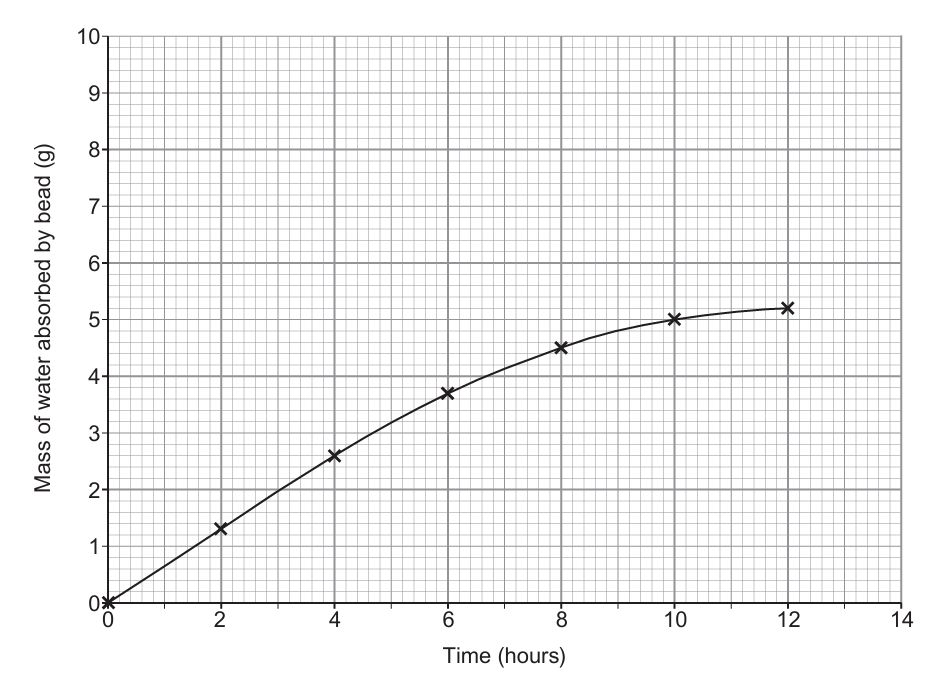
(i) On the grid below, plot the results using water at 40 °C and draw a suitable line.

Use the mass of water absorbed by the bead to 1 decimal place.

The results using water at 10 °C have already been plotted.

A grid with "Time (hours)" on the x-axis (0 to 14, in steps of 2) and "Mass of water absorbed by bead (g)" on the y-axis (0 to 10, in steps of 1). A curve for the 10 °C results is already plotted, rising gradually and levelling off at a lower final value than the 40 °C data would reach. The student must plot the 7 data points for the 40 °C results from the table in part (a) and draw a smooth curve through them.

[3]

(ii) Give two differences between the absorbing properties of the bead using water at 10 °C and at 40 °C.

Difference 1 ............................................................................................................

Difference 2 .........................................................................................................................

[2]

11a
2 marks

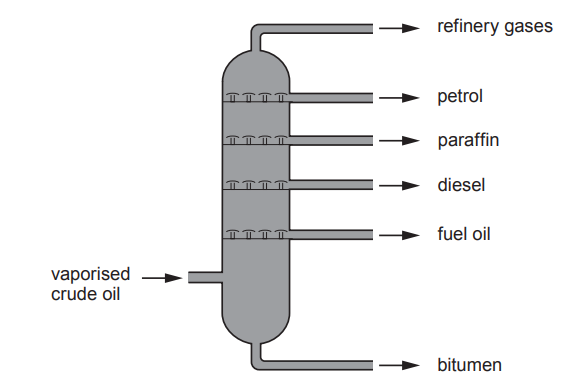
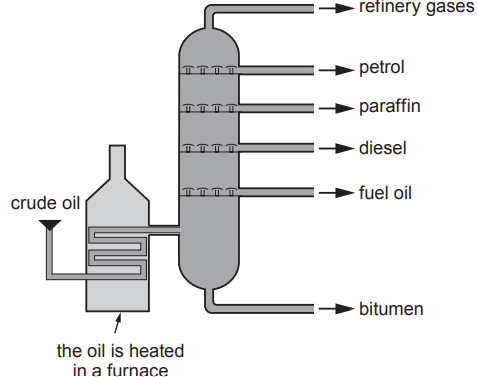
Crude oil is a mixture of hydrocarbon compounds. It is separated into different fractions inside a fractionating column. Each fraction has a different boiling point range.

Figure: Diagram of a fractionating column with vaporised crude oil entering near the bottom. Output pipes exit at different heights, from top to bottom: refinery gases, petrol, paraffin, diesel, fuel oil, and bitumen (bottom), with a temperature gradient shown as hottest at the bottom and coolest at the top.

Explain how the length of the hydrocarbon chains within each fraction determines where each fraction collects in the column.

11b
3 marks

Many of the hydrocarbons that are collected from crude oil go through a second process called cracking. The equation shows the cracking of the hydrocarbon with the formula C15H32.

C15H32 → C3H8 + 2C2H4 + 2............................

(i) Complete the equation for this reaction by adding the formula of one other product.

[1]

(ii) Give the reaction conditions used in the process.

[1]

(iii) Give one reason why it is important for oil companies to carry out cracking.

[1]

11c
3 marks

Many hydrocarbons display isomerism.

(i) Give the meaning of the term isomer.

[1]

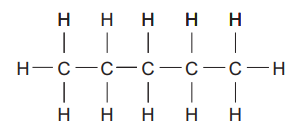
(ii) C5H12 has three isomers. The diagram shows one of these isomers.

Figure: Displayed structural formula of pentane — a straight chain of 5 carbon atoms, all single bonds, each carbon carrying the correct number of hydrogen atoms to give the formula C5H12.

Draw the two other isomers of C5H12.

Figure: Two blank boxes for the candidate to draw the remaining isomers of C5H12.

[2]

11d
3 marks

8.4 g of a hydrocarbon was found to contain 7.2 g of carbon. Use this information to determine whether the compound is an alkane or an alkene. You must show your working.

Ar(H) = 1 Ar(C) = 12

Conclusion ...............................................

12a
5 marks

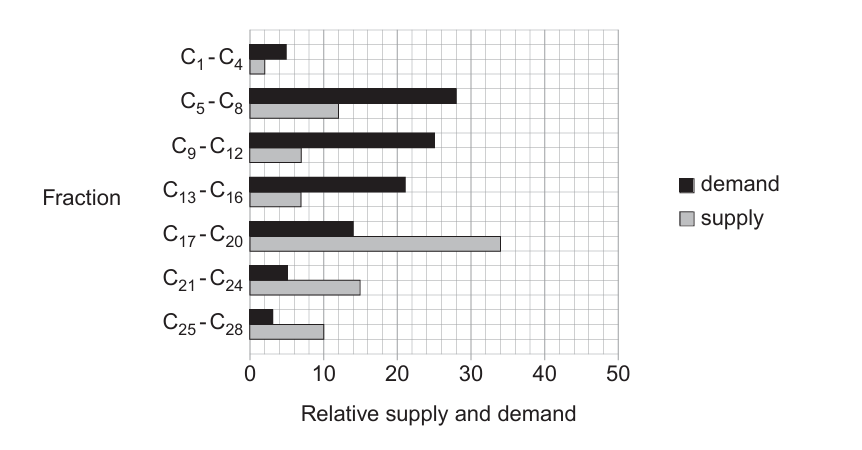
The bar chart shows the relative supply and demand for some fractions obtained from crude oil.

Horizontal bar chart. Y-axis lists fractions by carbon chain length: C1-C4, C5-C8, C9-C12, C13-C16, C17-C20, C21-C24, C25-C28. X-axis is "Relative supply and demand" from 0 to 50. Each fraction has two bars: a black "demand" bar and a grey "supply" bar. Demand bars: C1-C4 ≈5, C5-C8 ≈28, C9-C12 ≈25, C13-C16 ≈21, C17-C20 ≈14, C21-C24 ≈5, C25-C28 ≈3. Supply bars: C1-C4 ≈2, C5-C8 ≈12, C9-C12 ≈7, C13-C16 ≈7, C17-C20 ≈34, C21-C24 ≈15, C25-C28 ≈10.

(i) Use the chart to describe how the difference between supply and demand of the fractions changes as the chain length increases.

.............................................................................................................

............................................................................................................

[2]

(ii) The process of cracking is used to overcome the problem of insufficient supply of some fractions.

I. State what is meant by cracking and give the conditions needed for the process.

..............................................................................................................................

...............................................................................................................................

[2]

II. When hydrocarbon X is cracked, it forms hexene, ethene and butane.

Give the molecular formula of hydrocarbon X to complete the equation.

Incomplete cracking equation: a blank labelled hydrocarbon X leads to hexene, plus two ethene molecules, plus butane; formulas shown are C6H12, 2C2H4 and C4H10.

1]

12b
3 marks

C4H10 has two isomers.

(i) Give the meaning of the term isomers.

............................................................................................................

[1]

(ii) Draw the structures of both isomers of C4H10.

[2]

13a
1 mark

Saturated and Unsaturated Fats

Saturated and unsaturated fats are found in different amounts in different foods.

Unsaturated fats are often described as 'good fats'. When used to replace saturated fats in the diet they help lower cholesterol, one of the risk factors linked to heart disease.

While full-fat dairy products and meat contain large amounts of saturated fats, sources of unsaturated fats include nuts, seeds and vegetable oils.

Saturated and unsaturated fats differ in their chemical structures. Unsaturated fats contain double bonds between the carbon atoms within their molecular structure, whereas saturated fats have no double bonds.

The label on the bottle of a new brand of cooking oil claims that it is better than other cooking oils available on the market because it contains only 15% saturated fat. Scientists decided to investigate this claim.

They used bromine water to compare the percentage unsaturation of this new brand of cooking oil with four other vegetable oils, W, X, Y and Z. They also tested a known alkane and alkene.

They measured the volume of bromine water that could be added to each oil sample before the bromine water colour remained. Their results are shown below.

Sample

Mean volume of bromine water added (cm3)

Unsaturation (%)

Saturation (%)

oil W

20.4

50

50

oil X

12.0

30

70

oil Y

24.1

60

40

oil Z

16.3

40

60

new brand oil

30.1

?

?

alkane

0.1

-

-

alkene

40.0

-

-

Which one of these statements best describes the oils tested? Tick (✓) the correct answer.

the oils contain saturated fats only

□

the oils contain unsaturated fats only

□

the oils contain both saturated and unsaturated fats

□

it is not possible to tell whether the oils contain saturated or unsaturated fats

□

13b
2 marks

Explain why the first drops of bromine water that are added to each of the oil samples are decolourised.

13c
3 marks

The label states that the new oil contains only 15% saturated fat. Use the results to show whether this statement is correct.

13d
2 marks

Explain why these results might persuade many consumers to use this new brand of oil in preference to the other available brands.

14a
2 marks

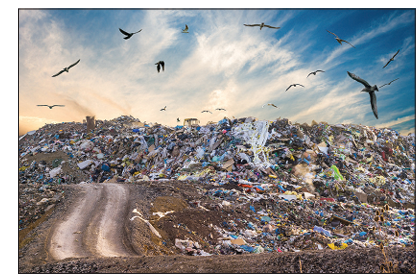
It is well known that plastic bags are a major source of litter. These bags can exist for a very long time, ranging from tens of years in the natural environment up to a thousand years in landfill.

The use of plastic bags is now banned in some countries. These countries commonly use bags made from paper or cotton, which do not cause the same litter problem as plastic bags.

Photograph of a large landfill site piled high with mixed rubbish, including extensive plastic waste. Birds fly above the waste and a muddy track runs through the foreground.

Paper or plastic?

Most people assume that a paper bag is better for the environment, however because paper bags are almost ten times heavier than plastic bags, they produce a greater mass of waste. On the other hand, because paper bags are biodegradable they do not lead to the same problem with litter as plastic bags.

When deciding whether paper is more suitable than plastic for making shopping bags, information from life cycle assessments (LCAs) of both materials must be taken into consideration.

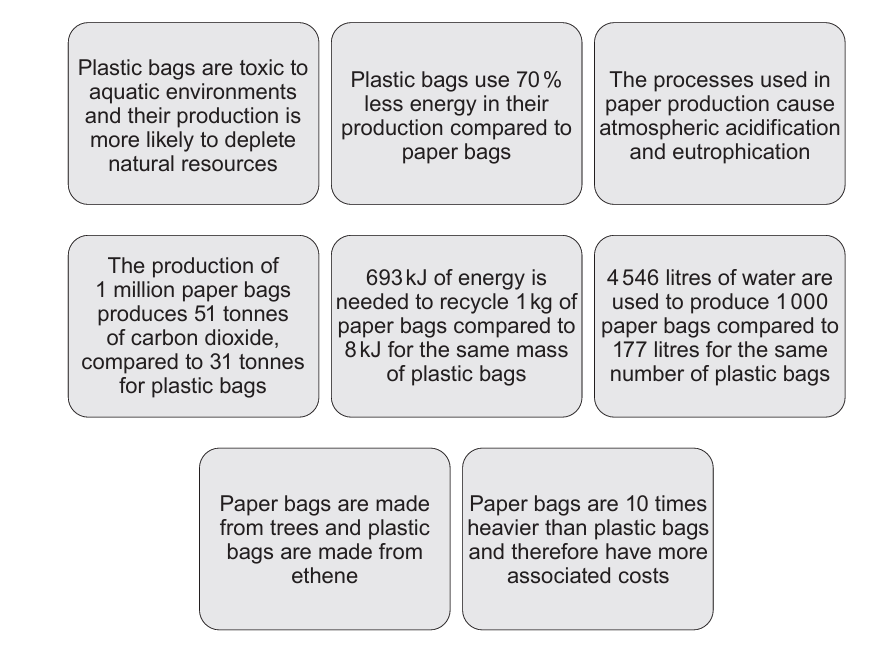
Some of the findings from LCAs of paper and plastic bags are shown below.

Eight rounded text boxes present life-cycle assessment findings comparing paper and plastic bags, arranged in three rows: three boxes, three boxes, then two centred boxes.

On reading these findings it is important to consider all factors relating to sustainability when deciding on the most suitable material to make shopping bags. We should not just be thinking about what happens when we throw them away!

Use the information in the passage to compare the mass of waste and volume of litter generated from the use of plastic and paper bags.

..................................................................................................................

14b
3 marks

Use the information from the LCAs to tick (✓) whether each of the factors supports or opposes the use of paper bags in preference to plastic bags.

Factor

Supports use of paper bags

Opposes use of paper bags

Impact of waste on marine life

□

□

Water consumption in production

□

□

Energy used in production

□

□

Carbon footprint generated in production

□

□

Energy used in recycling

□

□

Cost of transporting waste

□

□

14c
1 mark

The use of which type of bag is more likely to be linked to the erosion of limestone buildings?

Give a reason for your answer.

Type of bag ...................................................................................

Reason ..........................................................................................

15
2 marks

Butene, C4H8, also contains the elements carbon and hydrogen. Calculate the percentage by mass of hydrogen in butene.

Ar(H) = 1 Ar(C) = 12

Percentage = ........................................................ %

16a
3 marks

Crude oil is a fossil fuel and is described as a non-renewable resource.

(i) Describe how crude oil was formed.

[2]

(ii) Give the meaning of the term non-renewable.

[1]

16b
3 marks

To make crude oil more useful, it is separated into fractions.

Diagram of fractional distillation: crude oil is heated in a furnace and fed into a column. Fractions leave at different levels: refinery gases, petrol, paraffin, diesel, fuel oil and bitumen, from top to bottom.

(i) Complete the following sentences.

Crude oil is separated into different fractions by a process called fractional …....................……................................................................. .

The fractions can be separated because they have different …....................……................................................................. .

[2]

(ii) Circle the word which best describes crude oil.

mixture element compound

17a
1 mark

There are a number of factors that should be taken into consideration when deciding what makes the 'best fuel'.

Information was collected about various factors for three fuels, A, B and C.

Fuel A

  • Existing supplies will last around 50 years

  • Releases 2.8 kJ of energy per gram of fuel burned

  • Costs 0.03p per gram of fuel burned

  • Burns very easily and no storage issues

  • Releases carbon dioxide and water vapour when it burns

Fuel B

  • There are infinite supplies of this fuel

  • Releases 44.1 kJ of energy per gram of fuel burned

  • Costs 0.18p per gram of fuel burned

  • Burns very easily but can be difficult to store

  • Releases water vapour when it burns

Fuel C

  • Existing supplies will last around 250 years

  • Releases 1.2 kJ of energy per gram of fuel burned

  • Costs 0.04p per gram of fuel burned

  • Burns very easily and fairly easy to store

  • Releases carbon dioxide, sulfur dioxide and water vapour when it burns

This information was analysed by a group of students to decide what they considered to be the 'best fuel'.

Give the reason why the information about how easily each fuel burns was not useful to the students when reaching their decision.

17b
1 mark

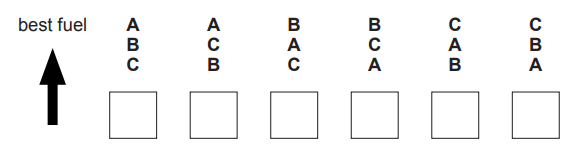
One of the students based his decision purely on a judgement of the available supply of each fuel. Choose the order that shows his conclusion. Place a tick (✓) in the appropriate box.

A “best fuel” upward arrow precedes six order options, each above an empty box: A, B, C; A, C, B; B, A, C; B, C, A; C, A, B; and C, B, A.
17c
2 marks

The cost efficiency of fuel A can be calculated as follows:

cost efficiency =2.80.03 = 93.3 kJ/p

Use the information given for fuel B and this example to calculate the cost efficiency of fuel B.

Cost efficiency = …....................…… kJ/p