Atomic Structure & The Periodic Table (WJEC GCSE Science (Double Award): Chemistry): Exam Questions

Exam code: 3430

3 hours34 questions
1
3 marks

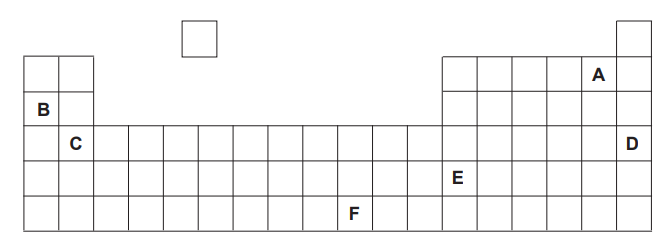
The diagram shows part of the Periodic Table. The letters A–F are not the chemical symbols of the elements.

Figure: Outline of part of the Periodic Table drawn as a grid of blank element boxes across five rows (periods), with a gap between the left-hand and right-hand blocks representing the transition metals region. Six specific element positions are marked with individual letters: A in the upper-right area (row 1), B in the far-left column (row 2), C in the second column from the left (row 3), D in the far-right column (row 3, same row as C), E right-of-centre (row 4), and F left-of-centre (row 5)

Use letters A–F to answer parts (i)–(iii).

(i) Give the letter of an element in Period 3.

.......................................................

[1]

(ii) Give the letter of an element in Group 2.

.......................................................

[1]

(iii) Give the letter of an element which is a non-metal.

.......................................................

[1]

2
5 marks

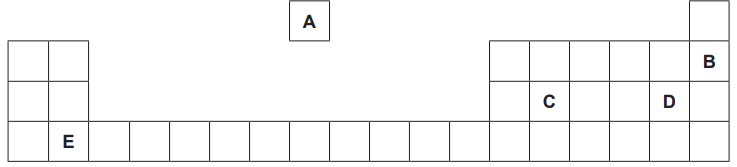
Elements A, B, C, D and E are shown in the Periodic Table.

Figure: Periodic table diagram highlighting five unlabelled positions, marked A, B, C, D and E at different points across the periods and groups (not using the elements' real chemical symbols)

These letters are not the chemical symbols for the elements.

Give the letter of the element which fits each description below.

Description

Letter

is in Group 2

..................................

makes a 'pop' noise with a lit splint

..................................

has both metal and non-metal properties

..................................

reacts with lithium to make lithium chloride

..................................

is unreactive

..................................

3a
1 mark

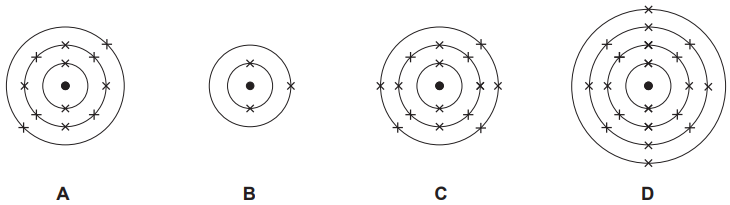
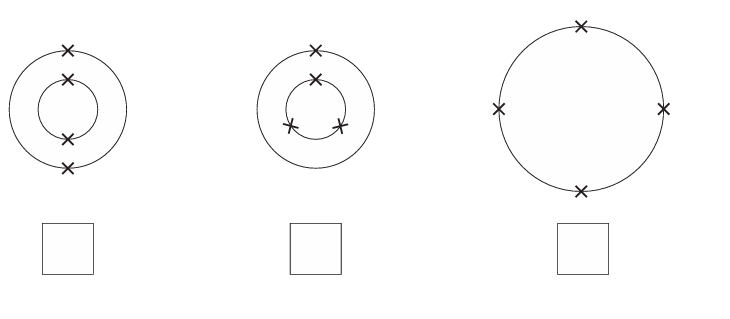
The diagrams below show the electronic structures of four elements, A, B, C and D.
The letters are not the chemical symbols of the elements.

Figure: Four separate electronic structure (Bohr) diagrams labelled A, B, C, D, each with a central nucleus dot. A has three concentric electron shells with a full outer shell. B has a single electron shell containing two electrons. C has three concentric shells with a partially-filled outer shell (fewer electrons than A's outer shell). D has four concentric shells with a partially-filled outermost shell

Give the letters of two elements which are in the same period in the Periodic Table.

................................................. and .................................................

3b
2 marks

Give the atomic number and the name of element D.

Atomic number .................................................

Name ......................................................................

3c
1 mark

Draw the electronic structure of the element directly above element C in the Periodic Table.

4
3 marks

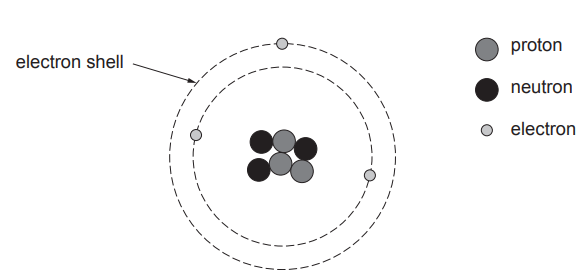
The diagram represents a lithium atom. Its nucleus contains protons and neutrons.

Figure: Diagram of a lithium atom showing a central nucleus containing protons and neutrons, surrounded by electron shells with electrons arranged in them.

(i) Complete the table of information about particles in the atom.

Name of particle

Charge

Mass

proton

..................................

1

neutron

0

..................................

electron

-1

almost zero

[2]

(ii) Use the information in the diagram to give the mass number of this lithium atom.

[1]

5a
4 marks

For over two centuries, scientists have created different models of the atom.
Our understanding of the atom has developed hugely over that time.

In the early 1800s, scientists already knew that:

  • atoms are invisible

  • atoms of one element are all the same

  • atoms of different elements are different

  • atoms combine to form compounds

The table shows some of the ideas that led to what we now know.

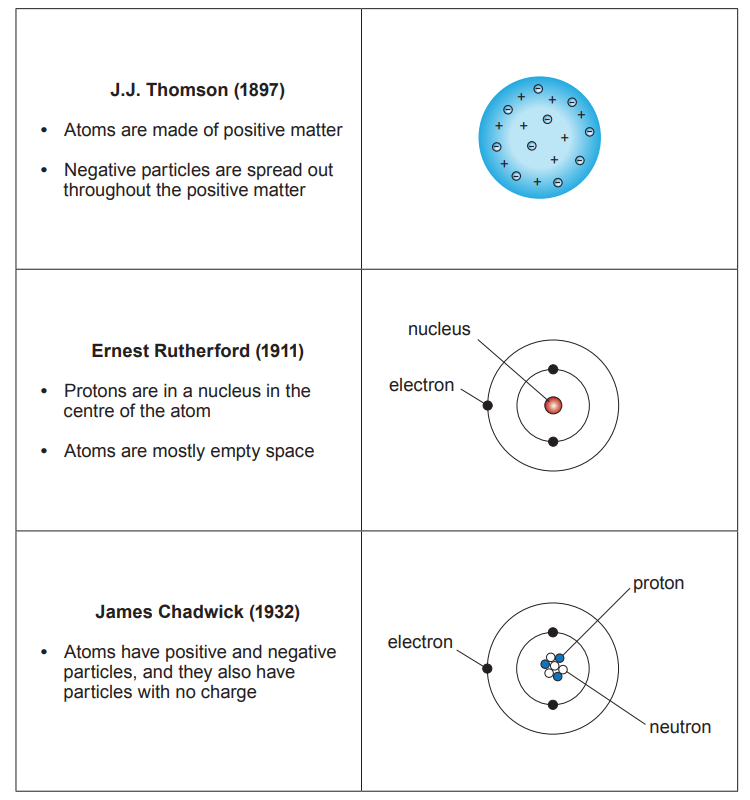
Figure: Table summarising three historical atomic models, each paired with its own diagram. J.J. Thomson (1897): atoms are made of positive matter with negative particles spread throughout — paired with a diagram of a shaded circle containing scattered + and − symbols (the "plum pudding" model). Ernest Rutherford (1911): protons are in a nucleus in the centre of the atom, atoms are mostly empty space — paired with a diagram of a small central nucleus surrounded by two electron shells, with "nucleus" and "electron" labelled. James Chadwick (1932): atoms have positive and negative particles, and also particles with no charge — paired with a diagram of a central nucleus containing labelled protons and neutrons, surrounded by two electron shells with "electron" labelled

(i) Tick (✓) the statement which describes a difference between J.J. Thomson's model and Rutherford's model.

neither model has any neutrons

□

Thomson had electron shells in his model

□

Thomson did not think atoms are mostly empty space

□

[1]

(ii) Tick (✓) the statement that does not describe Chadwick's model of the atom.

electrons are in shells outside the nucleus

□

atoms have equal numbers of protons and electrons

□

atoms have equal numbers of protons and neutrons

□

[1]

(iii) Tick (✓) the three statements which correctly describe how our knowledge about atoms today is different to J.J. Thomson's model.

electrons are outside the nucleus

□

electrons are inside the nucleus

□

there are more protons than electrons in an atom

□

protons are in a nucleus in the centre of an atom

□

atoms have particles with no charge

□

[2]

5b
2 marks

An atom of aluminium can be shown as Al1327.

State the number of protons and neutrons in this atom.

Number of protons ........................................................

Number of neutrons ........................................................

6
3 marks

The table shows some tests carried out to identify the ions contained in salts A, B and C, and the observations made.

Salt

Flame test

Silver nitrate test

Name of salt

A

lilac flame

yellow precipitate

............................

B

............................

no change

calcium nitrate

C

............................

...........................

barium bromide

Complete the table by giving the name of salt A and the observations expected for salts B and C.

7
1 mark

The class wanted to identify the gas produced. They tested it as shown in the table.

Test

Observation

bubble the gas through limewater

limewater did not change

place a burning splint in the gas

a squeaky pop and the splint went out

State the name of the gas.

............................................................................................................

8
4 marks

Chlorine, bromine and iodine are Group 7 elements.

(i) Describe and explain the trend in reactivity within the group.

[2]

(ii) X, Y and Z are known to be chlorine, bromine and iodine but not necessarily in that order.

A student identifies X, Y and Z by mixing them with solutions of halide salts.

The table shows the observations made.

Element

Sodium bromide

Sodium iodide

Sodium chloride

X

solution turns orange

solution turns brown

no change

Y

no change

no change

no change

Z

no change

solution turns brown

no change

Use the observations to identify elements X, Y and Z.

Explain your reasoning.

[2]

9a
3 marks

The table shows information about some Group 1 elements. The melting point of rubidium is missing.

Element

Melting point (°C)

Boiling point (°C)

Density (g / cm3)

lithium

181

1 330

0.53

sodium

98

883

0.99

potassium

64

759

0.86

rubidium

?

688

1.53

caesium

29

671

1.93

(i) State which of the elements lithium, sodium or potassium, is a liquid over the greatest temperature range.

.........................................................................................

[1]

(ii) Estimate a value for the melting point of rubidium.

.........................................................................................

[1]

(iii) Group 1 elements are stored in paraffin oil to prevent reactions with oxygen.

The density of paraffin oil is 0.80 g / cm3.

State which of the Group 1 elements would float on paraffin oil.

.........................................................................................

[1]

9b
2 marks

When a small piece of sodium is added to water, it fizzes, melts and moves around on the surface of the water.

Give another observation that you would expect to make when potassium is added to water. State the reason for the difference.

Observation .......................................................................................................................

Reason ........................................................................................................................

10
6 marks

A teacher wanted to demonstrate the reactivity of lithium, sodium and potassium with water.

State what safety precautions the teacher should take and describe the observations you would expect for each metal.

You are not expected to include equations in your answer.

11
2 marks

When silver nitrate solution is mixed with sodium chloride solution a white precipitate of silver chloride is produced.

(i) Tick (✓) the box next to the correct ionic equation for this reaction.

Ag+(aq) + Cl-(aq) → AgCl(aq)

□

Ag+(s) + Cl-(s) → AgCl(s)

□

Ag+(aq) + Cl-(aq) → AgCl(s)

□

Ag+(s) + Cl-(s) → AgCl(aq)

□

[1]

(ii) State the colour of the precipitate that forms when silver nitrate solution is mixed with sodium iodide solution.

.........................................................................................

[1]

12a
4 marks

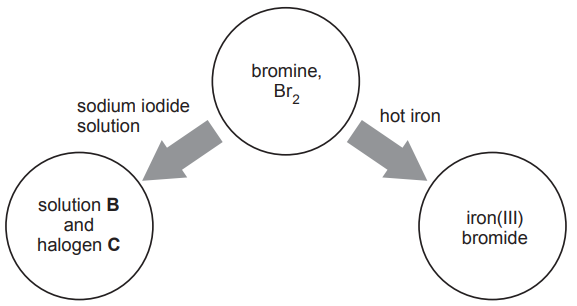
The diagram shows reactions of bromine, Br2.

Figure: Reaction scheme with "bromine, Br2" at the centre, an arrow labelled "sodium iodide solution" pointing to a box labelled "solution B and halogen C", and another arrow labelled "hot iron" pointing to a box labelled "iron(III) bromide"

(i) Give the names of solution B and halogen C.

solution B ..............................................................................................................

halogen C ..............................................................................................................

[2]

(ii) Explain why bromine reacts with sodium iodide solution.

[2]

12b
2 marks

Write the symbol equation for the reaction between bromine, Br2, and iron to form iron(III) bromide.

12c
3 marks

Silver nitrate solution was added to a solution of sodium iodide. Silver iodide was formed.

(i) State what you would expect to see.

....................................................................................................................

[1]

(ii) Give the ionic equation for the formation of silver iodide.

[2]

13a
2 marks

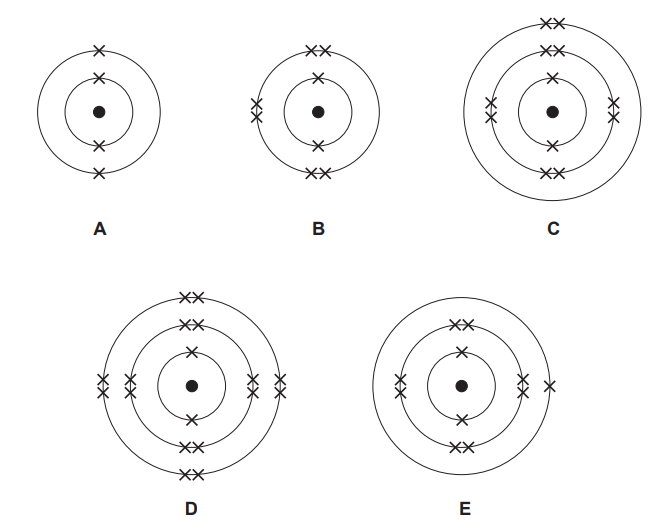
The diagrams below show the electronic structures of five elements, A, B, C, D and E.

The letters are not the symbols of the elements.

Figure: Five electronic structure (Bohr) diagrams, labelled A to E, each showing a central nucleus dot surrounded by concentric electron shells with electrons marked as crosses. A: two shells. B: two shells. C: three shells. D: three shells, with the outermost shell full (8 electrons). E: three shells, with the outermost shell partially filled

Give the letters of the elements found in Period 2 of the Periodic Table. Give a reason for your choice.

Letters ............................ and ............................

Reason ...............................................................................................................................

13b
2 marks

Give the letter of the element found in Group 0 of the Periodic Table. Give a reason for your choice.

Letter ............................

Reason .................................................................................................................................

13c
2 marks

Explain how the electronic structure of element E can be used to determine its atomic number.

14
3 marks

(i) The sulfate ions in sulfuric acid are identified using barium chloride solution. The equation for the reaction is shown below.

H2SO4(aq) + BaCl2(aq) → BaSO4(s) + 2HCl(aq)

Tick (✓) the correct ionic equation for the formation of the precipitate.

H+ + Cl- → HCl

□

Ba2+ + SO42- → BaSO4

□

Ba2+ + S2- + 4O2- → BaSO4

□

2H+ + 2Cl- → 2HCl

□

Ba2- + SO42+ → BaSO4

□

[1]

(ii) A student was asked to identify the ions present in barium chloride solution.

I. Other than adding sulfate ions, state how the student would test for barium ions. Give the expected observation for a positive test.

[1]

II. State how the student would test for chloride ions. Give the expected observation for a positive test.

[1]

15
4 marks

(i) Chlorine is a non-metal found in Group 7 of the Periodic Table. When it is bubbled into a solution of potassium iodide there is a colour change from pale green to brown. Explain why this reaction occurs.

...................................................................................................................................................................

...................................................................................................................................................................

[2]

(ii) Write the balanced symbol equation for the reaction between chlorine and potassium iodide.

[2]

16a
2 marks

A student investigated changes that happened when pairs of colourless solutions were mixed. The table shows the observations made after mixing.

Pair of solutions

Appearance of the reactants

Appearance when mixed

Temperature change when mixed

A

two colourless solutions

no change

increase

B

two colourless solutions

bubbles form

increase

C

two colourless solutions

white precipitate forms

no change

D

two colourless solutions

no change

no change

Which pair of solutions do not react? Give a reason for your answer.

16b
2 marks

(i) Which pair of solutions is silver nitrate and sodium chloride?

.........................................................................

[1]

(ii) What colour would sodium chloride give in a flame test?

.........................................................................

[1]

17a
4 marks

The table gives the composition of six particles, A-F, which are either atoms or ions.

Particle

Number of protons

Number of neutrons

Number of electrons

A

14

14

14

B

19

20

18

C

15

16

18

D

16

16

16

E

11

12

11

F

12

12

10

(i) Which particles are atoms? Explain your choice.

[2]

(ii) Which particles are positive ions? Give the charges on the particles you have chosen.

[2]

17b
2 marks

Carbon has two isotopes – carbon-12 and carbon-14.

Using these examples, explain what is meant by the term isotope.

18
6 marks

Explain the trends in reactivity of the elements in Groups 1 and 7 of the Periodic Table.

19
5 marks

The most common understanding of the term 'heavy metal' is a metallic element which is toxic and has a high density, atomic number and relative atomic mass. The definitions used vary depending on the context. In metallurgy, for example, a heavy metal is defined on the basis of density, whereas in physics the distinguishing factor is atomic number. A chemist would likely be more concerned with chemical behaviour. More specific definitions have been published but none of these have been widely accepted.

Despite this lack of agreement, the term is widely used in science. Heavy metals are sometimes defined as metals with a density greater than 5 g/cm3. They are often highly toxic or damaging to the environment. Chromium, arsenic, cadmium, mercury and lead have the greatest potential to cause harm on account of their extensive use.

Heavy metals are dangerous because they tend to bio-accumulate. Bio-accumulation occurs when the toxic chemical is taken into the body faster than it can be excreted. Lead can have an adverse impact on mental development in infants and children. Lead may also be a factor in behavioural problems. Heavy metal poisoning could result, for instance, from drinking-water contamination.

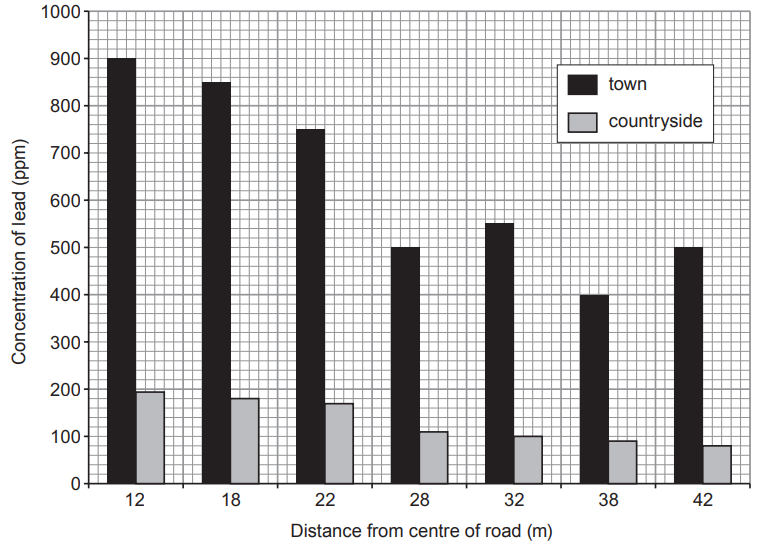
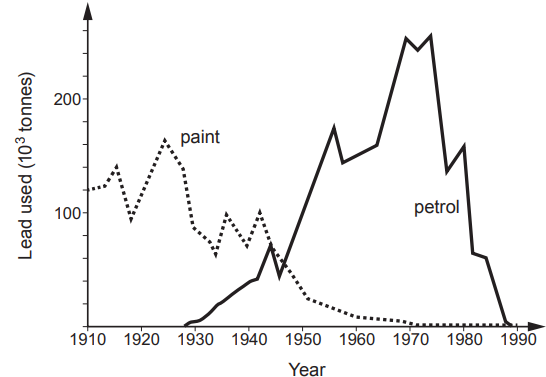
Lead is the most prevalent heavy metal contaminant. As a component of tetraethyl lead, (CH3CH2)4Pb, it was used extensively in 'leaded petrol' from the 1930s-1970s. Although the use of leaded petrol has been phased out, soils next to roads can have high lead concentrations – see Figure 1. Lead-based paints were another early source of lead pollution but their use is now banned in the UK. Figure 2 opposite shows how the amount of lead used in paint and petrol in the USA changed over the 20th century.

Figure 1

Bar chart of lead concentration against distance from a road centre: town values are 900, 850, 750, 500, 550, 400 and 500 ppm; countryside values are 200, 180, 170, 110, 100, 90 and 80 ppm at 12–42 metres.

Figure 2

Line graph of lead used in US paint and petrol from 1910–1990, measured in thousands of tonnes. Dotted paint falls to about zero by 1975; solid petrol peaks at about 250 in the early 1970s and reaches zero by 1990.

(i) Put a tick (✓) in the box next to the statement which best describes why a single definition of a 'heavy metal' is not accepted by all scientists.

metallurgists, physicists and chemists do not trust each other

□

metallurgists, physicists and chemists are not concerned with the fact that heavy metals are toxic

□

metallurgists, physicists and chemists are concerned with different properties of heavy metals

□

metallurgists, physicists and chemists study different heavy metals

□

[1]

(ii) Since the 1970s the use of lead water pipes has been prohibited across Europe. Explain why this is the case.

[1]

(iii) Put a tick (✓) in the box next to the two statements which describe the conclusions that can be drawn from the data in Figure 1.

lead contamination in road-side soil decreases in towns and in the countryside as the distance from the centre of the road increases

□

the decrease in lead contamination between 12 m and 42 m from the centre of the road is greater in towns than in the countryside

□

lead contamination in road-side soil at all distances is much greater in towns than in the countryside

□

lead contamination in road-side soil decreases between 12 m and 42 m from the centre of the road in the countryside

□

there is approximately 50% more lead contamination in road-side soil in towns compared to the countryside between 12 m and 28 m from the centre of the road

□

there is an overall decrease of nearly 70% in the lead contamination of road-side soil in towns between 12 m and 42 m from the centre of the road

□

[2]

(iv) In the mid-1970s the use of lead in paints and the manufacture of cars that used leaded petrol was banned. Put a tick (✓) in the box next to the statement which best describes what happened after the ban.

paint and petrol were lead-free by the mid-1970s anyway

□

paint and petrol were not lead-free until 1980

□

the use of lead-based paint and leaded petrol increased until 1980 before decreasing

□

it took 15 years for paint and petrol to become lead-free

□

[1]

20
2 marks

When magnesium ribbon is added to excess hydrochloric acid, HCl, magnesium chloride and hydrogen gas are produced.

magnesium + hydrochloric acid → magnesium chloride + hydrogen

Suggest two things that you would expect to see during this reaction.

  1. ...............................................................................................................

  2. ...............................................................................................................

21a
1 mark

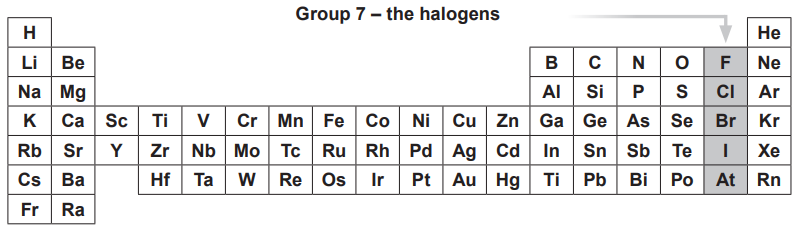
The following information is about the Group 7 elements of the Periodic Table, called the halogens.

Periodic table diagram titled “Group 7 – the halogens”, with fluorine, chlorine, bromine, iodine and astatine shaded in the same vertical column; an arrow points to fluorine at the top.

The Group 7 elements all exist as diatomic molecules, meaning their atoms go around in pairs. Fluorine is found at the top of the group, astatine is at the bottom of the group.

Chlorine, atomic number 17, is a pale green gas at room temperature (20°C). It has a melting point of -101°C. Bromine, atomic number 35, is a red-brown liquid at room temperature. It has a melting point of -7°C. Iodine, atomic number 53, is a grey solid at room temperature. It has a melting point of 114°C.

Chlorine is used to make bleaches, to treat public drinking water and to sterilise public swimming pools. Bromine is used by gardeners in pesticides, to prevent insects from harming plants. Iodine solution is used as an antiseptic on wounds and on patients before being operated on.

Which one of these statements best describes the trend in the melting points of the Group 7 elements as you go down the group? Tick (✓) the correct answer.

The melting point increases

□

The melting point decreases

□

The melting point increases and then decreases

□

There is no trend in the melting point

□

21b
2 marks

Predict a value for the boiling point of chlorine and explain your answer.

Boiling point of chlorine .................................... °C

Explanation ...................................................................................................................................................................

21c
1 mark

Give the property that the Group 7 elements have that means they can be used as described in the text.

21d
2 marks

Decide whether the following statements about astatine are true or false.

Astatine ...

True/False

... is a solid at room temperature

... conducts electricity

... has a melting point higher than 114°C

... is coloured

22
6 marks

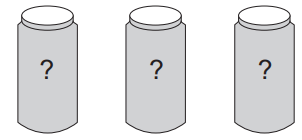
You have been given three jars containing the compounds potassium bromide, barium chloride and calcium iodide.

Figure: Three unlabelled jars, each containing a white powder/compound, marked with a question mark since their labels have been removed.

Unfortunately the labels have been removed from the jars and, because they are all white compounds, they cannot be identified by their appearance.

Describe two tests that you should carry out on all three of the compounds, so that each compound can be identified.

State how you would carry out both tests and give the expected observations for each compound.

23a
7 marks

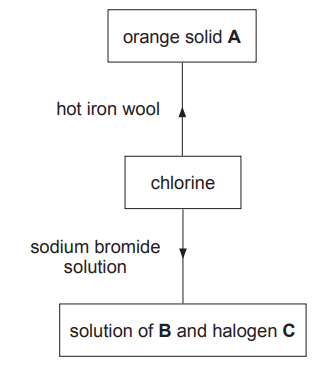
The diagram shows some reactions of chlorine.

Figure: Reaction diagram showing chlorine gas reacting in two directions. When chlorine is passed over hot iron wool, an orange solid A is formed. When chlorine is bubbled into sodium bromide solution, a solution containing substance B and halogen C is formed.

(i) Give the chemical formulae for substances A, B and C.

A ..........................................................

B ..........................................................

C ..........................................................

[3]

(ii) State, giving a reason, the main safety precaution that must be taken when carrying out these reactions.

[1]

(iii) State and explain how the observations for the reaction with sodium bromide would be different if the chlorine were replaced with iodine.

[3]

23b
5 marks

Silver nitrate solution is used to detect the presence of halide ions in solution.

(i) The equation below represents the reaction between silver nitrate solution and potassium bromide solution.

AgNO3 + KBr → AgBr + KNO3

Write the ionic equation for the reaction. Include state symbols.

[2]

(ii) Write the balanced symbol equation for the reaction between calcium iodide solution and silver nitrate solution.

[3]

24
6 marks

Describe how the reactions of lithium, sodium and potassium with water can be used to show the trend in reactivity in Group 1. Explain this trend in terms of the electronic structures of the elements.

25a
4 marks

A beryllium atom can be represented by the following symbol.

Be49

Choose a number from the box to complete each of the following sentences.

4

5

9

13

Each number can be used once, more than once or not at all.

Beryllium has ............................ protons.

The atomic number of beryllium is ............................ .

The mass number of beryllium is ............................ .

Beryllium has ............................ neutrons.

25b
1 mark

Beryllium has 4 electrons.

Put a tick (✓) in the box that shows the correct electronic structure for beryllium.

Four small Bohr-diagram options, each showing a nucleus with electron shells: option 1 shows a single shell with 4 electrons; option 2 shows an inner shell of 2 and an outer shell of 2 electrons; option 3 shows an inner shell of 2 and an outer shell of 4 electrons; option 4 shows three separate shells with 1, 1 and 2 electrons respectively. Each option has a tick box beside it
26
1 mark

The atmosphere today contains nitrogen, oxygen and water vapour.

Use the following information to identify another gas present.

  • a Group 0 gas

  • the third most abundant in the atmosphere

  • used in light bulbs and as an inert atmosphere for welding

27a
2 marks

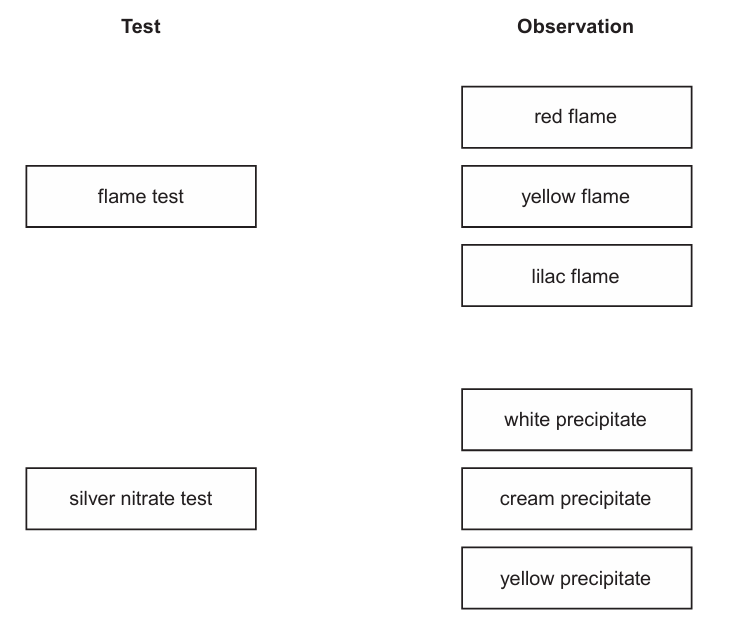
A technician carried out a flame test and a silver nitrate test on a solution of sodium iodide.

Draw one line from each test to the correct observation.

A matching exercise — two test boxes on the left ("flame test", "silver nitrate test") to be linked by drawn lines to six observation boxes on the right ("red flame", "yellow flame", "lilac flame", "white precipitate", "cream precipitate", "yellow precipitate"
27b
3 marks

(i) When silver nitrate and sodium iodide react, sodium nitrate and a precipitate of silver iodide are formed.

Write the formulae of sodium nitrate and silver iodide to complete the equation.

AgNO3 + NaI → ...................................... + ......................................

[2]

(ii) Suggest a method you could use to remove the precipitate from the reaction mixture.

[1]

28a
3 marks

(i) State why sodium is stored in oil in the laboratory.

[1]

(ii) Describe the change in appearance when a piece of freshly cut sodium is left for a few minutes.

[1]

(iii) Give the formula of the compound formed when sodium reacts with oxygen.

[1]

28b
3 marks

The table shows some properties of Group 7 elements.

Element

Melting point (°C)

Boiling point (°C)

Reaction with hot iron

fluorine

−220

−188

explosive

chlorine

−101

−34

very fast

bromine

−7

59

quite fast

iodine

114

......................

slow

(i) Put a tick (✓) in the box next to the most likely boiling point for iodine.

−25 °C

□

25 °C

□

100 °C

□

150 °C

□

[1]

(ii) Astatine lies below iodine in Group 7. State how you would expect astatine to react with hot iron.

Give a reason for your answer.

[2]

29a
2 marks

The table shows the electronic structures of atoms of the elements A–F.

A–F are not the chemical symbols for the elements.

Element

Electronic structure

A

2

B

2,6

C

2,8,1

D

2,8,7

E

2,8

F

2,8,6

Which of elements A–F is found in Group 6 and Period 3 of the Periodic Table?

Explain your choice, referring to electronic structure.

29b
2 marks

Which two of elements A–F are chemically inert?

Explain your choice, referring to electronic structure.

29c
2 marks

Element D has two isotopes. Isotope 1 has 18 neutrons and isotope 2 has 20 neutrons.

Complete the table by giving the atomic number and mass number of both isotopes.

Isotope

Atomic number

Mass number

1

......................

......................

2

......................

......................

30a
2 marks

The table shows some properties of elements in Period 3 of the Periodic Table.

Element

Melting point (°C)

Boiling point (°C)

Density (g / cm3)

Appearance

Malleability

Conductivity

Na

98

882

1.00

shiny solid

malleable

good

Mg

650

1091

1.75

shiny solid

malleable

good

Al

660

2470

2.70

shiny solid

malleable

good

Si

1410

3265

2.35

shiny solid

brittle

semiconductor

P

44

281

1.80

red solid

brittle

poor

S

113

444

2.05

yellow solid

brittle

poor

Cl

−101

−34

0.003

green gas

n/a

poor

One of the elements is difficult to classify as a metal or non-metal.

Identify this element and give your reasoning.

30b
2 marks

Tick (✓) two boxes which correctly describe the change in density and boiling point for the elements across Period 3.

The density of metals and non-metals increases

□

The boiling point of metals increases but the boiling point of non-metals shows no trend

□

The density of metals shows no trend but the density of non-metals decreases

□

The boiling point of metals and non-metals shows no trend

□

The density of metals increases but the density of non-metals shows no trend

□

The boiling point of metals shows no trend but the boiling point of non-metals decreases

□

The density of metals decreases but the density of non-metals shows no trend

□

30c
1 mark

Argon is the next element in Period 3 after chlorine, Cl.

State why it is not possible to predict a melting point for argon using the information in the table.

30d
3 marks

Phosphorus is found in phosphoric acid, H3PO4.

(i) During the production of phosphoric acid, phosphorus is heated to 60 °C.

Give the state of phosphorus at 60 °C. Explain your choice.

[2]

(ii) Phosphoric acid reacts with zinc to produce zinc phosphate and hydrogen.

Balance the equation for this reaction.

[ ]H3PO4 + [ ]Zn → Zn3(PO4)2 + [ ]H2

[1]

31
4 marks

The tables show the electronic structures of some Group 1 and Group 2 elements.

Group 1 metal

Electronic structure

Group 2 metal

Electronic structure

sodium

2,8,1

magnesium

2,8,2

potassium

2,8,8,1

calcium

2,8,8,2

(i) Use the information to explain the trend in reactivity down Group 1.

[2]

(ii) Use the information to explain the difference in reactivity of Group 1 and Group 2 elements.

[2]

32a
1 mark

Planet J is similar in size to the Earth. However, the temperature on planet J is about 470 °C and the clouds in its atmosphere are made of sulfuric acid.

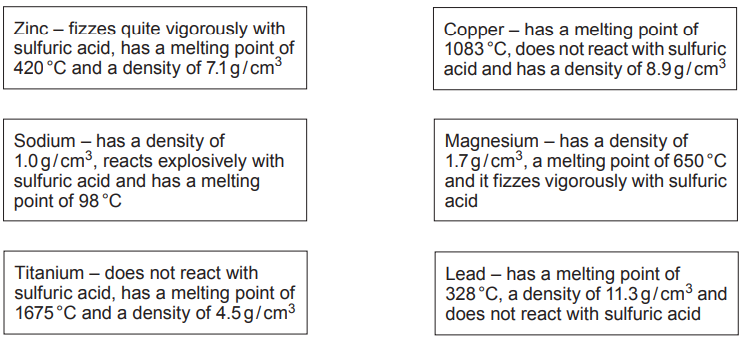
A group of students investigated the properties of some metals. Their aim was to see if they could find a metal suitable for designing a spacecraft to explore planet J. Their findings are shown below.

Figure: Six information cards, one per metal. Zinc: fizzes quite vigorously with sulfuric acid, melting point 420 °C, density 7.1 g/cm³. Copper: melting point 1083 °C, does not react with sulfuric acid, density 8.9 g/cm³. Sodium: density 1.0 g/cm³, reacts explosively with sulfuric acid, melting point 98 °C. Titanium: does not react with sulfuric acid, melting point 1675 °C, density 4.5 g/cm³. Magnesium: density 1.7 g/cm³, melting point 650 °C, fizzes vigorously with sulfuric acid. Lead: melting point 328 °C, density 11.3 g/cm³, does not react with sulfuric acid.

The spacecraft needs to withstand the conditions on the surface of planet J. The mass of the spacecraft also needs to be as low as possible in order for it to have enough energy to escape the Earth's gravity.

Which one of these statements best describes why magnesium is an unsuitable metal for the spacecraft? Put a tick (✓) in the box next to the correct answer.

its density is 1.7 g/cm³

□

its melting point is 650 °C

□

it fizzes vigorously with sulfuric acid

□

it is malleable

□

32b
1 mark

Small amounts of lead are sometimes used in electrical circuits.

Which one of these statements best describes why lead would not be suitable for use in the electrical circuits of the spacecraft? Put a tick (✓) in the box next to the correct answer.

it does not react with sulfuric acid

□

it is ductile

□

it would melt when it lands on planet J

□

its density is 11.3 g/cm³

□

32c
2 marks

The students decided that titanium is the most suitable metal from which to build the spacecraft.

Put a tick (✓) in the boxes next to the two statements that best describe the reasons for their choice.

it does not react with sulfuric acid

□

it is expensive

□

it is a good conductor of heat

□

it is non-magnetic

□

it has a melting point much higher than the temperature on planet J

□

it is shiny so will reflect the sun's rays

□

33a
3 marks

The table gives information about some elements.

Element

Electronic structure

Group

Period

oxygen

2,6

6

2

chlorine

................................

7

3

................................................

2,8,5

5

3

potassium

2,8,8,1

1

.....................

Complete the table.

33b
5 marks

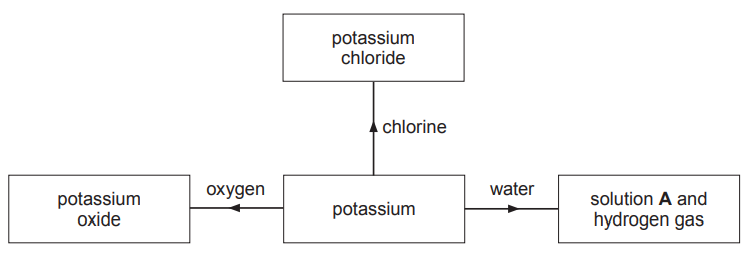
The flow chart shows some of the reactions of potassium.

Figure: Flow chart with "potassium" at the top. An arrow labelled "oxygen" leads to "potassium oxide". Another arrow labelled "water" leads to "potassium solution A and hydrogen gas". A third arrow labelled "chlorine" leads to "potassium chloride".

(i) State one observation you would make when potassium reacts with water.

...................................................................................................................................................................

[1]

(ii) Apart from wearing gloves and safety goggles, give one safety precaution that should be taken when adding potassium to water.

...................................................................................................................................................................

[1]

(iii) Give the formula of solution A.

..........................................................................................................

[1]

(iv) Suggest a value for the pH of solution A.

..........................................................................................................

[1]

(v) Name a Group 1 metal that is more reactive than potassium.

..........................................................................................................

[1]

34
3 marks

Some Year 10 students were given three unknown white solids – A, B and C.

They carried out a series of flame tests and silver nitrate tests to identify the solids.

Their results are shown in the table.

Solid

Observations

Flame test

Silver nitrate test

A

apple-green flame

cream precipitate

B

red flame

white precipitate

C

yellow flame

yellow precipitate

Name solids A, B and C.

A ..........................................................................................................

B ..........................................................................................................

C ..........................................................................................................