Water (WJEC GCSE Science (Double Award): Chemistry): Exam Questions

Exam code: 3430

2 hours19 questions
1a
2 marks

Some areas of the UK have hard water.

The box contains some advantages of hard water and some advantages of soft water.

uses less soap reduces risk of heart disease does not fur up kettles

strengthens teeth and bones does not cause limescale

From the box, state two advantages of hard water.

  1. .....................................................................................................................................................................

  2. .....................................................................................................................................................................

1b
1 mark

Circle the method that can be used to soften temporary hard water.

freezing

dissolving

boiling

filtering

1c
1 mark

The table shows the concentrations of some common ions in water samples from three areas, X, Y and Z.

Area

Concentration of sodium ions (mg / dm3)

Concentration of calcium ions (mg / dm3)

Concentration of potassium ions (mg / dm3)

X

41

81

0.5

Y

35

68

1.2

Z

13

102

0.8

Give the letter of the area with the hardest water.

......................................................................................................

2a
6 marks

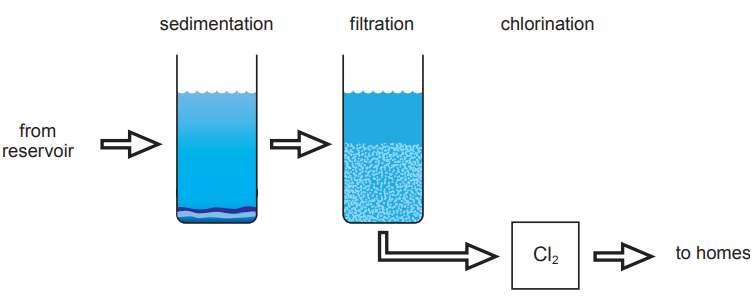
The diagram shows the stages of a typical water treatment process.

Figure: Diagram showing the stages of a typical water treatment process, from a reservoir through sedimentation, filtration and chlorination (using Cl2 gas) to homes

Describe the sedimentation, filtration and chlorination stages of this process and the purpose of each stage in making the water clean and safe to drink.

2b
2 marks

Fluoride is added to drinking water in some areas.

(i) Give the reason why fluoride is added.

[1]

(ii) Give one reason why some people think fluoride should not be added.

[1]

3
6 marks

Hard water can be softened by boiling or by passing through an ion exchange column.

Describe how each method softens hard water and compare the advantages and disadvantages of each method.

4a
1 mark

The table shows how the solubility of potassium nitrate in water varies with temperature.

Temperature (°C)

Solubility (g per 100 g of water)

0

13

10

21

20

32

30

46

40

64

50

86

Tick (✓) the box that shows approximately how many times more soluble potassium nitrate is at 40 °C than it is at 10 °C.

2 times

□

3 times

□

4 times

□

5 times

□

4b
5 marks

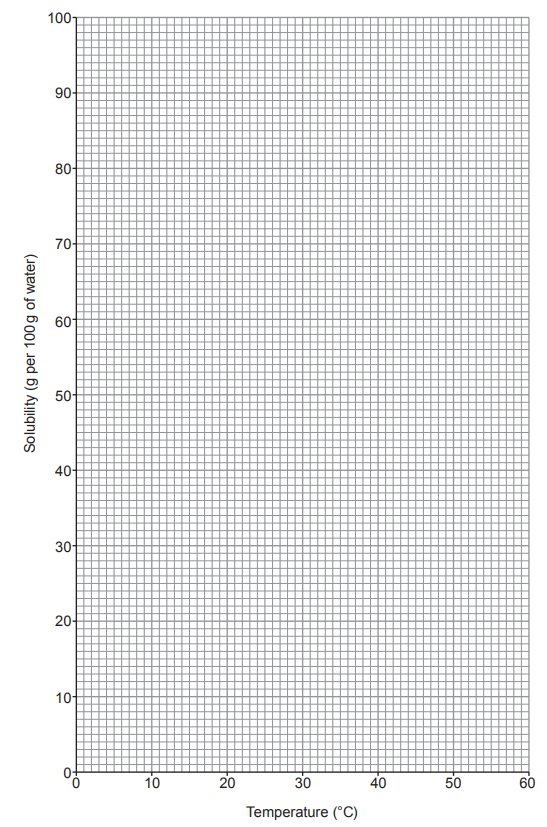
(i) Plot the solubility of potassium nitrate against temperature on the grid.

Draw a suitable line.

Figure: Blank grid with x-axis "Temperature (°C)" from 0 to 60 in steps of 10, and y-axis "Solubility (g per 100 g of water)" from 0 to 100 in steps of 10, for the candidate to plot the six data points from the table and draw a smooth curve through them.

[3]

(ii) I. State the solubility of potassium nitrate at 45 °C.

....................................................... g per 100 g of water

[1]

II. Calculate the mass of solid potassium nitrate that forms when a saturated solution in 100 g of water at 45 °C cools to 25 °C.

Mass = ....................................................... g

[1]

5
2 marks

The solubility of barium bromide at different temperatures is shown in the table.

Temperature (°C)

Solubility (g / 100 cm3 of water)

0

91

20

98

40

106

60

116

80

128

100

132

Calculate the mass of barium bromide that would crystallise when 500 cm3 of a saturated solution is cooled from 80 °C to 40 °C.

Mass = ....................................................................... g

6a
2 marks

Fluoride ions (mostly from sodium fluoride) are found naturally in the drinking water in some regions of England. The concentration of these fluoride ions is quite low with values being less than 0.5 mg / dm3.

However, water companies in some areas add fluoride ions to drinking water. Areas where this happens include Yorkshire, the North East, the East Midlands and the West Midlands. The mean concentration of fluoride ions added is around 1 mg / dm3.

It is known that a high concentration of fluoride ions in drinking water can be poisonous and can cause a yellowing of teeth – fluorosis. Fluoridation of drinking water is a controversial issue. Some people are opposed to it because it removes the individual's choice to not take fluoride.

The table shows the mean number of decayed, missing and filled teeth (DMFT) in five-year-old children in some areas of England in 2018.

Area

Mean DMFT

South East

0.6

West Midlands

0.7

North West

1.3

London

1.0

South West

0.7

Yorkshire

1.0

North East

1.0

East Midlands

0.9

East England

0.7

Which two of the following statements are correct according to the information given?

Tick (✓) two boxes.

London, Yorkshire and the North West all have a mean DMFT of 1.0

□

The South East has the lowest mean DMFT

□

The East Midlands has the highest mean DMFT

□

East England, the South West and the South East have a mean DMFT of 0.7

□

The East Midlands has a lower mean DMFT than Yorkshire

□

London, the North West and the South West all have a mean DMFT of 0.9

□

6b
2 marks

(i) Which of the following statements supports the argument for fluoridation of drinking water? Tick (✓) one box.

All areas with fluoridated drinking water have lower mean DMFT than areas which do not fluoridate drinking water

□

All areas with fluoridated drinking water have the same mean DMFT as non-fluoridated areas

□

All areas with fluoridated drinking water have lower mean DMFT than the North West

□

[1]

(ii) Which of the following statements could be used to oppose the argument for fluoridation of drinking water? Tick (✓) one box.

It is not possible to decide whether fluoridation of drinking water lowers mean DMFT

□

All areas with fluoridated drinking water have higher mean DMFT than areas which do not fluoridate drinking water

□

All areas with fluoridated drinking water have a higher mean DMFT than the South West

□

[1]

6c
1 mark

Suggest a possible reason why the South East has a low mean DMFT in five-year-old children even though no fluoride is added to drinking water in this area.

....................................................................................................................................

7a
2 marks

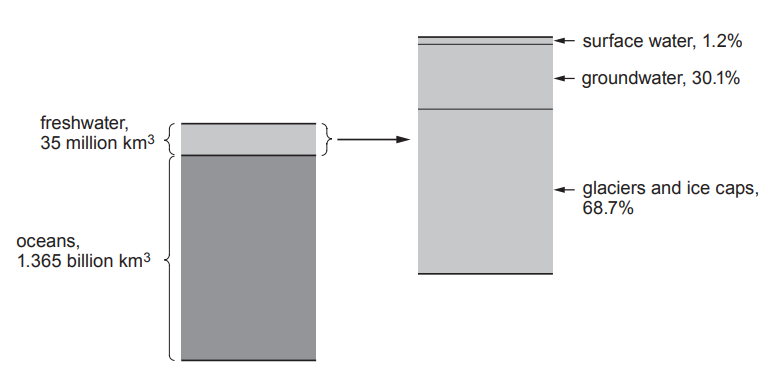
The diagram shows the distribution of water on Earth.

Figure: Bar chart showing the distribution of water on Earth. The left bar shows total water split into "oceans, 1.365 billion km3" (larger, lower portion) and "freshwater, 35 million km3" (smaller, upper portion). An arrow leads from the freshwater portion to a second, expanded bar breaking freshwater down further into: "surface water, 1.2%" (top, thin band), "groundwater, 30.1%" (middle band), and "glaciers and ice caps, 68.7%" (bottom, largest band)

Use the information in the diagram to calculate the volume of freshwater that is available as surface water.

Volume = ............................................. million km3

7b
1 mark

As the Earth's population continues to increase, there is going to be a greater need to get freshwater from seawater. This is known as desalination.

Give a method that could be used to obtain freshwater from seawater.

..........................................................................................................................

7c
3 marks

Calcium ions, Ca2+, cause hardness in groundwater.

Describe an experiment to compare the hardness of two groundwater samples.

7d
1 mark

Washing soda is used to soften hard water. This contains sodium carbonate.

Give the formula of sodium carbonate.

..................................................................................

8a
4 marks

Fluoride ions are added to drinking water in some areas of the UK.

The table below shows the effect of different levels of fluoride in drinking water on the number of decayed, missing and filled teeth (DMFT) and the percentage of people suffering from fluorosis.

Concentration of fluoride (mg / dm3)

Mean DMFT

Percentage of people affected by fluorosis (%)

0.3

7.0

4

0.6

4.5

6

0.9

3.0

15

1.2

2.5

35

1.5

2.3

40

1.8

2.0

45

2.1

2.1

60

2.4

2.1

68

2.7

2.1

75

The recommended concentration of fluoride ions to be added to drinking water in the UK is 1.0 mg / dm3.

Use the information in the table to explain why this is the recommended level in terms of DMFT and fluorosis.

DMFT

..................................................................................................................................................................

..................................................................................................................................................................

Fluorosis

..................................................................................................................................................................

8b
2 marks

Chlorine is added to all drinking water in the UK, whilst fluoride is only added in some areas.

Explain why some people are opposed to adding fluoride but no-one is opposed to adding chlorine to drinking water.

9a
1 mark

Drinking water contains a number of ions which are important in the human body. Some of these ions cause hardness in water.

The table shows the concentration of ions in drinking water from four different locations.

Location

potassium K+

ammonium NH4+

calcium Ca2+

fluoride F-

sulfate SO42-

nitrate NO3-

A

0.1

0.4

0.0

0.0

0.4

0.2

B

0.0

0.3

0.4

4.4

0.2

0.0

C

0.2

0.6

2.7

0.4

0.0

0.1

D

3.4

2.1

1.0

2.1

2.5

2.3

(all concentrations in mg / dm3 of water)

Which location is likely to have the hardest water?

Put a tick (✓) in the box next to the correct answer.

A

□

B

□

C

□

D

□

9b
1 mark

In which location do people have the least protection against tooth decay from their drinking water?

Put a tick (✓) in the box next to the correct answer.

A

□

B

□

C

□

D

□

10
6 marks

Describe the advantages and disadvantages of hard water.

11
6 marks

Calcium ions (Ca2+) and magnesium ions (Mg2+) both cause hardness in water. Both can be present in temporary hard water and permanent hard water. It is the other ions present which cause hardness to be temporary or permanent.

State the difference between the composition of temporary hard water and permanent hard water. Describe a method to distinguish between them in the laboratory. Explain how this method works.

12
6 marks

Several areas of the UK add fluoride to drinking water.

State the benefit of fluoridation and discuss the reasons why some people are opposed to it.

13a
2 marks

A student investigates the solubility of ammonium chloride by adding different masses to 10 g of water.

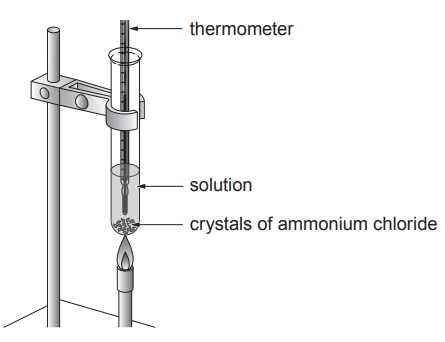
He uses the apparatus shown.

Figure: Diagram of a boiling tube clamped upright, containing a solution with crystals of ammonium chloride visible at the bottom, with a thermometer inserted into the solution to measure its temperature.

10 g of water is placed in a boiling tube and 3.0 g of ammonium chloride is added.

The tube is heated until all the solid dissolves.

The tube is allowed to cool.

The temperature at which solid ammonium chloride first appears is recorded.

The experiment is repeated using different masses of ammonium chloride.

The results are shown in the table.

Mass of ammonium chloride in 10 g of water (g)

3.0

3.3

4.1

5.2

5.9

6.6

Temperature at which solid ammonium chloride first appears (°C)

4

10

30

52

68

80

What practical problem is the student likely to come across in finding the first two results? Suggest how this problem might be overcome.

...................................................................................................................................................................

...................................................................................................................................................................

13b
4 marks

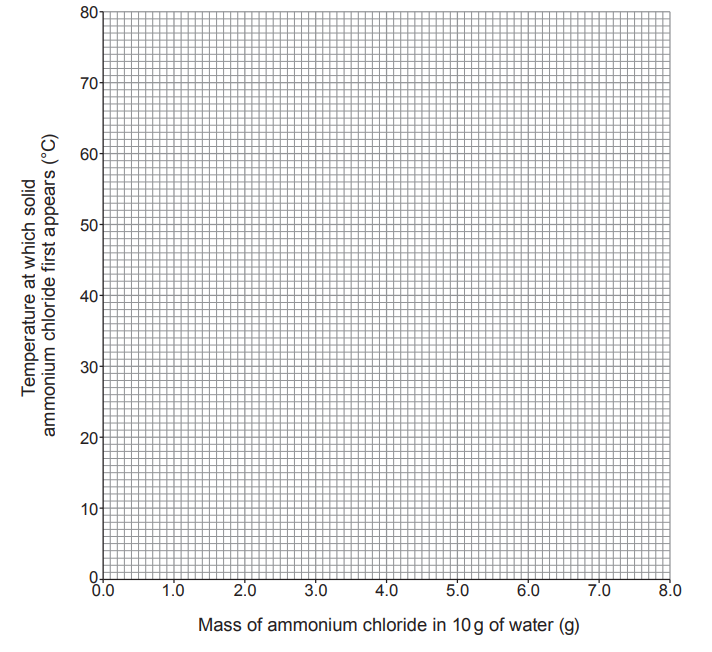
(i) On the grid below, plot the temperature at which solid ammonium chloride first appears against the mass of ammonium chloride in 10 g of water. Draw a suitable line.

Figure: Blank grid with x-axis "Mass of ammonium chloride in 10 g of water (g)" from 0.0 to 8.0, and y-axis "Temperature at which solid ammonium chloride first appears (°C)" from 0 to 80, for the student to plot the 6 data points from the table in part (a) and draw a suitable curve/line of best fit through them.

[3]

(ii) The student is given a boiling tube containing 5.0 g of ammonium chloride in 10 g of water. He stirs the ammonium chloride in the water and heats it to a temperature of 45°C.

State whether all the ammonium chloride dissolves. Give a reason for your answer.

...................................................................................................................................................................

[1]

13c
3 marks

The student is asked to use a different method to find the exact solubility of another compound in water at room temperature. He knows that it has a value of approximately 7 g per 100 g of water at this temperature.

He is given a 5.0 g sample of the compound and common laboratory equipment but no heating apparatus.

Describe how he would carry out his method and how he would find the solubility.

...................................................................................................................................................................

...................................................................................................................................................................

...................................................................................................................................................................

...................................................................................................................................................................

14
3 marks

A bottle contains a mixture of liquids E and F. Liquid E has a boiling point of 57°C and liquid F has a boiling point of 95°C.

Describe the process of distillation and explain why it can be used to separate these liquids.

...................................................................................................................................................................

...................................................................................................................................................................

...................................................................................................................................................................

15
6 marks

Explain how the processes of boiling and adding washing soda remove hardness from water. Include equations in your answer.

16a
2 marks

Peter, Claire and David compared the hardness of three samples of water, A, B and C. They added soap solution to each sample until it gave a lather on shaking. They carried out a fair test.

Give two ways they made it a fair test.

16b
4 marks

Their results are shown in the table.

Water sample

Volume of soap solution needed to give a lather (cm3)

Peter

Claire

David

Mean

A

18

19

17

.........................

B

8

10

9

9

C

1

1

1

1

(i) Calculate the mean volume of soap solution needed for sample A to give a lather.

Show your working.

Mean = ..................................................... cm3

[2]

(ii) Which of the three water samples is the hardest? Give a reason for your answer.

[2]

16c
2 marks

The box shows some advantages and some disadvantages of hard water.

strengthens bones and teeth forms limescale when heated

wastes soap reduces heart disease

forms a scum with soap tastes better

Choose all the disadvantages of hard water from the box.

16d
1 mark

Choose from the box an ion that causes hardness in water.

K+ Na+ Ca2+ Cu2+

Ion .....................................................

17a
6 marks

(i) A group of students were given three water samples. One was soft water, one was temporary hard water and one was permanent hard water.

Describe a method that the students could use to find out which is which. Give the expected results. You do not need to include the detail required to ensure a fair test.

[4]

(ii) The samples from part (i) were labelled X, Y and Z and sent to have their ion content measured. The table shows the results.

Ions present

Ion content in water sample (mg/dm3)

X

Y

Z

sodium

29

116

23

potassium

12

15

11

magnesium

31

4

98

calcium

141

2

27

hydrogencarbonate

30

19

219

chloride

17

14

20

sulfate

346

6

27

nitrate

12

15

19

Use this information to find whether sample Z is the soft water, the temporary hard water or the permanent hard water. Give a reason for your choice.

[2]

17b
3 marks

(i) Permanent hard water can be softened by ion exchange. Explain how ion exchange works.

[2]

(ii) Explain why the resin in ion exchange stops working after continued use.

[1]

18a
4 marks

Most of the tap water in Wales comes from mountain reservoirs. The water from these reservoirs is never pure.

(i) Information about some of the stages used in the treatment of tap water is shown.

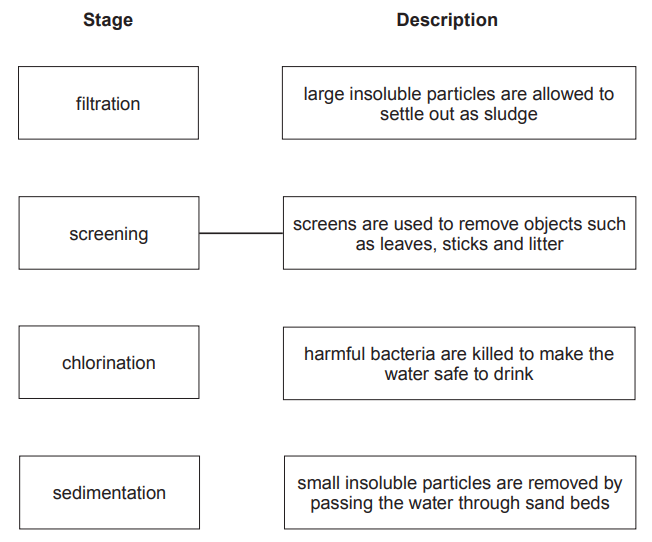
Draw a line to connect each stage to the correct description. One has already been completed.

Matching exercise with four stage and description boxes; only screening is connected to “screens are used to remove objects such as leaves, sticks and litter”, while the other three remain unconnected.

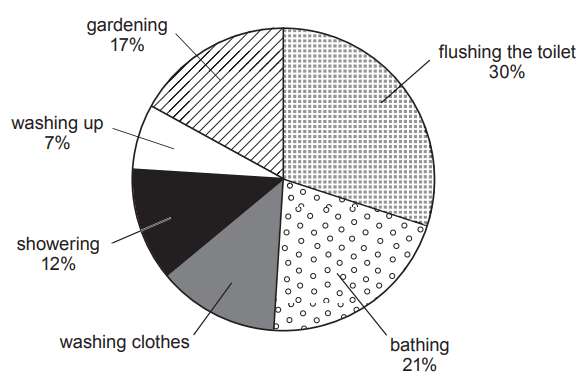
(ii) The pie chart shows some of the main uses of water in a typical Welsh home.

Figure: Pie chart showing main uses of water in a typical Welsh home: flushing the toilet 30%, bathing 21%, gardening 17%, showering 12%, washing up 7%, and washing clothes (unlabelled segment, to be calculated).

Use the pie chart to answer parts I and II.

I. Calculate the percentage of water used for washing clothes.

............................................................... %

[1]

II. Give the name of the use that accounts for three times as much water as another use.

...............................................................

[1]

18b
6 marks

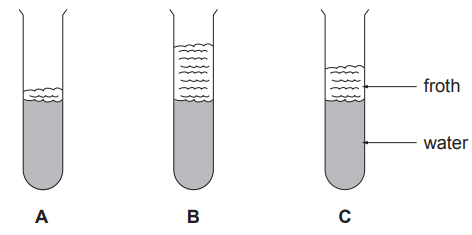
5 cm3 of three water samples, labelled A, B and C, were mixed with 10 drops of soap solution and shaken. One of the samples was distilled water. The boiling point of each water sample was also measured. The results obtained are shown.

Figure: Three test tubes labelled A, B and C, each showing a different height of froth/lather formed above the water after shaking with soap solution — A shows the least froth, B shows the most froth, C shows an intermediate amount.

Water sample

Boiling point (°C)

A

102

B

100

C

101

(i) Place the water samples, A, B and C, in order of hardness.

hardest ....................................

....................................

softest ....................................

[1]

(ii) Give the letter of the sample that is distilled water. Give two reasons for your choice.

Sample ....................................

Reasons

  1. ............................................................................................

  2. .............................................................................................

[2]

(iii) The volume of each water sample and soap solution was kept the same for each test. State which other variable must also be controlled before measuring the froth height. Describe how you would control this.

[2]

(iv) Hardness in water can be caused by dissolved calcium fluoride. Give the chemical formula for calcium fluoride.

.........................................................................

[1]

19a
1 mark

The following information is about hardness in water.

Hardness in water is caused by the presence of dissolved calcium (Ca2+) and magnesium (Mg2+) ions. These ions come from compounds that are dissolved by the water as it passes through rocks. Because they are dissolved, these ions are not removed during the water treatment processes.

Hardness in water can be identified using soap solution. The relative hardness in different water samples can be determined by measuring the volume of soap solution required to produce a given lather.

Temporary hardness in water can be removed simply by boiling. Permanent hardness can be removed by passing the sample through an ion exchange column.

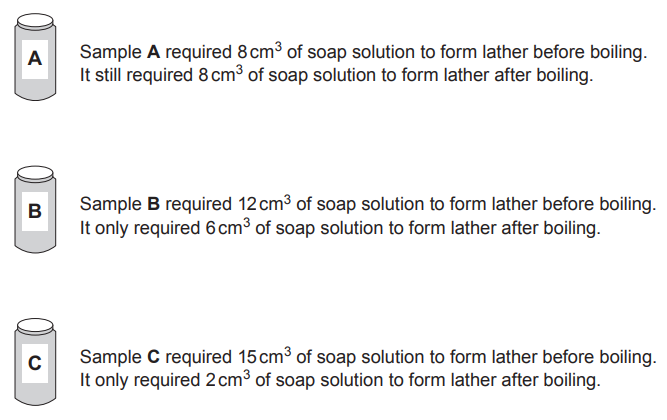
Three samples of water, A, B and C, were tested for hardness using soap solution. Distilled water was also tested.

Illustration of three water sample containers labelled A, B and C. Text states soap solution volumes before and after boiling: A 8 and 8 cm³, B 12 and 6 cm³, and C 15 and 2 cm³.

Distilled water required 2cm3 of soap solution to form lather both before and after boiling.

Which one of these statements best describes the water samples before boiling?

Tick (✓) the correct answer.

samples A, B and C contain magnesium or calcium ions

□

only samples A and B contain magnesium or calcium ions

□

only samples B and C contain magnesium or calcium ions

□

none of the samples contain magnesium or calcium ions

□

19b
1 mark

What is the purpose of testing the distilled water? Tick (✓) the correct answer.

to show the expected result for permanent hard water

□

to show the expected result for temporary hard water

□

to act as a control for the experiment

□

to make sure the investigation is a fair test

□

19c
1 mark

In carrying out the tests on the samples, which variables need to be kept the same each time? Tick (✓) the correct answer.

volume of soap solution and number of times shaken

□

volume of water sample and volume of soap solution used

□

volume of water sample and number of times shaken

□

volume of water sample, volume of soap solution and number of times shaken

□

19d
3 marks

Which one of these statements best describes water sample B? Tick (✓) the correct answer and explain your choice.

sample B contains temporary hardness only

□

sample B contains permanent hardness only

□

sample B contains a mixture of temporary and permanent hardness

□

sample B does not contain hardness

□

Explanation .................................................................................................................................................................................

19e
2 marks

In your opinion, do the advantages of living in a hard water area outweigh the disadvantages? Give two reasons to support your answer.