How to Create Setting in Creative Writing (Cambridge (CIE) IGCSE English Language): Revision Note
Syllabus Edition
First teaching 2025
First exams 2027
Exam code: 0500 & 0990

In the composition task (Paper 2, Section B, or coursework Assignment 2 and Assignment 3), including a setting is a crucial element of your writing task.
Whether you’re writing a story or a description, establishing a strong setting can help immerse the reader in your writing.
Should my creative writing include a setting?
In narrative or descriptive writing, setting is one of the most effective ways to create atmosphere. How you describe the setting will affect the tone, mood and impact of your writing.
An effective setting:
Creates a specific atmosphere or mood
Engages the reader’s senses (sight, sound, smell, touch, taste)
Reflects the emotions of characters
Can build tension or suspense
How to create setting
To achieve high marks in this question, you must carefully craft your setting using sensory details and language devices.
Examiners give high marks to writing that is “engaging and varied in vocabulary” and where “different sentence structures were controlled and used to create effects”, so choose your words carefully and use sentence structure to guide your reader. For example:
A gloomy and tense setting could use short sentences to build suspense
A peaceful setting could be described using longer sentences to create a feeling of calm
Choose one specific place. Cambridge examiners report that “A sense of a very specific place, brought to life in vivid ways, was often key to the effectiveness of the description”. Pick a named street or a single room, and bring it to life with precise detail.
Choose details for the atmosphere. Examiners advise you to “keep your focus on details which will help you evoke a specific atmosphere”. Leave out details that don’t add to the mood.
Keep a description in one place. Hold back on plot. Examiners say that stories written for descriptive tasks “made it difficult for examiners to award high marks for Content and Structure”.
Start with a question |
|
|---|---|
Think about why the setting matters |
|
Use weather or time of day to set the mood |
|
How do I develop my setting?
Once you have decided upon your setting, it is important to build on it and develop it throughout your writing
An effective setting description should not simply appear in the opening paragraph and then disappear
It should continue to evolve alongside your narrative or description and help influence the mood and atmosphere of your writing
A strong setting also holds the piece together. Cambridge examiners say the best descriptions have a “cohesive structure, often provided by the narrator’s reactions or a specific atmosphere, as well as carefully chosen detail and striking images or extended motifs which held the piece together”
Let’s look at some examples of effective settings which the writers have purposefully developed throughout their narratives.
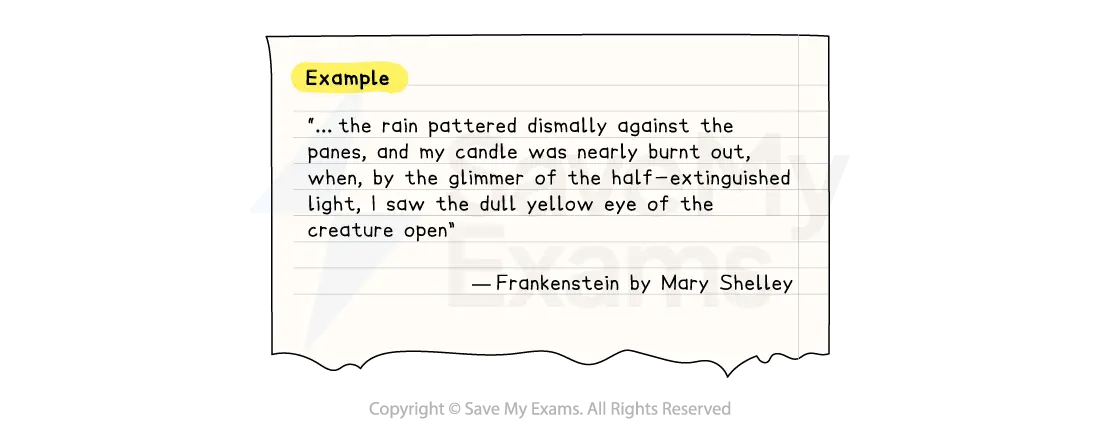
Example 1
In this example, the weather contributes to the gloomy tone. Here the writer uses darkness, the dismal rain and the flickering candlelight to build tension and suspense.
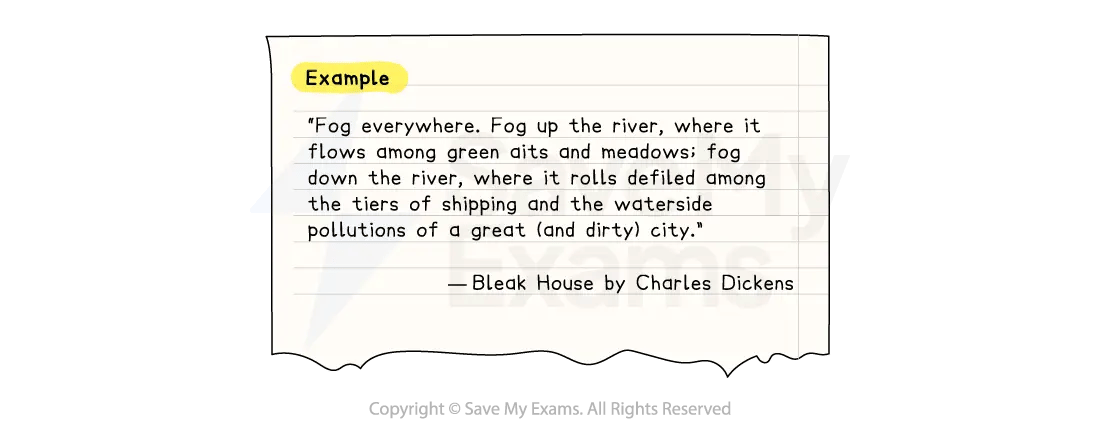
Example 2
In this example, the writer uses repetition of the word “fog” to overwhelm the reader and create a suffocating atmosphere. Here the repetition mimics the fog itself by creeping into every space.
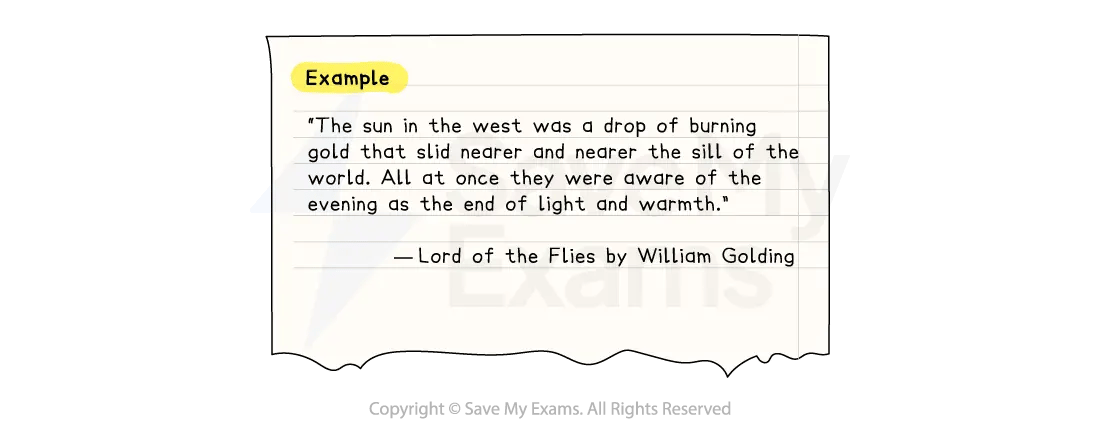
Example 3
In this example, the writer uses light and the setting sun as a metaphor. It is referred to as “a drop of burning gold” to reflect its intensity and preciousness, but the writer develops this further by stating that it “slid nearer and nearer the sill of the world” which suggests an encroaching darkness. This creates an atmosphere of foreboding.
What techniques should I use to describe my setting?
Here’s how to describe a setting using a range of techniques:
Technique | Why is this effective? | Example |
|---|---|---|
Five senses | Immerses the reader in the scene | “The scent of rain filled the air and the pavement glistened” |
Gives the setting human characteristics | “The wind whispered through the trees” | |
Gives deeper meaning to the setting, linking it to themes | “The broken clock on the wall ticked no more” | |
Creates vivid imagery | “The city was a sleeping giant” | |
Builds rhythm and attention to an idea or feeling | “The snow fell. It fell on the trees and on the ruined buildings. It fell everywhere” | |
Uses weather or nature to reflect emotion or mood | “the storm came rattling over the Heights in full fury” (Emily Brontë, Wuthering Heights) | |
Zoom in technique | Focuses the reader’s attention on specific details | “A thin crack appeared on the mirror, distorting her reflection” |
Contrast | Highlights change or mood shifts between places or times | “Inside, the people roared with laughter; outside, he stood alone in the rain” |
Examiner Tips and Tricks
Avoid vague descriptions of your settings. Instead, try to convey mood and atmosphere through detailed and vivid descriptions. A sentence such as “It was a dark and scary night” tells the reader very little, because “dark” and “scary” could describe almost any place.
For instance, you could link your setting to the emotions or actions of your characters. This will show the examiner that you’re thinking purposefully about how the setting supports your narrative and character development. One well-chosen detail can link the place and the character’s feelings in a single sentence. For example, you could write: “The kitchen felt smaller than ever, and the ticking clock seemed to count every second of his silence.”
Want to get the highest grade on the writing section of the English Language papers? Dive deeper into our Writing Exam Tips section with these topics:
More pathetic fallacy and other setting techniques for stories
How to structure your description and zoom in on detail
Creating a setting in your Cambridge IGCSE First Language English exam
In IGCSE descriptive writing, a well-developed setting helps you with both mark grids.
You’ll create a setting in your composition for Paper 2, Section B
In coursework, you’ll create one in Assignment 2 (writing to describe) and Assignment 3 (writing to narrate)
In the exam, you choose one of four titles: Questions 2 and 3 are descriptive, and Questions 4 and 5 are narrative
You should write about 350–450 words
Each composition question is worth 40 marks
Table D gives up to 16 marks for content and structure (W1 and W2)
Table E gives up to 24 marks for style and accuracy (W3, W4 and W5)
W3 asks you to “use a range of vocabulary and sentence structures appropriate to context”
At the top level of Table D, the descriptive criteria ask for “close observation, effective use of figurative language and varieties of focus”
For a story, the Level 4 criteria already mention “characterisation and setting of scene”
At the top level of Table E, the mark scheme asks for “Precise, well-chosen vocabulary”
Precise words for light, weather and sound are a simple way to show this. A setting described with general words like “nice” or “scary” gives the examiner little evidence of your vocabulary.
Paper | Question | What’s assessed | How to use this skill |
|---|---|---|---|
Paper 2 | Questions 2–3: descriptive (40 marks) | Table D content and structure /16; Table E style and accuracy /24 | One place, one atmosphere, details chosen for that atmosphere |
Paper 2 | Questions 4–5: narrative (40 marks) | Table D narrative criteria: “characterisation and setting of scene” | Set the scene early and let the place reflect the character’s feelings |
Component 3 | Assignment 2 (describe), Assignment 3 (narrate) | Content and structure; style and accuracy | Redraft to make the place more specific |
For a descriptive writing setting, choose one place and develop it across your whole piece, as the examples from Frankenstein, Bleak House and Lord of the Flies on this page show.
Examiner Tips and Tricks
Before you start writing, choose one place and one mood for your setting, and note three sensory details that match that mood. Then plan how the setting will change by the end of your piece. The 2027 specimen Question 2 builds this in, because it asks for a street “as it was in the past and as it is now”.
Planning this change gives your description a clear structure. It also shows the examiner that your setting is developing, which is exactly what the examples on this page do. For the street, you could open on a busy bakery and close on the same corner, now shuttered and silent. That contrast can hold your whole piece together.
Sources
Cambridge International (n.d.). Cambridge IGCSE First Language English 0500, Syllabus for exams in 2027, 2028 and 2029. Version 1.
Cambridge International (n.d.). Cambridge IGCSE First Language English 0500, Specimen Paper 2 and Specimen Mark Scheme, for examination from 2027.
Cambridge International (2024–2025). Cambridge IGCSE First Language English 0500, Principal Examiner Reports for Teachers, June 2024 and June 2025.

Unlock more, it's free!
Join the 100,000+ Students that ❤️ Save My Exams
the (exam) results speak for themselves:

Was this revision note helpful?
