11 mark
Which of the following molecules is an alkene?
C6H10
C4H10
C5H10
C6H14
Was this exam question helpful?
Exam code: 4XSD1
Which of the following molecules is an alkene?
C6H10
C4H10
C5H10
C6H14
Was this exam question helpful?
Bromine water is an orange-brown solution.
When shaken with bromine water, which of the following compounds would cause the solution to decolourise?
C3H8
C9H20
C6H16
C4H8
Was this exam question helpful?
The displayed formula of alkene Y is shown below:

What is the name of alkene Y?
Ethene
Propene
Butene
Pentene
Was this exam question helpful?
The structures of an alkane and an alkene are shown below.

Give two differences between an alkane and an alkene.
To distinguish between alkanes and alkenes, bromine water can be added.
Draw one line from each hydrocarbon to give the colour change that would be observed if bromine water was added.

What is the general formula for alkenes?
Draw the structure of propene.
Was this exam question helpful?
This question is about alkenes and alkanes.
Complete the table by giving the missing information about the alkene with the molecular formula C3H6
Molecular formula | C3H6 |
Name |
|
Empirical formula |
|
General formula |
|
Displayed formula |
Alkenes are unsaturated compounds.
i) State what is meant by the term unsaturated.
[1]
ii) Describe a test to show that a compound is unsaturated.
[2]
When the alkane methane reacts with chlorine, the products are chloromethane (CH3Cl) and hydrogen chloride gas.
i) Give a chemical equation for this reaction.
[1]
ii) State the condition needed for this reaction to occur.
[1]
When the alkane methane reacts with chlorine, the products are chloromethane (CH3Cl) and hydrogen chloride gas.
What is the name of this type of reaction?
addition
decomposition
neutralisation
substitution
When ethane reacts with chlorine, one of the products of the reaction has the formula C2H4Cl2 There are two isomers with this formula.
i) State what is meant by the term isomers.
[2]
ii) Draw the displayed formulae of the two isomers with the formula C2H4Cl2
[2]
Isomer 1 | Isomer 2 |
Was this exam question helpful?
Ocimene is an organic compound that gives some plants their particular smell.
The molecular formula of ocimene is C10H16
Calculate the relative formula mass (Mr) of ocimene.
Mr = ..............................
Using ocimene as an example, explain what is meant by the term empirical formula.
The displayed formula of ocimene is

Explain why ocimene is described as an unsaturated hydrocarbon.
Ocimene is an alkene.
Many alkenes have the general formula CnH2n
Suggest why ocimene does not have this general formula.
[1]
Ocimene is an alkene.
Which of these types of reaction occurs between ocimene and bromine?
addition
polymerisation
precipitation
substitution
Ocimene can take part in combustion reactions.
Complete the equation for the complete combustion of ocimene.
C10H16 + .......... O2 → .............................. + ..............................
Two different products can form during the incomplete combustion of ocimene.
One product is a solid and the other is a poisonous gas.
i) Identify these two products.
[2]
ii) State why the gas produced is poisonous.
[1]
Was this exam question helpful?
The structures of some organic compounds are shown below.

Compound R can be converted to compound T by reacting it with bromine.
What kind of reaction is this?
Substitution
Displacement
Combustion
Addition
Was this exam question helpful?
Name the product formed from the reaction between ethene and chlorine.
Chloroethane
Chloroethene
Dichloroethane
Dichloroethene
Was this exam question helpful?
This question is about alkenes and polymers.
Propene can be represented by different types of formulae.
Complete the table about propene by giving the missing information.
Molecular Formula | Empirical Formula | General Formula |
|---|---|---|
C3H6 |
Butene reacts with bromine in an addition reaction.
Complete the missing information in the symbol and word equations.
C4H8 + Br2 → ....................
butene + bromine → ..........................
i) Complete the equation for the polymerisation of propene.
[2]
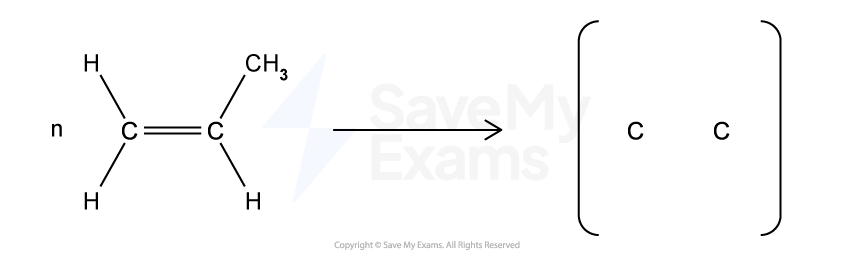
ii) Name the product of the reaction.
[1]
iii) State the type of polymerisation taking place.
[1]
The repeat unit of another polymer has the following structure:
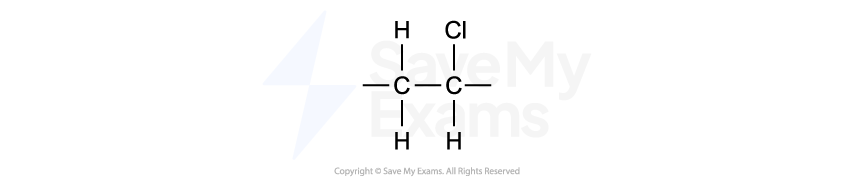
Draw the displayed formula of the monomer used to make this polymer.
Was this exam question helpful?
The table shows the structures of six organic compounds.

i) Give the letter of a compound not shown as a displayed formula.
[1]
ii) Give the letter of a saturated compound with the general formula CnH2n
[1]
iii) Name compound E.
[1]
iv) Explain why compound A and compound D are isomers.
[2]
Compound F reacts with bromine in the presence of ultraviolet radiation.
i) Complete the equation for the reaction.
[1]
CH4 + Br2 →
ii) Give the name of this type of reaction.
[1]
i) Another compound, G, has this percentage composition by mass.
C = 37.8% H = 6.3% Cl = 55.9%
Show by calculation that the empirical formula of compound G is C2H4Cl
[3]
ii) The relative formula mass (Mr) of G is 127
Determine the molecular formula of G.
[2]
molecular formula = ..............................
Compound E is used to make an addition polymer.
i) Complete the equation to show part of the polymer formed from two molecules of compound E.
[2]

ii) Give one problem caused by the disposal of addition polymers.
[1]
Was this exam question helpful?
The alkenes are unsaturated hydrocarbons. They form a homologous series, the members of which undergo the following chemical reactions.
addition reactions
polymerisation
combustion
Alkenes that have one carbon-carbon double bond have the same empirical formula.
i) State their empirical formula.
[1]
ii) Why is the empirical formula the same for these alkenes?
[1]
Complete the following equation for the addition reaction of propene.
CH3–CH=CH2 + Br2 → ....................................
Draw the repeat unit of poly(propene).
0.01 moles of an alkene needed 2.4 g of oxygen for complete combustion. 2.2 g of carbon dioxide were formed.
i) Determine the following mole ratio.
moles of alkene : moles of O2 : moles of CO2
From this ratio determine the formula of the alkene.
[3]
ii) Write an equation for the complete combustion of this alkene.
[1]
Was this exam question helpful?
Alkenes are unsaturated hydrocarbons. They undergo addition reactions.
Two of the methods of making alkenes are cracking and the thermal decomposition of chloroalkanes.
i) Complete an equation for the cracking of the alkane, decane.
C10H22 decane | → | ................ | + | ................. |
[2]
ii) Propene can be made by the thermal decomposition of chloropropane.
Describe how chloropropane can be made from propane.
reagents: propane and ..............................
conditions ...................................................
[2]
The following alkenes are isomers.

i) Explain why they are isomers.
[2]
ii) Give the name and structural formula of another hydrocarbon that is isomeric with the above.
name ......................................................
structural formula ......................................................
[2]
The structures of an alkane and an alkene are shown below.

i) Compare the structures of propene with propane.
[4]
ii) Compare the reactions of propene with propane.
[4]
Write a balanced symbol equation for the incomplete combustion of propene to form carbon monoxide and water.
Was this exam question helpful?