Energetics (Edexcel IGCSE Science (Double Award) (Modular): Chemistry Unit 1): Exam Questions

Exam code: 4XSD1

2 hours15 questions
1
1 mark

Which is true about chemical energy changes?


 Reaction type

Energy flows

Temperature of surroundings

A

exothermic

to the surroundings

increases

B

exothermic

from the surroundings

decreases

C

endothermic

to the surroundings

decreases

D

endothermic

from the surroundings

increases

  • Option A

  • Option B

  • Option C

  • Option D

2
1 mark

Which statement is true about exothermic and endothermic reactions?

  • The products have more energy than the reactants in an exothermic reaction

  • The products have more energy than the reactants in an endothermic reaction

  • The activation energy for an exothermic reaction is always larger than the activation energy for an endothermic reaction

  • Most reactions are endothermic

3
1 mark

When solid sodium oxide is added to water, an exothermic reaction occurs:

Na2O (s) + H2O (l)→2NaOH (aq)

A student uses the apparatus below to measure the temperature change of the reaction:

Two pieces of apparatus side by side. On the left, a measuring cylinder standing upright with a scale, labelled 25 cm^3^ at the top. On the right, a polystyrene cup, labelled polystyrene cup, standing inside a glass beaker, with a thermometer resting in the cup so that its bulb sits near the bottom.

The student records the following results for the reaction:

mass of sodium oxide used = 3.0 g

volume of water used = 50 cm3

starting temperature of mixture = 19.5 oC

maximum temperature of mixture = 30.5 oC

What is the heat energy, Q, released in this experiment, in J?

c = 4.2 J/g/ oC

mass of 1 cm3 of water = 1 g

  • Q = 2,310 J

  • Q = 2,450 J

  • Q = 139 J

  • Q = 126 J

1a
3 marks

A student uses this apparatus to investigate the heat energy change when a salt dissolves in water to form a solution.

A polystyrene cup, labelled polystyrene cup, part filled with liquid labelled distilled water. A thermometer rests at an angle in the cup, with its bulb below the surface of the liquid.

This is the student’s method.

  • Add 50 cm3 of distilled water to a polystyrene cup

  • Record the initial temperature of the water

  • Add a known mass of solid anhydrous copper(II) sulfate to the polystyrene cup and stir the solution with the thermometer until all the solid has dissolved

  • Record the maximum temperature of the copper(II) sulfate solution

i) Name the piece of apparatus the student should use to add the distilled water to the polystyrene cup.

[1]

ii) The student stirs the solution to help the solid dissolve more quickly.

Suggest another reason why the student stirs the solution.

[1]

iii) State the colour of the copper(II) sulfate solution.

[1]

1b
3 marks

The diagram shows the temperatures in one experiment.

Two thermometer scales side by side, each marked in °C. The one labelled initial temperature runs from 20 at the bottom to 25 at the top, with the black column reaching between 24 and 25. The one labelled maximum temperature runs from 25 at the bottom to 30 at the top, with the column reaching between 27 and 28.

Complete the table, giving all values to the nearest 0.1 °C.

maximum temperature in °C

initial temperature in °C

increase in temperature in °C

1c
6 marks

In a second experiment, when a student dissolves the anhydrous copper(II) sulfate in 50 cm3 of distilled water, the increase in temperature is 3.3 °C.

i) Show that the heat energy change (Q) in this second experiment is approximately 700 J.

[for water, c = 4.2 J / g / °C]

[mass of 1.0 cm3 of water = 1.0 g]

[2]

ii) In this experiment, the student uses 1.70 g of the anhydrous copper(II) sulfate.

Calculate the molar enthalpy change (∆H) in kJ / mol.

Include a sign in your answer.

[Mr of CuSO4 = 159.5]

[4]

∆H = ................................ kJ / mol

1d
2 marks

Another student does a similar experiment but uses hydrated copper(II) sulfate instead of anhydrous copper(II) sulfate.

 The table shows his results.

initial temperature in °C

23.8

final temperature in °C when all solid dissolves

22.7

 Explain what the results show about the type of energy change that occurs when hydrated copper(II) sulfate dissolves.

2
1 mark

Sodium oxide reacts with water to form sodium hydroxide.

A scientist plans to measure the temperature change of the reaction using calorimetry in a lab.

This is the scientist's basic method:

  • use 50 g of water

  • record the temperature of the water

  • add sodium oxide

  • stir

  • record the maximum temperature reached

Which apparatus list is the most appropriate for this experiment?

  • Electronic balance, measuring cylinder, glass beaker, thermometer

  • Measuring cylinder, glass beaker, polystyrene cup, thermometer

  • Electronic balance, measuring cylinder, glass beaker, polystyrene cup, thermometer

  • Measuring cylinder, glass beaker, glass rod, thermometer

3a
1 mark

A student uses this apparatus to investigate the heat energy released when a liquid fuel is burned.

A copper can, labelled copper can, part filled with liquid labelled water, with a thermometer standing in the water. Below the can is a spirit burner, labelled spirit burner, part filled with liquid labelled liquid fuel, with a lit wick burning beneath the can.

This is the student’s method.

  • measure the mass of the spirit burner and fuel

  • add 100 cm3 of water to the copper can

  • record the temperature of the water

  • use the spirit burner to heat the water until the temperature rises by 30 °C

  • immediately measure the new mass of the spirit burner and fuel

Suggest why the student measures the mass of the spirit burner and fuel immediately after heating the water.

3b
3 marks

When the fuel is burned, the student notices that a black solid forms on the bottom of the copper can.

i) Identify the black solid.

[1]

ii) Explain why the black solid forms.

[2]

3c
6 marks

i) Show that the heat energy change, Q, to raise the temperature of 100 cm3 of water by 30 °C is approximately 13 kJ.

[mass of 1.0 cm3 of water = 1.0 g] [c for water = 4.2 J / g / °C]

[3]

ii) The student burns 0.96 g of methanol, CH3OH Calculate the molar enthalpy change, ∆H, in kJ / mol, for the combustion of methanol. Include a sign in your answer. [Mr of methanol = 32]

[3]

∆H = ...................................................................... kJ / mol

3d
5 marks

The table shows data book values for the molar enthalpy change, ∆H, for the combustion of some alcohols with different numbers of carbon atoms per molecule.

Number of carbon atoms per molecule

1

2

3

4

5

Molar enthalpy change, ∆H, in kJ/mol

-730

-1370

-2020

-2680

-3320

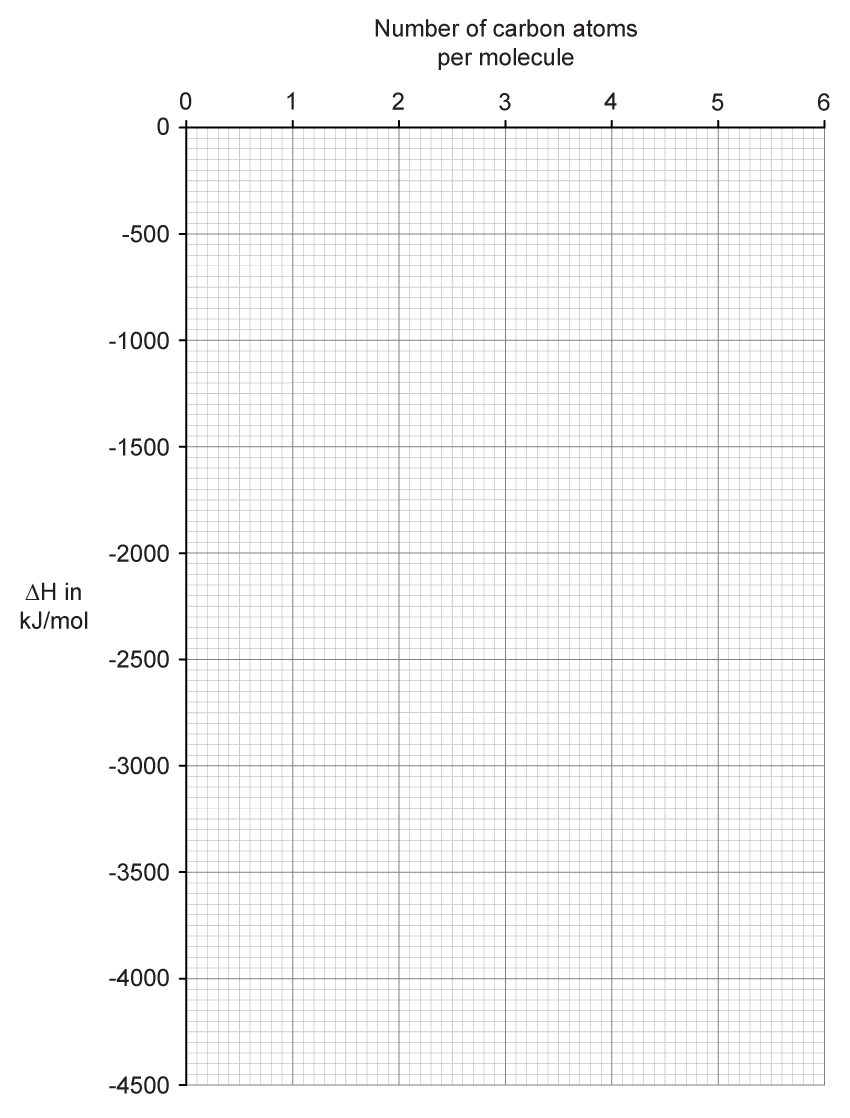
i) Plot the data values from the table on the grid. Draw a straight line of best fit.

[2]

An empty graph grid ruled in small squares. The x-axis, labelled number of carbon atoms per molecule, runs along the top from 0 to 6 in steps of 1. The y-axis, labelled ∆*H* in kJ/mol, runs downwards from 0 at the top to −4500 at the bottom, labelled every 500, with each small square worth 100 kJ/mol.

ii) Deduce the value of ∆H for an alcohol with six carbon atoms per molecule. Show on the graph how you obtained your answer.

[2]

∆H = ...................................................................... kJ/mol

iii) State the relationship between ∆H and the number of carbon atoms per molecule.

[1]

4a
3 marks

This question is about lithium oxide.

The diagram shows the electron configurations of an atom of lithium and an atom of oxygen.

Two shell diagrams side by side. The one labelled lithium has two crosses on the inner shell and one cross on the outer shell. The one labelled oxygen has two dots on the inner shell and six dots on the outer shell.

Describe the changes in electronic configuration when lithium and oxygen react to form lithium oxide, Li2O

4b
10 marks

Lithium oxide reacts with water to form lithium hydroxide as the only product. A scientist uses this apparatus to measure the temperature change of the reaction.

A polystyrene cup, labelled polystyrene cup, standing inside a glass beaker, labelled beaker. The cup is part filled with liquid, labelled 100 g water, and a thermometer stands in the liquid with its bulb near the bottom of the cup.

This is the scientist’s method.

  • pour 100 g of water into a polystyrene cup

  • record the temperature of the water

  • add the lithium oxide and stir the mixture

  • record the maximum temperature reached

The diagram shows the thermometer readings before and after adding the lithium oxide.

Two thermometer scales side by side, labelled before and after, each ruled with minor divisions every 0.2 °C. The before scale is labelled 15 at the bottom and 20 further up, with the grey liquid column reaching between 17 and 18. The after scale is labelled 25 at the bottom and 30 further up, with the column reaching between 27 and 28.

i) Complete the table, giving all values to the nearest 0.1 °C.

[2]

temperature in °C after adding the lithium oxide

temperature in °C before adding the lithium oxide

17.3

temperature rise in °C

ii) Calculate the heat energy change in the reaction. Give your answer to two significant figures. [c = 4.2 J / g / °C]

[4]

heat energy change = .............................. J

iii) In another experiment the scientist obtains these results.

amount of lithium oxide in mol

0.0580

heat energy change in J

5210

Calculate the molar enthalpy change (∆H) in kJ / mol. Include a sign in your answer.

[3]

∆H = ..............................kJ / mol

iv) Give a reason why the scientist does the experiment in a polystyrene cup.

[1]

5
1 mark

Another student carries out the experiment to find the heat energy released in the reaction of sodium oxide with water:

Na2O (s) + H2O (l) → 2NaOH (aq)

They found that 10,800 J of heat energy was released when 0.060 mol of sodium oxide reacts.

What is the value of ΔH, in kJ/mol, for the reaction of sodium oxide with water?

  • 0.0056 kJ/mol

  • 180 kJ/mol

  • 1,800 kJ/mol

  • 8,000 kJ/mol

6
1 mark

The actual molar enthalpy change, ΔH, for the reaction of sodium oxide with water, is -238 kJ/mol.

Experimental results from calorimetry in labs give less exothermic results.

Which of the following does not explain this difference?

  • The reaction may have been incomplete

  • Heat energy also transfers to the surroundings

  • The calorimetry equipment also has a specific heat capacity, and so affects the final temperature reading

  • The student measured the initial temperature of the water as lower than the actual value.

7a
6 marks

This question is about chemical energy changes.

Zinc reacts with copper(II) sulfate solution to form copper and zinc sulfate

A student uses this apparatus to measure the temperature change of the reaction.

A polystyrene cup, labelled polystyrene cup, standing inside a glass beaker, labelled beaker. The cup is part filled with liquid, labelled 100 cm^3^ copper(II) sulfate solution, and a thermometer stands in the liquid with its bulb near the bottom of the cup.

This is the student’s method.

  • pour 100 cm3 of copper(II)sulfate solution into a polystyrene cup

  • record the temperature of the solution

  • add the zinc powder and stir the mixture

  • record the maximum temperature reached

The diagram shows the thermometer readings before and after adding the zinc powder.

Two thermometer scales side by side, labelled Before and After, each ruled with fine minor divisions. The Before scale is labelled 15 at the bottom and 20 further up, with the grey liquid column reaching a little over halfway between them, between 17 and 18. The After scale is labelled 25 at the bottom and 30 further up, with the column reaching between 28 and 29.

i) Complete the table, giving all values to the nearest 0.1o C.

temperature in oC after adding the zinc

temperature in oC before adding the zinc

17.7

temperature rise in °C

[2]

ii) Calculate the heat energy change in the reaction.

Give your answer to two significant figures.

[c = 4.2 J/g/oC]

[4]

7b
3 marks

i) State two observations you might expect to see in the reaction

[2]

ii) Give the name of the type of reaction taking place.

[1]

1a
2 marks

When aqueous solutions of potassium hydroxide and nitric acid are mixed together, an exothermic reaction occurs. The diagram shows the apparatus used in an experiment to measure the temperature increase.

Three pieces of apparatus side by side. On the left a tall measuring cylinder labelled 25 cm^3^. In the middle a polystyrene cup, labelled polystyrene cup, part filled with liquid and with a thermometer standing in it. On the right a narrower measuring cylinder labelled 10 cm^3^.

This is the student’s method:

  • use the larger measuring cylinder to add 25 cm3 of aqueous potassium hydroxide to the polystyrene cup

  • record the steady temperature

  • use the smaller measuring cylinder to add 5 cm3 of dilute nitric acid to the cup, stir the mixture with the thermometer

  • record the highest temperature of the mixture

  • continue adding further 5 cm3 portions of dilute nitric acid to the cup, stirring and recording the temperature, until a total volume of 35 cm3 has been added.

A teacher advises the student to use a 50 cm3 burette instead of the 10 cm3 measuring cylinder. Suggest two reasons why it would be better to use a burette instead of a measuring cylinder to add the acid in this experiment.

1b
2 marks

The diagram shows the thermometer readings at the start and at the end of one experiment.

Two thermometer scales side by side, labelled start and end, each ruled with minor divisions. The start scale is labelled 15 at the bottom and 20 further up, with the grey column reaching between 18 and 19. The end scale is labelled 20 at the bottom and 25 further up, with the column reaching above the 25 mark.

Complete the table to show:

  • the thermometer reading at the start of the experiment

  • the temperature rise in the experiment.

thermometer reading at end / °C

26.8

thermometer reading at start / °C

thermometer rise / °C

1c
2 marks

Another student uses the same method, adding the dilute nitric acid from a burette. The table shows his results.

volume of acid added / cm3

0.0

5.0

10.0

15.0

20.0

25.0

30.0

35.0

temperature of mixture / °C

18.0

20.8

23.5

24.2

29.0

28.6

27.6

26.5

The same results table, showing volume of acid added in cm^3^ from 0.0 to 35.0 in steps of 5.0, against temperature of mixture in °C of 18.0, 20.8, 23.5, 24.2, 29.0, 28.6, 27.6 and 26.5.

This is the student’s graph.

A graph of temperature of mixture in °C against volume of acid added in cm^3^. The x-axis runs from 0.0 to 35.0 with each small square worth 1.0 cm^3^, and the y-axis from 16.0 to 32.0 with each small square worth 0.4 °C. All eight points are plotted as crosses, with the 15.0 point lying below the trend. A straight line of best fit rises through the first five points and a second straight line falls through the last four, the two crossing just past 20 cm^3^ at a little under 30 °C.

The point where the lines cross represents complete neutralisation.

i) Identify the maximum temperature reached during the experiment.

[1]

maximum temperature = .............................................................. °C

ii) Identify the volume of dilute nitric acid that exactly neutralises the 25 cm3 of aqueous potassium hydroxide.

[1]

volume = .............................................................. cm3

1d
4 marks

Another student records these results.

volume of aqueous potassium hydroxide

 20.0 cm3

starting temperature of aqueous potassium hydroxide

 18.5 °C

maximum temperature of mixture

 30.0 °C

volume of dilute nitric acid

 20.0 cm3

Calculate the heat energy released in this experiment.

c = 4.2 J /g/ °C

mass of 1 cm3 of mixture = 1 g

heat energy = .............................................................. J

1e
2 marks

In another experiment, the heat energy released is 1600 J when 0.040 mol of potassium hydroxide is neutralised. Calculate the value of ΔH, in kJ/mol, for the neutralisation of potassium hydroxide.

ΔH = .............................................................. kJ/mol

2a
1 mark

A student investigates the reaction between magnesium and hydrochloric acid.

He uses this method:

   Step 1: add 25 cm3 of dilute hydrochloric acid to a polystyrene cup

   Step 2: record the temperature of the acid

   Step 3: find the mass of a 10 cm strip of magnesium ribbon

   Step 4: add the magnesium ribbon to the hydrochloric acid

   Step 5: when all the magnesium has reacted, record the highest temperature reached

Complete the word equation for the reaction.

 magnesium + hydrochloric acid → ......................... + ...........................

2b
8 marks

The thermometer shows the temperature of the acid at the start of the experiment.

A thermometer scale marked in °C, labelled 20 at the bottom and 25 at the top, with a long mark at every whole degree and short marks every 0.2 °C. The black column reaches a little way above the 22 mark.

i) Complete the table by giving the temperatures to the nearest 0.1 °C.

[2]

temperature of the acid at the start in °C

highest temperature reached in °C

temperature rise in °C

20.8

ii) Show that the heat energy change (Q) for this reaction is about 2200 J.

[mass of 1.0 cm3 of solution = 1.0 g]

[for the solution, c = 4.2 J / g / °C]

[2]

iii) The mass of magnesium used by the student was 0.12 g.

Calculate the value of the enthalpy change (∆H), in kilojoules per mole of magnesium, for the reaction between magnesium and hydrochloric acid.

Include a sign in your answer.

[4]

3a
2 marks

The reaction between magnesium and copper(II) sulfate solution is exothermic. This apparatus is used to measure the temperature increase when excess magnesium is added to 100 cm3 of copper(II) sulfate solution.

A beaker part filled with liquid, labelled 100 cm^3^ copper(II) sulfate solution, with a thermometer resting at an angle in the liquid. Above it a spatula holds a grey powder, labelled magnesium powder, which is being tipped into the beaker.

i) State why a reaction occurs when magnesium is added to copper(II) sulfate solution.

[1]

ii) Complete the word equation for this reaction.

[1]

magnesium + copper(II) sulfate → .............................................................. + ..............................................................

3b
4 marks

The temperature at the start of the reaction is 20.2 °C. The maximum temperature recorded is 56.3 °C.

i) Calculate the heat energy change, in joules, for the reaction.

[mass of 1.00 cm3 of solution = 1.00 g] [c for the solution = 4.2 J/g/ °C]

[2]

heat energy change = .............................................................. J

ii) Explain why it is better to use a polystyrene cup rather than a glass beaker in this experiment.

[2]

3c
6 marks

The reaction between zinc and copper(II) sulfate solution is also exothermic.

i) A mass of 0.500 g of zinc is reacted with an excess of copper(II) sulfate solution. The heat energy change is 1.67 kJ. Calculate the molar enthalpy change, ∆H, in kJ/mol. Include a sign in your answer. Give your answer to three significant figures.

[3]

∆H = .............................................................. kJ/mol

ii) The ionic equation for the reaction between zinc and copper(II) sulfate is

Zn (s) + Cu2+ (aq) → Zn2+ (aq) + Cu (s)

Explain why this is a redox reaction.

[3]

4a
3 marks

A student uses this apparatus to investigate the reaction between potassium hydroxide solution and dilute hydrochloric acid.

A polystyrene cup, labelled polystyrene cup, standing inside an outer beaker, with a thermometer standing upright in the cup and its bulb near the bottom.

This is her method.

  • pour 25 cm3 of potassium hydroxide solution into a polystyrene cup and record the temperature of the solution

  • pour 25 cm3 of dilute hydrochloric acid into a measuring cylinder and record the temperature of the acid

  • add the acid to the polystyrene cup and stir the mixture

  • record the highest temperature reached

i) Give a word equation for the reaction between potassium hydroxide and hydrochloric acid.

[1]

ii) Explain why the student needs to stir the mixture.

[2]

4b
2 marks

The table gives the temperatures of the solutions before the student mixes them.

 potassium hydroxide solution

17.8 °C

 dilute hydrochloric acid

18.4 °C

Calculate the mean (average) temperature of the two solutions.

mean temperature = .............................................................. °C

4c
8 marks

The student repeats the experiment on a different day, using 25 cm3 of potassium hydroxide solution and 25 cm3 of dilute hydrochloric acid. The thermometer shows the highest temperature reached at the end of the experiment.

A thermometer scale marked in °C, labelled 20 at the bottom and 25 at the top, with a long mark at every whole degree and short marks every 0.2 °C. The black column reaches a little way above the 22 mark.

i) Complete the table by giving the missing information. Give both temperatures to the nearest 0.1 °C.

[2]

Mean temperature at start in °C

Temperature at end in °C

Temperature rise in °C

5.2

ii) Show that the heat energy change, Q, in the student’s experiment is about 1100 J.

[for the mixture, c = 4.2 J/g/°C]

[mass of 1.0 cm3 of mixture = 1.0 g]

[3]

iii) The student uses 0.020 mol of potassium hydroxide in his experiment. Calculate the enthalpy change (∆H) in kJ/mol, for 1.0 mol of potassium hydroxide. Include a sign in your answer.

[3]

5a
6 marks

A student investigates the temperature change during the reaction between zinc metal and copper(II) sulfate solution.

The student considers two different methods.

Method 1

An open polystyrene cup, labelled polystyrene cup, with a thermometer standing upright inside it and its bulb near the bottom. The cup has no lid.
  • Pour 50 cm3 of copper(II) sulfate solution into the polystyrene cup

  • Record the temperature of the solution

  • Add 3 g of zinc powder

  • Stir using the thermometer and record the highest temperature reached

Method 2

A glass bottle, labelled glass bottle, closed at the neck by a stopper labelled bung. A thermometer passes through the bung so that its bulb reaches near the bottom of the bottle.
  • Record the temperature of 50 cm3 of copper(II) sulfate solution

  • Pour the 50 cm3 of copper(II) sulfate solution into the glass bottle

  • Add 3 g of zinc powder

  • Push the bung and thermometer into the bottle and record the highest temperature reached

Discuss the advantages and disadvantages of each method.

5b
2 marks

The equation for the reaction is

Zn (s) + CuSO4 (aq) → ZnSO4 (aq) + Cu (s)

50 cm3 of copper(II) sulfate solution contains 0.025 mol CuSO4

A mass of 3 g of zinc is used.

Show that the zinc is in excess.

[Ar of zinc = 65]

5c
6 marks

The student reacts a solution containing 0.025 mol CuSO4 with an excess of zinc.

These are the student’s results.

  • Temperature of 50 cm3 of copper(II) sulfate solution = 21.1 °C

  • Highest temperature reached = 40.6 °C

i) Show that the energy change Q for this reaction is about 4000 J

[mass of 1 cm3 of solution = 1.0 g]

[for the solution, c = 4.2 J / g / °C]

[3]

ii) Calculate the molar enthalpy change (∆H), in kJ / mol, for the reaction.

[3]

∆H = .............................. kJ / mol

5d
2 marks

The ionic equation for the reaction is 

Zn (s) + Cu2+ (aq) → Zn2+ (aq) + Cu (s)

 Explain what is oxidised and what is reduced in this reaction.