11 mark
Which of these is measured in becquerel (Bq)?
Activity
Frequency
Half-life
Radiation
Was this exam question helpful?
Exam code: 4XSD1
Which of these is measured in becquerel (Bq)?
Activity
Frequency
Half-life
Radiation
Was this exam question helpful?
Alpha, beta and gamma radiations are described as ionising.
(i) Complete the table to show alpha, beta and gamma radiations in order of increasing ionisation.
[1]

(ii) Describe two ways in which these ionising radiations can cause harm.
[2]
People who work with ionising radiations need to measure the amount of radiation they are exposed to. For many years, a film badge was used to detect the radiation.
The diagram shows how a film badge is constructed.

Complete the table to show if alpha, beta and gamma radiations penetrate each material. Some have been done for you.
Use the words “goes through” or “stopped”.

Was this exam question helpful?
Radioactivity is used in PET scanners in hospitals.
PET scanners are used to diagnose cancer.
State two precautions that hospital staff might take when working with radioactivity.
State two other uses of radioactivity, apart from treatment or diagnosis of cancer.
The diagram shows a machine which makes aluminium foil.
The machine uses a radioactive source to measure the thickness of the foil.

The radioactive source emits beta particles. The output from the detector indicates the thickness of the foil.
Complete the following sentences by highlighting the correct answer.
If the aluminium foil gets too thin, the count rate at the detector increases / decreases.
This sends a signal to a computer to push the rollers closer together / further apart.
Beta particles are used because they can / cannot pass through aluminium.
Give two reasons why gamma is the most suitable type of radiation for sterilising medical equipment.
Was this exam question helpful?
State the definition of half-life.
The half-life of cobalt-60 is 5 years.
The count rate of a sample of cobalt-60 is 100 counts per minute.
(i) How many half-lives are there in 10 years?
[1]
(ii) Calculate the count rate of the cobalt-60 sample after 10 years.
[2]
A radioactive isotope can be used as a tracer in a patient’s body. It is monitored by a radiation detector outside the body.
Four possible radioactive isotopes are shown in the table
Radioactive isotope | Type of radiation emitted | Half-life |
Radon‐222 | Alpha | 3.8 days |
Iodine‐131 | Gamma | 8 days |
Cobalt‐60 | Gamma | 5 years |
Americium-241 | Alpha | 470 years |
(i) Doctors wear a lead apron when they use radioactive isotopes. Explain why.
[2]
(ii) Which radioactive isotope from the table is best to use as a medical tracer?
Tick () one box.
Radon-222 | |
Iodine-131 | |
Cobalt-60 | |
Americium-241 |
Explain your answer.
[3]
Was this exam question helpful?
Radioactive materials are usually stored in containers lined with metal. This is done to reduce the amount of radiation that escapes, and to protect people nearby.
Which metal is the most effective for this purpose?
Aluminium
Lead
Copper
Steel
The risk caused by working with radioactive sources can be minimised by various methods.
Which of the following methods would not minimise this risk?
Store the sources in lead-lined boxes
Minimise the amount of time spent handling the sources
Keep the source hot
Keep the source as far away as possible, for example, using a pair of tongs
A student carried out an experiment to find the half-life of a radioactive substance. Their results are shown in the table below.
time (s) | count-rate (counts / s) |
0 | 300 |
20 | 200 |
40 | 150 |
60 | 100 |
80 | 75 |
State the half-life of the substance.
State what is meant by the activity of a radioactive sample, and give its unit.
Was this exam question helpful?
There are two sources of alpha radiation in some houses:
Radon gas in the air
Solid americium in a smoke alarm
The alpha particles from radon are a greater risk to health then the alpha particles from americium.
Explain why.
The graph shows how the activity of a sample of radon-220 changes with time.
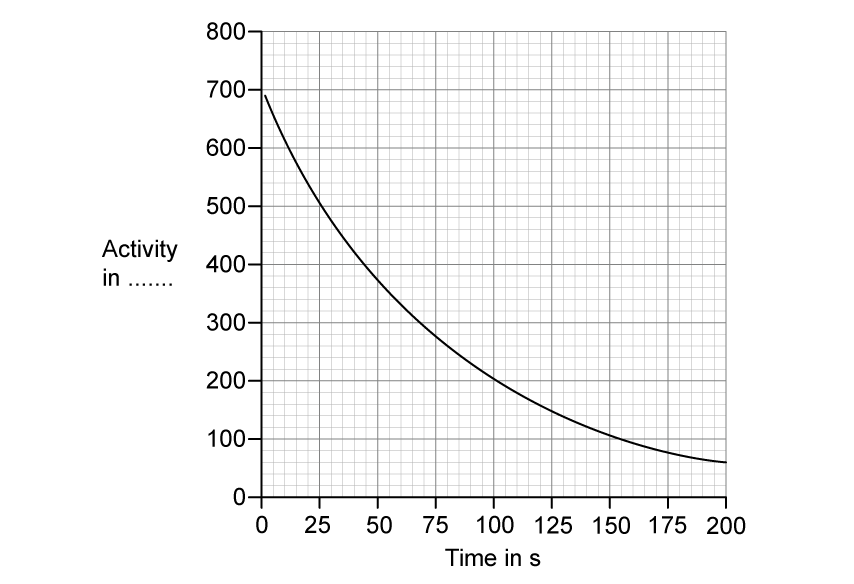
(i) Complete the graph by adding the missing unit for activity.
[1]
(ii) Explain what is meant by the term half-life.
[2]
(iii) Use the graph to find a value for the half-life of radon-220.
[2]
Half-life = .................................................... s
Was this exam question helpful?
A smoke alarm contains a source of alpha particles and a detector.
The alpha particles reach the detector through a sample of air from the room.
The alarm sounds if there is a sudden drop in the detector reading.
This graph shows changes in the detector reading.

(i) Why is the detector reading never zero?
[1]
(ii) Why is the detector reading never constant?
[1]
Suggest why fewer alpha particles reach the detector if there is a fire.
Was this exam question helpful?
A teacher shows his class how to investigate the half-life of a radioactive source.

The readings from the counter need to be corrected for background radiation.
(i) State one source of background radiation.
[1]
(ii) Describe the method the teacher should use to correct for background radiation.
[3]
Every half a minute, the teacher records the count rate. He corrects for background radiation and produces this results table.

(i) Draw a graph of corrected count rate against time for these results.
[5]

(ii) Use your graph to estimate the half-life for this material.
[1]
Half-life = .................................................. minutes
The isotope technetium-99 is a gamma emitter with a half-life of 6 hours. It is used as a radioactive tracer in medicine.
The technetium-99 is injected into a patient’s bloodstream and carried around the body by the blood. The radiation it emits is detected outside the body.
Explain why technetium-99 is suitable for use as a tracer in this way.
Was this exam question helpful?
The photograph shows an old camera lens that contains several pieces of glass.

One of the pieces of glass includes a radioactive isotope, thorium-232.
Thorium-232 undergoes alpha decay and produces an isotope of radium, Ra.
Complete the equation for this decay.

The radioactive glass also emits beta particles from a different isotope. The diagram shows the position of the radioactive glass in the camera.

Amateur astronomers sometimes remove an old camera lens to use as a lens in a homemade telescope.
(i) Suggest why it is safe to use radioactive glass in the camera as shown.
[1]
(ii) Suggest why an astronomer should not use a lens with radioactive glass close to their eye.
[2]
Was this exam question helpful?
A teacher investigates the half-life of a radioactive isotope that decays quickly.
The teacher measures the background activity.
Explain how this value should be used in the investigation.
Explain what is meant by the term half-life.
The graph shows how the activity of a sample of the radioactive isotope changes with time.
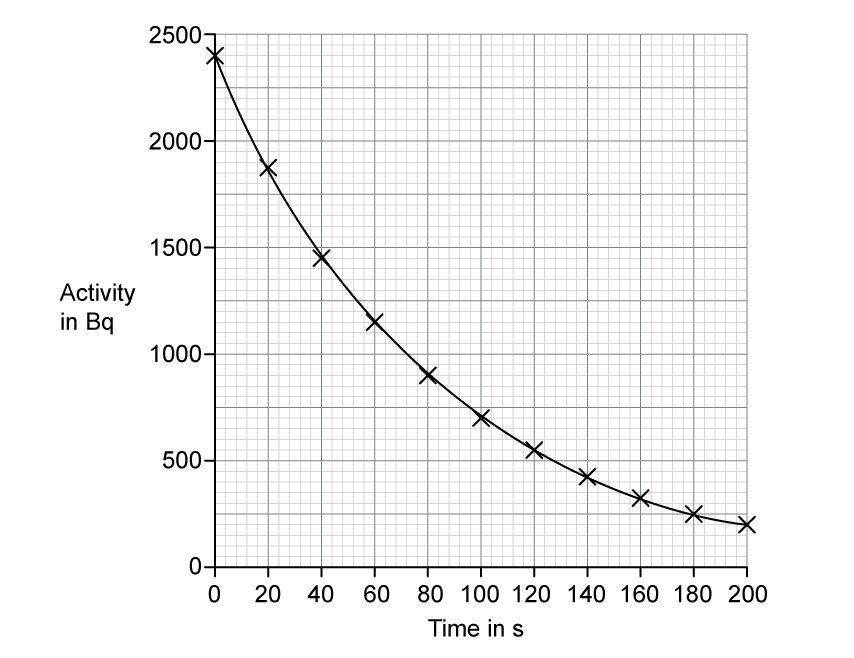
(i) Use the graph to find the half-life of the isotope.
[2]
Half-life = ................................... s
(ii) The teacher takes a new reading every 20 s. Suggest why the teacher measures the activity so frequently.
[1]
Was this exam question helpful?
An unstable isotope of strontium has a half-life of 28.8 years.
It is a beta emitter and can be represented by this symbol.

(i) What is the mass number of this isotope?
[1]
(ii) Explain the meaning of the term half-life.
[2]
(iii) A person can absorb strontium atoms, which stay in their bones.
Explain why strontium-90 in the bones is a serious health hazard.
[2]
When a strontium-90 nucleus emits a beta particle, it decays to form yttrium-90.

(i) Complete the equation for this decay.
[2]
(ii) Yttrium-90 is also an unstable isotope.
Explain why strontium-90 and yttrium-90 can both be described as isotopes, even though they have different numbers of protons.
[2]
Was this exam question helpful?
lodine-131 is used to treat thyroid cancer. This radioactive isotope is allowed to enter the tumour.
Explain why iodine-131 is suitable for this treatment.
Was this exam question helpful?
The diagram shows a machine which makes aluminium foil.
The machine uses a radioactive source to measure the thickness of the foil.

The radioactive source emits beta particles. The output from the detector indicates the thickness of the foil.
Explain why beta particles are used, rather than alpha particles or gamma rays.
Was this exam question helpful?
Thorium-232 decays into radon-220 through a number of alpha decays and beta decays.
The incomplete nuclear decay equation summarises this process.
Complete the nuclear equation for the decay of thorium-232 into radon-220 by giving the missing numbers.
Radon-220 is a gas and an alpha emitter with a half-life of 55.6 s.
(i) State what is meant by the term half-life.
[1]
(ii) A sample of radon-220 has an initial activity of 760 Bq.
Calculate how long it takes for the activity of the sample to decrease to 95 Bq.
[2]
(iii) Explain why radon gas would be harmful if inhaled.
[2]
Was this exam question helpful?
Carbon-14 has a half-life of 5700 years. A sample of cloth contains 6.0 g of carbon-14.
What mass of carbon-14 will remain in the cloth after 11 400 years?
1.5 g
2.0 g
2.5 g
3.0 g
Was this exam question helpful?
The graph shows how the activity of tritium in a luminous sign varies with time.
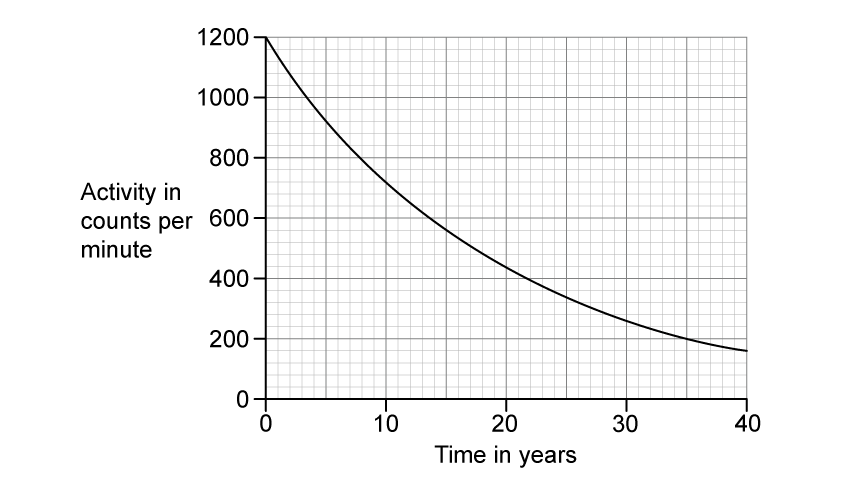
(i) Explain what is meant by the term half-life.
[2]
(ii) Use the graph to estimate the half-life of tritium. Show your working.
[2]
The manufacturer of the luminous sign claims that the sign will work for more than 20 years. The minimum activity required for the tubes to emit sufficient light is 400 counts per minute.
Evaluate the manufacturer’s claim.
Was this exam question helpful?
What is meant by the term half-life?
A doctor uses gamma radiation to produce an image of a person's brain.
A radioactive isotope called technetium-99m is used in this process. Technetium-99m emits gamma rays and has a short half-life.

The doctor injects a solution of technetium-99m into the patient. A detector outside the patient received gamma radiation to form the image.
Suggest why isotopes that emit alpha particles or beta particles are not suitable for this use.
Technitium-99m has a half-life of 6 hours. A sample of technitium-99 has an activity of 420 MBq.
(i) Explain why the activity of a radioactive sample reduces with time.
[2]
(ii) Calculate the activity of the technitium-99m sample after 24 hours.
[3]
Activity = ..............................................MBq
Was this exam question helpful?
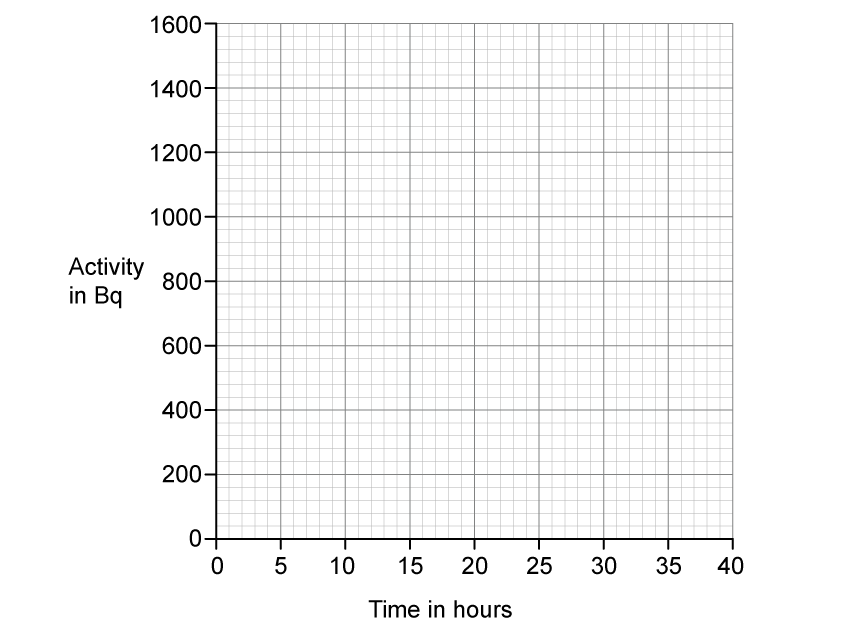
A sample of sodium-24 has an activity of 1400 Bq. The half-life of sodium-24 is 15 hours.
On the axes, sketch a graph to show how the activity of this sample changes over the next 40 hours.
Granite is a rock. It contains a radioactive isotope of uranium that decays very slowly.
(i) Explain how scientists can use this radioactivity to find the age of a piece of granite.
[4]
(ii) Suggest why the age of a piece of granite could not be found using a uranium isotope with a half-life of 15 hours.
[2]
Was this exam question helpful?
A scientist placed a radioactive source in front of a Geiger-Muller detector and measured the count rate every 20 minutes.
The table shows her data.

The scientist corrects the count rate readings to allow for background radiation.
(i) State two sources of background radiation.
[2]
(ii) Describe how the scientist should measure the background radiation and correct the count rate readings.
[3]
(i) Plot a graph of the corrected count rate against time and draw the curve of best fit.
[5]

(ii) Use your graph to find the half-life of the radioactive source.
[2]
half-life = ...................................................... minutes
The scientist needs to reduce the risks when working with radioactive sources.
(i) Explain why radioactive sources can be dangerous.
[2]
(ii) Describe how the risks of working with radioactive sources can be reduced.
[3]
Was this exam question helpful?