14 marks
The diagram shows an electric motor and the direction of current.

Explain how the current produces movement of the coil.
Was this exam question helpful?
Exam code: 4XSD1
The diagram shows an electric motor and the direction of current.
Explain how the current produces movement of the coil.
Was this exam question helpful?
Photograph E shows a rechargeable torch.

When a student shakes the torch, the magnet moves through the coil and back again.
This induces a voltage across the ends of the coil.
The voltage is used to provide current to recharge the battery.

(i) Explain why a voltage is induced.
[2]
(ii) State one way to increase this voltage.
[1]
Photograph F shows the components inside the torch.

The torch uses a light-emitting diode (LED) to provide light.
The manufacturer of the torch states that
"An LED is a more efficient source of light than a filament lamp."
Explain this statement in terms of energy transfer.
Was this exam question helpful?
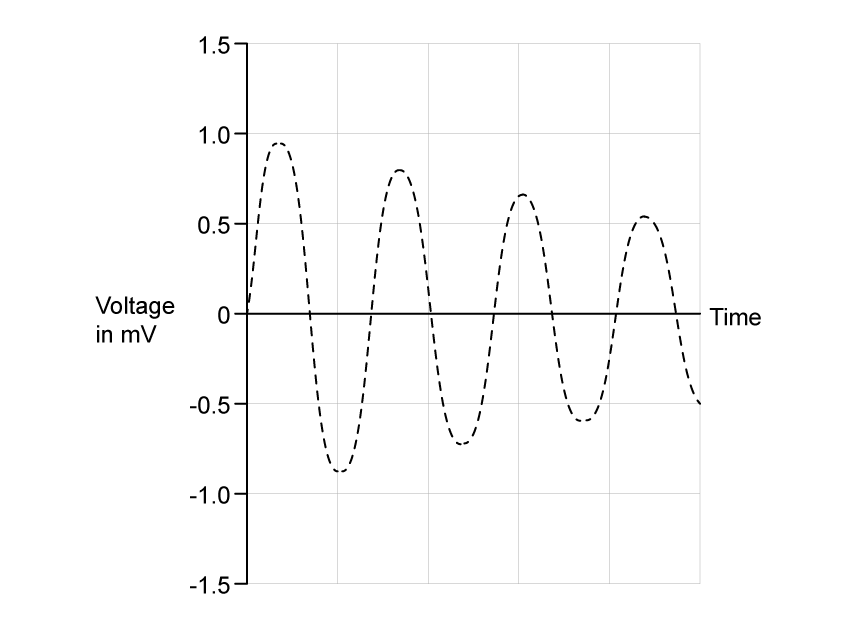
A student investigates how to produce a voltage. He hangs a magnet from a spring, above a coil that is connected to a data logger.

The student pulls the magnet through the coil to X and then releases it. The magnet moves up and down through the coil. The data logger produces this graph of voltage against time.

(i) Explain why the data logger records a varying voltage.
[2]
(ii) Which feature of the graph shows that the voltage is alternating?
[1]
(iii) Suggest why the voltage changes as shown by the graph.
[2]
The student repeats the experiment using two magnets taped together.
Compared to one magnet, these two magnets take a longer time to move up and down. The dotted line on the grid shows the original graph for one magnet.
On the same grid, sketch the graph that would be produced using two magnets.
Was this exam question helpful?
The diagram shows a magnet held above a coil. The coil is connected to a voltmeter.

The magnet is released and falls into the coil.
(i) Explain why the voltmeter shows a reading.
[2]
(ii) The magnet is released from a greater height. How does this affect the voltmeter? Explain your answer.
[2]
State how the voltmeter reading changes when the same magnet
(i) moves more slowly into the coil.
[1]
(ii) moves into a coil with more turns.
[1]
(iii) is reversed so the S-pole enters the coil first.
[1]
Was this exam question helpful?
A student uses this apparatus to investigate electromagnetic induction.

When the S pole of the magnet is moved into the coil, the pointer on the sensitive ammeter moves to the left.
Describe two ways that the student can make the pointer move to the right.
The student has a bicycle with a dynamo (generator) that supplies electricity for its lights. The diagram shows the dynamo. The friction wheel, W, presses against the bicycle tyre. When the student pedals, the friction wheel turns and causes part Y to rotate.

(i) Complete the key for the diagram by giving the names of parts Y and Z.
[2]
(ii) The graph shows how the output voltage of the dynamo varies with time as the student pedals steadily.
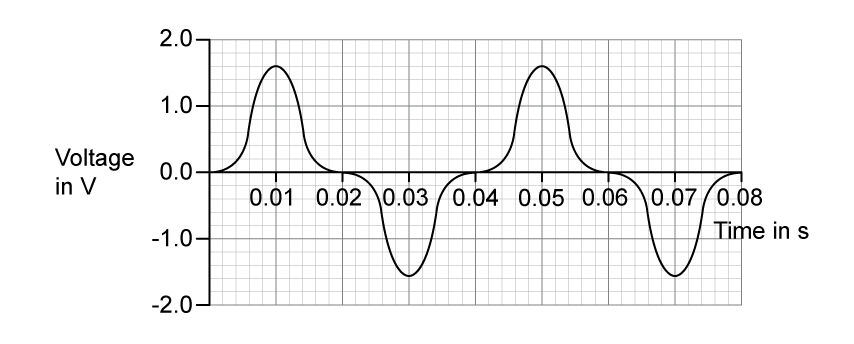
State the maximum output voltage of the dynamo.
[1]
Maximum output voltage = ........................... V
(iii) Calculate the frequency of the output voltage.
[2]
Frequency = ........................ Hz
(iv) Apart from changing the speed of the friction wheel, suggest how the output voltage of the dynamo can be increased.
[1]
Was this exam question helpful?