Ideal Gases (Edexcel IGCSE Science (Double Award) (Modular): Physics Unit 2): Exam Questions

Exam code: 4XSD1

3 hours20 questions
1a
1 mark

This question is about temperature and pressure in gases.

A sealed boiling tube contains gas.

The boiling tube is heated.

A boiling tube drawn in outline and tilted at an angle, with its rounded end at the lower right. A shaded stopper sealing the open upper end is labelled Bung. The tube itself is labelled Boiling tube. The space inside the rounded lower end is labelled Gas. An arrow points upwards at the rounded bottom of the tube and is labelled Heat.

As the temperature increases, the particles in the gas

  • expand

  • collide with the container walls with more force

  • move closer together

  • have a lower average speed

1b
1 mark

The boiling tube is then placed in an ice bath.

As the temperature decreases, the particles in the gas

  • expand

  • move slower

  • evaporate

  • move faster

1c
3 marks

The diagrams show three states of matter.

Three labelled boxes of the same size, side by side, each containing circles that represent particles. Box A holds four circles spaced widely apart with large gaps between them. Box B is filled with about twenty-four circles touching one another in an irregular, random arrangement. Box C is filled with about thirty circles packed in a regular grid of neat rows and columns with no gaps.

(i) Write the letters in the correct order from least dense to most dense.

[1]

(ii) Explain why you chose this order.

[1]

2a
1 mark

The diagram shows a syringe which contains air.

Horizontal cross-section of a syringe. A long rectangular cylinder is closed at the left-hand end and open at the right. The space inside the left-hand section is labelled Air, the outer rectangle is labelled Cylinder, and a shaded block sealing the right-hand end of the air space is labelled Piston. A narrow rod extends from the piston to the right, out of the cylinder. An arrow to the right of the cylinder points to the right.

The piston is pushed in. The volume and pressure in the syringe change.

How do the volume and pressure of the air change when the piston is pushed in?

  • Volume decreases and pressure decreases

  • Volume increases and pressure decreases

  • Volume decreases and pressure increases

  • Volume increases and pressure increases

2b
4 marks

The passage below is about kinetic theory.

Complete the sentences. 

Molecules in a gas are in constant random motion at ............... speeds. 

Random motion means that the molecules do not travel in a specific path and undergo sudden changes in their motion if they collide with the ............... of its container or with other ................. .

The random motion of tiny particles in a fluid is known as .................. motion.

2c
4 marks

(i) State what is meant by the term absolute zero.

[2]

(ii) State the value of absolute zero including a unit.

[2]

absolute zero = ...................... unit ...............

3a
1 mark

The diagram shows a bicycle pump with a moveable piston containing air.

A horizontal bicycle pump cylinder, closed at the left-hand end, with a piston near the right-hand end and a rod extending out to the right. The space to the left of the piston is labelled air, the tube is labelled cylinder and the sliding disc is labelled piston. An arrow beside the rod points to the right, away from the cylinder.

The arrow indicates the direction in which the piston is moved.

Which of the following increases as the piston is moved?

  • the rate at which air particles collide with the walls of the cylinder

  • the pressure of the air inside the cylinder

  • the mass of the air inside the cylinder

  • the volume of the air inside the cylinder

3b
4 marks

A bicycle tyre is inflated using a hand pump.

Two drawings of a bicycle inner tube. On the left a limp, folded tube with a valve, labelled Before being inflated. On the right the same tube as a full circular ring with the valve at the bottom, labelled After being inflated.

The air inside the tube exerts an outward force on the wall of the tube.

It takes 3.2 litres of air from the atmosphere to inflate the empty tube to a pressure of 360 000 Pa.

Atmospheric pressure is 100 000 Pa.

(i) State the angle that the outward force makes with the wall of the tube.

[1]

(ii) State the equation linking the initial pressure, initial volume, final pressure and final volume.

[1]

(iii) Calculate the final volume of air inside the tube once inflated.

[2]

final volume = ................................... L

3c
4 marks

When a bicycle pump is used to inflate the tube, the air in the bicycle pump gets warm. 

Complete the sentences by circling the correct words

When the air in the bicycle pump is compressed, the volume / pressure of the gas decreases and the volume / pressure increases.

This is because the particles are moving in less space and collide more often / less often / the same amount.

The increased / decreased pressure leads to an increase in temperature. This is because the temperature is a measure of the average kinetic / potential / thermal energy of particles.

When the air in the bicycle pump is compressed, this increases / decreases the energy in the kinetic / potential / thermal store of the air particles and contributes to the overall kinetic / potential / thermal energy stored in the system, this is why the bicycle pump gets warm.

4a
1 mark

The particles of a gas exert a pressure on the walls of a container.

Which of the following rows correctly describes the relationship between pressure and the number of particle collisions with the walls of the container every second?


pressure

number of collisions with the walls of the container every second

A

increases

stays the same

B

increases

increases

C

decreases

stays the same

D

decreases

increases

  • Option A

  • Option B

  • Option C

  • Option D

4b
1 mark

A digital thermometer gives a temperature reading of 19 °C.

Convert this temperature to kelvin.

4c
3 marks

A small container contains helium gas at high pressure. It comes with a label stating the pressure and volume of the helium gas inside.

A grey gas cylinder with a narrow neck, beside a two-row table. The first row reads Container pressure, 6.00 MPa. The second row reads Container volume, 10.5 cm3.

The helium gas from one small container is pumped into a large balloon which fills a final volume of 1100 cm3.

(i) State the equation linking the initial pressure, initial volume, final pressure and final volume of a gas.

[1]

(ii) Calculate the final pressure of the gas in the large balloon.

[2]

final pressure = .............................. MPa

5a
2 marks

State what is meant by an ideal gas.

5b
5 marks

The molecules of an ideal gas move around rapidly in a container as shown in the diagram.

Outline drawing of a cube-shaped container holding seven shaded circular molecules, each with an arrowed line showing its direction of travel; the arrows point in many different directions and some paths bend where a molecule rebounds

Complete the following sentences by circling the correct words

  1. If the temperature of the gas increases, the kinetic energy of the molecules increases / decreases, hence, the average velocity of the molecules increases / decreases.

  2. As a result, the frequency of the collisions increases / decreases.

  3. This leads to a larger / smaller change in momentum in each collision.

  4. Since force is directly / inversely proportional to the change in momentum, a greater change in momentum leads to an increase / decrease in the force exerted by the molecules on / by the walls of the container.

  5. Since pressure is directly / inversely proportional to the force, this leads to an increase / decrease in the pressure of the gas.

5c
3 marks

On the axes below, sketch a graph of pressure against temperature for a constant volume of gas. Clearly mark the value of absolute zero on your graph.

Blank axes with pressure on the vertical axis and temperature in degrees Celsius on the horizontal axis; the horizontal axis extends to the left of the origin and no line is drawn
6a
1 mark

A gas is sealed in a box.

The pressure of the gas is doubled. No gas leaves or enters the box.

What happens to the temperature of the gas?

  • Temperature doubles

  • Temperature remains constant

  • Temperature halves

  • Temperature is squared

6b
1 mark

The volume of the box is doubled. No gas leaves or enters the box and the temperature remains constant.

What happens to the pressure of the gas?

  • Pressure doubles

  • Pressure remains constant

  • Pressure halves

  • Pressure is squared

6c
1 mark

The box is heated and the Kelvin temperature of the gas increases by a factor of 16.

How has the average speed of the gas particles changed?

  • Average speed has increased by a factor of 2

  • Average speed has increased by a factor of 4

  • Average speed has increased by a factor of 8

  • Average speed has increased by a factor of 16

6d
2 marks

The gas has a temperature of 87 °C.

Calculate its temperature in kelvin.

1a
1 mark

A fission reactor is cooled with helium gas. The gas enters the reactor at 500 °C.

What is this temperature in kelvin?

1b
3 marks

Helium gas enters the reactor at a pressure of 8.40 MPa and leaves the reactor at a temperature of 1170 K.

Calculate the pressure of the helium gas as it leaves the reactor. [Assume the volume of the gas does not change.]

2a
2 marks

This question is about temperature and pressure in gases.

Describe what happens to the average kinetic energy of particles as the temperature decreases from 10 K towards 0 K.

2b
4 marks

(i) Convert a temperature of 27 °C into kelvin (K).

[1]

temperature = ............................. K

(ii) The gas in a cylinder has a pressure of 210 kPa at a temperature of 27 °C. Calculate the new pressure when the temperature of the gas rises to 81 °C.

[3]

pressure = ............................ kPa

3a
9 marks

Aneroid barometers are used to measure air pressure.

A student makes a model aneroid barometer as shown.

A diagram of a model aneroid barometer. A cylindrical can of air is sealed at the top by stretchy balloon fabric. A long thin pointer is taped to the balloon fabric near the left of the can and rests on a pivot at the right-hand edge of the can, extending horizontally to the right. The free end of the pointer lies against a tall vertical piece of card that acts as a scale.

(i) The balloon fabric is attached to the can to stop the air escaping.

Explain how the air inside the can causes a pressure on the balloon fabric.

[3]

(ii) The balloon fabric is tight and flat.

The pointer is horizontal as shown.

Explain what happens to the different parts of the model when the atmospheric pressure increases. [You may assume that the temperature remains constant.]

[4]

(ii) Suggest two ways that the model could be altered to increase its sensitivity to changes in atmospheric pressure.

[2]

3b
3 marks

The student heats the air in her can by placing the can in a water bath.

(i) State how this affects the reading shown by the pointer.

[1]

(ii) Explain why this happens.

[2]

4a
3 marks

Compressed air from a can is used to clean computer keyboards.

A metal aerosol can with a white nozzle. The label reads pressurised air duster and the base of the can is marked 400 ml.

Use ideas about particles to explain how a gas causes a pressure on the inside of a container.

4b
3 marks

The can has a warning sign on it.

A boxed warning label. It reads WARNING, pressurised container, do not expose to temperatures above 50 °C.

(i) How would increasing the temperature of the compressed air affect the pressure in the can?

[1]

(ii) Explain your answer.

[2]

4c
3 marks

The can has a volume of 400 cm3 and the pressure of the compressed air inside is 5 times atmospheric pressure.

Calculate the volume that the air would occupy if it were all released to atmospheric pressure. 


volume = ..................................... cm3

5a
2 marks

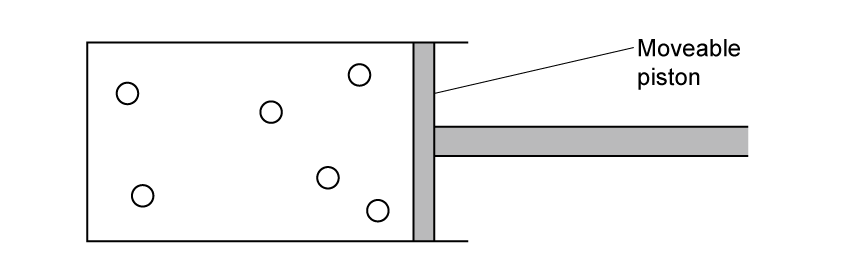
The diagram shows some gas particles in a container.

The piston can be moved in or out to change the volume of the gas.

A sealed rectangular container drawn in cross-section, with six small open circles inside it representing gas particles at random positions. The right-hand end of the container is closed by a hatched moveable piston, labelled moveable piston, which is attached to a hatched horizontal rod running off to the right.

Add arrows to the diagram to show the random motion of the gas particles.

5b
3 marks

Explain how the motion of the gas particles produces a pressure inside the container. 

5c
1 mark

State what would happen to the pressure if you pushed the piston into the container without changing the temperature.

5d
3 marks

When the gas in the container is heated, the piston moves outwards. Place ticks (✓) against the three correct statements.

Statement

Tick (✓)

the gas particles get bigger

the mass of the gas particles stays the same

the gas particles move faster

the average distance between the gas particles increases

the temperature of the gas decreases

6a
1 mark

A hot air balloon is filled with air through an opening.

The air is heated using a burner.

A line diagram of a hot air balloon. The teardrop-shaped envelope is labelled balloon and the space inside it is labelled hot air. The neck of the balloon narrows to an opening above a small square box labelled burner, which sits on top of a rectangular basket.

Describe the effect of an increase in temperature on the average speed of the air molecules.

6b
3 marks

The hot air causes a pressure on the inside of the balloon.

Use ideas about molecules to explain how the hot air causes this pressure.

6c
1 mark

Give a reason why the hottest air rises to the top of the balloon.

6d
4 marks

The average density of the hot air in the balloon is 0.95 kg/m3. The volume of this air is 2800 m3.

(i) State the equation linking density, mass and volume.

[1]

(ii) Calculate the mass of hot air in the balloon.

[3]

Mass of hot air = .......................... kg

6e
2 marks

As the balloon climbs higher, the air pressure outside it decreases.

(i) Suggest a reason for this change in the outside air pressure.

[1]

(ii) Suggest how the decrease in air pressure outside the balloon affects the hot air inside.

[1]

7a
1 mark

All gases above absolute zero exert a pressure on the walls of their container. 

State the value of absolute zero in °C. 

7b
3 marks

All gases above absolute zero exert a pressure on the walls of their container. 

Explain, in terms of its molecules, how a gas exerts a pressure on the walls of its container. 

1a
6 marks

A spray-can contains gas particles that are constantly moving.

A tall spray-can with a button on the top. The upper part of the can is labelled gas and is drawn with many small circles spread through it. The lower part is shaded grey and labelled liquid. A narrow tube runs from the button down through the gas and into the liquid.

(i) How do the gas particles produce a pressure on the walls of the spray-can?

[3]

(ii) A student presses the button and some liquid leaves the can.

The student concludes

A photograph of a student beside a speech bubble reading: I think that the gas pressure in the spray-can decreases as the liquid leaves the can.

Evaluate this conclusion.

[3]

1b
1 mark

What happens to the average speed of the gas particles when the spray-can is warmed by the sun on a hot day?

2a
2 marks

The diagram shows a can that produces whipped cream using gas at high pressure.

A line diagram of a whipped cream can. A small cylindrical high pressure gas container, marked with the letter S at its sealed neck, is angled above the top left of the can. The can is tapered, wider at the base. Its upper region is labelled space above the cream and contains three downward arrows; the region below it is labelled cream. A narrow tube runs from the top of the can down to the base, where two upward arrows are labelled cream forced up. At the top of the can a tap, drawn as a small circle with a cross, connects the gas container and the tube to a spout pointing up and to the right. The outer wall is labelled can.

The volume of the high pressure gas container is 10 cm3.

The pressure of the gas is 10 000 kPa.

When the seal at S is broken, the gas is released into the space above the cream.

The gas expands to a total volume of 270 cm3.

Calculate the new pressure of the gas.

pressure = ..................................... kPa

2b
3 marks

As the gas expands into the space above the cream, its temperature decreases. Using ideas about molecules, explain how this affects the pressure of the gas. 

2c
3 marks

Some of the gas molecules dissolve into the cream.

(i) Suggest how this affects the pressure of the gas in the space above the cream.

[2]

(ii) When the tap is opened, the pressure of the gas forces the cream out of the spout.

The pressure outside the can is less than it is inside.

Suggest what happens to the dissolved gas as the cream leaves the can.

[1]

3a
3 marks

The photograph shows a car tyre that needs to be inflated.

A black and white photograph of a car wheel fitted with a multi-spoke alloy rim. The tyre is deflated, bulging outwards at the sides and flattened where it meets the road surface.

Author: Ildar Sagdejev

The tyre exerts a pressure on the road of 270 kPa.

Use ideas about molecules to explain why the air inside the tyre exerts pressure.

3b
3 marks

Air is pumped into the tyre to inflate it.

This increases the temperature and the pressure of the air in the tyre.

Use ideas about molecules to explain why the air pressure in the tyre increases. 

4a
6 marks

A diver breathes air from a cylinder when he is under water.

A black and white photograph of a scuba diver swimming underwater above a sandy seabed. The diver wears a wetsuit, fins and a mask, and carries a cylinder of air strapped to his back. A stream of small bubbles rises from the diver towards the surface.

(i) The cylinder contains 8 litres of air at 200 times atmospheric pressure.

The air is released from the cylinder at normal atmospheric pressure.

The diver needs 16 litres of air per minute.

Calculate the maximum amount of time that the diver can breathe under water using this cylinder.

[4]

time = ..................................... minutes

(ii) When the diver breathes out, bubbles are released.

Suggest why the bubbles expand as they rise to the surface.

[2]

4b
4 marks

A student wants to investigate how the volume of a balloon changes with pressure.

A line drawing of two hands. The left hand grips the barrel of a cylindrical pump while the right hand holds the neck of a round inflated balloon that is attached to the nozzle at the end of the pump.

(i) Suggest how the student could measure the volume of an inflated balloon.

[2]

(ii) The student plans to measure the pressure of the air in the balloon.

A boxed handwritten extract of the student's plan. It reads: To measure the pressure in the balloon I will count how many times I push the pump. The same amount of air goes into the balloon with each push. When there is twice as much air in the balloon the pressure will be twice as high, so the pressure will be proportional to the number of times I push the pump.

Explain why the student’s plan will not work.

[2]

5a
4 marks

A student blows up two balloons to the same size.

She puts one balloon into a freezer.

After a while, the student compares the two balloons.

The balloon that has been cooled is smaller.

Two grey inflated balloons side by side on a white background. The balloon on the left is larger and more elongated. The balloon on the right is smaller and rounder. Both balloons are tied with a knot at the neck.

Use ideas about particles to explain why the cooled balloon is smaller.

5b
6 marks

The student decides to investigate the link between temperature and the size of the balloon.

She writes a plan.

A handwritten plan on a spiral-bound notepad. It reads: I will change the temperature of the balloon by putting it into a freezer. To get a range of different temperatures I will put the balloon into the freezer for different times. I will measure the temperature of the balloon using a thermometer. To measure the size of the balloon I will take it out of the freezer and line it up next to a ruler. To make sure it is a fair test I will repeat the experiment three times. I will plot a graph of size against temperature.

There are several faults in the student's plan.

Identify three of these faults and suggest an improvement to correct each one.

6a
3 marks

A diver works in the sea on a day when the atmospheric pressure is 101 kPa and the density of the seawater is 1028 kg/m3.

A black and white underwater photograph of a scuba diver swimming above a coral reef. The diver wears a mask, wetsuit and fins, with a gas cylinder strapped to the back, and bubbles of exhaled air rise from the breathing apparatus towards the surface.

The diver uses compressed air to breathe under water.

1700 litres of air from the atmosphere is compressed into a 12-litre gas cylinder.

The compressed air quickly cools to its original temperature.

Calculate the pressure of the air in the cylinder.

pressure = .......................... kPa

6b
4 marks

(i) State the equation linking pressure difference, depth, density and g.

[1]

(ii) Calculate the increase in pressure when the diver descends from the surface to a depth of 11 m.

[2]

increase in pressure = .......................... kPa

(iii) Calculate the total pressure on the diver at a depth of 11 m.

Assume that the atmospheric pressure remains at 101 kPa.

[1]

total pressure = .......................... kPa

6c
2 marks

As the diver breathes out, bubbles of gas are released and rise to the surface.

The bubbles increase in volume as they rise.

Explain this increase in volume. 

7a
3 marks

A student uses this apparatus to investigate the pressure and volume inside a sealed gas syringe.

A vertical gas syringe standing on a flat base. The graduated barrel of the syringe holds a plunger whose rod extends upwards to support a horizontal platform. Three weights sit on the platform, two side by side with a third resting on top of them. Labels point to the weights, the platform and the gas syringe.

She takes readings of the volume as she increases the pressure (loading) and as she decreases the pressure (unloading).

These are her results.

A results table with four columns. The first column is headed Pressure in kPa. The other three columns sit under one heading, Volume of gas in cm3, and are headed loading, unloading and average (mean). The rows read 100, 50, 50, 50. Then 90, 56, 55, 55.5. Then 84, 60, 60, 60. Then 55, 90, a blank cell, 92. Then 60, 85, 83, 84. Then 50, 101, 101, 101.

(i) Complete the table by filling in the missing value.

[1]

(ii) Suggest why the student takes readings for increasing the pressure and for decreasing the pressure.

[2]

7b
6 marks

The student plots this graph.

A line graph with average volume of gas in cm3 on the horizontal axis, scaled from 40 to 110, and pressure of gas in kPa on the vertical axis, scaled from 40 to 110. Six points are plotted as crosses, at volume 50 and pressure 100, volume 55 and pressure 90, volume 60 and pressure 84, volume 84 and pressure 60, volume 92 and pressure 55, and volume 101 and pressure 50. A straight line of best fit and a curve of best fit are both drawn. The curve passes very close to every cross. The straight line passes through the second and fifth crosses, lies above the curve between them, and passes below the first and last crosses.

(i) Suggest a reason why the axes do not start from the origin (0,0).

[1]

(ii) The student has drawn both a straight line of best fit and a curve of best fit.

Discuss which line is correct for this investigation.

[2]

(iii) Suggest a way that the student could make this experiment valid (a fair test).

[1]

(iv) Suggest two ways in which the student could improve the quality of her data.

[2]

7c
3 marks

The student concludes that her data validates the relationship between pressure and volume of a fixed mass of gas.

Use data from this table to evaluate her conclusion.

Pressure in kPa

Average volume in cm3

Space for calculations

100

50

90

55.5

84

60

55

92

60

84

50

101