11 mark
The Period 2 element with the highest melting temperature is
aluminium
boron
carbon
silicon
Was this exam question helpful?
Exam code: XCH11
The Period 2 element with the highest melting temperature is
aluminium
boron
carbon
silicon
Was this exam question helpful?
The trends in three physical properties of the Period 3 elements sodium to sulfur are shown in the graphs.


Which of these properties is not shown?
atomic radius
electrical conductivity
first ionisation energy
melting temperature
Was this exam question helpful?
Which Period 3 element has the highest melting temperature?
aluminium
silicon
sulfur
argon
Was this exam question helpful?
Which statement does not explain the increase in first ionisation energy across a period?
Atomic radius decreases
Nuclear charge increases
The number of electrons increases
Shielding stays approximately the same
Was this exam question helpful?
Which of these metals has the highest melting temperature?
sodium
magnesium
aluminium
potassium
Was this exam question helpful?
In which series are the elements in order of increasing melting temperature?
I2 < Br2 < Cl2 < F2
Li < Be < B < C
Li < Na < K < Rb
Si < P < S < Cl
Was this exam question helpful?
The graph shows the first ionisation energies of the elements in Period 3, labelled A to H in order of increasing atomic number.

Element X has the electronic configuration [Ne] 3s2 3p2.
Which letter on the graph labels element X?
C
D
E
F
The first ionisation energy of element C is lower than that of element B. What is the reason for this?
Element C's outermost electron is paired
Element C has fewer protons than element B
Element C has more outer-shell electrons than element B, increasing electron–electron repulsion
Element C's outermost electron occupies a 3p sub-shell, which is at a higher energy and more shielded than the 3s sub-shell holding element B's outermost electron
The first ionisation energy of element F is lower than that of element E. What is the reason for this?
Element F has more shielding than element E
Element F has a larger atomic radius than element E
Element F's outermost electron is in a higher-energy sub-shell than element E's
Element F has 3p4 with one paired orbital — the spin-pair repulsion makes one of the paired electrons easier to remove than an electron from element E's 3p3
Was this exam question helpful?
Which of these lists the first ionisation energies, in kJ mol−1, of sulfur, chlorine, argon and potassium, in that order?
419, 1000, 1251, 1521
1000, 1251, 1521, 419
1000, 1251, 1521, 1700
1521, 1251, 1000, 419
Was this exam question helpful?
Which statement best explains why nitrogen has a greater first ionisation energy than oxygen?
N atoms have a greater nuclear charge than O atoms
N atoms lose a 2s electron, but O atoms lose a 2p electron
N atoms have an odd number of electrons and O atoms have an even number
N atoms have no paired 2p electrons, but O atoms have a pair of electrons in one 2p orbital that repel each other
Was this exam question helpful?
The first ionisation energy of beryllium is greater than that of boron.
Which statement explains this?
Boron has a full outer shell
Boron atoms are larger than beryllium atoms
Beryllium has a greater nuclear charge than boron
The outer electron of boron is in a 2p sub-shell, which is at a higher energy than the 2s sub-shell
Was this exam question helpful?
Which of these trends is correct?
First ionisation energy decreases from lithium to caesium
First ionisation energy increases from nitrogen to oxygen
Melting temperature decreases from lithium to carbon
Melting temperature increases from silicon to phosphorus
Was this exam question helpful?
The graph shows the logarithm of the first ionisation energy plotted against atomic number for the elements with atomic numbers 1 to 36. Four of the elements are labelled A to D.
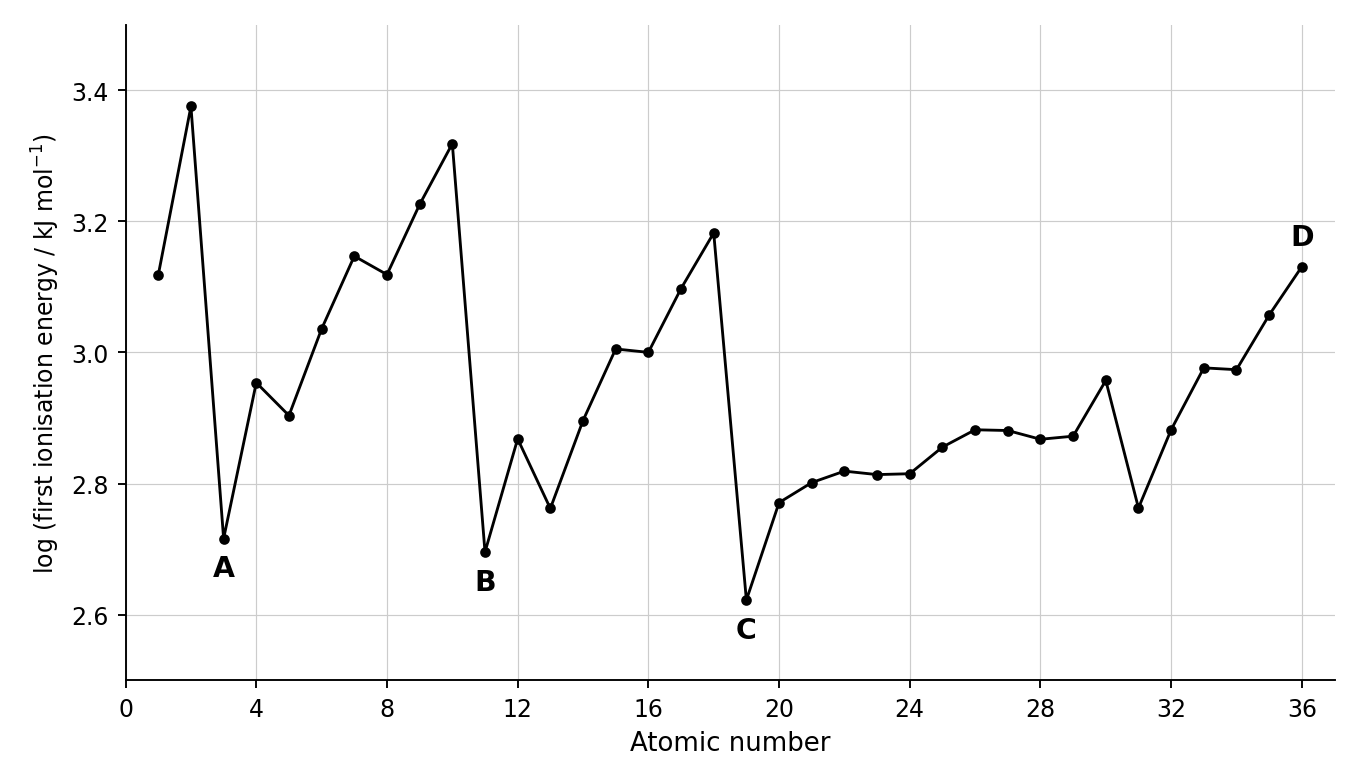
Which labelled element is in Group 1 and Period 4?
Was this exam question helpful?
In which pair does the second element have a greater first ionisation energy than the first element?
First element | Second element | |
|---|---|---|
A | Mg | Al |
B | N | O |
C | Ne | Na |
D | K | Na |
Was this exam question helpful?
The table shows the first ionisation energies and melting temperatures of five consecutive elements in Period 2, in order of increasing atomic number. The letters are not the symbols of the elements.
Element | V | W | X | Y | Z |
|---|---|---|---|---|---|
First ionisation energy / kJ mol−1 | 520 | 900 | 801 | 1086 | 1402 |
Melting temperature / K | 454 | 1560 | 2350 | 3820 | 63 |
Which statement is correct?
Y has the highest melting temperature because it has the strongest metallic bonding of the five elements
V has the lowest first ionisation energy of the five elements because its outer electron is in a 2p sub-shell
X has a lower first ionisation energy than W because the outer electron of X is in a higher-energy 2p sub-shell
Z has a low melting temperature because little energy is needed to break the covalent bonds within its molecules
Was this exam question helpful?
X, Y and Z are consecutive elements in Period 3, in that order.
Of these three elements, Y has the highest first ionisation energy and the lowest melting temperature.
Which of these could be X, Y and Z?
aluminium, silicon, phosphorus
magnesium, aluminium, silicon
silicon, phosphorus, sulfur
sodium, magnesium, aluminium
Was this exam question helpful?
Element J has a lower first ionisation energy and a higher melting temperature than the element before it in the Periodic Table.
The ion formed by J has the same electronic configuration as argon.
What is element J?
sodium
aluminium
phosphorus
sulfur
Was this exam question helpful?
The graph shows the first ionisation energies of four consecutive elements, labelled A to D.

One of these elements, X, reacts with hydrogen to form a covalent compound with the formula HX.
Which element could be X?
Was this exam question helpful?
In which row is the first ionisation energy of element Y greater than that of element X?
Element X | Element Y | |
|---|---|---|
A | 1s2 2s2 2p6 3s2 | 1s2 2s2 2p6 3s2 3p1 |
B | 1s2 2s2 2p6 3s2 3p3 | 1s2 2s2 2p6 3s2 3p4 |
C | 1s2 2s2 2p6 3s2 3p5 | 1s2 2s2 2p6 3s2 3p6 |
D | 1s2 2s2 2p6 3s2 3p6 | 1s2 2s2 2p6 3s2 3p6 4s1 |
Was this exam question helpful?