Polarisation (Edexcel International AS Chemistry): Revision Note
Exam code: XCH11

The Polarisation of anions & Cations
Theoretical lattice energies assume a perfect ionic model where the ions are 100% spherical and the attractions are purely electrostatic
So overall, there has been a complete transfer of outer shell electrons between the two elements in the compound so that one ion is negatively charged and the other ion positively charged and the charges are whole values
Comparing theoretical and experimental lattice energies is covered at A level, in Unit 4
Theoretical lattice energy can differ from measured lattice energy
This is because covalent character is introduced when there is polarisation of the anions
When this occurs, the cation attracts electrons from the anion therefore distorting electron density of the anion
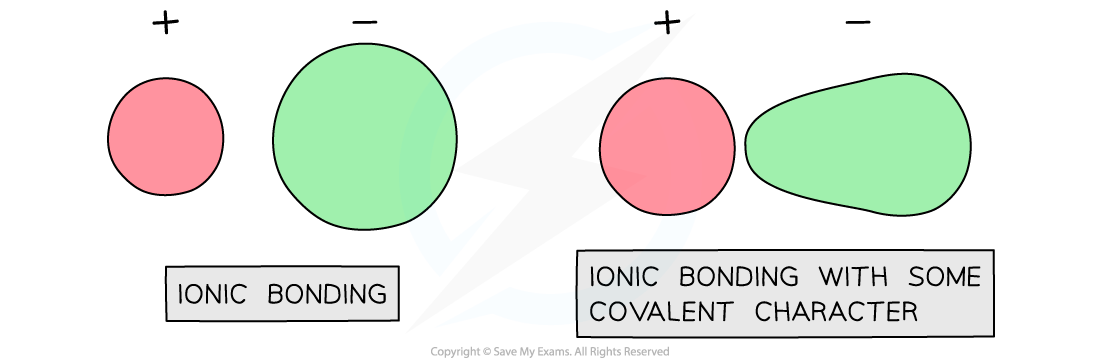
Polarisation of anion leading to covalent character
Cations
A cation with a large charge density will have a larger polarising power
The charge density depends on the charge of the cation and its ionic radius: the smaller and more highly charged the cation, the higher its charge density, for example
K+ will have a lower polarising power than Li+ as the ionic radius is greater
Na+ will have a lower polarising power than Mg2+ as the charge is smaller
So a cation that is small and highly charged will have the greatest polarising power
Anions
Anions are polarised
The polarisability of an anion depends on its ionic radius and its charge
The larger the ionic radius, or the greater the charge, the more easily an anion is distorted, for example
Br- will be more polarisable than Cl- as the ionic radius is larger

Unlock more, it's free!
Join the 100,000+ Students that ❤️ Save My Exams
the (exam) results speak for themselves:

Was this revision note helpful?
Build on this topic