11 mark
The wavefront diagrams show consecutive waves approaching gaps of different sizes.

The wavefronts diffract as they pass through each gap.
In which diagram will the diffracted wavefronts not be semicircular?
Was this exam question helpful?
Exam code: XPH11
The wavefront diagrams show consecutive waves approaching gaps of different sizes.
The wavefronts diffract as they pass through each gap.
In which diagram will the diffracted wavefronts not be semicircular?
Was this exam question helpful?
A student determines the wavelength of the light emitted by a laser. She uses the laser, a diffraction grating and a screen.
Which of the following measurements is not required?
the distance from the diffraction grating to the screen
the distance from the central maximum to the first order maximum
the distance from the laser to the diffraction grating
the distance between the slits in the diffraction grating
Was this exam question helpful?
A pulse of ultrasound is emitted from the bottom of a boat. The ultrasound reflects from the seabed and is detected at the bottom of the boat after time t. The depth d of water under the boat is shown.

The ultrasound has a frequency f and travels at a speed v in the seawater.
Which of the following can be used to calculate d?
Was this exam question helpful?
A moving electron has a de Broglie wavelength of 656 nm.
Which of the following could be used to determine the speed of the electron?
Was this exam question helpful?
The de Broglie wavelength for a moving electron is 5.47 × 10⁻¹⁰ m.
Which of the following expressions gives the speed of the electron in m s–1?
Was this exam question helpful?
The diagram represents an arrangement to demonstrate electron diffraction.

A beam of electrons is directed at a sample of crystalline material.
Which of the following single changes would decrease the angle of diffraction θ?
decrease the distance between the sample and the screen
increase the anode potential V
increase the current in the filament
use a sample with a smaller atomic spacing
Was this exam question helpful?
An electron and a proton are travelling at the same velocity.
The electron has a mass and a de Broglie wavelength .
The proton has a mass .
Which of the following gives the de Broglie wavelength of the proton?
Was this exam question helpful?
When laser light of wavelength is directed towards a diffraction grating, a diffraction pattern is observed on a screen. The position of a second-order maximum on the screen is shown in the diagram.
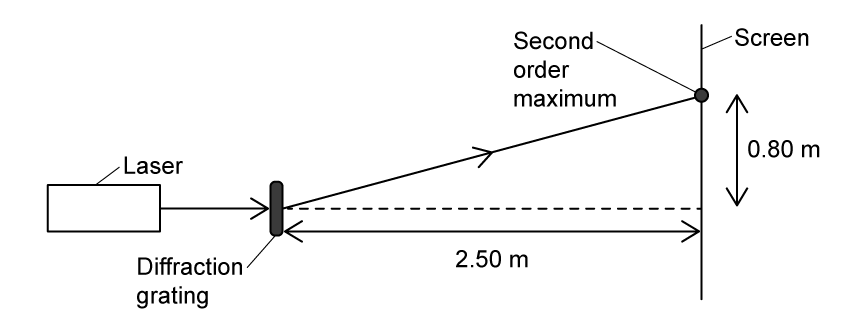
Which of the following calculations should be used to determine the number of lines per mm of the grating?
where
where
where
where
Was this exam question helpful?