Nuclear Instability & Radius (AQA A Level Physics): Exam Questions

Exam code: 7408

3 hours31 questions
1
1 mark

Which of the following statement is incorrect?

  • β+ emitters are neutron–rich compared to stable isotopes

  •  βemitters are neutron–rich compared to stable isotopes

  • Electron capture occurs in proton–rich isotopes

  • α emitters are isotopes with a proton number greater than 60

2
1 mark

Which of the following shows the correct N (neutron number) and Z (proton number) graph for α decay?

8-3-mcq--q2-easy-aqa-a-level-physics
    3
    1 mark

    What is the radius of an Mg–24 nucleus? 

    You may use  R0 = 1.2 fm

    • 10 fm

    • 29 fm

    • 3.5 fm

    • 83 fm

    4
    1 mark

    Which graph shows how intensity I varies with angle θ when electrons are diffracted by a nucleus?

    8-3-mcq--q4-easy-aqa-a-level-physics
      5
      1 mark

      A nuclear stability graph is shown in the diagram below.

      8-3-mcq--q5-easy-aqa-a-level-physics

      Which row correctly matches the number to the type of decay most likely by nuclei in that area? 


      Alpha Decay

      β Decay

      β+ Decay

      A

      B

      C

      D

      1

      2

      1

      3

      4

      4

      2

      1

      3

      1

      3

      4

        1
        1 mark

        The radius of a nucleus of cobalt-59 (Co2759) is 4.38 × 10⁻¹⁵ m. 

        What is the radius of a nucleus of gadolinium-158 (Ga64158)?

        • 8.23 × 10⁻¹⁵ m

        • 0.65 × 10⁻¹⁵ m

        • 178 × 10–15 m

        • 6.08 × 10⁻¹⁵ m

        2
        1 mark

        Bi-214 decays by an α decay and 3 β decays. 

        What is the position of the nucleus on the N–Z graph following these decays?

        8-3-mcq--q2-medium-aqa-a-level-physics
          3
          1 mark

          The diameter of a nucleus of nihonium­–297 (Nh113297) is approximately three times larger than the diameter of a nucleus of

          • Na1123

          • B511

          • As3375

          • Cl1733

          4
          1 mark

          Which of the following graphs relating nuclear radius R and nucleon number A has a gradient of 13 ?

          8-3-mcq--q4-medium-aqa-a-level-physics
            5
            1 mark

            Which of the following statements about nuclear density is correct?

            • The density of a nucleus does not depend on its radius

            • The density of a nucleus depends on its mass number

            • The density of a nucleus is inversely proportional to its radius cubed

            • The density of a nucleus increases as the radius increases

            6
            Sme Calculator
            1 mark

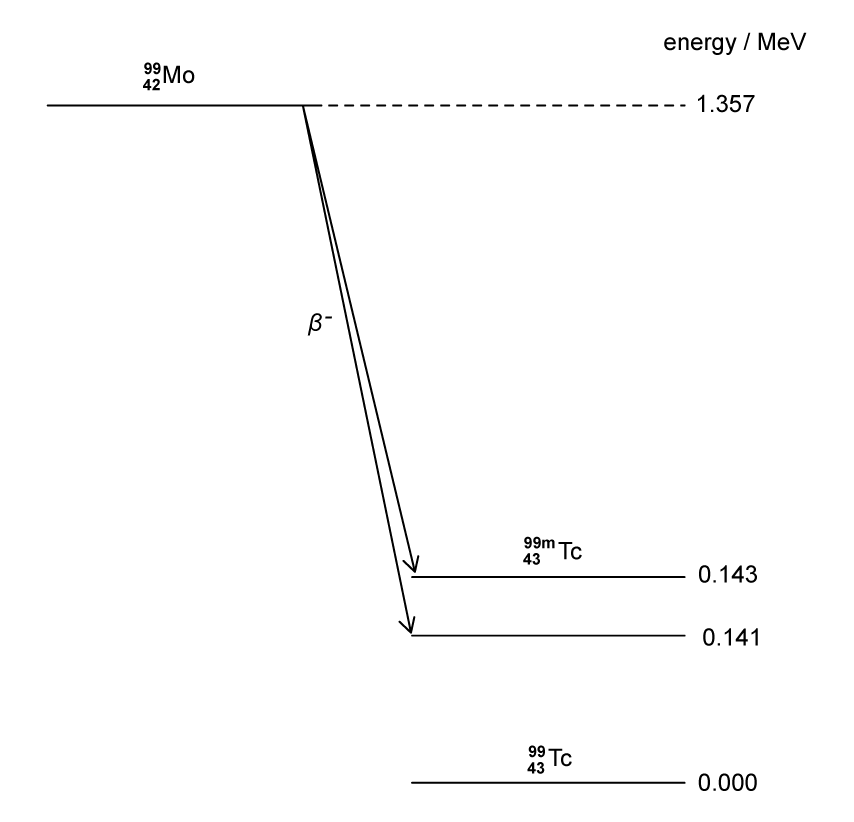
            Mo4299 decays to one of two excited states of Tc4399m by beta minus emission.

            Both excited states then decay by emitting a gamma photon.

            The diagram shows the nuclear energy levels involved in the decay of Mo4299. All energies are measured relative to the ground state of Tc4399.

            Nuclear energy level diagram with three horizontal lines on a vertical energy axis. Top line: molybdenum-99 at 1.357 MeV. Middle lines: technetium-99m at 0.143 MeV and 0.141 MeV. Bottom line: technetium-99 at 0 MeV (ground state). Two downward arrows labeled beta-minus connects the Mo-99 level to the Tc-99m levels. The proton number increases from left to right (Mo: Z = 42 on the left, Tc: Z = 43 on the right), so the beta-minus arrows slant slightly to the right

            What is the maximum possible energy of the beta particle emitted when Tc4399m decays to the ground state?

            • 0.143 MeV

            • 1.216 MeV

            • 1.357 MeV

            • 1.500 MeV

            7
            Sme Calculator
            1 mark

            Two nuclei have nucleon numbers 216 and 27.

            What is the ratio of the radius of the larger nucleus to the radius of the smaller nucleus?

            • 2

            • 3

            • 4

            • 8

            1
            1 mark

            A nucleus of In–116 decays into a stable nucleus of Sn–116 by β emission followed by the emission of γ–radiation as the Sn–116 nucleus de-excites into its ground state. 

            The In–116 nucleus can decay into one of three excited states of the Sn–116 nucleus.

            8-3-mcq--q1-hard-aqa-a-level-physics

            Which line in the table gives the correct values for the maximum number of discrete wavelengths and the longest possible wavelength of the emitted γ–radiation? 


            maximum number of discrete wavelengths

            longest possible wavelength

            A

            B

            C

            D

            6

            6

            3

            3

            4.6 × 10⁻¹² m

            8.9 × 10⁻¹² m

            8.9 × 10⁻¹² m

            4.6 × 10⁻¹² m

              2
              1 mark

              The graph shows how the relative intensity of the scattered electrons varies with angle due to diffraction by the oxygen–16 nuclei. The angle is measured from the original direction of the beam.

              8-3-mcq--q2-hard-aqa-a-level-physics

              What is the momentum of the electrons?

              The constant of proportionality is R0 = 1.2 fm

              • 0.3 × 10⁻¹⁹ kg m s–1

              • 1.5 × 10⁻¹⁹ kg m s–1

              • 2.0 × 10⁻¹⁹ kg m s–1

              • 4.7 × 10⁻¹⁹ kg m s–1

              3
              1 mark

              In the Rutherford scattering experiment, α particles were fired directly at a sheet of thin gold foil (Au79197). Some particles were found to rebound straight back from the foil. 

              Which of the following gives the best estimate of the distance of closest approach to a gold nucleus of an α particle with an initial speed of 2.5 × 10⁷ m s–1?

              • 12 fm

              • 60 fm

              • 35 fm

              • 17 fm

              4
              1 mark

              Which of the following gives an approximate value for the density of a nucleus?

              The constant of proportionality is R0 = 1.2 fm

              • 1.1 × 10¹⁴ g cm–3

              • 2.3 × 10¹⁴ g cm–3

              • 1.1 × 10¹⁷ kg m–3

              • 2.3 × 10¹⁷ g m–3

              5
              1 mark

              The ratio radius of a nucleus of Radiumradius of a nucleus of Osmium is equal 1.06, where the nucleus of Osmium is O76190s

              What type of decay is Radium­ most likely to decay through?

              • α decay

              • β decay

              •  β+decay

              • γ  decay