Investigating Circular Motion (OCR A Level Physics): Revision Note
Exam code: H556

Investigating Circular Motion
Equipment & Method
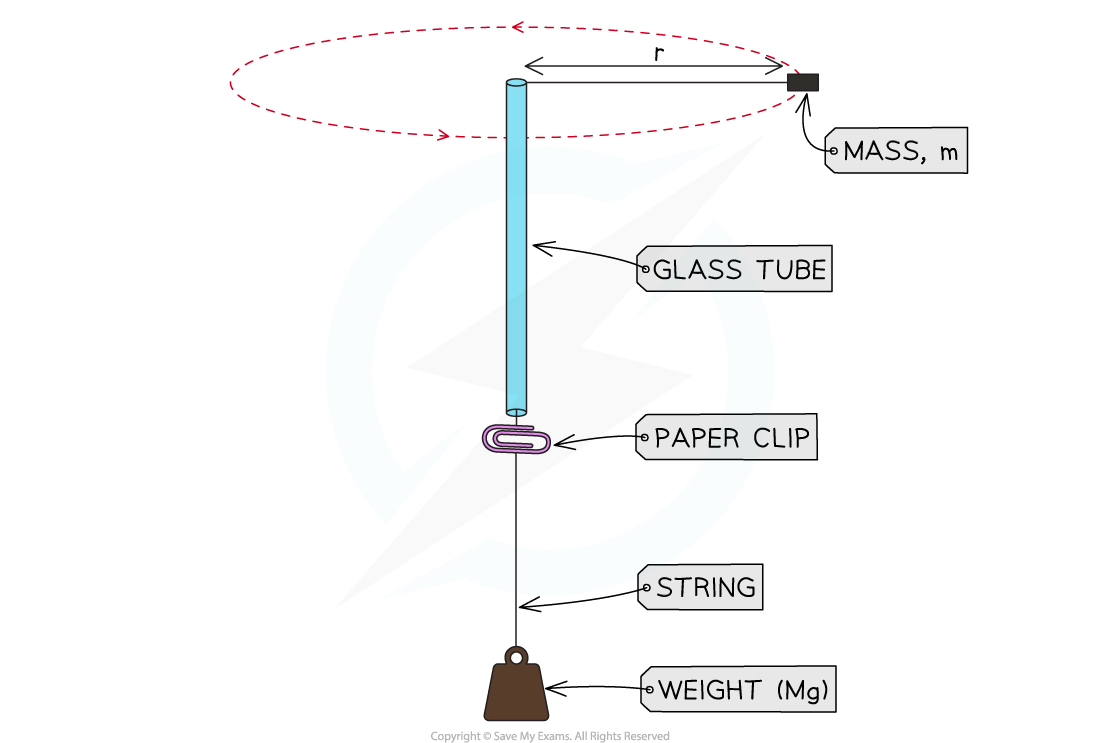
Circular motion can be investigated using the following setup:
Tie a bung of mass m, to a piece of string, which sits horizontally
Thread it though a glass tube and a paper clip, which sits vertically
At the other end of the string an object with mass M is suspended vertically (a mass or some washers are commonly used)
This weight creates constant tension in the string and provides the centripetal force
The paperclip acts as a marker; the speed of the rotation is adjusted until the paperclip remains in a fixed position just below the glass tube
The string is spun in a horizontal circle
The period of the rotation is measured
The time taken for multiple rotations is recorded and repeated to reduce random errors
The experiment is repeated again using different distances between the mass and the glass tube (the radius of the circle)
Explanation
The weight force Mg exerted on the string by the hanging mass M creates tension in the string
The centripetal force should be found to be approximately equal to this weight force
The angular velocity of the bung, mass m, can be found using
Where:
= angular velocity (rad s-1)
= time period of oscillation (s)
The centripetal force can be calculated using
Where:
= centripetal force (N)
= mass of bung (kg)
= angular velocity (rad s-1)
= radius of circle = length of string between bung and glass tube (m)
The centripetal force should be found to be approximately equal to the weight of the hanging mass,
Where:
= mass of the hanging mass providing the tension in the string (kg)
= gravitational field strength (N kg-1)
The investigation should show that as increases, the time period increases, but the centripetal force remains the same
Examiner Tips and Tricks
In a non-experimental setting, you are expected to understand the physics of swinging a mass in a vertical circle. However, this is difficult to measure in a practical setting so you would not be expected to carry out the investigation.
In a vertical circle:
As the bung moves around the circle, the direction of the tension will change continuously
The magnitude of the tension will also vary continuously, reaching a maximum value at the bottom and a minimum value at the top
This is because the direction of the weight of the bung never changes, so the resultant force will vary depending on the position of the bung in the circle
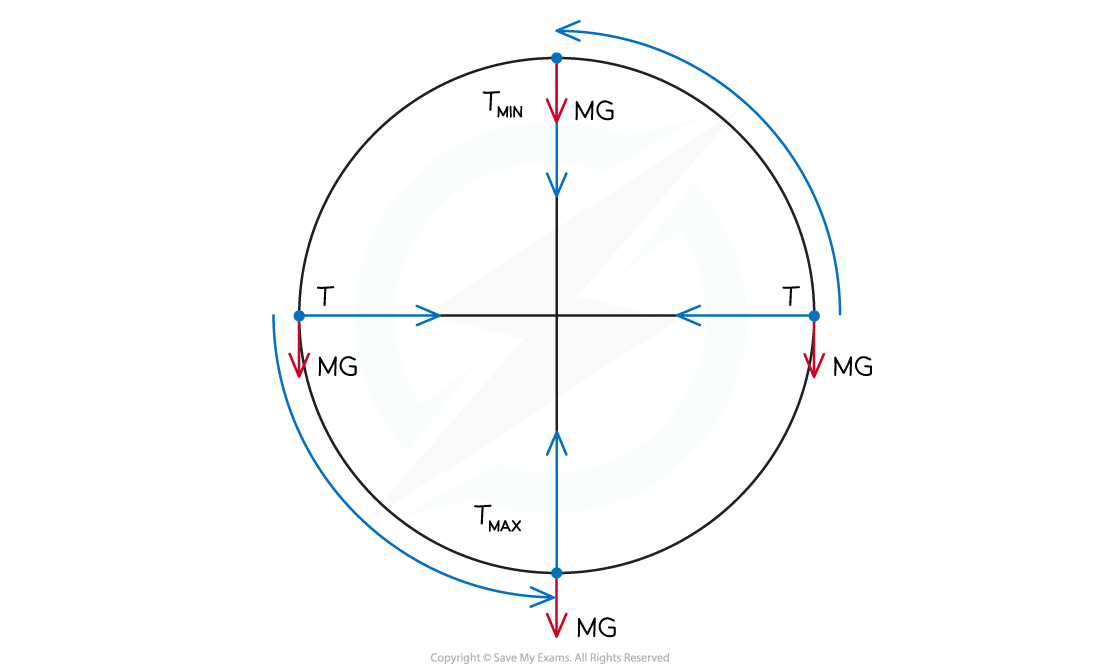
At the bottom of the circle, the tension must overcome the weight, this can be written as:
As a result, the acceleration, and hence, the speed of the bung will be faster at the bottom
At the top of the circle, the tension and weight act in the same direction, this can be written as:
As a result, the acceleration, and hence, the speed of the bung will be slower at the top
If the speed is too slow, the string will go slack, since the tension force cannot be negative

Unlock more, it's free!
Join the 100,000+ Students that ❤️ Save My Exams
the (exam) results speak for themselves:

Was this revision note helpful?
Build on this topic