14 marks
(i) Sketch the graph of in the interval .
(ii) Write down all the values of where in the given interval.
Was this exam question helpful?
(i) Sketch the graph of in the interval .
(ii) Write down all the values of where in the given interval.
Was this exam question helpful?
The graph below shows the curve with equation in the interval .
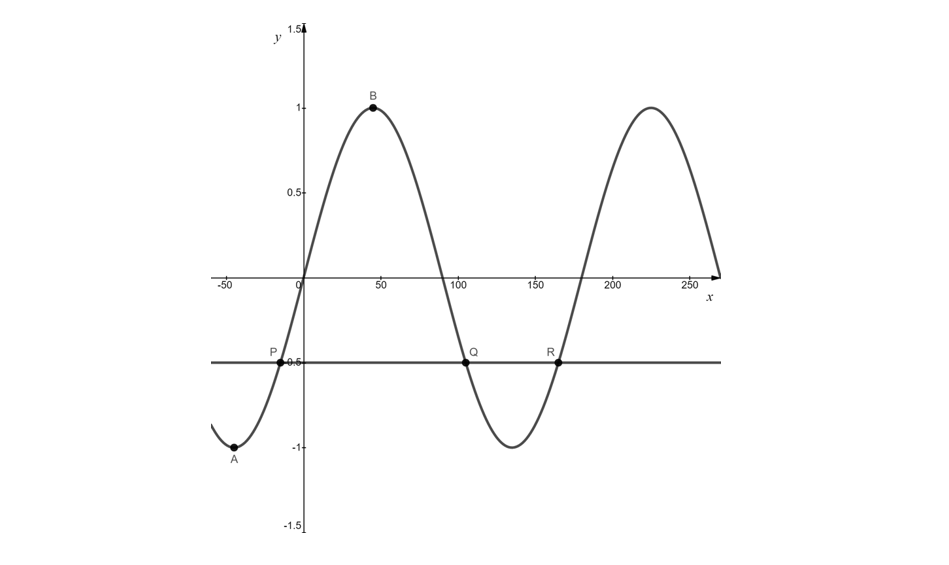
Point has coordinates and is the minimum point closest to the origin. Point is the maximum point closest to the origin. State the coordinates of .
A straight line with equation meets the graph of at the three points , and , as shown in the diagram.
Given that point has coordinates , use graph symmetries to determine the coordinates of and .
Was this exam question helpful?
A dolphin is swimming so that it dives in and out of the water at a constant speed.
On each jump and dive, the dolphin reaches a height of 2 m above sea level and a depth of 2 m below sea level.
Starting at sea level, the dolphin takes seconds to jump out of the water, dive back in and return to sea level.
The height, metres, of the dolphin relative to sea level, seconds after it leaves sea level, can be modelled by
where .
Find the value of and the value of .
Was this exam question helpful?
A section of a new rollercoaster has a series of rises and falls. The vertical displacement, metres, of the rollercoaster carriage relative to a fixed reference height can be modelled by
where is the time in seconds.
(i) Sketch the graph of against for .
(ii) Write down the number of times the carriage falls during the 30 seconds.
(iii) Find the time taken for the carriage to reach the bottom of the first fall.
Was this exam question helpful?
The height, metres, of the water in a reservoir can be modelled by the function
where is the time in hours after midnight, and and are positive constants.
Write down, in terms of and ,
(i) the height of the water at midnight;
(ii) the maximum height of the water;
(iii) the minimum height of the water.
The maximum height of the water is 3 m more than its height at midnight, and three times its minimum height.
Find the maximum height, the minimum height and the height of the water at midnight.
(i) Write down the number of times each day that the water is at its maximum height.
(ii) Find the times of day at which the water is at its minimum height.
Was this exam question helpful?
A lifejacket falls over the side of a boat from a height of 3 m. The height, metres, of the lifejacket above or below sea level, seconds after it falls, can be modelled by
where sea level is .
The lifejacket reaches its furthest point below sea level after 0.742 seconds. Find the total distance it has fallen, giving your answer correct to three significant figures.
Find the first three values of for which the lifejacket is at sea level.
(i) Find the value of when .
(ii) Hence explain why, for , the lifejacket is always within 4 cm of sea level.
Was this exam question helpful?
The number of daylight hours, , in the UK on the day that is days after the spring equinox (the day in spring on which there are 12 hours of daylight) can be modelled by
(i) Find the number of daylight hours on the day that is 100 days after the spring equinox.
(ii) Find the two integer values of for which the number of daylight hours is closest to 9.
Find the number of days in the year for which the model predicts more than 15 hours of daylight.
Was this exam question helpful?
Felicity is a keen ice skater and has entered a competition that requires her to skate in a circular pathway in front of three judges. Her distance, metres, from the judges' table, seconds after she starts her routine, can be modelled by
(i) State the distance between Felicity and the judges' table at the start of her routine.
(ii) State the distance between Felicity and the judges' table after 15 seconds.
Find, in terms of , the circumference of Felicity's circular pathway on the ice rink.
Find, in terms of , Felicity's average speed for each lap on the ice rink.
Felicity's routine took three laps in total around the ice rink.
Find the times during Felicity's routine at which she was at a distance of 21 metres from the judges' table.
Was this exam question helpful?
Let , for .
Let .
The function can be written in the form .
The range of is . Find and .
Find the range of .
(i) Find the value of and .
(ii) Find the period of .
The equation has two solutions where . Find both solutions.
Was this exam question helpful?
An average heart holds approximately 140 millilitres of blood and pumps out half of this volume with each beat. A healthy adult has a heart rate of about 70 beats per minute.
The volume of blood, millilitres, in the heart seconds after it is at full capacity can be modelled by
where .
Find the values of , and .
Show that the volume of blood first reaches its minimum when .
Was this exam question helpful?
(i) Sketch the graph of in the interval .
(ii) Write down all the values of for which in the given interval.
Was this exam question helpful?
A graph has the equation for the interval .
Sketch the graph on the axes below.

A straight line with equation intersects the graph of .
(i) Sketch the line on to the same set of axes.
(ii) Find the coordinates of the points of intersection between and .
Was this exam question helpful?
Let .
The following diagram shows part of the graph of , for .

The first local minimum is at point and the next local maximum is at point .
Find the value of
(i)
(ii)
(iii) .
Let .
Find the two solutions of , for .
Was this exam question helpful?
A particle, , starts at a fixed point, , before being set into motion. The vertical displacement, cm, of the particle from can be modelled by
where is the horizontal displacement, in cm, of the particle from .
Find the straight-line distance of the particle from at the end of the motion.
A second particle, , starts moving at the same time as particle . The vertical displacement, cm, of particle can be modelled by
where .
Particle collides with particle at the end of the motion of particle . Find the value of .
Was this exam question helpful?
A snake moves along a horizontal surface following a line that is 3 m from, and parallel to, the edge of a straight section of river, as shown in the diagram below.

The perpendicular distance, cm, of the tip of the snake's tail from the edge of the river can be modelled by
where is the horizontal distance, in cm, moved by the tip of the tail from the start of the movement.
(i) Write down the maximum perpendicular distance between the tip of the tail and the edge of the river.
(ii) Find the number of times that the tip of the tail is at this maximum distance for .
A stone is located at a perpendicular distance of 294 cm from the river when the snake has travelled of the total horizontal distance.
Show that the tip of the tail will collide with the stone.
Was this exam question helpful?
A hamster runs in its exercise wheel, rotating the wheel at a constant speed. The wheel has a diameter of 14 centimetres and the top of the wheel is positioned at a height of centimetres above the floor of the cage.
A point at the top of the wheel is marked before the hamster starts to run, turning the wheel clockwise. The hamster takes 4 seconds to turn the wheel one complete revolution.
After seconds, the height, cm, of the mark above the floor of the cage is given by
After 26 seconds, the mark is 3 cm above the floor of the cage. Find .
Find the value of .
Find the value of when the mark is 8 cm above the floor of the cage for the fifth time, and state whether the mark is moving up or down at that time.
Was this exam question helpful?
A student sets up an experiment with a model car moving along a horizontal surface in a straight line. The car has a trailer attached by a pin joint. A momentary force is applied to the end of the trailer, perpendicular to the direction of travel, which causes it to move sideways back and forth as the car continues to move forwards. A diagram can be seen below.

Point is situated at the midpoint of the end of the trailer. The displacement, cm, of point relative to the centre line of the car in the direction of motion can be modelled by
where is the time in seconds since the application of the force.
Find the total distance that point has moved perpendicular to the line of motion in the first 3 seconds.
When the maximum displacement from the centre line does not exceed 2.5 mm, the trailer is considered to be stable.
Find the time after which the trailer can be considered stable.
Was this exam question helpful?
Let .
Sketch the graph of for . Label the coordinates of the local maximum and minimum points, giving each coordinate as an exact value.
Was this exam question helpful?
(i) Sketch the graph of in the interval .
(ii) Write down all the values of for which in the given interval.
Was this exam question helpful?
A Ferris wheel with centre and diameter 100 metres rotates clockwise at a constant speed. The diagram is not to scale.

Passengers board the Ferris wheel at point . The height, metres, of a compartment above the ground, minutes after it passes through point , can be modelled by
Find the height of point above the ground.
(i) Find the time, in minutes, taken for one complete revolution.
(ii) Hence find the number of revolutions the Ferris wheel makes in one hour.
Points and indicate the edges of the region in which a person has the best view of the city during the rotation of the Ferris wheel. is reached 10 minutes after boarding the wheel. Point is a vertical distance of 26.2 m below point .
Find
(i) the length of time for which the person has the best view of the city
(ii) .
Was this exam question helpful?
A particle is travelling horizontally while moving in and out of a body of water at a constant speed. The particle reaches a maximum height of 1.3 m above the water level and a maximum depth of 2.6 m below it.
The particle starts at a depth of m and takes seconds to move up through the water, reach the maximum height, dive to the maximum depth and return to its starting depth.
The height, metres, of the particle relative to the water level, seconds after it starts, can be modelled by
where and .
Find the values of , , and .
Was this exam question helpful?
A section of a model railway track has a series of rises and falls. The vertical displacement, metres, of a train carriage moving along the track, relative to the horizontal floor, can be modelled by
where is the time in minutes.
Find the average vertical speed of the carriage between the lowest point and the highest point of this section of track.
Vertical metal supports are required to ensure that the track is stable. A support is required at each end of the track, as well as at each local maximum and local minimum.
Given that there is 7.9 m of metal available to create the supports, show that this is not sufficient to place the supports in the locations required.
A support attached to the side of the track is also required. The support must attach to the track at four separate points, including the end point of this section of track, and can be modelled by the line , where is a constant.
Find the length of the side support from the first point of connection with the track to the fourth.
Was this exam question helpful?
A large clock face is mounted on a tower, with the centre of the clock face at a height of 19 m above ground level and the tip of the minute hand reaching the circumference of the clock face.
The clock is started at 12:00 and the tip of the minute hand travels a total distance of 5.8 m from its initial position in 35 minutes.
The height, metres, of the tip of the minute hand above ground level can be modelled by
where is the time in minutes after 12:00 and .
Find the values of , and .
Given that the tip of the minute hand has travelled a total distance of 31.8 m before the clock is stopped, find
(i) the final angle, in radians, between the hour hand and the minute hand
(ii) the final height of the tip of the minute hand above the ground.
Was this exam question helpful?