11 mark
Which one of the following food groups is linked to lactose intolerance?
Cereal foods
Vegetables
Dairy foods
Sugary foods
Was this exam question helpful?
Exam code: 8585
Which one of the following food groups is linked to lactose intolerance?
Cereal foods
Vegetables
Dairy foods
Sugary foods
Was this exam question helpful?
For our bodies to maintain a healthy weight, we need
energy balance
energy deficiency.
energy imbalance
energy surplus
Was this exam question helpful?
Which life stage does the Eatwell Guide not apply to?
Adults over 50 years old
Children under 2 years old
Elderly over 65 years old
Teenagers under 16 years old
Was this exam question helpful?
High blood pressure is linked to
cardiovascular disease.
iron deficiency.
skeletal disease.
tooth decay.
Was this exam question helpful?
Basal metabolic rate (BMR) is
the amount of energy used for physical activity.
the amount of energy food and drink contains.
the amount of energy the body needs to stay alive.
the amount of energy used compared to food eaten.
Was this exam question helpful?
What percentage of daily energy intake should come from protein?
5%
15%
35%
50%
Was this exam question helpful?
Which of the following can be used to calculate the energy and nutritional value of a meal?
A temperature probe
Nutritional analysis software
A star profile sensory test
A food provenance label
Was this exam question helpful?
Which of the following meals would be most suitable for someone following a high-fibre diet?
Grilled chicken with white rice and peeled carrots
Cheese omelette with white toast
Lentil curry with brown rice and vegetables
Baked fish with mashed potato and white bread
Was this exam question helpful?
Which dietary change could help reduce the risk of coronary heart disease (CHD)?
Replace butter with an unsaturated vegetable oil
Replace wholemeal bread with white bread
Increase foods high in free sugars
Increase foods high in saturated fat
Was this exam question helpful?
Which person is likely to have an increased need for iron?
A teenage girl who has started menstruating
A young child who drinks plenty of water
An adult with a low physical activity level
An older adult who has reduced their portion sizes
Was this exam question helpful?
The amount of energy we use for movement each day is known as
BMR
DRV
PAL
RNI
Was this exam question helpful?
Which of the following describes a lacto-vegetarian diet?
Dairy products and plant foods, but no eggs
Eggs and plant foods, but no dairy products
Plant foods only, with no animal products
Dairy products, eggs, plant foods and fish
Was this exam question helpful?
Childhood obesity is increasing in Britain and has been linked to an unhealthy diet.
Assess the various factors which contribute to childhood obesity and explain how an unhealthy diet in childhood may put future health at risk.
Was this exam question helpful?
Describe a breakfast that would supply the micronutrients needed for good dental health in young children. Give reasons for your choice.
Was this exam question helpful?
All life stages have different nutritional needs. Describe the different nutritional needs to be considered when planning meals for:
Teenagers
The Elderly
Was this exam question helpful?
The information below shows a recipe for a batch of vegetarian burgers.
Vegetarian burgers This source has been removed due to third-party copyright restrictions. Other information: Not suitable for vegans. | Ingredients: Sunflower oil for shallow frying 1 small onion, finely chopped 1 garlic clove, crushed 400g can chickpeas 1 tsp ground cumin 1 tsp fresh coriander 1 tsp fresh parsley 1 egg, beaten Method: 1. Shallow fry the onion and garlic. 2. Mix all ingredients together in a food processor. 3. Shape into 6 balls 4. Flatten into burgers 5. Brush with a little oil. 6. Grill burgers for 4 minutes on each side |
Using the information above, answer the following questions.
Explain why this dish is not suitable for vegans.
Was this exam question helpful?
Information about two soups is given below.
You should use this information when answering the question that follows.
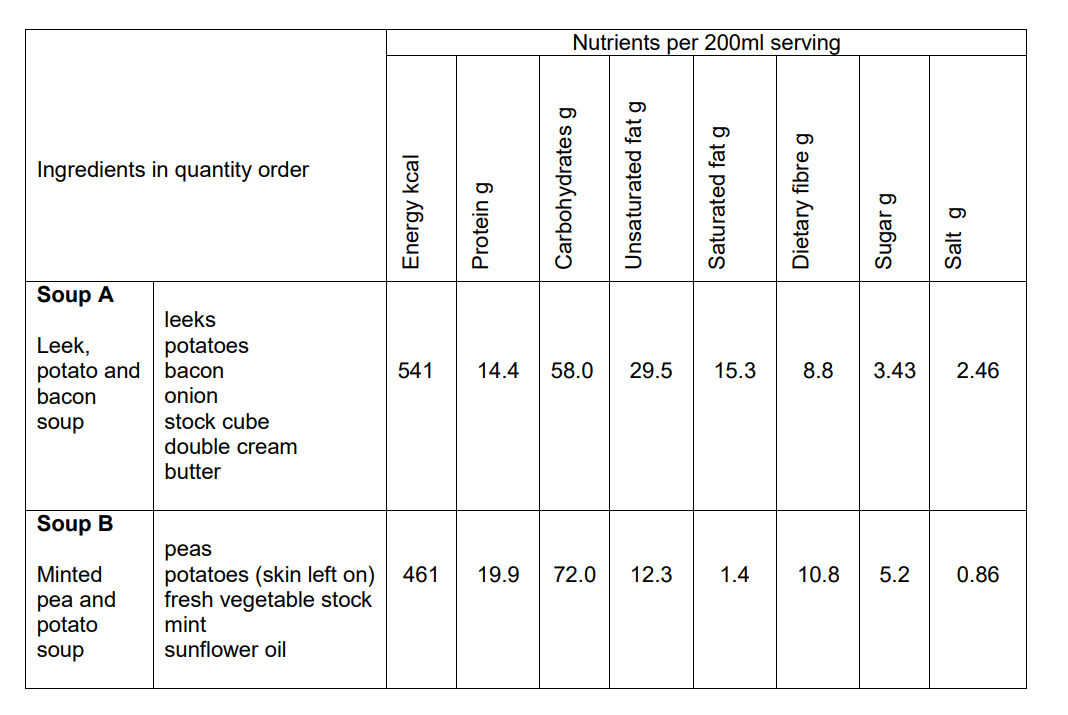
With reference to the ingredients and nutrient content of each of the soups, evaluate the suitability of these soups for people with Coronary Heart Disease (CHD).
Give justified reasons for your choice.
Was this exam question helpful?
University students may have a diet of ready meals and takeaways.
They often do not get their 5-a-day.
Explain the term 5-a-day.
Explain how a diet containing too many ready meals and takeaways could impact a student's long-term health.
Was this exam question helpful?
Discuss how students can use healthy eating guidelines when planning meals to achieve a well-balanced diet.
Was this exam question helpful?
Good bone health in younger people “helps to prevent osteoporosis in later life” (British Nutrition Foundation, 2019).
Analyse the dietary factors that can cause osteoporosis.
Evaluate the nutritional advice that should be followed to improve bone health.
Was this exam question helpful?
The ingredient list below is for beef lasagne.
Ingredient List
For the cheese sauce:
|
Explain how the ingredients can be changed so that the lasagne is suitable for someone following a vegan diet.
Was this exam question helpful?
The following food diary is a record of a day’s food intake for an overweight adult.
Breakfast
Snack
Lunch
Evening meal
|
Use this information and your knowledge of healthy eating guidelines and nutrition to:
analyse the suitability of this food diary for an overweight adult
evaluate how the adult’s diet could be improved to meet their nutritional needs.
Was this exam question helpful?
A care home for older people is going to add one of the following fish-based meals to the weekly menu:
tuna and tomato pasta bake, topped with grated cheese
battered cod and chips, served with peas.
Nutritional Information
Meals | Tuna and tomato pasta bake, topped with grated cheese. | Battered cod and chips, served with peas. |
Ingredients | Wholemeal pasta, canned tuna (in spring water), chopped tomatoes, onion, sweetcorn, spinach, cheddar cheese, garlic, basil, salt and pepper. | Potato, cod fillet, milk, plain flour, egg, peas, oil, salt and pepper. |
Energy (kcal) | 602 | 859 |
Fat (g) | 14 | 25 |
Saturated fat (g) | 5 | 11 |
Carbohydrate (g) | 89 | 65 |
Sugar (g) | 10 | 4 |
Protein (g) | 32 | 36 |
Fibre (g) | 9 | 3 |
Salt (g) | 0.7 | 1.1 |
Using the nutritional information and your knowledge of healthy eating and nutrition:
analyse the suitability of each meal for an older person
evaluate which meal is the healthier choice, justifying your reasons.
Was this exam question helpful?
State three factors that can affect a person's basal metabolic rate (BMR).
Was this exam question helpful?
Explain how a person's basal metabolic rate (BMR) and physical activity level (PAL) affect their daily energy requirements.
Was this exam question helpful?
A student is planning a lunch for someone with coeliac disease. The lunch contains breaded chicken, couscous and salad.
Suggest two changes that would make the lunch suitable for someone with coeliac disease. Give a reason for each change.
Was this exam question helpful?
An adult has been told they are at increased risk of developing Type 2 diabetes.
Suggest two changes they could make to reduce their risk. Give a reason for each change.
Was this exam question helpful?
Give three dietary recommendations that could help reduce the risk of rickets.
Was this exam question helpful?
An older adult has a low physical activity level (PAL).
Compare their energy and portion-size requirements with those of an active teenager. Explain the reasons for the differences.
Was this exam question helpful?