The Nature of Substances & Chemical Reactions (WJEC GCSE Science (Double Award): Chemistry): Exam Questions

Exam code: 3430

2 hours41 questions
1a
4 marks

The table shows four compounds and their formulae.

Compound

Formula

nitrogen dioxide

NO2

hydrogen bromide

HBr

ethane

C2H6

ammonia

NH3

Use the information in the table to answer the following questions.

(i) Give the name of the compound that contains the elements hydrogen and bromine.

.............................................................................................................................

[1]

(ii) Give the names of the elements present in ethane.

....................................................... and .......................................................

[1]

(iii) Give the total number of atoms found in a molecule of nitrogen dioxide.

.......................................................

[1]

(iv) Tick (✓) the box next to the diagram that represents a molecule of ammonia, NH3.

Figure: Ball-and-stick diagram of a diatomic molecule — one small filled black sphere bonded to one larger hatched sphere

□

Figure: Ball-and-stick diagram of a six-atom molecule — two large black spheres bonded together, each also bonded to two smaller black spheres

□

Figure: Ball-and-stick diagram of a four-atom molecule — one central crosshatched sphere bonded to three smaller open spheres, arranged in a non-linear, pyramidal pattern

□

Figure: Ball-and-stick diagram of a three-atom molecule — one central crosshatched sphere bonded in a straight line to two open spheres, one on each side

□

[1]

1b
1 mark

Some ants spray a toxic mixture containing formic acid to defend themselves from predators.

Each molecule of formic acid contains two atoms of hydrogen, one atom of carbon and two atoms of oxygen.

Use this information to give the formula of formic acid.

.......................................................................................

1c
3 marks

The box contains the names of three compounds that are made from positive and negative ions.

lithium chloride

magnesium bromide

calcium oxide

(i) Give the formulae of the ions present in lithium chloride.

................................................. and .................................................

[1]

(ii) Give the formula of magnesium bromide.

.......................................................................................

[1]

(iii) Tick (✓) the box next to the correct equation for the reaction between calcium and oxygen to produce calcium oxide.

Ca + O2 → 2CaO

□

2Ca + O2 → 2CaO

□

Ca + O → CaO

□

[1]

2
3 marks

A sample of an oxide of nitrogen contains 1.4 g of nitrogen and 4.0 g of oxygen.

Find the simplest formula of this oxide. You must show your working.

Ar(N) = 14 Ar(O) = 16

Simplest formula .......................................................................

3a
2 marks

Rock salt is a mixture of salt and sand. Crystals of pure salt can be obtained from rock salt.

A–E are the steps in the method used but they are in the wrong order.

A

Add water to a sample of rock salt in a beaker and stir

B

Heat the solution to evaporate some of the water

C

Grind the rock salt into a fine powder

D

Filter the mixture to separate the sand from the salt solution

E

Leave the saturated solution in a warm place for a few days so that crystals of salt form

Put the steps in the correct order. The first step is already included.

C → ...... → ...... → ...... → ......

3b
4 marks

A student was asked to investigate the dyes present in an orange sweet.

The student carried out the following method. There are two errors in the method.

  • Draw a line using a ruler and pen on chromatography paper.

  • Place a sample of the orange colour on the line.

  • Stand the chromatography paper in a beaker and add enough water to just cover the sample.

  • Leave the paper to stand until the water rises to the top of the paper.

(i) State the two errors in the method.

1.

2.

[2]

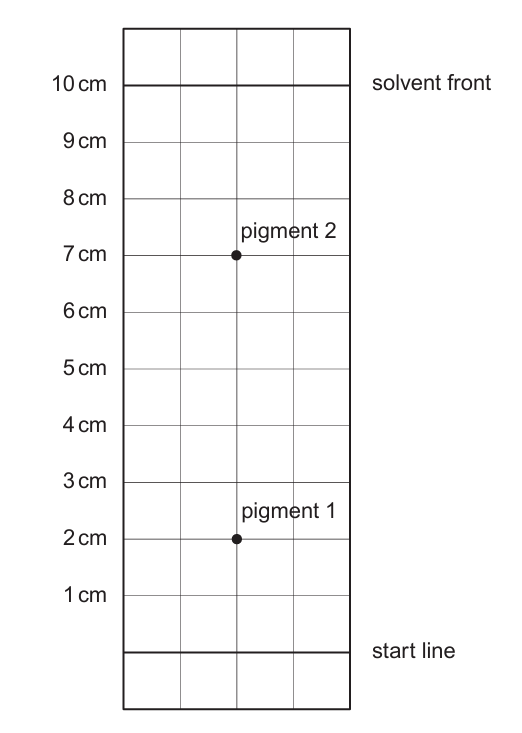
(ii) Another student used a correct method and obtained the chromatogram below.

Chromatography strip, 10 cm tall, with a start line near the bottom, a dashed solvent front line at the top (10 cm), and two spots marked above the start line: pigment 1 at a lower height and pigment 2 at a higher height

Use the formula to calculate the Rf value for pigment 2.

Rf=distance travelled by the pigmentdistance travelled by the solvent front

Rf = .......................................................

[2]

4
4 marks

Lithium reacts with oxygen. The word equation for this reaction is as follows.

lithium + oxygen → lithium oxide

(i) Name the metal in this equation.

...........................................................................................................

[1]

(ii) Name the compound in this equation.

...........................................................................................................

[1]

(iii) Name a reactant in this equation.

...........................................................................................................

[1]

(iv) Lithium oxide contains the ions Li+ and O2-.

Underline the formula of lithium oxide.

LiO2 2LiO Li2O Li2O

[1]

5a
2 marks

Compounds are formed when atoms of different elements combine.

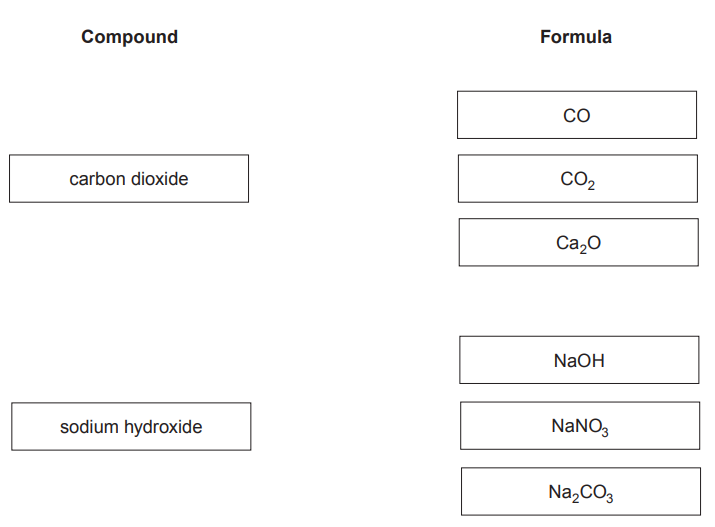
Draw one line from each compound to its formula.

Figure: Matching diagram with two columns — the left column lists two compound names (carbon dioxide, sodium hydroxide) and the right column lists six formulae in scrambled order (CO, CO2, Ca2O, NaOH, NaNO3, Na2CO3), with lines to be drawn from each compound name to its correct formula
5b
1 mark

Magnesium oxide contains the ions Mg2+ and O2-.

Give the formula of magnesium oxide.

..............................................................................................................

5c
2 marks

Calcium sulfate has the formula CaSO4.

Calculate the relative formula mass (Mr) of calcium sulfate.

Ar(Ca) = 40 Ar(S) = 32 Ar(O) = 16

Mr = .........................................................

5d
1 mark

Aluminium chloride, AlCl3, is formed by the reaction of aluminium with chlorine.

Write a number in the box to balance the equation for this reaction.

2Al + [ ] Cl2 → 2AlCl3

6a
2 marks

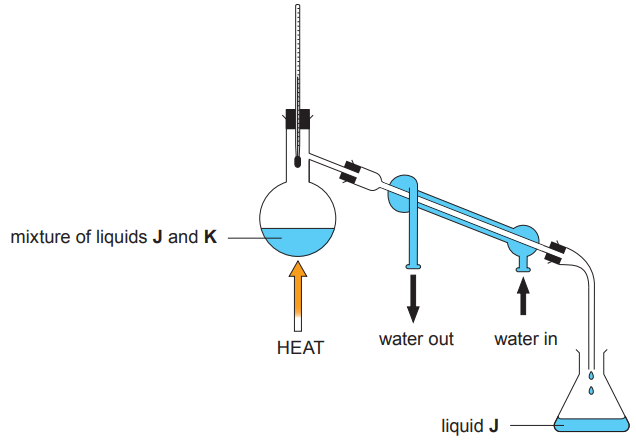
The diagram shows the separation of a mixture of liquids J and K.

Figure: Distillation apparatus separating a mixture of liquids J and K — the mixture is heated in a flask, a thermometer reads 56 °C at the side-arm, the vapour passes through a water-cooled condenser (water in and water out labelled), and drops of liquid J fall steadily into a collection flask
  • The temperature on the thermometer stays at 56 °C even though the mixture is still being heated

  • Drops of liquid J fall steadily into the flask

Use the information given above and in the diagram.

State the conclusions that you can draw about the boiling points of liquids J and K.

6b
2 marks

K is a compound with the formula C4H8O. The relative formula mass (Mr) of compound K is 72.

Calculate the percentage by mass of carbon in compound K.

Ar(C) = 12

Percentage = ....................................................................... %

7a
2 marks

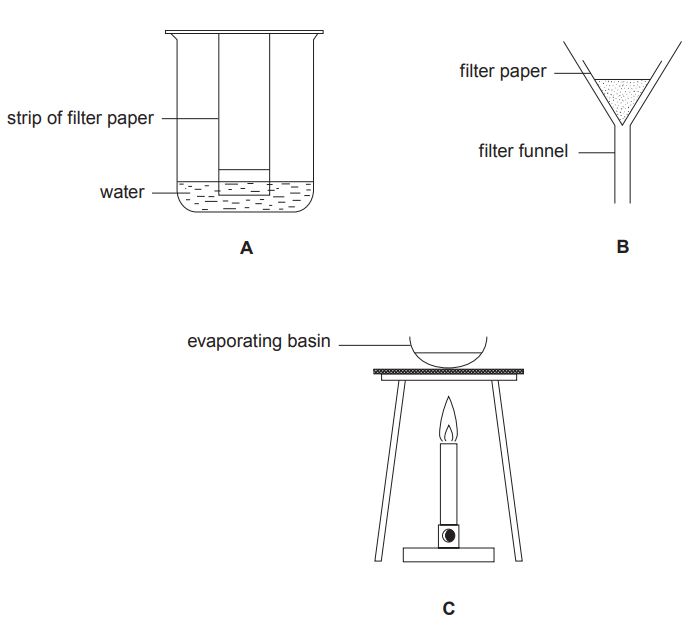
The diagrams show three methods, A, B and C, used to separate mixtures.

Figure: Three diagrams labelled A, B and C. A: a strip of filter paper dipped partly into water in a beaker (paper chromatography). B: a filter funnel lined with filter paper, sitting over a container, used to filter a mixture. C: an evaporating basin, used to evaporate a liquid.

Give the letter, A, B or C, of the method you would use to:

(i) remove sand from sea-water, .....................................................

[1]

(ii) show that sea-water contains salt. .....................................................

[1]

7b
4 marks

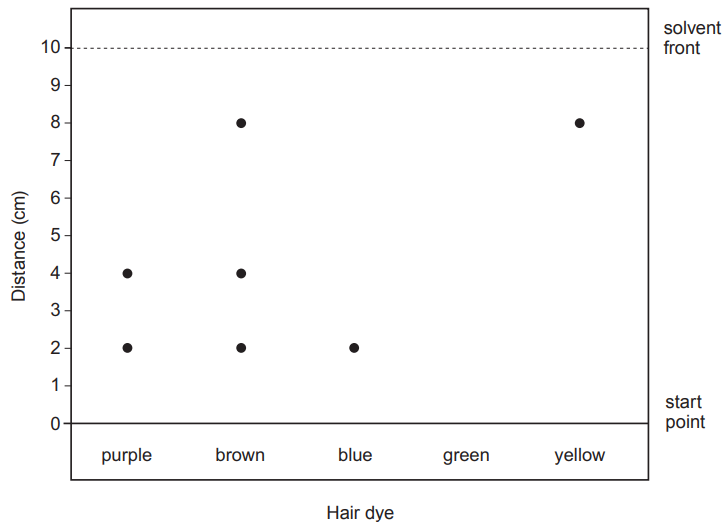
Paper chromatography was used to show the pigments present in different hair dyes.

Figure: Chromatography diagram showing a strip with a start point near the bottom and a solvent front near the top, with a vertical scale marked 0 to 10 cm. Below the start point, four separated spots are shown for known dyes: purple, brown, blue, and green, each dye's spots plotted at specific heights on the strip, plus a fifth lane for yellow. The brown dye lane shows two spots at the same heights as the purple and yellow spots, indicating brown is a mixture of those two dyes.

(i) Give the two dyes that are mixed to make brown hair dye.

.......................................................... and ..........................................................

[1]

(ii) Green hair dye is made by mixing together blue and yellow dyes.

Draw on the diagram the result that you would expect to see for green hair dye.

[1]

(iii) The Rf value of a substance can be used to identify that substance.

The Rf value of the pigment in red hair dye is 0.4.

Use the equation below to calculate the distance this red hair dye would have moved on the diagram.

distance moved = Rf × distance moved by solvent

distance moved = ............................................. cm

[2]

8
2 marks

Lithium reacts with oxygen to give lithium oxide.

Complete the equation for the reaction by:

  • giving the formula for lithium oxide

  • putting numbers in the boxes to balance the equation

[ ] Li + O2 → [ ] .....................

9a
2 marks

Iron reacts with chlorine gas to form iron(III) chloride according to the equation shown.

2Fe + 3Cl2 → 2FeCl3

Calculate the mass of iron(III) chloride that could be produced using 22.4 g of iron.

Ar(Fe) = 56 Ar(Cl) = 35.5

Mass = ....................................................................... g

9b
1 mark

White phosphorus has the formula P4. It reacts with chlorine to form phosphorus trichloride, PCl3.

Put a number in each box to balance the equation for this reaction.

P4 + [ ] Cl2 → [ ] PCl3

10a
2 marks

The chemical formula of potassium carbonate is K2CO3.

(i) State how many carbon atoms are present in the formula, K2CO3. ..........................

[1]

(ii) Give the total number of atoms shown in the formula, K2CO3. ..........................

[1]

10b
2 marks

Calculate the percentage by mass of carbon in potassium carbonate, K2CO3.

percentage by mass = ....................................... %

11
2 marks

Sodium hydrogencarbonate contains the HCO3- ion.

Sodium hydrogencarbonate is the only product made when captured carbon dioxide reacts with sodium hydroxide.

Write a balanced symbol equation for this reaction.

12
3 marks

Low-grade copper ores commonly contain the mineral cuprite. Cuprous oxide is an old name for the oxide of copper found in cuprite.

A sample of cuprous oxide was found to contain 2.54 g of copper and 0.32 g of oxygen.

Use this information to find the simplest formula of cuprous oxide.

You must show your working.

Ar(Cu) = 63.5 Ar(O) = 16

Simplest formula .....................................................

13
3 marks

Potassium nitrate decomposes on heating to produce potassium nitrite, KNO2, and oxygen.

(i) Balance the equation for the reaction.

2KNO3 → [ ]KNO2 + O2

[1]

(ii) On heating potassium nitrate, a student expected to make 4.35 g of potassium nitrite. However, in an experiment she only made 3.13 g.

Calculate the percentage yield of potassium nitrite in her experiment. Give your answer to the nearest whole number.

Percentage yield = ....................................................... %

[2]

14a
2 marks

The equation for the reaction between calcium carbonate and dilute hydrochloric acid is as follows.

CaCO3 + 2HCl → CaCl2 + H2O + CO2

Calculate the mass of calcium chloride produced when 7.8 g of calcium carbonate is reacted with excess acid.

Mr(CaCO3) = 100 Mr(CaCl2) = 111

Mass = ........................................................ g

14b
2 marks

When the reaction was repeated with a different mass of calcium carbonate, it was found that 14.3 g of calcium chloride formed. This represents a yield of 53.7%.

Calculate the maximum mass of calcium chloride that could have been formed.

Maximum mass = ........................................................ g

15
3 marks

Chlorine can form a number of compounds by reacting with oxygen gas. One of these is used in water treatment.

A sample of this compound contains 0.71 g of chlorine and 0.64 g of oxygen. Calculate its simplest formula.

Simplest formula ..........................................................

16
2 marks

One of the diagrams represents the element oxygen. Oxygen reacts with potassium to form potassium oxide.

Give the formula for potassium oxide and balance the equation for this reaction.

[ ]K + O2 → 2 ......................................

17
3 marks

Fluorine reacts with titanium at very high temperatures, forming titanium fluoride.

In an experiment 3.8 g of fluorine reacted with 2.4 g of titanium.

Calculate the simplest formula for titanium fluoride. You must show your working.

Ar(Ti) = 48 Ar(F) = 19

Simplest formula ...................................................................................

18
2 marks

A litre bottle of mineral water contains 184 mg of dissolved calcium sulfate, CaSO4.

Calculate the number of moles of calcium sulfate present.

Give your answer to three significant figures.

1 mg = 0.001 g

Ar(Ca) = 40 Ar(S) = 32 Ar(O) = 16

Moles of calcium sulfate = ........................................... mol

19
4 marks

(i) Lead can form a number of oxides with different formulae. Red lead, Pb3O4, is used to make batteries. It is manufactured by reacting lead carbonate with oxygen. Carbon dioxide is also produced.

Balance the equation for this reaction.

[ ]PbCO3 + O2 → [ ]Pb3O4 + [ ]CO2

[1]

(ii) 11.36 g of a lead oxide contains 10.18 g of lead. Calculate the empirical formula of this oxide.

Ar(Pb) = 207 Ar(O) = 16

Empirical formula ...............................................

[3]

20
3 marks

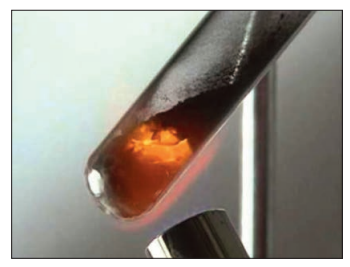
A teacher showed her class how copper can be extracted from copper(II) oxide using charcoal.

Photograph of a boiling tube containing a solid mixture glowing orange at its closed end while being heated by a Bunsen burner, illustrating the copper extraction experiment.

2CuO(s) + C(s) → CO2(g) + 2Cu(s)

In her experiment, the teacher heated 1.59 g of copper(II) oxide and 0.12 g of charcoal in a boiling tube. She continued to heat the mixture strongly until it had been glowing for 5 minutes.

She recorded the mass of the boiling tube and its contents before heating and then again after heating, once the carbon dioxide produced had been released from the tube.

Mass of boiling tube = 37.43 g

Mass of boiling tube and contents before heating = 39.14 g

Mass of boiling tube and contents after heating = 38.82 g

(i) The teacher had expected the reaction to produce 1.27 g of copper from the masses of copper(II) oxide and charcoal used. Use her results to show that the mass produced suggests a 109% yield.

[2]

(ii) Assuming the reactants had been heated at a high enough temperature for sufficient time, suggest one reason for the yield being larger than expected.

[1]

21
3 marks

Write the symbol equation for the reaction that takes place.

.................. + ........................ → ........................ + .......................

22
1 mark

What is the correct formula for chlorine gas? Tick (✓) the correct answer.

CL2

□

Cl2

□

cl2

□

2Cl

□

23a
3 marks

The balanced symbol equation for the reaction between sodium and oxygen is given below.

4Na + O2 → 2Na2O

Calculate the mass of sodium oxide that should be produced when 0.736 g of sodium is burned in air.

mass = ............................................ g

23b
2 marks

When the reaction was carried out using 0.736 g of sodium, it was found that the mass of sodium oxide formed was 0.338 g.

(i) Use your answer to part (a) to calculate the percentage yield of the reaction.

percentage yield = .............................................. %

[1]

(ii) If no product was lost, suggest one possible explanation for the percentage yield not being 100%.

[1]

24a
1 mark

A food colouring contains a mixture of yellow and green dyes.

The table shows the Rf values of these dyes using different solvents in separate chromatography experiments.

Colour

Rf value when the solvent is

Water

Acid

Alcohol

yellow

0.74

0.35

0.00

green

0.76

0.81

0.46

Why would yellow and green dyes be difficult to separate in a chromatography experiment using water as the solvent?

...................................................................................................................

24b
1 mark

Describe what you would expect to see in the chromatogram obtained using alcohol as the solvent.

...........................................................................................................................

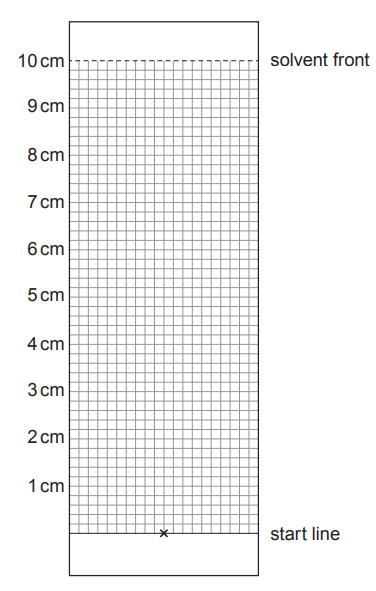
24c
2 marks

Complete the chromatogram to show the results you would expect using acid as the solvent.

Figure: Blank chromatography strip, 10 cm tall, with a start line near the bottom marked with a single spot (×) and a dashed solvent front line at the very top (10 cm mark); the candidate must mark two spots at the correct heights for yellow and green dyes based on their Rf values in acid
25a
2 marks

A year 10 class investigated the reactions between some metals and hydrochloric acid. Their results are summarised in the table below.

Metal

Initial temperature (°C)

Final temperature (°C)

Rise in temperature (°C)

General observations

zinc

21

32

11

a few bubbles

calcium

22

66

44

lots of bubbles, solution spills out of test tube

magnesium

20

31

......................

lots of bubbles

copper

21

21

0

no bubbles

iron

22

25

3

one or two bubbles

(i) State which metal did not react with hydrochloric acid.

Give a reason for your choice.

Metal

Reason

[1]

(ii) Calculate the final temperature for the reaction between magnesium and hydrochloric acid.

Final temperature = ........................................................ °C

[1]

25b
1 mark

What name is given to a reaction which gives a rise in temperature?

Choose your answer from the box.

endothermic

combustion

exothermic

precipitation

....................................................................................

26
1 mark

Beryllium is found in the compound beryllium fluoride, BeF2.

Give the total number of atoms shown in the formula.

........................................................

27
1 mark

Nitrogen can be obtained by heating sodium azide, NaN3. Sodium is also produced in the reaction.

Complete the balancing of the equation for this reaction.

2NaN3 → 2Na + [ ]N2

28a
1 mark

Ionic compounds dissolve in water to form positive and negative ions.

Which two compounds may have dissolved in the drinking water at location B?

Put a tick (✓) in the box next to the correct answer.

potassium fluoride and calcium sulfate

□

ammonium sulfate and potassium nitrate

□

calcium fluoride and ammonium nitrate

□

ammonium sulfate and calcium fluoride

□

28b
3 marks

(i) Calculate the relative formula mass (Mr) of calcium sulfate, CaSO4.

Ar(Ca) = 40 Ar(S) = 32 Ar(O) = 16

Mr = .......................................................

[1]

(ii) Calculate the percentage by mass of fluorine in calcium fluoride, CaF2.

Mr(CaF2) = 78 Ar(F) = 19

Percentage = ....................................................... %

[2]

29
3 marks

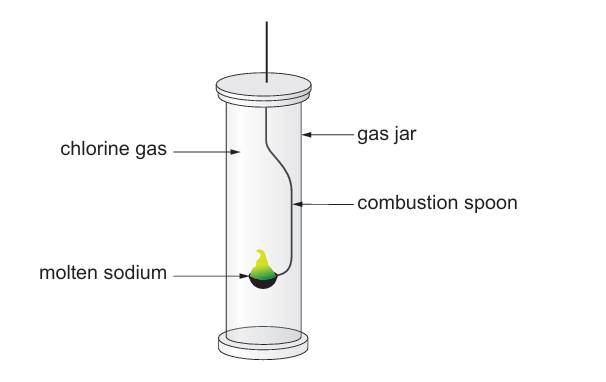
The diagram shows the reaction of sodium with chlorine.

Diagram of a gas jar filled with chlorine gas; a combustion spoon holding a piece of burning/molten sodium is being lowered into the gas jar from above

(i) State why it is necessary to carry out this reaction in a fume cupboard.

[1]

(ii) Complete and balance the equation for the reaction of sodium and chlorine.

[ ]Na + Cl2 → ......................................

[2]

30
2 marks

The stock solution of sodium thiosulfate used in both experiments was made by dissolving 1.0 g of the solid in 1 dm3 of water.

Calculate the number of moles of sodium thiosulfate (Na2S2O3) in 1.0 g.

Give your answer to two significant figures.

Ar(Na) = 23 Ar(S) = 32 Ar(O) = 16

Number of moles = ........................................................ mol

31
1 mark

The combustion of the fossil fuel propane (C3H8) produces carbon dioxide and water. Balance the equation for this reaction.

C3H8 + [ ] O2 → [ ]CO2 + [ ]H2O

32a
3 marks

Sodium reacts with water to produce sodium hydroxide and hydrogen. The equation for this reaction is shown.

2Na(s) + 2H2O(l) → 2NaOH(aq) + H2(g)

Calculate the mass of sodium needed to produce 11.2 g of hydrogen gas.

Ar(Na) = 23 Ar(H) = 1

Mass of sodium = ........................................................ g

32b
2 marks

Group 2 metals react in a similar way with water as Group 1 metals.

The word equation for the reaction of calcium and water is shown.

calcium + water → calcium hydroxide + hydrogen

Write the balanced symbol equation for this reaction.

33a
4 marks

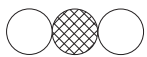
Diagrams A, B, C and D represent hydrogen (H2), sulfur dioxide (SO2), hypochlorous acid (HClO) and phosphine (PH3) but not in that order.

Figure: Four molecule diagrams made of coloured/patterned circles. Diagram A: three circles in a row — black, diagonally hatched, white. Diagram B: a central grey circle with three black circles attached around it (one above, two to the sides). Diagram C: two black circles joined together. Diagram D: three circles in a row — white, a larger black circle in the centre, white.

(i) Give the letter of the diagram that represents an element. Give a reason for your answer.

Letter ................................................

Reason ............................................................................................................

[2]

(ii) Give the letter of the diagram that represents SO2.

................................................

[1]

(iii) Use diagrams A, B, C and D above to work out which of the following diagrams represents water (H2O). Circle the correct diagram.

[1]

Figure: Four molecule diagrams, each made mostly of black and white circles (one includes a hatched circle). Diagram 1: two black circles joined to one larger white circle, in a row. Diagram 2: two larger white circles with one small black circle joined between them, in a row. Diagram 3: one larger white circle in the centre, flanked by one small black circle on each side. Diagram 4: one black circle, one hatched circle and one black circle, in a row.
33b
3 marks

(i) Calculate the relative molecular mass (Mr) of hypochlorous acid, HClO.

Ar(H) = 1 Ar(O) = 16 Ar(Cl) = 35.5

Mr = .......................................................

[1]

(ii) The relative molecular mass (Mr) of sulfur dioxide is 64.

Calculate the percentage by mass of sulfur in sulfur dioxide, SO2.

Ar(S) = 32

Percentage = ....................................................... %

[2]

33c
1 mark

Phosphine (PH3) is made when phosphorus and hydrogen react.

Put a tick (✓) in the box next to the correctly balanced symbol equation for this reaction.

2P + 3H2 → PH3

□

2P + 3H2 → 2PH3

□

2P + 3H2 → 3PH3

□

2P + 3H2 → 4PH3

□

34a
1 mark

A student investigates the pigments found in some fruit and vegetables.

She obtains some coloured extracts from carrots, tomatoes and beetroot.

She places a spot of each extract on chromatography paper, along with spots of the three pigments beta-carotene, chlorophyll and betalain.

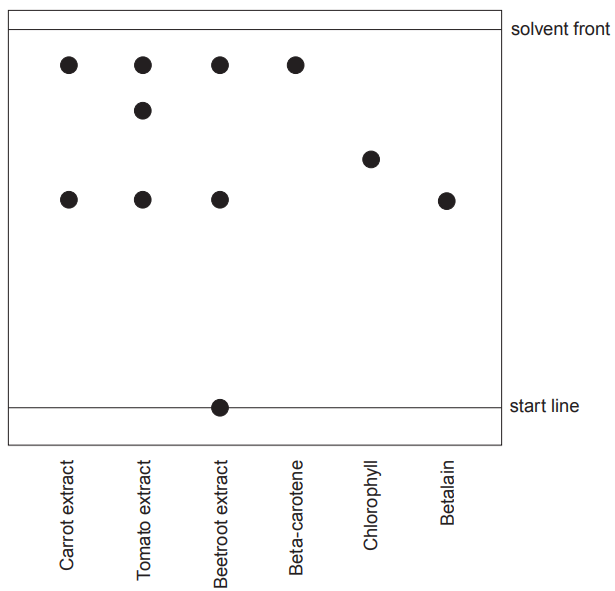
The diagram shows the chromatogram at the end of the experiment.

Figure: Paper chromatography diagram. A horizontal "start line" near the bottom and a horizontal "solvent front" line near the top. Six lanes are spotted at the start line, labelled (left to right): Carrot extract, Tomato extract, Beetroot extract, Beta-carotene, Chlorophyll, Betalain. Each of the three pure pigment lanes (beta-carotene, chlorophyll, betalain) shows a single spot at its own characteristic height. The three extract lanes each show one or more spots aligning in height with one or more of the pure pigment spots, showing which pigments are present in each extract.

Give the names of all the substances which are not mixtures. Give a reason for your choice.

Substances ...................................................................................................................................................................

Reason ...................................................................................................................................................................

34b
2 marks

Put a tick (✓) in the boxes next to the two conclusions that can be drawn from the chromatogram.

chlorophyll is not present in carrot, tomato or beetroot extracts

□

beta-carotene is present in carrot extract but not present in tomato extract

□

both beta-carotene and betalain are present in beetroot extract

□

betalain is present in tomato extract but not present in carrot extract

□

both carrot and beetroot extracts contain a pigment other than beta-carotene, chlorophyll and betalain

□

34c
2 marks

One of the pigments present in the carrot extract has travelled 4.4 cm above the start line.

The solvent front has travelled 8.0 cm. Calculate the Rf value of the pigment using the following equation.

Rf=distance travelled by pigmentdistance travelled by solvent front

Rf = .......................................................

34d
1 mark

Give the reason why there is a spot remaining on the start line in the chromatogram for beetroot.

...................................................................................................................................................................

35
2 marks

Sodium reacts explosively with sulfuric acid. Sodium sulfate and hydrogen are produced. Complete and balance the equation for this reaction.

[ ]Na + H2SO4 → .................... + H2

36
1 mark

Ammonia present in the Earth's early atmosphere reacted with oxygen to produce nitrogen and water vapour. Complete the balancing of the symbol equation for this reaction.

[ ] NH3 + 3O2 → [ ]N2 + 6H2O

37a
2 marks

Complete and balance the symbol equation for the reaction between magnesium chloride and silver nitrate.

MgCl2 + [ ]AgNO3 → .....................................

37b
3 marks

0.103 g of silver nitrate, AgNO3, was used to make up a solution.

Calculate the number of moles of silver nitrate in this mass. Give your answer in standard form.

Ar(Ag) = 108 Ar(N) = 14 Ar(O) = 16

Number of moles = ............................................ mol

38
2 marks

One molecule of liquid E contains two oxygen atoms. The percentage by mass of oxygen in liquid E is 43.2%.

Use the following equation to calculate the relative molecular mass (Mr) of liquid E.

mass of oxygenMr×100=43.2

Ar(O)=16

Mr = .......................................................

39a
3 marks

The symbol equation for the reaction between iron and chlorine is as follows.

2Fe + 3Cl2 → 2FeCl3

Calculate the mass of chlorine needed to react with 1.32 g of iron.

Ar(Fe) = 56 Ar(Cl) = 35.5

Mass of chlorine = ....................................................... g

39b
2 marks

(i) Under certain conditions, Group 7 elements will react with each other to produce new compounds.

When chlorine is reacted with bromine, chlorine tribromide is made.

Balance the symbol equation for this reaction.

Cl2 + [ ]Br2 → ....[ ]ClBr3

[1]

(ii) A chemist calculated that if she reacted 7.00 g of chlorine with an excess of bromine, the theoretical mass of chlorine tribromide produced is 27.55 g.

However, when she carried out the experiment using 7.00 g of chlorine the mass of chlorine tribromide obtained was 21.34 g.

Calculate the percentage yield of chlorine tribromide.

Percentage yield = ....................................................... %

[1]

40
1 mark

Hydrogen peroxide solution decomposes to give water and oxygen gas. Many metal oxides act as catalysts for the reaction.

Use the symbol equation for the reaction to find the formula of hydrogen peroxide.

2 .............. → 2H2O + O2

41a
1 mark

Some of the impurities are removed from the furnace as slag. Slag contains calcium silicate which has the chemical formula CaSiO3.

Tick (✓) the box next to the calculation used to find the correct relative formula mass of calcium silicate, CaSiO3.

Ar(Ca) = 40 Ar(Si) = 28 Ar(O) = 16

40 + 28 + 16

□

40 + 40 + 40 + 28 + 28 + 28 + 16 + 16 + 16

□

40 + 28 + 16 + 16 + 16

□

40 + 16 + 16 + 16

□

40 + 28 + 28 + 28 + 16 + 16 + 16

□

41b
2 marks

820 tonnes of iron was extracted from 1 750 tonnes of iron ore. Calculate the percentage of iron in the ore. Give your answer to one decimal place.

Percentage = ....................................................... %