11 mark
What term is commonly used by sociologists to describe the research method which asks respondents to identify any crimes they have committed?
Crime study
Offenders’ study
Self-report study
Victim study
Was this exam question helpful?
Exam code: 8192
What term is commonly used by sociologists to describe the research method which asks respondents to identify any crimes they have committed?
Crime study
Offenders’ study
Self-report study
Victim study
Was this exam question helpful?
Item A
Percentage of adult and juvenile offenders in England and Wales who reoffend by age, April to June 2023
Age group | Percentage of offenders who reoffend (%) |
10-14 | 30.3 |
15-17 | 32.0 |
18-20 | 27.7 |
21-24 | 24.8 |
25-29 | 27.2 |
30-34 | 30.3 |
35-39 | 31.7 |
40-44 | 30.6 |
45-49 | 27.1 |
50+ | 17.2 |
Source: Adapted from Ministry of Justice data, 2025
From Item A, examine one strength of the research.
Was this exam question helpful?
Item C
Researchers have studied GCSE results to understand the attainment gap between pupils who are eligible for free school meals (FSM) and those who are not. One measure used is the proportion of pupils achieving a “standard pass” in both English and Maths. In 2024, 43.6% of pupils receiving FSM achieved this standard, compared with 72.3% of pupils not eligible, creating an attainment gap of 28.7 percentage points. Researchers found that although the gap has remained broadly stable in recent years, it varies across regions. For example, FSM pupils in London had much higher attainment than FSM pupils nationally, and the gap there was the smallest. In contrast, FSM pupils in the South East had lower attainment and the largest regional gap. Researchers also found that girls receiving FSM achieved higher results than FSM boys. Source: Adapted from Francis-Devine, B., Malik, X., Foley, N., Food poverty: Households, food banks and free school meals, 2025. |
From Item C, examine one strength of using quantitative data to research attainment gaps.
Was this exam question helpful?
Item A
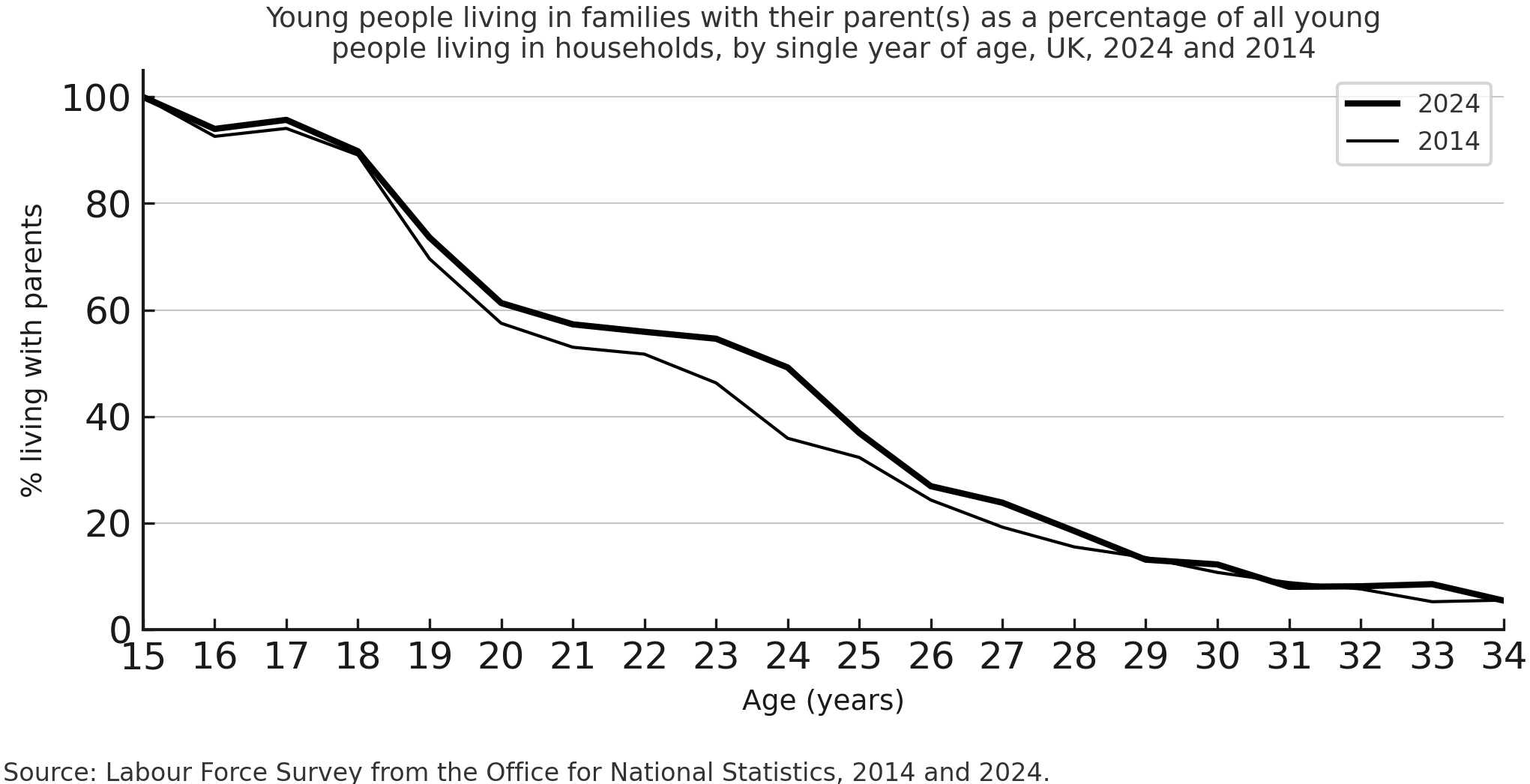
Source: Labour Force Survey, Office for National Statistics, 2014 and 2024.
From Item A, examine one strength of using survey data to research young people living with their parents.
Was this exam question helpful?
Item A
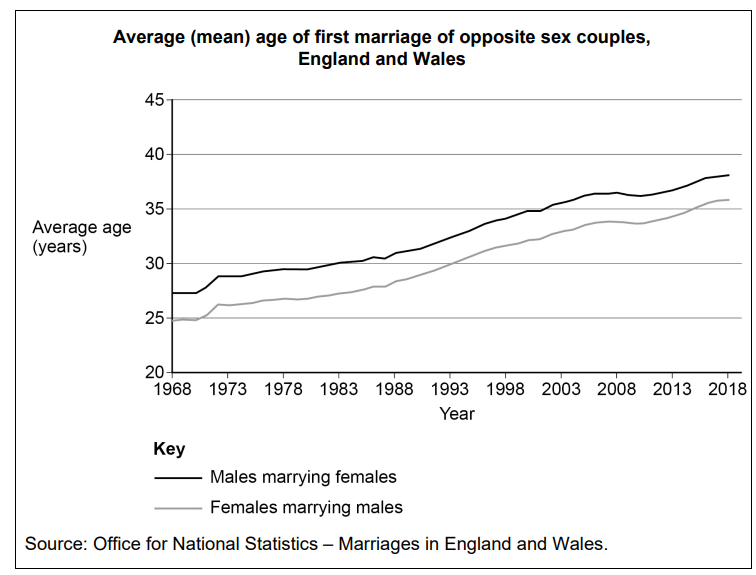
From Item A, examine one strength of the data.
Was this exam question helpful?
Item C
Glenys Lobban used content analysis to study the way in which gender roles were presented. She studied 179 stories in books used to teach reading in primary schools in the 1960s and 1970s. She found only 35 of these stories had female heroines, compared to 71 that had male heroes. Lobban concluded that boys were presented as more adventurous than girls. Girls were presented as more caring than boys, and as more interested in domestic matters.
More recent research has also found evidence of gender stereotyping. In 1992, Lesley Best and her students conducted content analysis to try and discover whether gender bias in children’s books had decreased. These researchers examined a sample of stories from 132 children’s books. They found that little had changed. She found only 44 female heroines, compared to 94 male heroes within those books.
Sources: Lobban, G, Data report on British reading schemes, The Times Educational Supplement, 1974. Best, L, Analysis of sex-roles in preschool books, Sociology Review: Philip Allan, 1992.
From Item C, examine one strength of using content analysis to research gender stereotyping in education.
Was this exam question helpful?
Item A
The Crime Survey for England and Wales (CSEW) is a large-scale victim survey, conducted by the government since 1981. It measures the amount of crime in England and Wales by asking people about the crimes they have experienced during the past year. The sample size is approximately 50,000 respondents.
Percentage of adults who were victims of crime by age, year ending March 2020.
Age group | Adults who were victims of crime (%) |
16–24 | 23.7 |
25–34 | 22.3 |
35–44 | 21.5 |
45–54 | 21.1 |
55–64 | 19.2 |
65–74 | 13.8 |
75+ | 9.2 |
Source: Office for National Statistics
From Item A, examine one strength of the research.
Was this exam question helpful?
Item C
Predicted life expectancy at birth for selected regions in England
Region | Male life expectancy | Female life expectancy |
North East | 77.6 | 81.5 |
North West | 77.9 | 81.7 |
East Midlands | 79.2 | 82.7 |
West Midlands | 78.5 | 82.5 |
South East | 80.6 | 84.1 |
South West | 80.3 | 84.1 |
Source: Office for National Statistics, 2021.
From Item C, examine one strength of using official statistics to research life expectancy.
Was this exam question helpful?
Item A
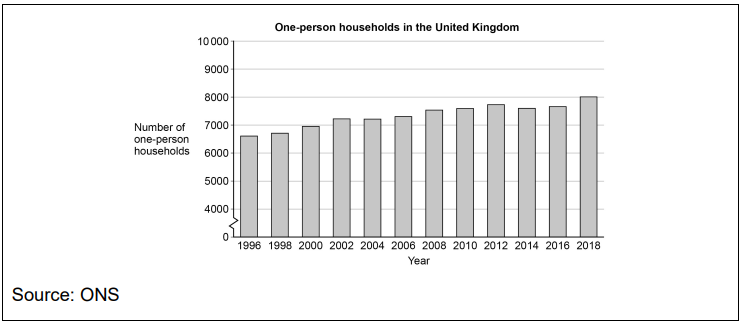
From Item A, examine one strength of using statistics to research one-person households.
Was this exam question helpful?
Item A
James Patrick studied a gang of teenage boys in Glasgow. He used covert participant observation. He gained access to the gang by befriending ‘Tim’, a gang member who acted as his protector. He met with the gang on 12 occasions between October 1966 and January 1967.
Patrick found the gang to be dangerous – some members became suspicious of him when he chose not to carry a weapon, and was reluctant to fully participate in fights. He left the gang abruptly when the violence became too intense.
Patrick was scared of the gang and waited years before writing up his notes and publishing his work to protect their identities.
Patrick’s work focused on the social conditions that led to the formation of the gang, such as poverty, unemployment and poor housing conditions.
Source: Patrick, J, A Glasgow Gang Observed, 2013.
From Item A, examine one strength of the research.
Was this exam question helpful?
Item C
In 2020, Public Health England produced a report into the inequalities faced by ethnic minority women in their experiences of pregnancy and childbirth.
Researchers used a range of secondary sources to compile the report, including existing peer-reviewed smaller scale academic research, government research and guidance. The report found that women from Black, Asian and Minority Ethnic backgrounds were up to five times more likely to die during pregnancy than white women. A range of potential issues were considered, such as language barriers, poorer health, concentration in lower social classes and less chance of accessing and engaging with pregnancy services.
The report went on to recommend a range of interventions including improved access to maternity services, improved personalised care by the NHS and encouraging healthier lifestyles.
Source: Public Health, Reducing the inequality of outcomes for women from Black, Asian and Minority Ethnic communities and their babies, 2020.
From Item C, examine one weakness of the research.
Was this exam question helpful?
Item C
Number of A-level examination entries in the United Kingdom by gender, 2019
Subject | Males | Females |
Computing | 9 649 | 1 475 |
English Language | 3 973 | 10 141 |
English Literature | 9 153 | 31 671 |
French | 2 515 | 5 840 |
Mathematics | 56 290 | 35 605 |
Physics | 30 159 | 8 799 |
Source: Joint Council for Qualifications (JCQ). The JCQ is an organisation representing the largest qualification providers in the United Kingdom. Each year the JCQ collates and publishes examination information.
From Item C, examine one strength of using the number of entries for different A-level examinations to research gender differences in education.
Was this exam question helpful?
Item A
There are concerns from some social commentators about the relatively high level of youth crime in society.
The Ministry of Justice produced a report entitled ‘Youth Justice Statistics: 2018 to 2019’, in which they presented the national statistics on recorded criminal behaviour amongst young people (below the age of 18). The report stated that there were 21 700 children either cautioned or sentenced in that time. Of this group:
85% were male
15% were female
73% were White
27% were Black, Asian and Minority Ethnic
23% were aged 10–14
77% were aged 15–17.
Source: Ministry of Justice, 2020
From Item A, examine one weakness of using government-reported statistics to research youth crime.
Was this exam question helpful?
Item C
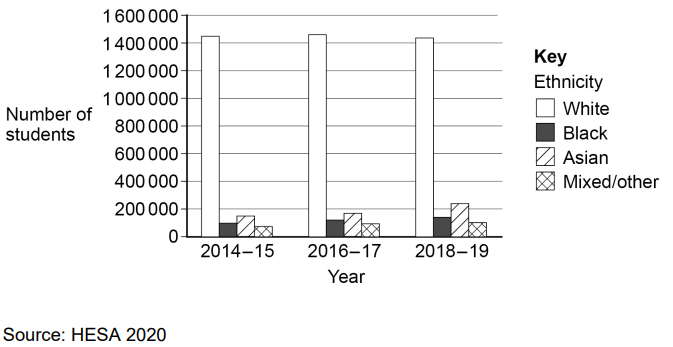
The Higher Education Statistics Agency (HESA) produced a report on university enrolment by personal characteristics from 2014/15 to 2018/19. This report found that the vast majority of students that attend university are from white backgrounds, although the number of students from minority ethnic backgrounds is increasing year on year.
From Item C, examine one strength of the research.
Was this exam question helpful?
Item A
Despite concerns over the increase in the number of children in single-parent families, recent research has found that children raised by a single parent are no less happy than those living with two biological parents. Rather, it is the quality of relationships at home which are most strongly linked to a child’s well-being.
Researchers analysed data from the Millennium Cohort Study, which was made up of 12 877 children aged seven, in 2008, from across the UK. The children came from three family types: those living with two biological parents; those living with a step-parent and a biological parent; and those with just a single parent.
The seven-year-olds were asked the question: “How often do you feel happy?” Of the children living with a lone parent, 36 per cent said they were happy “all the time” while the remaining 64 per cent reported being happy “sometimes or never”.
Exactly the same percentages were recorded when the question was put to children from the other family types.
The results were largely unchanged when other factors which could influence a child’s well-being were taken into account, such as their parents’ social class or the affluence of the area in which they live.
From Item A, examine one strength of the research.
Was this exam question helpful?
Item A
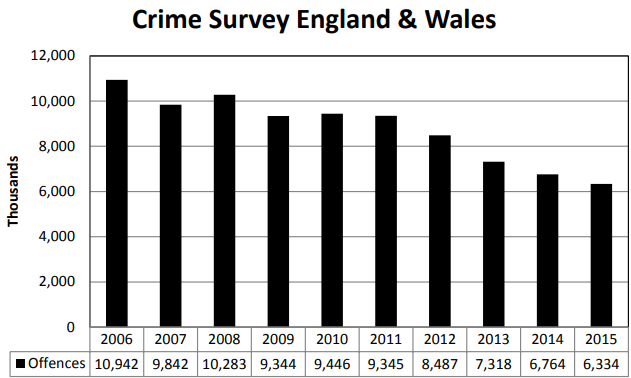
From Item A, examine one strength of research using official statistics on crime.
Was this exam question helpful?
What term is commonly used by sociologists to describe research that involves collecting data from the same sample group over time?
Case Study
Longitudinal
Qualitative
Quantitative
Was this exam question helpful?
Identify and explain one advantage of using a longitudinal study to investigate changing attitudes to marriage.
Was this exam question helpful?
Identify and explain one disadvantage of using a case study to investigate conjugal roles within the family.
Was this exam question helpful?
Identify and explain one disadvantage of using structured interviews to investigate gender stereotyping in schools.
Was this exam question helpful?
Identify and explain one advantage of using observations to investigate pupil subcultures.
Was this exam question helpful?
Item A
Describe the type of statistical data shown in Item A. Identify the trend shown by the data and explain one factor which may account for this trend.
Was this exam question helpful?
Identify and explain one disadvantage of using unstructured interviews to investigate one-person households.
Was this exam question helpful?
Identify one practical issue you would need to consider when using postal questionnaires to investigate role relationships within the family and explain how you would deal with this issue in your investigation.
Was this exam question helpful?
Item C
Becky Francis studied the ways in which gender affects students learning in school. Her research involved three different London secondary schools. The schools were all mixed-sex, with a large majority of working-class pupils. Francis used observation to record classroom interaction and student behaviour during GCSE lessons. She also carried out individual interviews.
Francis observed two top set lessons and two lower set lessons in both English and Maths in each school. She was unable to accurately record all the interaction because of the sheer noise levels in some of the classes. This limited the classroom observation.
In the majority of the lessons observed, boys dominated the classroom interaction. They were louder, and more disruptive than the girls and took up more of the teachers’ attention.
Source: Francis, B, The Impact of Gender Constructions on Pupils’ Learning and Educational Choices, 2005.
Identify and explain one advantage of using non-participant observation to investigate classroom interactions as shown in Item C.
Was this exam question helpful?
Identify and explain one advantage of using structured interviews to investigate working-class students’ experiences of school.
Was this exam question helpful?
Identify and explain one disadvantage of using a case study to investigate a teenage gang.
Was this exam question helpful?
Identify and explain one disadvantage of using official statistics to understand the extent of crime committed by women.
Was this exam question helpful?
Identify and explain one advantage of using previously published research to investigate gender inequality in accessing health care.
Was this exam question helpful?
Identify and explain one disadvantage of using group interviews to investigate gender-based subject choices in schools.
Was this exam question helpful?
Identify and explain one possible disadvantage of using a longitudinal study to investigate the effects of home-schooling on students.
Was this exam question helpful?
Identify and explain one disadvantage of using overt observation to study anti-social behaviour amongst young people.
Was this exam question helpful?
Identify and explain one advantage of using ethnography as a research method to investigate life chances.
Was this exam question helpful?
Identify and explain one advantage of using unstructured interviews to investigate relationships between family members.
Was this exam question helpful?
Identify and explain one disadvantage of using questionnaires to investigate the literacy skills of parents.
Was this exam question helpful?
Identify and explain one advantage of using observation to investigate policing in urban areas.
Was this exam question helpful?
Identify and explain one disadvantage of using structured interviews to research young people’s experience of unemployment.
Was this exam question helpful?
Identify and explain one disadvantage of using participant observation to investigate teacher labelling in the classroom.
Was this exam question helpful?