Answering 6-Mark Questions (Cambridge (CIE) IGCSE Economics): Revision Note
Syllabus Edition
First teaching 2025
First exams 2027
Exam code: 0455 & 0987

How do I answer IGCSE economics 6-mark 'discuss' questions?
To answer IGCSE Economics 6-mark 'discuss' questions, consider the following:
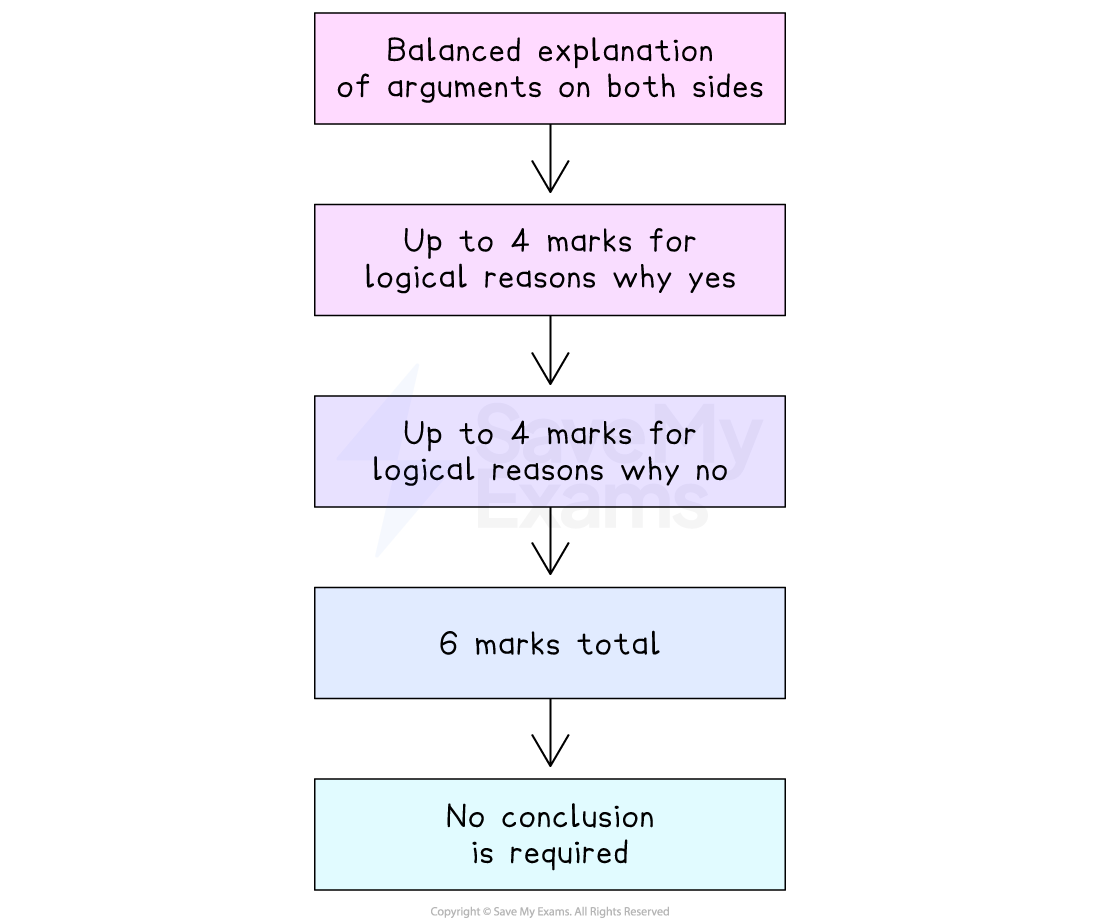
A 6-mark 'Discuss' question requires a balanced explanation of arguments on both sides
Examiners award:
Up to 4 marks for logical reasons why yes
Up to 4 marks for logical reasons why no
A maximum 6 marks total
For each reason:
(1) for the reason
(1) for development (cause → effect → impact)
Two developed reasons on one side, plus one developed reason on the other, are enough for full marks
No conclusion is required
Summary of the 6-mark 'discuss' structure
Worked Example
Discuss whether or not the Algerian Government should impose a carbon tax
Model Answer
Arguments for
A carbon tax puts financial pressure on firms to reduce emissions (1),
helping to lower pollution and reduce the external costs caused by production (1)
The tax can raise government revenue (1), which can then be spent on public services such as healthcare or renewable energy projects (1)
Argument against
If other countries do not impose a carbon tax, Algerian products may become less internationally competitive (1), reducing exports and potentially causing firms to move production abroad (1)
Mark Scheme & Guidance
Award up to 4 marks for well-developed arguments in favour
Award up to 4 marks for well-developed arguments against
Maximum total: 6 marks
Each point may only be credited once, but development explaining how/why the effect occurs can gain an additional mark
No conclusion is required
How do I answer IGCSE economics 6-mark 'analyse' questions?
To answer IGCSE Economics 6-mark 'analyse' questions, consider the following:
A 6-mark ‘Analyse’ question requires you to give two fully developed chains of economic reasoning
Examiners award:
Up to 3 marks for each analytical chain
A maximum 6 marks total
For each chain:
(1) for the reason
(1) for developing the reason
(1) for explaining the final impact (cause → effect → consequence)
Two well-developed chains are enough for full marks
No evaluation or conclusion is required
Worked Example
Analyse two reasons why the demand for public transport may increase.
Model Answer
Analytical chain 1
Higher petrol prices make using private cars more expensive (1), so consumers switch to cheaper alternatives such as buses and trains (1), leading to higher demand for public transport at every price level (1)
Analytical chain 2
Additionally, government subsidies can reduce the price of public transport (1),
making it more affordable for households (1), which increases the quantity demanded according to the law of demand (1)
Examiner Tips and Tricks
Signpost the start of your second chain by using conjunctives such as 'additionally' or 'secondly'
How do I answer IGCSE economics 6-mark 'analyse, using a demand and supply diagram' questions?
To answer IGCSE Economics 6-mark 'analyse, using a demand and supply diagram' questions, consider the following:
A 6-mark ‘analyse, using a diagram’ question requires you to:
Draw an accurate, fully labelled diagram
Explain the economic change shown in the diagram
Examiners award:
Up to 4 marks for the diagram
Up to 2 marks for the written analysis
A maximum 6 marks total
For diagram marks:
(1) correctly labelled axes
(1) correct original curves
(1) correct shift
(1) correct new equilibrium
For analysis marks:
(1) for explaining the cause of the shift
(1) for explaining the impact on price or quantity
A full, correct diagram plus a short, clear explanation is enough for full marks
No evaluation or conclusion is required
Worked Example
Analyse, using a demand and supply diagram, the effect of falling steel prices on the market for cars
Model Answer
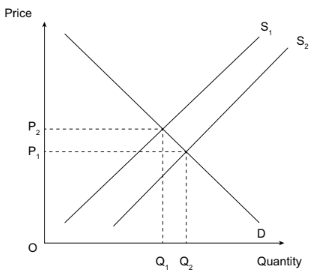
Falling steel prices reduce firms’ production costs in car manufacturing (1),
shifting the supply curve in the market for cars to the right and leading to a lower market price and higher quantity of cars sold (1)
Mark Scheme & Guidance
A student can still gain analysis marks even if the diagram is incomplete
Diagrams must be fully labelled to receive full diagram marks

Unlock more, it's free!
Join the 100,000+ Students that ❤️ Save My Exams
the (exam) results speak for themselves:

Was this revision note helpful?
