Plastic Pollution (Cambridge (CIE) IGCSE Environmental Management): Exam Questions

Exam code: 0680

14 mins6 questions
1
2 marks

Figure 5.1 shows the global production of non-biodegradable bioplastics and biodegradable bioplastics in 2021 and 2023.
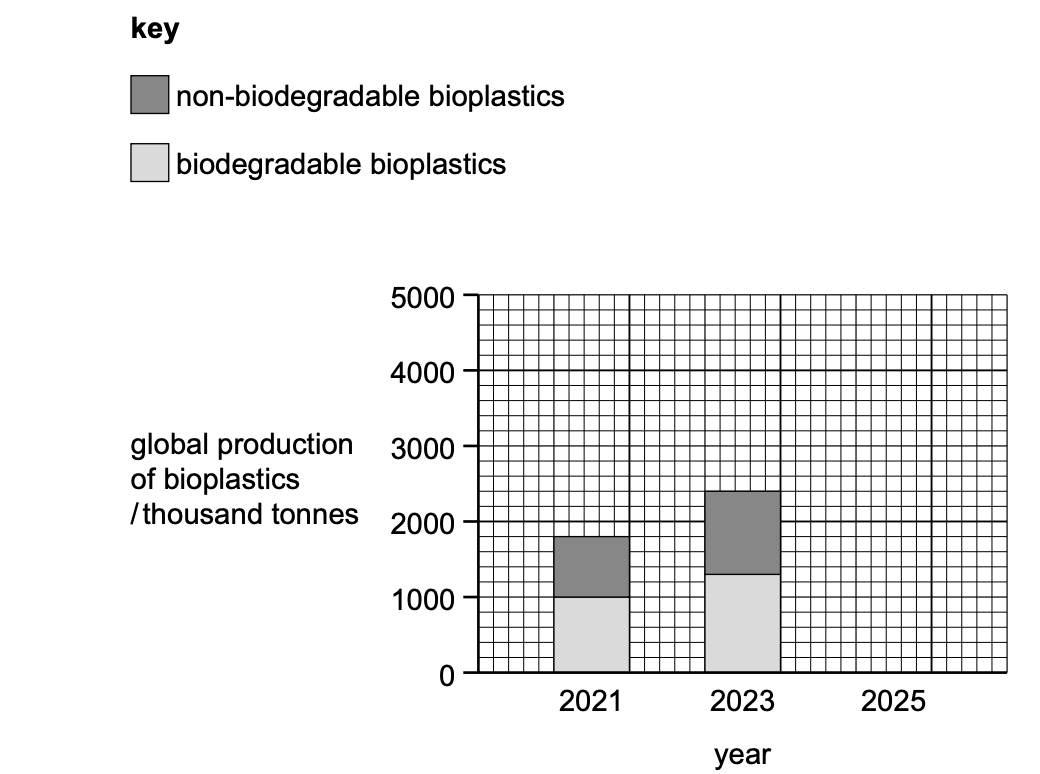
Stacked bar chart of global production of non-biodegradable and biodegradable bioplastics: 2021 totals 1,800 thousand tonnes and 2023 totals 2,400. The 2025 bar is blank for plotting. y-axis 0–5,000 thousand tonnes.
Figure 5.1

Table 5.1 shows the predicted global production of non-biodegradable bioplastics and biodegradable bioplastics in 2025.

Table 5.1

year

global production of non-biodegradable bioplastics / thousand tonnes

global production of biodegradable bioplastics / thousand tonnes

2025

2500

2400

Plot the data for 2025 on the grid in Figure 5.1.

2
3 marks

Figure 5.1 shows the global production of non-biodegradable bioplastics and biodegradable bioplastics in 2021 and 2023.

Stacked bar chart of global production of non-biodegradable and biodegradable bioplastics: 2021 totals 1,800 thousand tonnes and 2023 totals 2,400. The 2025 bar is blank for plotting. y-axis 0–5,000 thousand tonnes.
Figure 5.1

Determine the mass of non-biodegradable bioplastics produced in 2023.

Give the unit.

3
1 mark

Biodegradable bioplastics break down over time.

Name one group of organisms that break down biodegradable bioplastics.

4
2 marks

Biodegradable bioplastics break down over time.

Name two products formed when biodegradable bioplastics break down.

5
2 marks

Biodegradable bioplastics break down over time.

Suggest two abiotic factors that affect the rate of break down of biodegradable bioplastics.

6
4 marks

Bioaccumulation and biomagnification are two impacts of plastic pollution on marine ecosystems.

Describe other impacts of plastic pollution on marine ecosystems.