Fission & Fusion (Edexcel IGCSE Science (Double Award) (Modular): Physics Unit 2): Exam Questions

Exam code: 4XSD1

2 hours15 questions
1
1 mark

The diagram shows a nuclear reactor.

Cross-section of a nuclear reactor, drawn in black, grey and white with five labels. A thick outer wall encloses the reactor vessel, which is labelled on the right. Inside it stand alternating vertical rods: thin black control rods, labelled top left, and thicker pale fuel rods, labelled bottom left, all set in a grey block labelled moderator on the left. A pipe leaves the top right of the vessel with an arrow pointing right, labelled coolant out, and a second pipe enters at the bottom right with an arrow pointing left, labelled coolant in.

A uranium nucleus in the fuel rod may split when a neutron hits it.

This process of splitting is known as ...

  • fission

  • moderation

  • reflection

  • refraction

2a
4 marks

The diagram shows a nuclear reactor.

Cross-section diagram of a nuclear reactor. A thick outer wall surrounds a sealed reactor vessel. Inside the vessel a bank of vertical rods stands in a pale block of moderator. A label line points to the top of one of the dark rods, marked control rod. A second label line points to the pale block between the rods, marked moderator. A third label line points to one of the lighter rods lower down the bank, marked fuel rod. A fourth label line points to the vessel wall on the right, marked reactor vessel. A pipe leaves the top right of the vessel with an arrow pointing right, away from the reactor, labelled coolant out. A pipe joins the bottom right of the vessel with an arrow pointing left, into the reactor, labelled coolant in.

Match each part of the reactor to its function:

Two columns of boxes with a gap between them for lines to be drawn. The left column is headed Part and lists, from top to bottom, fuel rod, control rod, shielding and moderator. The right column is headed Function and lists, from top to bottom, provides material for fission, slows the neutrons, absorbs neutrons to control the rate of reaction, and prevents irradiation of workers. No lines are drawn between the two columns.
2b
3 marks

The sentences relate to nuclear fission and fusion.

Use words from the box to complete the passage.

A box containing six words arranged in two rows. The top row reads Sun, Moon, splitting. The bottom row reads moderator, fusion, joining.

(i) Fission is the ............... of a nucleus

[1]

(ii) Fusion is the ............... of two nucleii

[1]

(iii) Fusion occurs naturally in the ...............

[1]

2c
2 marks

State two conditions needed for nuclear fusion.

3a
1 mark

Nuclear fission is defined as

  • the process of transmuting mercury into gold

  • a process which does not produce radioactive waste material

  • the splitting of a larger nucleus into two smaller nuclei

  • a process which takes in more energy than it releases

3b
3 marks

The passage describes some of the properties of fission.

Use words from the box to complete the passage.

A rectangular box containing six words to choose from, arranged in two rows. The top row reads shielding, fast, high. The bottom row reads fuel rods, daughter, baby.

Some of the ............... nuclei produced in nuclear fission are highly radioactive and emit ............... energy neutrons when they decay. Concrete ............... can be used to absorb the neutrons.

3c
1 mark

Nuclear fusion is defined as

  • the creation of a larger nucleus from smaller nuclei

  • the emission of an electron from the nucleus

  • the cooling of the Sun

  • a natural process which occurs in the core of the Earth

3d
1 mark

An example of an element that might undergo fusion is

  • polonium-210

  • hydrogen-1

  • americium-241

  • krypton-84

4a
1 mark

State the element which undergoes fission in a nuclear reactor.

4b
1 mark

State the particle released during fission of this substance which can enable further fission reactions.

4c
4 marks

The following passage is about chain reactions.

Arrange the sentences into the correct order by numbering them 1 to 4.

This causes fission of these uranium nuclei

A nucleus of uranium undergoes fission to form two daughter nuclei

The neutrons released by fission are absorbed by other uranium nuclei

Neutrons are released alongside the daughter nuclei

5a
4 marks

The following passage is about control rods and moderators in a nuclear reactor.

Select words from the box to complete the sentences.

graphite

ionise

refract

magnesium

boron

slow

cardboard

absorb

The moderator in a nuclear reactor is often made from ............... . The moderator is used to ............... neutrons.

The control rods in a nuclear reactor are often made from ............... . The control rods are used to ............... neutrons.

5b
2 marks

This passage is about the differences between nuclear fission and fusion.

Tick the correct statements in the table below

Fission is the splitting of a large nucleus into daughter nuclei

Electrons are released alongside the daughter nuclei in fission

Fusion is the joining of two small nuclei into a heavier nucleus

Fission releases energy, but fusion does not

5c
1 mark

Which of the following are the correct conditions for nuclear fusion to occur?

  • low temperature and low pressure

  • low temperature and high volume

  • high temperature and low volume

  • high temperature and high pressure

5d
1 mark

State why these conditions are necessary.

1
1 mark

The control rods control the reaction in a nuclear reactor by

  • Absorbing some of the neutrons

  • Cooling the reactor vessel

  • Removing uranium nuclei from the reaction

  • Slowing the neutrons slightly

2a
2 marks

The diagram shows the main parts of a nuclear reactor.

Cross-section diagram of a nuclear reactor. A thick grey outer wall labelled shielding surrounds a tall rectangular reactor vessel, labelled on the right. Inside the vessel a shaded block labelled moderator, labelled on the left, holds five thick black vertical fuel rods, labelled on the left. Thinner control rods, labelled on the left, hang down into the vessel from above and pass between the fuel rods. Near the top of the vessel a pipe runs out to the right with an arrow pointing right, away from the reactor, labelled coolant out. Near the bottom a pipe runs in from the right with an arrow pointing left, towards the reactor, labelled coolant in.

Draw a line linking each part of the reactor with its main function.

The first one has been done for you.

A matching exercise with two columns of boxes. The left column is headed part of reactor and holds four boxes reading, from top to bottom, control rod, coolant, fuel rod and shielding. The right column is headed main function and holds four boxes reading, from top to bottom, controls the rate of fission, absorbs dangerous radiation, contains uranium for fission and removes energy from the reactor. Every box has a dot on its inner edge. One line is already drawn, joining control rod to controls the rate of fission. The other three pairs of dots are not joined.
2b
1 mark

In a fission reaction, energy is transferred from the nuclear store of the particles to which store?

2c
2 marks

Explain the role of the moderator in a fission reaction.

2d
3 marks

Explain, in terms of neutrons, what is meant by controlled nuclear fission. 

3a
3 marks

A student finds this representation of nuclear fission on a website.

Diagram of nuclear fission, read left to right. On the left a small grey circle labelled n has an arrow pointing right towards a large dark grey circle labelled uranium nucleus, and a second arrow points right from the uranium nucleus to a spiky starburst explosion symbol. Five arrows point outwards from the starburst: up and to the right to a medium grey circle labelled daughter nucleus, up and to the right to a small grey circle labelled n, horizontally right to a small grey circle labelled n, down and to the right to a small grey circle labelled n, and down and to the left to a second medium grey circle labelled daughter nucleus.

Describe what happens when nuclear fission of uranium occurs.

3b
1 mark

The daughter nuclei move off with high speed.

Name the energy store that gives them high speed.

4a
5 marks

The diagram shows the main parts of a nuclear reactor.

In the nuclear reactor uranium−235 nuclei undergo fission in a controlled chain reaction.

Labelled cross-section of a nuclear reactor. A thick outer wall labelled shielding encloses a square inner wall labelled reactor vessel. Inside the vessel sits a shaded block labelled moderator, holding a row of thick black control rods lowered in from above and interleaved with pale fuel rods. Leader lines on the left label control rod, moderator and fuel rod. Leader lines on the right label shielding, coolant out, reactor vessel and coolant in. A pipe leaves the upper right of the reactor vessel labelled coolant out, its arrow pointing right, away from the reactor. A pipe enters the lower right labelled coolant in, its arrow pointing left, towards the reactor.

Describe nuclear fission and how the chain reaction is controlled.

Use terms from the diagram to help you.

4b
1 mark

Name the energy store that is filled after the nucleus splits in a fission reaction.

4c
1 mark

How does the shielding improve safety?

5a
2 marks

In a nuclear reactor, a uranium-235 nucleus absorbs a neutron and fission occurs.

Complete the equation below that shows a typical fission reaction.

An incomplete nuclear equation with empty boxes where numbers are missing. Reading from the left: a box containing 235 above a box containing 92, to the left of U, plus a box containing 1 above a box containing 0, to the left of n, then an arrow pointing right, then a box containing 142 above an empty box, to the left of Ba, plus an empty box above a box containing 36, to the left of Kr, plus 3 followed by a box containing 1 above a box containing 0, to the left of n
5b
3 marks

Explain how nuclear fission can lead to a chain reaction.

5c
4 marks

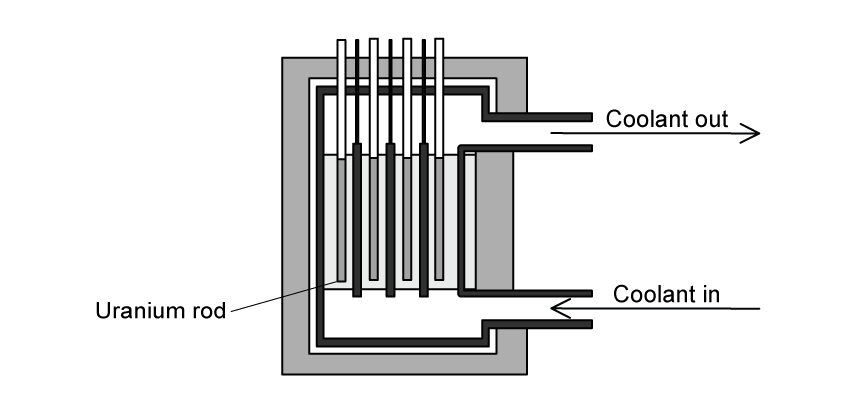
The diagram shows a nuclear reactor.

A cross-section of a nuclear reactor. A thick pale grey outer wall surrounds a reactor vessel drawn as a thick black outline. Inside the vessel stand eleven vertical rods arranged alternately: six grey rods and five black rods. The five black rods continue upwards, passing out through the top of the vessel and the top of the outer wall. A leader line from the left labels one of the grey rods uranium rod. On the right, two horizontal pipes pass through the outer wall. The upper pipe is labelled coolant out and its arrow points right, away from the reactor. The lower pipe is labelled coolant in and its arrow points left, towards the reactor. No other part of the diagram is labelled

(i) On the diagram, label the control rods and the shielding.

[2]

(ii) Explain why the shielding is needed.

[2]

1a
5 marks

The diagram shows the fuel used in some nuclear reactors.

The fuel is contained inside spheres.

The silicon carbide layer of each sphere is designed to contain the fission products for at least one million years.

Diagram of a nuclear fuel sphere. On the left a whole sphere is drawn in outline with a section cut away; on the right is the cut face, made of concentric shaded layers. Three leader lines label the layers from the outside inwards: graphite for the outer shell, silicon carbide for the light grey middle layer, and fuel for the darker inner core. A vertical double-headed arrow runs between two horizontal dashed lines across the full height of the sphere and is labelled 60 mm. The caption beneath reads: section through a fuel sphere.

(i) Give the name of a fuel that could be used.

[1]

(ii) Explain what is meant by the term fission products.

[2]

(iii) Explain why it is important to contain these fission products for such a long time.

[2]

1b
3 marks

The graphite layer in every fuel sphere acts as a moderator.

(i) State the function of the moderator in a nuclear reactor.

[1]

(ii) The nuclear reactor also contains boron control rods.

Explain why it is dangerous to remove most of the control rods from the reactor.

[2]

2a
1 mark

The diagram shows a neutron colliding with a nucleus of uranium-235, producing a number of products.

A diagram showing a nuclear reaction. On the left a small pale sphere is labelled neutron, with a horizontal arrow pointing right from it towards a large cluster of pale and dark spheres labelled uranium-235, in which several of the dark spheres are marked with a plus sign. A second horizontal arrow points right from the uranium-235 cluster to two smaller clusters of pale and dark spheres, one drawn above the other, the dark spheres again marked with plus signs. From these two smaller clusters a further two arrows point right and diverge, the upper arrow rising to a single pale sphere and the lower arrow falling to a single pale sphere.

Name the process shown in the diagram.

2b
3 marks

Explain how the process shown in the diagram can lead to a chain reaction.

2c
2 marks

This process releases energy.

Explain the energy transfer taking place in this reaction.

2d
5 marks

The energy released in this process can be used in a nuclear power station.

A cross-section diagram of a nuclear power station. On the left, a large shaded container labelled pressurised water encloses a rounded reactor vessel labelled reactor, which holds a set of vertical rods. A closed pipe loop leaves the reactor to the right, passes down through a tall vessel beside it and returns along the bottom to the reactor, with arrows on the loop showing the flow out of the reactor, downwards through the tall vessel and back left along the bottom into the reactor. From the top of that tall vessel a pipe labelled steam carries an arrow pointing right to a wheel labelled turbine. A horizontal shaft joins the turbine to a second wheel on its right labelled generator. Below the turbine a return pipe labelled water carries an arrow pointing left, back towards the tall vessel. From the top of the generator two cables labelled wires run up and to the right to a pylon at the far right of the diagram.

(i) The pressurised water acts as a coolant. It also acts as a moderator.

What is the purpose of a moderator?

[1]

(ii) Complete the chart below to show the main useful energy transfers in a nuclear power station.

A flow chart of five rectangular boxes in a row, joined left to right by four thick black arrows. The first box reads: Energy is transferred from the nuclear store of the uranium. The second box reads: To the, then a gap to be filled in, then store of the water. The third box reads: To the, then a gap to be filled in, then store of turbine. The fourth box reads: To the, then a gap to be filled in, then store of generator. The fifth box reads: Transferred away, then a gap to be filled in, then via the national grid.

[4]

3a
5 marks

Nuclear power stations use a uranium isotope as fuel.

The table shows information about three isotopes of uranium.

A table with five columns headed Isotope, Proton number, Neutron number, Half-life and Amount in natural uranium. The uranium-234 row reads proton number 92, neutron number 142, half-life 0.0002 billion years, 0.005% of natural uranium. The uranium-235 row has an empty proton number cell, neutron number 143, half-life 0.7 billion years, 0.7% of natural uranium. The uranium-238 row reads proton number 92, an empty neutron number cell, half-life 4.5 billion years, 99% of natural uranium.

(i) Complete the table by filling in the missing numbers.

[2]

(ii) Explain what is meant by the term half-life.

[2]

(iii) Suggest why uranium-238 is the most common isotope of uranium.

[1]

3b
3 marks

What are the products of the fission of uranium nuclei?

3c
3 marks

The diagram shows the reactor in a nuclear power station.

A cross-section diagram of a nuclear reactor. Vertical control rods pass down through the top of the reactor, alternating with vertical fuel rods, into a shaded block of moderator. Labels on the left with leader lines pointing into the reactor read control rod, moderator and fuel rod, reading from top to bottom. Labels on the right read shielding, pointing to the thick outer wall enclosing the reactor, and reactor vessel, pointing to the inner wall. A pipe at the upper right is labelled hot water out, with an arrow pointing right, away from the reactor. A pipe at the lower right is labelled cold water in, with an arrow pointing left, into the reactor. The water pipe loops around the inside of the reactor vessel, above and below the rods.

(i) What is the purpose of the moderator?

[1]

(ii) Describe what happens in the reactor when a control rod is removed.

[2]

3d
5 marks

There have been several accidents at nuclear power stations. The most serious accident caused an explosion in the reactor. This explosion spread material from inside the reactor to the surrounding area.

Explain why it is difficult to make the surrounding area safe again after a serious nuclear accident. 

4a
5 marks

Nuclear fission occurs in nuclear reactors.

Cross-section of a nuclear reactor. A rectangular outer wall labelled reactor vessel encloses the core, which is a pale grey block labelled moderator. Vertical rods run down into the core: thick black rods labelled control rod, which enter from above and are only partly lowered, alternating with pale grey rods labelled fuel rod. A thick black coolant pipe loops around the core inside the vessel. On the right of the diagram an arrow pointing right, away from the vessel, is labelled coolant out at the top, and an arrow pointing left, into the vessel, is labelled coolant in at the bottom.

Describe the process of nuclear fission in the reactor, including the material used in the fuel rod. Explain what happens to the energy released.

4b
6 marks

Explain the role of the moderator and the control rods. Suggest materials which would be suitable to use for each one.

4c
4 marks

Explain how a chain reaction can occur in the reactor.

5a
1 mark

Which of the following statements about nuclear power is incorrect? 

  • An advantage of nuclear power is that it produces no carbon dioxide

  • Concrete shielding is a helps ensure harmful radiation does not escape from a nuclear reactor

  • The products of fusion include daughter nuclei and neutrons

  • The moderator slows down neutrons

5b
1 mark

Which of the following statements about nuclear fusion is incorrect?

  • Fusion requires high temperature and pressure

  • The rate of reaction of fusion can be increased using neutrons

  • Fusion occurs in the Sun

  • Fusion involves light nuclei

5c
2 marks

Energy and mass can be converted using the equation:

changeinenergy=changeinmass×speedoflight2

ΔE=Δmc2

Fusion and fission are examples of when this conversion process occurs.

A particular fusion reaction that can occur is:

Nuclear fusion reaction drawn as clusters of plain circles representing nucleons. A bracket labelled Reactants spans two clusters: a cluster of three circles labelled Helium-3 on the left, and a cluster of four circles labelled Helium-4 to its right. A horizontal arrow points to the right, from the reactants towards a second bracket labelled Product, which spans a cluster of seven circles labelled Beryllium-7. All circles are identical outlines with no shading, so protons and neutrons are not distinguished.

In this reaction:

  • Mass of reactants mR = mass of helium−3 + mass of helium−4

  • Mass of product mP = mass of beryllium−7

  • Energy is released

State and explain which quantity is greater, mR or mP.

5d
3 marks

The difference in mass of the reactants and products was found to be 2.8 × 10⁻³⁰ kg.

The speed of light is 3.00 × 10⁸ m/s.

Calculate the amount of energy released. Give the unit.