Waves & The Electromagnetic Spectrum (Edexcel IGCSE Science (Double Award) (Modular): Physics Unit 2): Exam Questions

Exam code: 4XSD1

2 hours35 questions
1
1 mark

Which of these statements is correct?

  • Microwaves always travel faster than radio waves.

  • Microwaves always travel slower than radio waves.

  • Microwaves and radio waves travel at the same speed in a vacuum.

  • Microwaves and radio waves travel at the same speed in all materials. 

2a
1 mark

Which of the following electromagnetic waves has the shortest wavelength?

  • infrared

  • microwaves

  • ultraviolet

  • visible light

2b
1 mark

Which of these statements about electromagnetic waves is not correct? 

  • electromagnetic waves are longitudinal

  • electromagnetic waves can transfer energy

  • electromagnetic waves can travel between stars

  • electromagnetic waves travel at the same speed in free space

2c
1 mark

Which of the following is a use for x-rays?

  • broadcasting television

  • cooking a potato

  • looking at the internal structure of objects

  • looking through night vision goggle

3
1 mark

All types of electromagnetic radiation from the Sun are emitted with

  • the same amplitude

  • the same frequency

  • the same speed

  • the same wavelength

4
1 mark

The diagram shows a wave on the sea.

A transverse wave drawn as a smooth curve about a horizontal undisturbed line, with two full crests and two troughs. Four double-headed arrows are labelled A, B, C and D. Arrow A is horizontal, lying along the undisturbed line and spanning the first trough from one crossing point to the next. Arrow B is vertical, drawn at the first full crest from the top of that crest down to the bottom of the trough beside it. Arrow C is vertical, drawn at the second crest from the top of that crest down to the undisturbed line. Arrow D is horizontal, drawn beneath the wave from the bottom of one trough to the bottom of the next trough.

Which letter shows the amplitude of the wave?

  • Option A

  • Option B

  • Option C

  • Option D

5a
3 marks

Describe one difference between transverse and longitudinal waves.

Draw a labelled diagram to help your answer. 

5b
2 marks

State two properties that are the same for all electromagnetic waves. 

6a
2 marks

The names of two parts of the electromagnetic spectrum are missing.

radio waves

A

infrared

visible light

ultraviolet

B

gamma rays

Complete the table with the names of the missing parts.

Name

A

B

6b
2 marks

The Sun emits visible light, infrared and ultraviolet that travel through space and reach the surface of the Earth.

State two similarities between visible light, infrared and ultraviolet.

6c
2 marks

Too much exposure to infrared and ultraviolet can cause damage to the human body. State the damage that each can cause.

6d
1 mark

Seven colours can be seen in the visible light spectrum.

Which colour has the longest wavelength? 

7
1 mark

Different types of waves are used in hospitals. Some of the waves used are electromagnetic.

Which of these properties is the same for all electromagnetic waves?

  • Amplitude

  • Frequency

  • Speed in free space

  • Wavelength in free space  

8
1 mark

The diagram shows part of a water wave.

Graph of height against distance for a water wave. The curve starts at the origin, labelled 0, rises to a crest, falls to a trough of equal depth, then rises to a second crest before returning to the horizontal distance axis. Four labelled double-headed arrows mark measurements on the wave. A is a vertical arrow from the horizontal axis up to the top of the first crest. B is a horizontal arrow drawn at crest level from the first crest across to the second crest. C is a horizontal arrow along the axis, from where the curve rises back through the axis after the trough to where the curve meets the axis at the right-hand end. D is a vertical arrow in the middle of the diagram running from crest level down to the bottom of the trough.

Which letter represents the amplitude?

  • Option A

  • Option B

  • Option C

  • Option D

9
1 mark

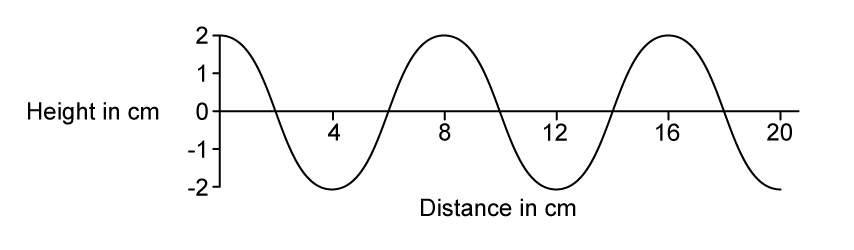
The diagram shows a water wave.

Graph of height in cm against distance in cm for a water wave. The vertical axis runs from minus 2 to 2 in steps of 1 and the horizontal axis from 0 to 20 in steps of 4. The curve starts at a height of 2 cm at zero distance, falls to minus 2 cm at 4 cm, rises to 2 cm at 8 cm, falls to minus 2 cm at 12 cm, rises to 2 cm at 16 cm and falls back towards minus 2 cm at 20 cm

What is the amplitude of the wave?

  • 1 cm

  • 2 cm

  • 4 cm

  • 8 cm

10
1 mark

Some types of wave are used in hospitals.

A scanner uses one type of wave to check for broken bones. What type of wave is emitted by the scanner?

  • infrared

  • microwave

  • ultrasound

  • x-rays

11a
1 mark

The Sun emits different types of electromagnetic waves. 

Which of the following properties is the same for all the waves?

  • amplitude

  • frequency

  • speed

  • wavelength

11b
1 mark

Which type of electromagnetic wave causes sunburn and snow blindness?

  • gamma rays

  • infrared

  • radio waves

  • ultraviolet

12a
1 mark

The Earth receives different types of electromagnetic waves from the Sun.

These include

  • infrared

  • ultraviolet

  • visible light

Complete the table by arranging these three types of electromagnetic wave in order of decreasing wavelength.

longest wavelength ⟶ shortest wavelength

12b
2 marks

Name two other types of electromagnetic wave.

12c
4 marks

Ultraviolet waves are useful, but they can be dangerous.

(i) State two uses of ultraviolet waves.

[2]

(ii) State two dangers of ultraviolet waves.

[2]

13
2 marks

A man watches some waves pass his boat.

He sees the crest of the waves pass him every 5 s.

Calculate the frequency of these waves.


frequency = ............................ Hz

1
1 mark

Microwaves are part of the electromagnetic spectrum.

Which part of the electromagnetic spectrum has longer wavelengths than microwaves? 

  • gamma rays

  • radio waves

  • ultraviolet light

  • visible light 

2
1 mark

The diagram shows part of a water wave.

Graph of height against distance for a water wave, showing one and a half cycles: a crest, then a trough, then a second crest. Four labelled double-headed arrows are marked. A is vertical, running from the horizontal axis up to the top of the first crest. B is horizontal, running from the top of the first crest across to the top of the second crest. C is horizontal, running along the axis from where the curve rises back through zero after the trough to where it returns to zero after the second crest. D is vertical, running from the level of the tops of the crests straight down to the bottom of the trough.

Which letter represents the wavelength?

  • Option A

  • Option B

  • Option C

  • Option D

3
1 mark

The diagram shows a water wave.

Graph of height in cm against distance in cm, showing a wave with crests of height 2 cm at 0 cm, 8 cm and 16 cm along the distance axis, and troughs of height −2 cm at 4 cm, 12 cm and 20 cm

What is the wavelength of the wave?

  • 2 cm

  • 4 cm

  • 8 cm

  • 20 cm

4
1 mark

The table shows the main sections of the electromagnetic spectrum.

A single-row table of the electromagnetic spectrum divided into seven equal cells, labelled from left to right: Gamma rays, X-rays, Ultraviolet, Visible, Infra-red, Microwaves, Radio. Below the table a long horizontal black arrow runs the full width of the table, pointing from left to right, from the Gamma rays end towards the Radio end.

The arrow below the table shows the direction of

  • increasing wave amplitude

  • increasing wave frequency

  • increasing wave speed

  • increasing wavelength

5
1 mark

The diagram shows a wave on the sea.

A wave drawn as a smooth curve crossing a horizontal centre line, showing just over two complete cycles. Four labelled double-headed arrows mark different measurements on the wave. Arrow A is horizontal and lies along the centre line, running from one crossing point to the next and spanning a single trough. Arrow B is vertical and runs from the top of a crest down to the level of the bottom of a trough. Arrow C is vertical and runs from the top of a crest down to the centre line. Arrow D is horizontal and sits below the wave, running from the bottom of one trough to the bottom of the next trough.

Which letter shows the wavelength of the wave?

  • Option A

  • Option B

  • Option C

  • Option D

6a
2 marks

Water waves are transverse waves. Other waves can be longitudinal.

State a similarity and a difference between a transverse wave and a longitudinal wave. 

6b
5 marks

A student writes some sentences about electromagnetic waves. Their teacher underlines a mistake in each sentence.

In the table, write a suitable correction for each mistake.

The first one has been done for you. 

Sentence

Correction

 Electromagnetic waves travel at 3 × 10⁻² m/s in a vacuum. 

3 × 10⁸ 

 Sound waves are electromagnetic. 


 Infra-red waves are the most harmful to people. 


 Gamma waves are used for heating up food. 


 Radio waves have the highest frequency. 


 Gamma waves have the longest wavelength. 


7a
2 marks

Gamma radiation is used in hospitals even though it can be dangerous. 

Describe one use of gamma radiation in hospitals.

7b
3 marks

(i) Explain the risks to patients and doctors of using gamma radiation.

[2]

(ii) State one way of reducing the risks to a doctor who uses gamma radiation.

[1]

8a
4 marks

The table shows the main sections of the electromagnetic spectrum.

A single row table showing the seven main sections of the electromagnetic spectrum in order from left to right: gamma rays, X-rays, ultraviolet, visible, infrared, microwaves and radio. A horizontal arrow below the row points from left to right, from the gamma rays end towards the radio end.

(i) State two sections of the spectrum that are used for communications.

[2]

(ii) State two sections of the spectrum that are used for cooking.

[2]

8b
4 marks

A radio station broadcasts at a frequency of 200 kHz. The wavelength of the radio waves is 1500 m.

(i) State the equation linking wave speed, frequency and wavelength.

[1]

(ii) Calculate the speed of these radio waves and give the unit.

[3]

speed = ...................... unit ........

9a
3 marks

The chart lists some electromagnetic radiations.

radio

microwave

infrared

visible light

ultraviolet

x-ray

gamma

Complete the table by giving one radiation from the chart from each use.

You may give each radiation once, more than once, or not at all.

Use for radiation

Type of radiation

cooking

treating cancer

identifying broken bones

9b
2 marks

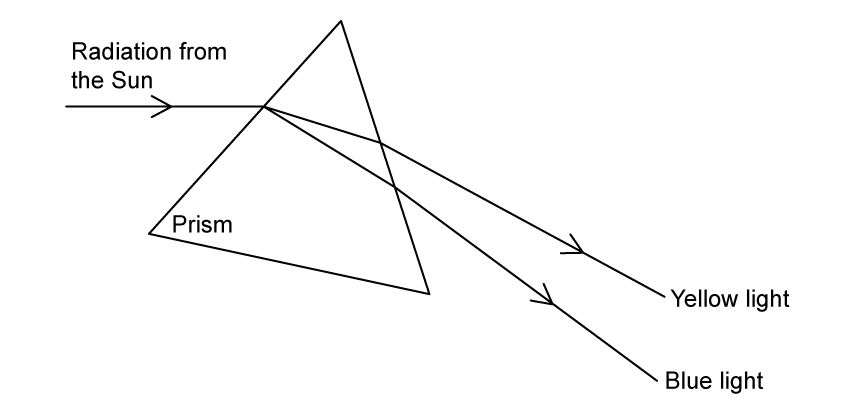
William Herschel was a scientist who investigated infrared radiation. He passed electromagnetic radiation from the Sun through a triangular glass prism. The prism refracted different radiations by different amounts.

The paths of yellow and blue visible light rays are shown in the diagram.

A horizontal ray labelled radiation from the Sun travels to the left-hand sloping face of a triangular glass prism, which is labelled prism. Inside the prism the ray splits into two rays that pass through the right-hand face and travel down to the right, the upper one labelled yellow light and the lower one labelled blue light

Add to the diagram to show how the prism refracts an infrared ray.

10a
1 mark

Some waves travel across the sea.

They all have the same wavelength.

What is meant by the term wavelength?

10b
3 marks

The waves travel across the sea at 3.0 m/s and have a frequency of 1.5 Hz.

(i) State the equation linking wave speed, frequency and wavelength.

[1]

(ii) Calculate the wavelength of the waves

[2]

wavelength = ........................... m

11
1 mark

Which of these electromagnetic radiations has a frequency greater than ultraviolet?

  • infrared

  • gamma rays

  • radio waves

  • visible light

12a
3 marks

A pulsar is a type of star.

We receive radiation from a pulsar in regular short bursts called pulses.

Some pulsars emit radio waves. Other pulsars emit x-rays.

(i) State a property of waves that is the same for radio waves and x-rays.

[1]

(ii) State two properties of waves that are different for radio waves and x-rays.

[2]

12b
4 marks

The graph shows five pulses of the signal from a pulsar.

Graph of signal strength in arbitrary units on the vertical axis against time in s on the horizontal axis, drawn on a fine grid. The vertical axis is scaled from 0 to 1 in steps of 0.2. The horizontal axis is labelled 0 and 1, with further unlabelled major gridlines at equal intervals of 1 s up to 6 s. The trace stays at zero apart from five narrow spikes of similar height, each rising to between about 0.59 and 0.69, with their peaks at roughly 0.3 s, 1.7 s, 3.0 s, 4.3 s and 5.7 s.

(i) Use the graph to estimate the average time between each pulse.

[2]

(ii) Calculate the frequency of the pulses in the signal.

Give the unit.

[2]

frequency = .......................... units ...........

13a
2 marks

The diagram represents a microwave travelling in free space from point A to point B.

A transverse wave drawn along a horizontal distance axis running from point A on the left to point B on the right, then continuing to an arrowhead labelled distance. Between A and B the curve leaves the axis at A, rises to four crests and dips to three troughs of equal height, and returns to the axis at B. A double-headed arrow beneath the axis spans A to B and is labelled 0.60 m.

The distance from A to B is 0.60 m.

Calculate the wavelength of this microwave.

wavelength = ................................

13b
4 marks

(i) State the equation linking wave speed, frequency and wavelength.

[1]

(ii) Calculate the frequency of this microwave.

[speed of microwave in free space = 3.0 × 10⁸ m/s]

[3]

14a
3 marks

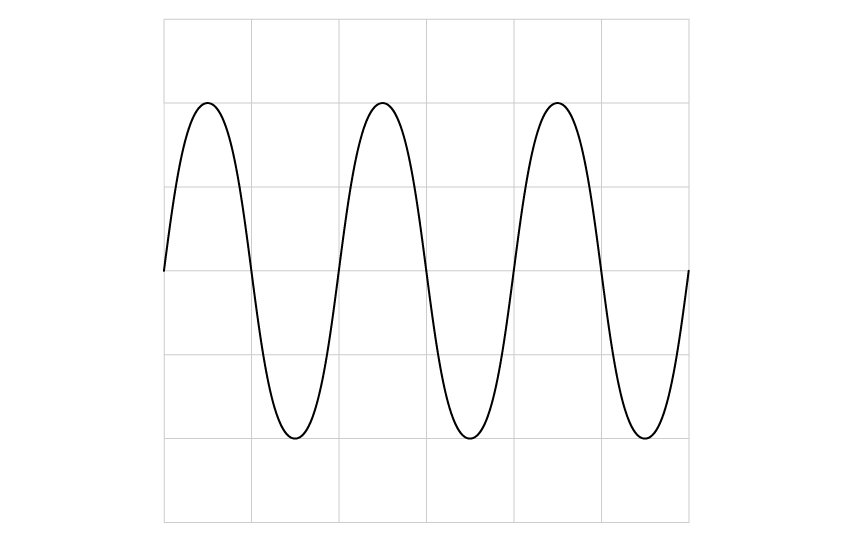
A microphone is connected to an oscilloscope to display a sound wave.

The diagram shows the trace on the oscilloscope screen.

An oscilloscope screen showing a grid six squares wide and six squares tall. A smooth wave is drawn across the grid, starting on the centre horizontal line at the left edge and rising first. Each peak reaches two squares above the centre line and each trough reaches two squares below it, and three complete cycles fit across the six squares.

The oscilloscope settings are:

Y direction: 1 square = 1 V

X direction: 1 square = 0.001 s

(i) How many time periods are shown on the trace?

[1]

(ii) What is the frequency of the sound wave?

[2]

14b
2 marks

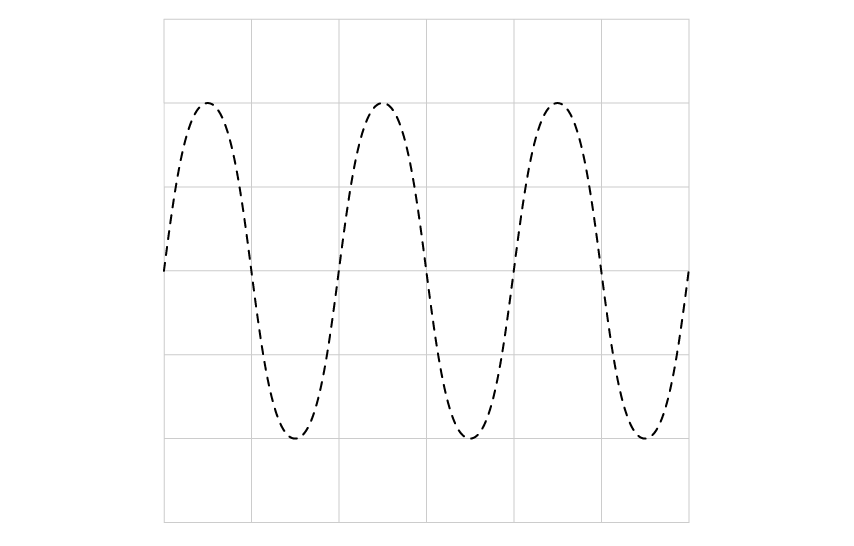
On the grid below, sketch the trace of a sound wave with a smaller amplitude and a higher frequency than the wave shown by the dotted line.

An oscilloscope grid six squares wide and six squares tall with a dashed wave drawn across it. The dashed wave starts on the centre horizontal line at the left edge and rises first, with each peak two squares above the centre line and each trough two squares below it, and three complete cycles fit across the six squares.
15a
3 marks

In 1901, Marconi received the first radio signal across the Atlantic Ocean.

The frequency of Marconi’s radio wave was 820 kHz and the wavelength was 366 m.

(i) State the equation linking wave speed, frequency and wavelength for radio waves.

[1]

(ii) Calculate the speed of the radio waves Marconi received.

[2]

speed of radio waves = .................................. m/s

15b
1 mark

Some people do not believe that Marconi received 820 kHz radio waves.

They think that the frequency was really twice as much: 1640 kHz.

If these people are correct, what wavelength radio waves did Marconi receive?

wavelength = .......................... m

15c
3 marks

Other people do not think Marconi received a radio signal across the Atlantic Ocean at all.

They think the radio waves he received were really caused by electrostatic discharges from storm clouds.

A line drawing of a large storm cloud in the sky, labelled storm cloud. A row of plus signs runs along the top edge of the cloud and a row of minus signs runs along the base of the cloud. On the ground below, three trees stand on the left and three houses stand on the right.

Explain what happens when a storm cloud discharges.

1
1 mark

Ultrasound waves are also used to produce images.

This is an ultrasound image of a fetus surrounded by fluid.

Greyscale ultrasound scan showing a fan-shaped scan region on a black background. A curled fetus appears near the centre as a bright outline of head, spine and limbs, surrounded by darker fluid. A depth scale marked 0, 5 and 10 runs down the left-hand edge of the fan.

The ultrasound image is caused by waves which bounce off the fetus.

This is an example of waves that are

  • absorbed

  • reflected

  • refracted

  • repelled

2
1 mark

A student has some LEDs connected in a circuit. They emit light of different colours.

The different colours of light are waves which must have:

  • the same amplitude in free space

  • the same frequency in free space

  • the same speed in free space

  • the same wavelength in free space

3a
1 mark

A student is listening to a radio.

A portable radio with a mesh speaker grille on the left, a dark tuning panel on the right showing two vertical frequency scales and a band-selector switch, a folded carrying handle at the side, and an extended telescopic aerial rising from the top right

The radio is powered by batteries that provide a direct current (d.c.).

What is direct current?

3b
5 marks

Radio waves are part of the electromagnetic spectrum.

(i) Suggest a property of radio waves that makes them suitable for use in communication.

[1]

(ii) Complete the table to show uses and possible harmful effects of some other parts of the electromagnetic spectrum.

[4]

Part of the electromagnetic spectrum

Use

Possible harmful effect on people

Microwaves

Gamma

4
1 mark

A scanner uses one type of wave to check for broken bones.

An image of the bone is seen because the waves from the scanner are  

  • absorbed by the bone  

  • reflected by the bone  

  • refracted by the bone  

  • transmitted by the bone  

5
1 mark

A remote control emits infrared waves to operate a television.

Two photographs side by side. On the left, a flat-screen television with a blank grey screen standing on an oval base. On the right, a hand holding a remote control with rows of buttons, pointing it forwards

The television receives infrared waves and radio waves.

It emits light waves and sound waves.

Which type of wave has the highest frequency?

  • infrared

  • light

  • radio

  • sound

6a
3 marks

Different types of waves are used in hospitals.

(i) Draw a line linking each type of electromagnetic wave with its use.

Two columns of labelled boxes with a dot on the inner edge of each box and no lines drawn between them. The left column is headed type of electromagnetic wave and contains gamma rays, microwaves and x-rays from top to bottom. The right column is headed use and contains heating food for patients, imaging broken bones and with medical tracers from top to bottom

[2]

(ii) Electromagnetic waves are transverse.

Describe how the vibrations of a transverse wave relate to the direction in which the wave travels.

[1]

6b
4 marks

Another type of wave used in hospitals is ultrasound. Ultrasound waves are used to make images of internal organs.

A scanner emits an ultrasound wave into the patient and records any reflections.

(i) The scanner records the time from when a wave is emitted to when its reflection is received.

A technician calculates the depth of the reflection using the equation

depth=12×(speed of ultrasound in patient×time recorded by scanner)

Explain why the technician uses the value 12 in the equation.

[2]

(ii) An ultrasound wave travels faster in the patient than it does in air.

Explain how a change in speed affects the wavelength of the ultrasound wave.

[2]

6c
2 marks

Name one type of wave that is used in cancer treatment and explain what it does during the treatment.

7a
4 marks

Ultrasound waves are sound waves with a very high frequency. They are often used for medical purposes.

Dentists use ultrasound waves to clean patients’ teeth.

The diagram shows an ultrasound cleaner removing plaque from teeth.

Line drawing of the inside of a mouth, showing a row of front teeth seen from behind. A shaded grey layer lying along the base of the teeth at the gum line is labelled plaque. A hand-held instrument angled into the mouth from the upper right is labelled ultrasound cleaner, and its fine hooked point, touching the plaque at the gum line, is labelled vibrating tip. A second, wider nozzle enters from the upper left, and a line labelled spray of water points to the place where its jet meets the teeth.

The tip of the ultrasound cleaner vibrates 96 million times per second and is sprayed with water.

(i) State the frequency of the ultrasound emitted by the cleaner and give the unit.

[2]

frequency = ....................... unit .....

(ii) Suggest how the cleaner removes plaque.

[1]

(iii) Suggest why water is sprayed on the tip of the cleaner.

[1]

7b
4 marks

(i) State the equation linking wave speed, frequency and wavelength.

[1]

(ii) The ultrasound waves have a wavelength of 0.00044 m and travel at a speed of 1540 m/s in the fluid.

Calculate the frequency, in MHz, of the ultrasound waves.

[3]

7c
2 marks

Other waves also have medical uses.

Ultraviolet waves are used by doctors to cure some skin conditions.

Suggest two differences between ultrasound waves and ultraviolet waves.