Antarctica as a Global Common (AQA A Level Geography): Exam Questions

Exam code: 7037

2 hours15 questions
1
1 mark

What is the main purpose of the Antarctic Treaty of 1959?

  • To divide Antarctica between the seven countries that had made territorial claims.

  • To set Antarctica aside for peaceful, scientific use, freezing territorial claims and banning military activity.

  • To allow the controlled mining of Antarctica's mineral resources.

  • To give the United Nations direct ownership and control of Antarctica.

2
1 mark

What does the Madrid Protocol of 1991 do?

  • It opens Antarctica to commercial fishing without any limits.

  • It allows tourism to expand freely across the whole continent.

  • It hands control of Antarctica to the country with the most research stations.

  • It bans all mineral exploitation and designates Antarctica a 'natural reserve, devoted to peace and science'.

3
4 marks

Outline how fishing and whaling threaten Antarctica and the Southern Ocean.

4
4 marks

Outline how climate change is a threat to Antarctica.

5
4 marks

Outline the value of scientific research in Antarctica.

1
Sme Calculator
6 marks

Figures 1, 2 and 3 show climatic statistics for three places in Antarctica.

Figure 1

Temperatures (degrees Celsius)

Jan

Feb

Mar

Apr

May

Jun

Jul

Aug

Sep

Oct

Nov

Dec

Mean Annual temperature

1

−32

−44

−58

−65

−66

−65

−67

−68

−66

−57

−43

−42

-56

2

−28

−41

−54

−57

−57

−58

−60

−60

−60

−51

−38

−28

-49

3

0

−6

−14

−17

−19

−19

−22

−23

−21

−16

−7

−1

-14

1 = Vostok (78 degrees S - near to the 'Pole of Inaccessibility' - the point on Antarctica that is furthest from the sea in any direction). Height 3448 metres

2 = Amundsen-Scott (90 degrees S - the base at the South Pole). Height 2880 metres

3 = McMurdo (79 degrees S - on the coast of the Ross Sea). Height 24 metres

Figure 2

Precipitation (mm water equivalent)

Jan

Feb

Mar

Apr

May

Jun

Jul

Aug

Sep

Oct

Nov

Dec

Total

1

0.1

0

0.7

0.5

0.4

0.5

0.6

0.7

0.3

0.2

0.1

0

4.1

2

0.2

0.3

0

0

0.1

0

0

0

0.1

0

0

0.1

0.8

3

15

21.2

24.1

18.4

23.7

24.9

15.6

11.3

11.8

9.7

9.5

15.7

200.9

Figure 3

Average length of day (hours)

Jan

Feb

Mar

Apr

May

Jun

Jul

Aug

Sep

Oct

Nov

Dec

2

24

24

17.8

0

0

0

0

0

17.2

24

24

24

Using Figures 1, 2, and 3, analyse characteristics of the climate of Antarctica
2
Sme Calculator
6 marks

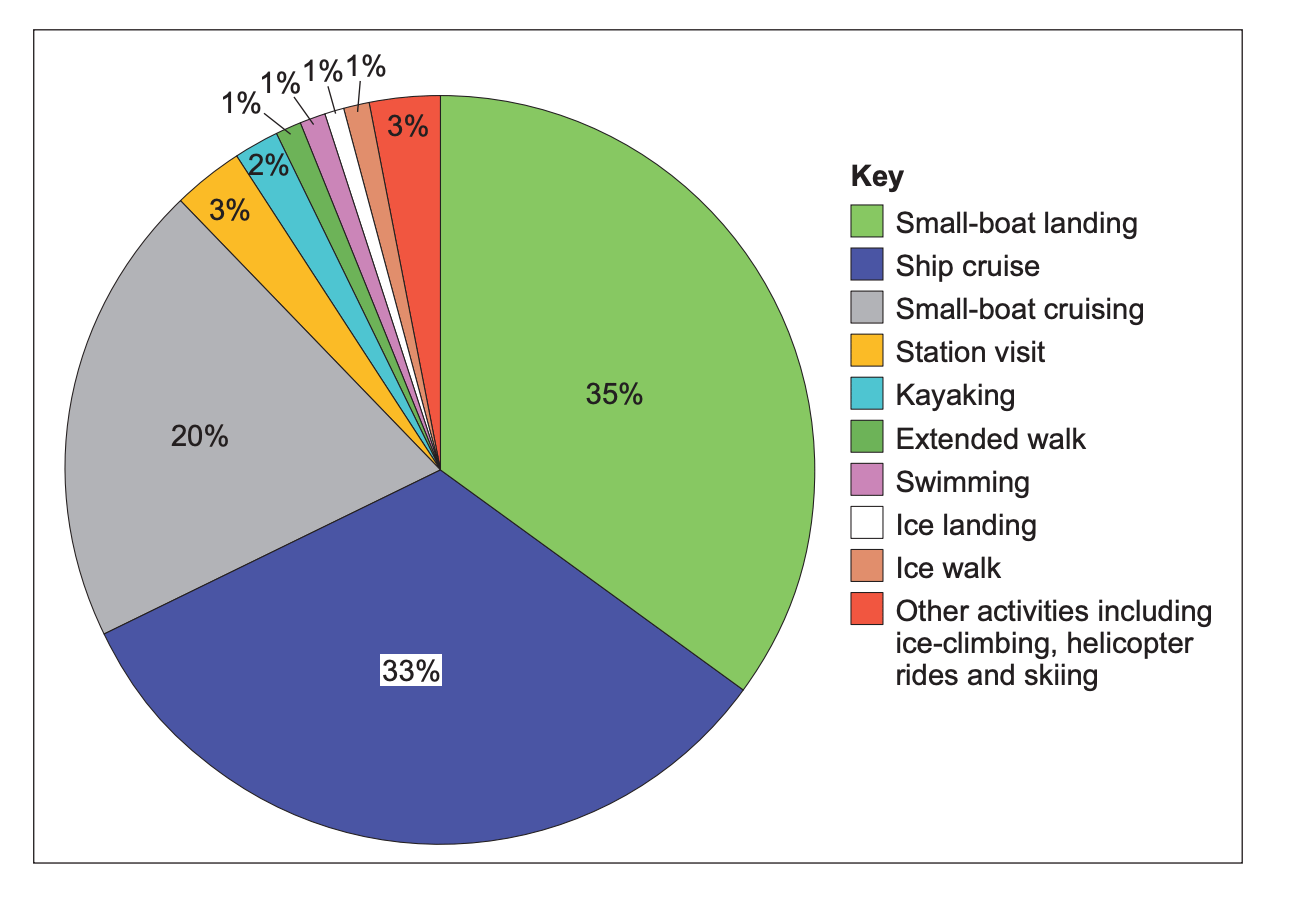
Figure 2a shows percentage breakdown of main tourist activities for visitors to Antarctica in 2016–17. In the 2016–17 season there were 44 202 visitors to Antarctica.

Figure 2b shows a small-boat landing party of tourists visiting a penguin colony on South Orkney Islands in Antarctica.

Figure 2a

percentage breakdown of main tourist activities for visitors to Antarctica in 2016–17. In the 2016–17 season there were 44 202 visitors to Antarctica.

Pie chart of Antarctic tourist activities: 35% small-boat landing, 33% ship cruise, 20% small-boat cruising, others each 3% or less including walks and kayaking

Figure 2b

a small-boat landing party of tourists visiting a penguin colony on South Orkney Islands in Antarctica

fig-2b-inserts-paper2-nov2020-aqa-alevel-geography

Using Figure 2a, Figure 2b and your own knowledge, to what extent do you agree that tourism is a threat to Antarctica?

3
Sme Calculator
6 marks

Figure 1a shows the mean July temperatures at Faraday, a research station in Antarctica, between 1976 and 2016.

Figure 1b is a graph showing the annual mean temperature at Faraday between 1950 and 2016.

Figure 1c shows the mean July temperatures in rank order and the formula for calculating inter-quartile range.

Figure 1a 

Year

Mean July temperature (degreeC)

1976

-11.8

1980

-16.0

1984

-6.4

1988

-5.4

1992

-10.4

1996

-5.7

2000

-3.8

2004

-4.8

2008

-4.7

2012

-3.9

2016

-8.5

Figure 1b

fig-1b-paper2-june2018-aqa-alevel-geography

Figure 1c

Position

Mean July temperature (degreeC)

1

-3.8

2

-3.9

3

-4.7

4

-4.8

5

-5.4

6

-5.7

7

-6.4

8

-8.5

9

-10.4

10

-11.8

11

-16.0

  Inter-quartile range:

  Upper-quartile (UQ) = th position = _________ degreeC

  Lower-quartile (LQ)  = fraction numerator 3 open parentheses n plus 1 close parentheses over denominator 4 end fraction th position = _________ degreeC

  Inter-quartile range (IQR) = _____________

  IQR is the difference between UQ and LQ 

Complete Figure 1c and analyse the temperature variations shown in Figures 1a, 1b and 1c.

[6]

4
9 marks

Assess the extent to which Antarctica's mineral resources are likely to be exploited in the future.

5
Sme Calculator
6 marks

Study Figure 1, which shows the number of tourists visiting Antarctica in selected seasons.

Figure 1: Number of tourists visiting Antarctica, selected seasons

Season

Number of tourists

1992 to 1993

6,700

2007 to 2008

46,000

2014 to 2015

37,000

2019 to 2020

74,000

2022 to 2023

105,000

Analyse the data shown in Figure 1.

1
Sme Calculator
20 marks

‘In a globalising world, the use of the global commons of Antarctica can never be sustainable.’

How far do you agree with this view?

2
Sme Calculator
20 marks

‘Climate change and pressures from economic growth mean that it is becoming more difficult to protect the global commons, such as Antarctica.’

To what extent do you agree with this view?

3
Sme Calculator
20 marks

Assess the relative importance of NGOs and international government organisations in enhancing protection of Antarctica.

4
20 marks

Evaluate the view that the Antarctic Treaty System is no longer sufficient to protect Antarctica from contemporary threats.

5
20 marks

'The impacts of changes in the carbon cycle represent the greatest threat to Antarctica and the Southern Ocean.'

How far do you agree with this view?