Great Leap Forward 1958–62: Mao's Second Five-Year Plan (Edexcel A Level History: Route E: Communist states in the twentieth century): Revision Note
Exam code: 9HI0

Summary
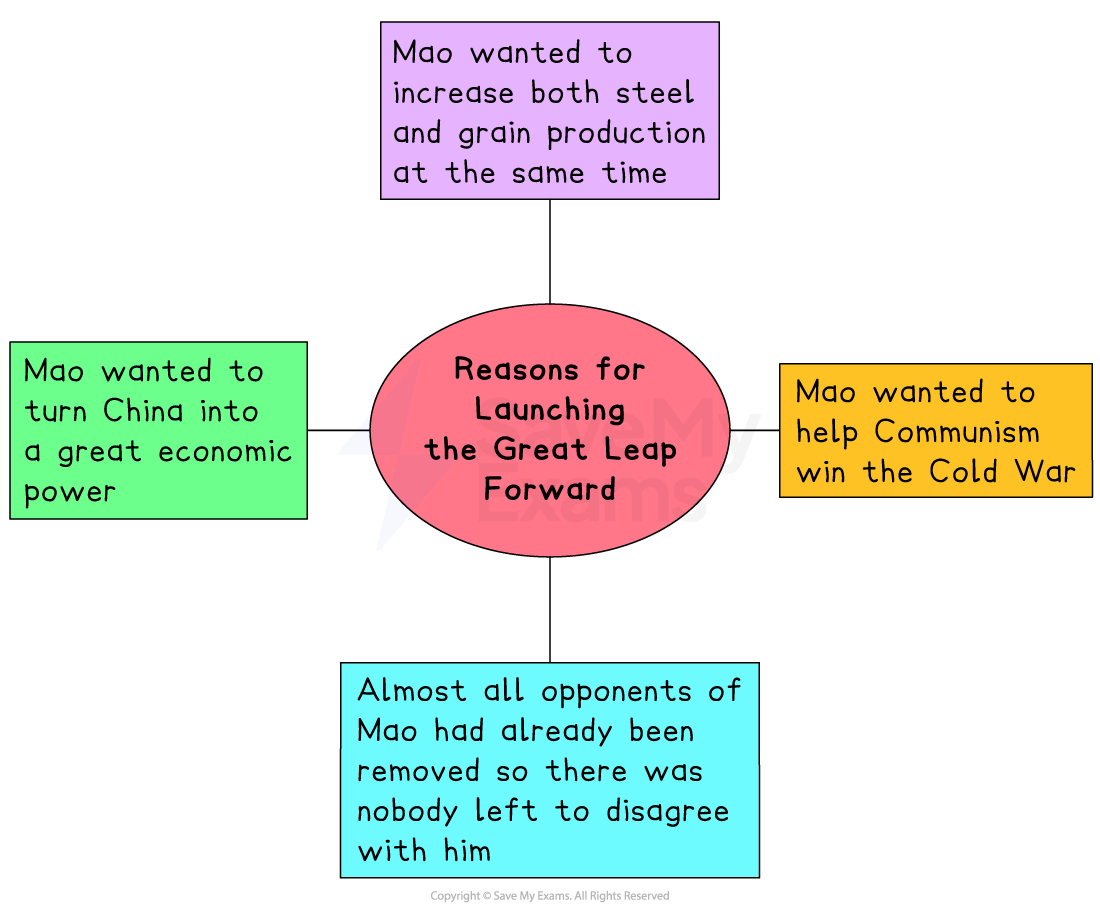
Mao wanted to build on what he believed was the success of the First Five-Year Plan and turn China into a great economic power
He saw an increase in steel production as being key to this and ordered thousands of 'backyard furnaces' to be built
These produced very poor-quality steel and kept peasants out of the fields
This led to a decrease in both agricultural and industrial output
Minister of Defence, Peng Dehuai, questioned the official grain production figures at the Lushan Conference in 1959
He was swiftly denounced as a traitor and replaced
Great Leap Forward: Mao's reasons for launching the Second Five-Year Plan
Mao had been greatly encouraged by the progress made during the First Five-Year Plan
He was convinced that the combination of China's vast manpower of 600 million people and the revolutionary spirit could overcome any obstacle
Great Leap Forward: Steel Production, State Enterprises and Economic Failure
Steel Production
Increasing the amount of steel produced in China was one of Mao's main motivations for launching the Great Leap Forward
To achieve this, he demanded the construction of small, home-made 'backyard furnaces'
Unachievable production targets were set, so peasants were forced to work day and night to keep the furnaces burning
The number of furnaces outstripped the supply of raw materials
This led peasants to feed tools, cooking implements and even the roofs of their homes into the furnaces
Most of the steel produced was of such low quality that factories were unable to use it
At the same time, because peasants were tending to furnaces rather than crops in the field, the yields fell or even rotted in the field as they were left unharvested
Many peasants died from exhaustion and starvation
State Enterprises
During the Great Leap Forward, all industrial businesses were taken over by the State
The production targets and prices were set by the Party rather than being dictated by market demands
Workers were supplied with a home, health care and guaranteed wages regardless of how hard they worked or what they produced
There was no incentive or reward for being efficient or productive
Economic Failure
The combination of 'backyard furnaces' and state ownership of enterprises led to industrial production falling
Between 1958 and 1962, industrial production fell by 40 per cent
Lushan Conference 1959: Peng Dehuai's challenge and Mao's response
The Chinese Communist Party (CCP) held a conference in Lushan in July 1959
Whilst there, the Minister of Defence, Peng Dehuai, began to express doubts about the accuracy of the reported record grain harvest
Peng Dehuai had been a peasant who had risen to become a brilliant military leader and played a vital role in the wars against the Nationalists and in Korea
Peng Dehuai hoped that his past achievements and standing in the party would allow him to question Mao
He wrote a letter to Mao and explained that his travels to his home village had caused him to question the grain harvest reports
Mao responded by denouncing Peng as a traitor who had been working with the Soviet leader Nikita Khrushchev
Peng was removed as Minister of Defence and replaced by one of Mao's closest allies, Lin Biao
Mao had sent a clear message to the CCP that no criticism or questioning of him would be tolerated
To what extent was the Great Leap Forward an economic disaster of Mao's own making?
Some Western historians believe that the disaster that followed the Great Leap Forward was entirely due to Mao and his political decisions
Others, particularly Marxist historians, argue that there were factors beyond Mao's control
Factors Beyond Mao's Control
China was struck by natural disasters and the end of Soviet support as Mao implemented the Second Five-Year Plan
Key historians
What happened to make the great successes turn into such a great disaster? First, we should perhaps note two mitigating factors. The years 1959 and 1960 saw the worst weather conditions in Chinese recorded history, with over half of all cultivated land hit by droughts or floods, or in some cases both. While it is very easy to blame the deaths entirely on the failings of the Great Leap, we cannot know what impact the weather would have had whatever system existed. The second mitigating factor was the withdrawal of all Soviet advisers to China in the summer of 1960. This move hit hard in the industrial sector, as the Soviets also took home their blueprints and cut China off from many key components for industry.
S.G. Breslin, Mao, 2014
Mao's Political Mistakes
Mao's removal of all opposition left no one to question his decisions
Key historians
The anti-rightist campaign merged seamlessly into the Great Leap Forward, a gigantic production drive that failed disastrously. The Leap’s failure was inevitable, but disaster was not. The economic reasoning behind the Great Leap Forward was flawed and would not have achieved its lofty goals under any circumstances. Disaster, however, was created by the politics of the Leap: it was launched and sustained through two massive campaigns to root out disloyalty within the party.
Andrew G. Walder, China Under Mao: A Revolution Derailed, 2015
Examiner Tips and Tricks
Examinations obviously require you to write at speed. However, recent examiner reports have highlighted the increased problems of illegible handwriting and the inappropriate use of shorthand and abbreviations. You will only get marks for what examiners can read and understand, so ensure that your writing is clear and that you explain any abbreviations the first time that you use them.

Unlock more, it's free!
Join the 100,000+ Students that ❤️ Save My Exams
the (exam) results speak for themselves:

Was this revision note helpful?
Build on this topic