China & the Korean War, 1950-53 (Edexcel A Level History: Route E: Communist states in the twentieth century): Revision Note
Exam code: 9HI0

Summary
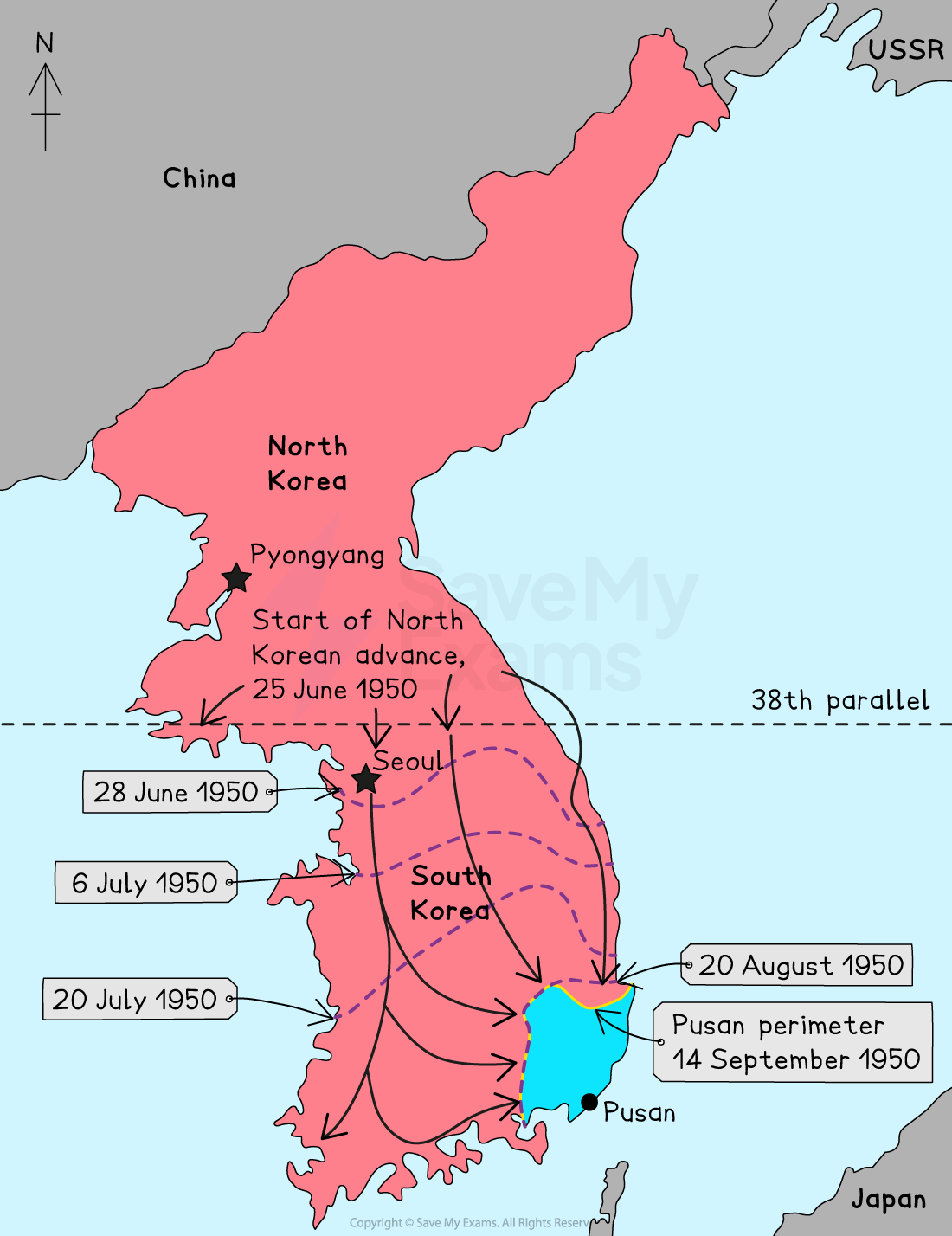
Korea had been occupied by Japan from 1910 until 1945
Soviet forces invaded Korea from the north, expelled the Japanese forces and appointed Kim Il Sung as leader
A rival, non-Communist government was appointed in the south of the country
Korea was divided into two countries along the 38th parallel.
In June 1950, Kim Il Sung launched an invasion of the South
The United Nations (UN) authorised a military force, led by the USA, to defend the South
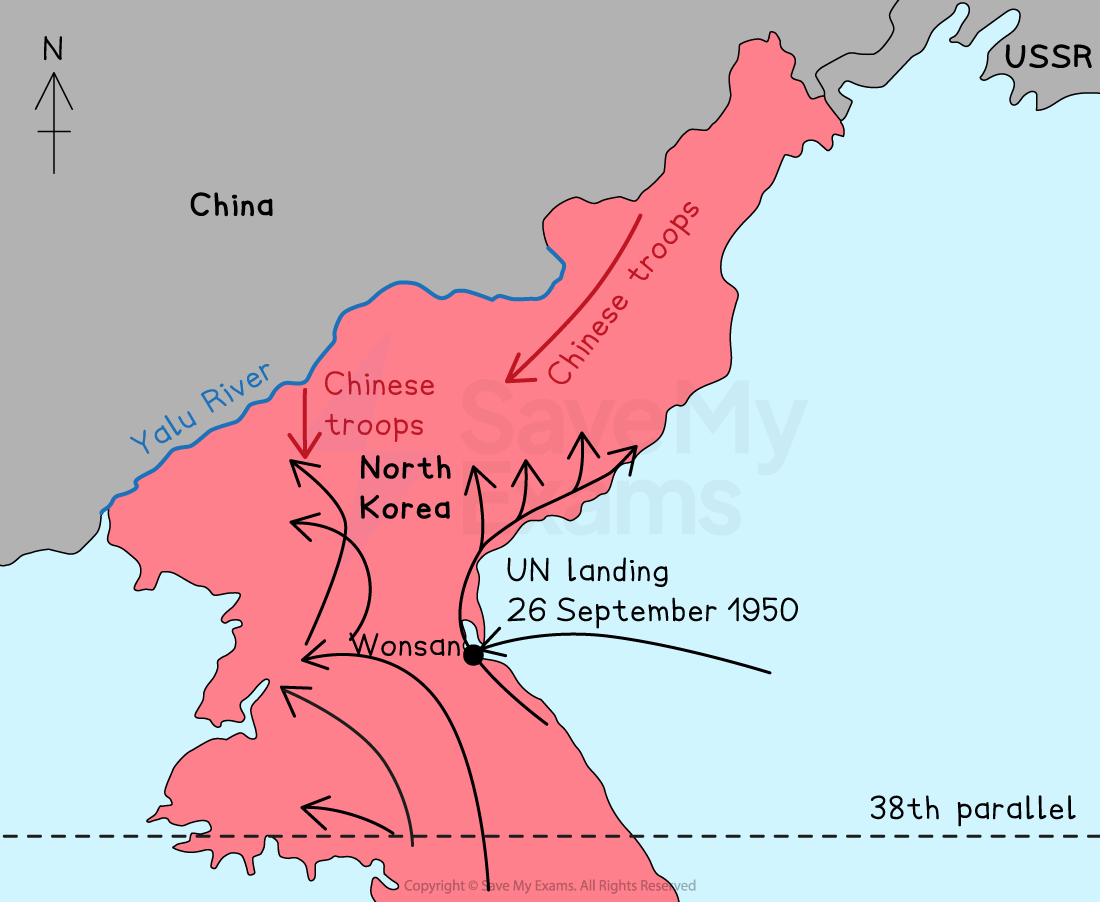
The UN force successfully removed the North Korean troops from South Korea, but then crossed the 38th parallel and approached the Chinese border.
This led Mao, who had been initially reluctant to get involved, to join the war
This benefited the Chinese Communist Party (CCP) as it enabled it to remove opponents, create a sense of national unity and enhance China's international prestige
However, the Korean War also cost China a huge amount, both in terms of money and human lives
This prevented Mao from carrying out many of his promised reforms.
Korean War: Boosting CCP Control, Suppressing Internal Opposition and National Unity
The Communist government in China had only been in place for one year when the war in Korea broke out
The war benefited Mao's government in several ways
Boosting CCP control
Entering into a war against forces led by the capitalist Americans strengthened China's relationship with the Soviet Union (a powerful communist ally)
The war allowed Mao to prove that he was a useful, trustworthy and militarily formidable friend to Stalin
Suppressing internal opposition
The war gave the CCP the premise to attack and neutralise its enemies
Opponents could be identified as traitors or spies and locked up
Anyone who was tempted to criticise the CCP knew they could be branded a capitalist sympathiser
National unity
The CCP launched the "Resist America, Aid Korea" campaign to help boost national pride and unity
The campaign encouraged workers to donate their wages to the war effort
In times of war, populations tend to rally behind their leader
Mao was seen by many as being brave and heroic for standing up to the USA
Korean War: Human Cost, Financial Cost and Military Impact on China
Human Cost
Over 3 million Chinese soldiers fought in Korea
Around 700,000 of them were killed, including Mao's eldest son
Food was requisitioned to feed the enormous numbers of troops in Korea
This led to food shortages, starvation and famine in some areas of China
The crackdown on opponents of the CCP during the Korean War also had an enormous human cost
People who had worked or lived abroad, Christian missionaries, business people and those who had worked for the former Nationalist government were all suspected of being traitors or spies
Many were arrested and sent to labour camps
Others had their property confiscated and were forced to flee abroad
Financial Cost
The war in Korea was enormously expensive for the CCP
It cost in the region of 10 billion US Dollars
Much of this money was borrowed from the Soviet Union and had to be paid back in future years
Money that was meant to be spent rebuilding China's infrastructure and introducing education and healthcare reforms was spent on fighting the war instead
Things were made even worse by the trade embargo imposed on Chinese goods by the USA
This led to a sharp drop in China's foreign trade
Military Impact
The Korean War meant that China had made a powerful enemy in the USA
America became more actively involved in Asia and attempted to undermine Chinese rule in Tibet
It also led to the USA pledging to defend Taiwan from a Chinese attack
However, the creation and preservation of North Korea meant China had another Communist ally
It also meant that the Korean peninsula, which was a strategic weakness for China and the entry point for several foreign invasions, was secured
The Korean War and China's International Prestige on the World Stage
For decades, China had been viewed as a backward, impoverished nation that had been occupied and bullied by various imperial powers
The Korean War saw them hold off a superpower that was being supported by the militaries of more than a dozen other nations
This military success gave them enormous international prestige
To What Extent did Intervention in the Korean War strengthen the CCP's Position at Home?
China's involvement in the Korean War has been interpreted in different ways
Some historians believe that it allowed Mao to crush all opposition by branding those who disagreed with him as spies and traitors
Other historians saw the war as an expensive burden that prevented Mao from implementing his reforms
Crushing Opponents
Mao was able to claim that anyone who opposed him was either a counter-revolutionary, spy or traitor
Many of these people were imprisoned or put to death
Key historians
The war also changed Mao’s internal priorities. In September 1950, shortly before Chinese troops entered the war, he had demanded that the government not execute “a single secret agent” and not even arrest “the majority of them.” He hoped to induce them by peaceful means “to make a clean breast of things” and to prevent the courts from being overwhelmed. After the war began, Mao, worried about the dangers of facing internal and external enemies at the same time, emphasised the need to consolidate power, noting, “It is absolutely essential that suspicious elements be dealt with so that these organs may be placed in the hands of reliable personnel.” Instead of talking about not executing secret agents, Mao now warned: “In suppressing counterrevolutionaries, please make sure that you strike firmly, accurately, and relentlessly, so that nothing [detrimental] can be said about it among the various circles in society.” The government summarily executed those it considered bandits, spies, or secret agents. In less than six months, more than 700,000 counterrevolutionaries were put to death.
Lee Feigon, Mao, A Reinterpretation (2003)
The expense of the Korean War prevented Mao's reforms
Fighting America for three years was incredibly expensive and meant that Mao could not focus on domestic policies
Key historians
The PRC’s forces had faced the might of the USA and held them at bay for three years. But this had come at a high international and domestic cost. The Korean War deepened the hostility between China and the USA and led to a generation of Sino-Western tension. The bamboo curtain was as powerful a barrier to international understanding as Europe’s iron curtain was. One particular outcome of the war was that the USA pledged itself to the defence of Taiwan. This effectively ruled out any possibility of the People's Republic of China (PRC) reclaiming the Guomindang (Nationalist) stronghold in the foreseeable future. Nor was the deterioration in China’s relations with the USA balanced by an improvement in Sino-Soviet understanding. Mao’s feeling that Stalin had deliberately misled him was intensified by the Soviet leader’s consistent refusal to involve the USSR directly in Korea. In the first major military contest of the Cold War, it had been Chinese, not Soviet comrades who had died in the cause of international Communism. The loss of a million young men was not the end of the PRC’s tribulations. The national economy had to be redirected to meet the war effort. Such was the disruption that the domestic growth that might have been expected in peacetime was delayed by over a decade. The financial burdens were especially heavy. Wartime production costs increased China’s debts. Mao remarked that China had to pay down to the last rifle and bullet for the Soviet supplies it received during the Korean conflict.
Michael Lynch, Mao, Second Edition, (2017)
Examiner Tips and Tricks
This module is called Mao's China for a reason. When revising, link everything back to Mao. Whatever the topic, ask yourself, 'how does this show Mao's power?' or 'was this a success for Mao?' or 'did this strengthen or weaken Mao's position?'

Unlock more, it's free!
Join the 100,000+ Students that ❤️ Save My Exams
the (exam) results speak for themselves:

Was this revision note helpful?
Build on this topic