The People's Communes: Organisation and Impact (Edexcel A Level History: Route E: Communist states in the twentieth century): Revision Note
Exam code: 9HI0

Summary
After the successes of the Mutual Aid Teams (MATs) and the Agricultural Producers' Co-operatives (APCs), Mao was eager to press on with agricultural reforms
People's Communes, which were made up of at least 5,000 households each, were established
Mao believed that the pooling of resources and labour on such a scale would yield an even greater increase in production than the APCs
He also felt that they would free people from family responsibilities and domestic chores, enabling them to work for longer in the fields
He combined these changes with the introduction of Lysenkoism, which compelled farmers to plant seeds and tend crops in very specific ways.
Neither Lysenkoism nor the communes led to an immediate increase in production
Mao put this down to crops being damaged by the 'four pests' of sparrows, rats, mosquitoes and flies
The extermination of the sparrow population led to an explosion in the amount of insects, and locusts in particular caused great damage to crops
There was a great reluctance to report the true impact of these reforms
The production figures reported to the CCP leadership were inflated
Rather than understanding that there was a shortage of food, the leadership believed there was going to be an excess
This led to food being exported to other communist countries around the world
By the time the accurate production figures were clear, it was too late to prevent one of the worst famines of the 20th century
This led to the deaths of between 30 and 50 million people
Liu Shaoqi and Deng Xiaoping reversed many of the reforms of the communes and reintroduced aspects of private farming
This led to levels of food production returning to pre-commune levels by 1965
People's Communes: Structure, communal living and collective farming
After the establishment of the Mutual Aid Teams (MATs) and the Agricultural Producers' Co-operatives (APCs), the next stage in the creation of the Communist Society in the countryside was the People's Communes
Communes were much bigger than MATs and APCs and contained over 5,000 households
The first commune was created in 1958 and named after the Soviet satellite Sputnik that had been launched the previous year
Structure of communes
Mao believed that communes would lead to an increase in production because people would be freed from the burdens of family life
Food would be provided in enormous mess halls
So time would not be spent cooking
Children would be placed in crèches and schools
Parents were free from childcare responsibilities
The elderly would be placed in 'happiness homes'
Their children and grandchildren would not have to care for them
Private ownership of anything was banned
All land, tools, equipment, animals and household possessions became the property of the commune, without compensation
Some communes did away with household dwellings, and instead, people slept in communal dormitories
Extremely long working hours were expected, with only a few hours allowed for sleep each day
Married couples only slept together during arranged conjugal visits
Abolition of private farming and Lysenkoism in Mao's China
Under the MATs and APCs, individuals had been rewarded for how much work they put in
In the communes, all individual rewards were scrapped
Militias in every commune monitored the community
They ensured no food or goods were sold for individual benefit
Working hard to improve the lives and conditions for the whole commune was seen as motivation enough
If people were not motivated to work, they were compelled to by team leaders who competed with team leaders in other communes to outproduce each other
Lysenkoism
Trofim Lysenko was a Soviet agricultural scientist who was very influential in the USSR in the 1930s
In 1958, the Chinese government made some of Lysenko's ideas official government policy that Chinese farmers had to follow
These included planting seeds deep in the soil and closely together
Farmers were also instructed to expose the seeds to water and low temperatures before planting
Lysenko's ideas were scientifically flawed and led to a dramatic fall in crop yields
Great Chinese Famine 1959–61: Causes, scale and human cost
The move to communes is regarded as significantly contributing to the worst famine experienced anywhere in the world during the 20th century
The cost of communal living
Life in the communes was extremely hard
Morale was further damaged by parents feeling forced to abandon their children to the care of inexperienced strangers
The tradition and comfort provided by the family's eating together were ended
Food provided by the mess halls was poor and lacked nutrition
Connections with parents and grandparents were also broken by the 'happiness homes'
The Four Pests
When the move to communes did not result in an immediate increase in production, Mao looked for explanations
The culprits he identified became known as the 'four pests'
Mao launched a campaign to wipe out rats, flies, mosquitoes and sparrows, which he identified as destroyers or consumers of grain
Sparrows were targeted by preventing them from landing by banging pots and pans
Eventually, they fell to the floor exhausted and were killed
The extermination of the sparrow population led to insect populations, such as the locust, rapidly increasing
Plagues of locusts then destroyed entire harvests
Lack of incentives
People were exhausted by:
The relentless physical labour of farming
Chasing the 'four pests'
They were also miserable because they had been separated from loved ones
The farmers knew they would receive no extra reward if they put in extra work
This led people to do as little as they could get away with without being punished by the team leaders
This resulted in reduced production
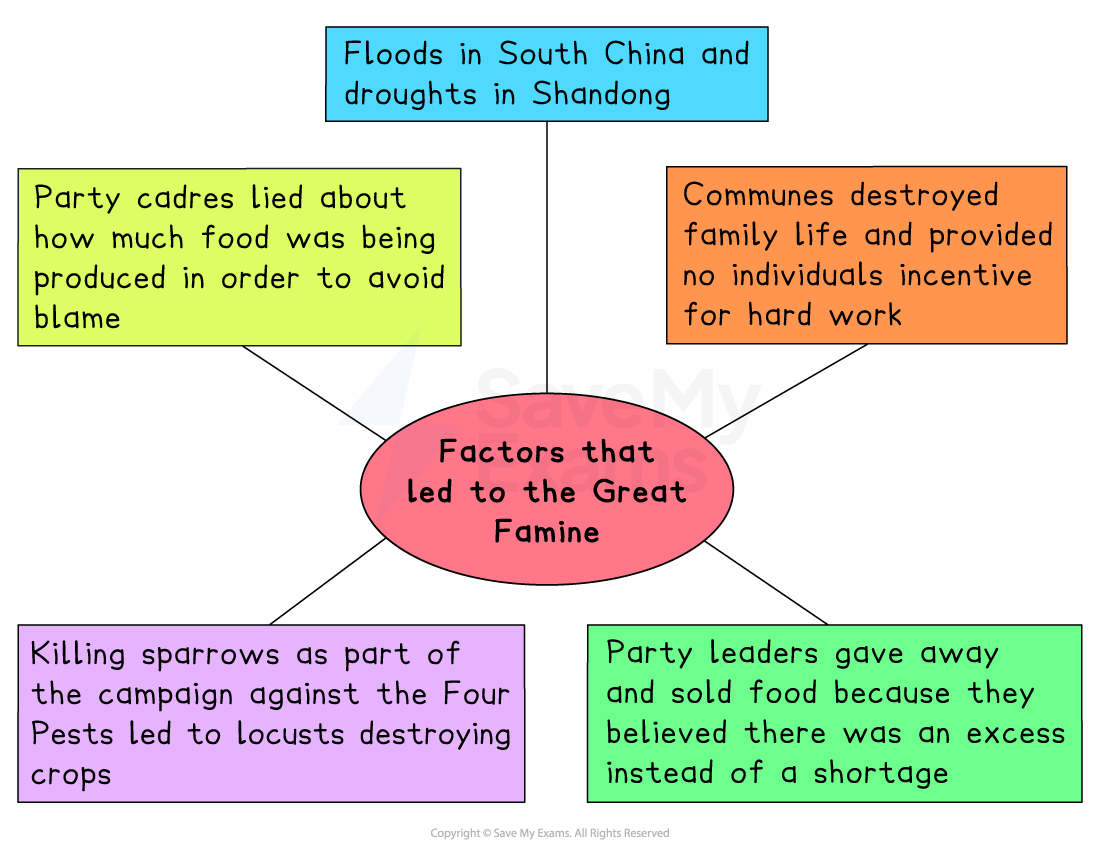
Exporting 'excess' food
The team leaders and Party cadres were reluctant to report the drop in agricultural production in case they were personally blamed
Instead, they reported inflated production figures
This led the CCP to believe there was going to be too much food to be able to store safely
As a result, 'excess' food was then gifted to other Communist countries
Rice became a staple food in East Germany
Floods and droughts
In South China, torrential rain led to vast areas becoming flooded
In Shandong, there was a severe drought
Both events disrupted food production
The scale and human cost of the famine
There are no definitive figures on the cost in human lives of the Great Famine
It is generally accepted that between 30 and 50 million people died
Malnourishment disproportionately affected children and the elderly, who fell victim to disease as their bodies were so weakened
The birth rate fell dramatically as so many women became infertile due to starvation
There were reports of people eating tree bark, worms and frogs to survive
Some men forced their wives into prostitution in return for food
Others resorted to cannibalism
Although there were food shortages in the cities, it was the rural areas that were worst affected
Tibet suffered terribly, and it is estimated that one in four of its population died during the famine
The situation was made worse in Tibet by the forced switch from barley to other crops that would not grow in Tibetan conditions
Liu Shaoqi and Deng Xiaoping: Restoring private farming after the famine
As reports of the number of deaths began to reach the CCP leadership, attempts were made to try and mitigate the disaster
Many of the reforms of the communes were reversed,
Traditional farming methods and processes were restored
This was overseen by Liu Shaoqi and Deng Xiaoping
The enormous communes were reduced in size, and food was allowed to be traded at markets
Any unused land was allowed to be turned into private plots, which peasants could either use to feed themselves or sell for a profit
Tools and fertiliser were sent to the countryside by the central government
These reversals of reforms saw agricultural production return to pre-commune levels by 1965
How far were the people's communes responsible for the Great Famine of 1959 to 1961?
Historians have debated whether the Great Famine of 1959 to 1961 was due to the People's Communes or down to other factors
Production fell, and yet food was still exported
Famines had periodically occurred in China due to natural disasters
The views of Marxist Historians
In agriculture, 1958 was certainly a good year, though not as good as had been thought. The three succeeding years were extremely bad. In 1959, almost half the cultivated area was affected by heavy floods or serious drought. In 1960, drought, typhoons, floods and pests struck 55 million hectares, more than half of the cultivated area, and seriously affected another 22 to 24 million hectares, some of which bore no crop at all. The Yellow River practically dried up for a month in Shandong, an almost unheard-of event. A serious food shortage developed, but famine was avoided by rationing and collective effort. The commune system, by its ability to mobilise large numbers of people, undoubtedly helped in avoiding famine in these difficult years.
E.L. Wheelwright and Bruce McFarlane, The Chinese Road to Socialism, 1973
The views of Western Historians
Close to 38 million people died of starvation and overwork in the Great Leap Forward and famine, which lasted four years. This was the greatest famine of the twentieth century – and of all recorded human history. Mao knowingly starved and worked these tens of millions of people to death. During the two critical years 1958–59, grain exports alone, almost exactly seven million tons, would have provided the equivalent of over 840 calories per day for 38 million people – the difference between life and death. And this was only grain; it does not include the meat, cooking oil, eggs and other foodstuffs that were exported in very large quantities. Had this food not been exported (and instead distributed according to humane criteria), very probably not a single person in China would have had to die of hunger.
Jung Chang and Jon Halliday, Mao, The Unknown Story, 2012
(Jung Chang has been criticised for being sensationalist, and some of her figures have been questioned)
Examiner Tips and Tricks
The key debate in this topic is how far the communes caused the Great Famine versus other factors such as poor weather, Lysenkoism and local cadre dishonesty in reporting yields.
The strongest answers will argue that the communes created the structural conditions that turned a bad harvest into a catastrophic famine.

Unlock more, it's free!
Join the 100,000+ Students that ❤️ Save My Exams
the (exam) results speak for themselves:

Was this revision note helpful?
Build on this topic