Hormones in Humans: Reproduction & Metabolism (AQA GCSE Biology): Exam Questions

Exam code: 8461

3 hours15 questions
1a
1 mark

Which is not an example of a secondary sex characteristic?

  • increase in height

  • development of facial hair

  • deepening of the voice

  • development of breasts

1b
2 marks

Name the two hormones that are produced in the ovaries.

1c
1 mark

Which hormone is responsible for causing the development of secondary sex characteristics in males?

  • oestrogen

  • adrenaline

  • testosterone

  • insulin

1d
1 mark

Define the term 'ovulation'.

2a
2 marks

A woman starts her first day of menstruation on 7 January.

Calculate when she is most likely to ovulate (assume a 28-day menstrual cycle).

2b
2 marks

Figure 1 shows descriptions of the four different stages of the menstrual cycle.

Figure 1

Matching diagram. Boxes on the left are headed Stage: Stage 1, Stage 2, Stage 3 and Stage 4. Boxes on the right are headed Description, listed from top to bottom. First box: the uterus lining is maintained for about 14 days. If no fertilised egg implants, the wall lining starts to break down. Second box: an egg is released from the ovary through ovulation. Third box: the uterus lining builds up again into a thick spongy layer full of blood vessels. Fourth box: the uterus lining breaks down for about four days.

Draw one line from each description to the correct stage.

2c
1 mark

Which gamete does testosterone play a role in the development of? 

2d
1 mark

Higher Tier Only

Figure 2 shows the blood hormone concentration of oestrogen and progesterone during a 28-day period.

It also shows the changes that occur in the uterus lining throughout that time.

Figure 2

Two line graphs with time in days on the horizontal axis, from 0 to 28. The top graph shows blood hormone concentration. Progesterone falls during the first day or two, stays low until about day 14, rises to a peak at about day 24, then falls steeply until day 28. Oestrogen rises to a peak at about day 12, falls until about day 18, rises to a smaller peak at about day 24, then falls until day 28. The bottom graph shows thickness of the uterus lining. It falls to its lowest at about day 3, rises until about day 14, stays level until about day 25, then falls until day 28.

What change is associated with the decrease in the concentration of progesterone between days 25 and 28?

  • The uterus lining increases in thickness.

  • The uterus lining is maintained.

  • Blood concentration of oestrogen increases.

  • The uterus lining decreases in thickness.

3a
1 mark

Higher Tier Only

An increase in the secretion of luteinising hormone (LH) triggers ovulation in women.

Figure 1 shows the blood concentration of hormones involved in the menstrual cycle.

Figure 1

Line graph of blood hormone concentration against time in days, from 1 to 28. The vertical axis has no label. Four lines are labelled A to D. Line A is low until about day 12, rises steeply to a tall, narrow peak just before day 14, then falls steeply and stays low. Line B rises from about day 6 to a tall, wide peak just before day 14, falls until about day 17, rises to a smaller peak at about day 20, then falls. Line C is at zero until about day 12, rises to a peak at about day 20, then falls to zero by day 28. Line D is low and slightly above line A at the start and at the end, with a short, narrow peak just before day 14

Which line represents LH?

    3b
    2 marks

    Figure 2 shows the number of pregnancies in four groups of 100 women. Each group used a different form of contraception.

    Figure 2

    Bar chart of number of pregnancies, from 0 to 20, for four methods of contraception. Contraceptive pill: just over 1. Intra-uterine device (IUD): just over 2. Diaphragm: about 5. Menstrual cycle tracking: 20

    Explain which is the most effective form of contraception.

    3c
    2 marks

    Which two contraceptive methods shown in Figure 2 are most likely to contain hormones?

    Figure 2

    Bar chart of number of pregnancies, from 0 to 20, for four methods of contraception. Contraceptive pill: just over 1. Intra-uterine device (IUD): just over 2. Diaphragm: about 5. Menstrual cycle tracking: 20
    3d
    1 mark

    A woman uses 'natural methods' of contraception and avoids sexual intercourse during her most fertile period. Figure 3 represents the woman's 28-day menstrual cycle.

    Figure 3

    Circular diagram of a 28-day menstrual cycle, with the days numbered 1 to 28 clockwise. Days 1 to 4 are shaded and labelled menstruation (period)

    When in the menstrual cycle should she avoid having sexual intercourse, if she does not want to conceive?

    • days 1–4

    • days 5–8

    • days 12–15

    • days 20–23

    4a
    1 mark

    Some people who have already had children often consider more permanent methods of contraception.

    Which method of contraception is usually permanent?

    • condom

    • sterilisation

    • intrauterine device

    • contraceptive implant

    4b
    1 mark

    Higher Tier Only

    Some women struggle to get pregnant and are often treated with hormones to stimulate ovulation.

    Which two hormones can be given to women to increase the chance of ovulation?

    • FSH and LH

    • oestrogen and progesterone

    • LH and progesterone

    • FSH and oestrogen

    4c
    2 marks

    Higher Tier Only

    A number of women who undergo hormone treatment for infertility become pregnant with twins or triplets.

    Suggest why this may occur.

    4d
    2 marks

    Higher Tier Only

    In vitro fertilisation (IVF) can be used to help couples to have children. The IVF procedure involves the following events, as set out in Table 1.

    Table 1

    Event

    Description

    A

    The fertilised eggs develop into embryos

    B

    Hormones are used to stimulate the maturation of several eggs

    C

    One or two embryos are inserted into the mother's uterus

    D

    Eggs are collected from the mother and fertilised with sperm from the father

    Complete Table 2 by reordering events A–D into chronological order.

    Table 2

    1st

    2nd

    3rd

    4th

    5a
    1 mark

    Where is oestrogen mainly produced?

    • pituitary gland

    • ovary

    • uterus

    • thyroid gland

    5b
    2 marks

    Complete the sentences about reproductive hormones. Use words from the box.

    eggs, FSH, LH, oestrogen, progesterone, testosterone

    1. ________ is the main male reproductive hormone. It is produced by the testes and stimulates sperm production.

    2. ________ is the main female reproductive hormone. At puberty, it is produced in the ovary, and eggs begin to mature.

    5c
    1 mark

    Name the hormone that stimulates the release of a mature egg from the ovary.

    5d
    2 marks

    Fertility can be controlled by a variety of hormonal and non-hormonal methods of contraception.

    Describe how oral contraceptives prevent pregnancy.

    5e
    2 marks

    Condoms are a non-hormonal method of contraception.

    Explain how condoms prevent pregnancy.

    5f
    2 marks

    Give one advantage and one disadvantage of using a condom rather than taking an oral contraceptive.

    1a
    3 marks

    Higher Tier Only

    During puberty reproductive hormones cause secondary sex characteristics to develop.

    In girls, the menstrual cycle also begins.

    A number of hormones involved in the menstrual cycle are produced by the pituitary gland in the brain.

    Describe how hormones interact to control the release of an egg during the menstrual cycle.

    1b
    1 mark

    What is meant by the term 'contraception'?

    1c
    4 marks

    The oral contraceptive pill and the contraceptive implant both contain hormones.

    Explain how each method prevents pregnancy.

    Suggest one advantage of the implant over the pill.

    1d
    2 marks

    On average, sperm production in males begins at around 12 years old.

    Explain what initiates sperm production.

    2a
    4 marks

    The graph in Figure 1 shows how infertility and the likelihood of a woman falling pregnant change with age.

    Figure 1

    Line graph of percentage likelihood, from 0 to 100, against age of women in years, from 20 to 50. A solid line shows the likelihood of getting pregnant and a dashed line shows the likelihood of infertility. Describing the trends is part of this task

    In 1975, the average age of women in England and Wales when they had their first child was 24.2 years.

    In 2019, the average age had risen to 28.9 years.

    Describe the impact of the increase in the average age of women having their first child.

    Use data from Figure 1 in your answer.

    2b
    5 marks

    Higher Tier Only

    A 42-year-old woman wants to have a child with her partner but they have been unable to fall pregnant naturally.

    Describe how modern reproductive technology can be used to treat infertility.

    2c
    2 marks

    Higher Tier Only

    Explain how treating fertility issues with hormones can result in multiple births.

    3a
    3 marks

    Oestrogen and testosterone are two important hormones in the human body.

    Explain why they are classified as hormones.

    3b
    5 marks

    Higher Tier Only

    Thyroxine is synthesised in and secreted by the thyroid gland.

    Describe how negative feedback controls thyroxine levels.

    3c
    5 marks

    Higher Tier Only

    Adrenaline is known as the ‘flight or fight’ hormone.

    Explain why.

    3d
    3 marks

    Higher Tier Only

    Hypothyroidism is caused by an underactive thyroid gland.

    Suggest what would happen in the body of a person with hypothyroidism.

    4a
    2 marks

    Higher Tier Only

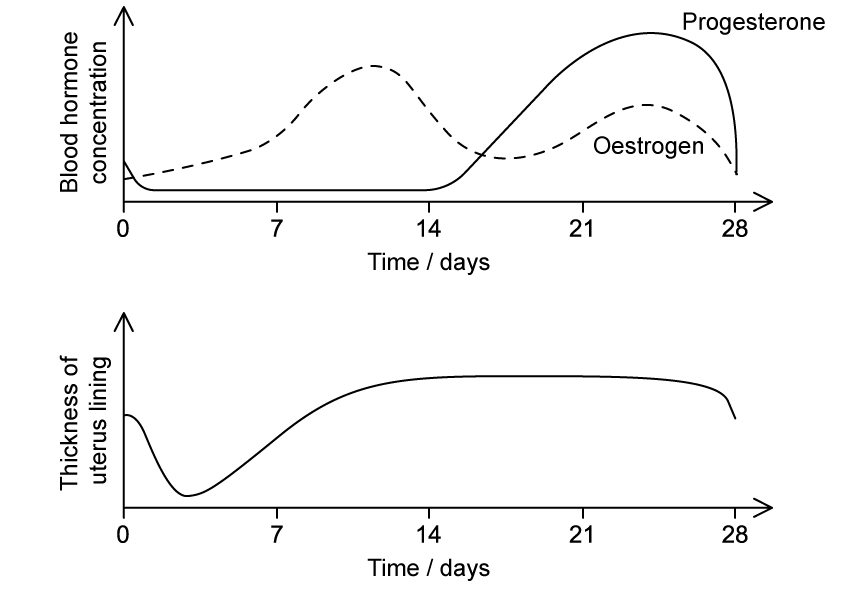
    The menstrual cycle is regulated through the action of several hormones.

    Figure 1 shows the changes in the hormones oestrogen and progesterone over the 28-day period of the menstrual cycle. It also shows the changes that occur in the uterus lining throughout that time.

    Two line graphs, one above the other, with time in days on the horizontal axis, from 0 to 28. The top graph shows blood hormone concentration, with a solid line for progesterone and a dashed line for oestrogen. The bottom graph has one line for the thickness of the uterus lining. Describing how the lines change is part of this task.

    Figure 1

    Explain two reasons for the decrease in the thickness of the uterus lining shown between days 0 and 3 in Figure 1.

    4b
    2 marks

    Higher Tier Only

    Describe and explain the relationship between the concentration of oestrogen in the blood and the thickness of the uterus lining between days 7 and 14.

    4c
    3 marks

    Higher Tier Only

    Figure 1 shows that progesterone levels rise after day 14, reach a peak at around day 24 and then fall by day 28. However, if an egg is fertilised, the concentration of progesterone does not follow the pattern shown in Figure 1.

    Use your knowledge of hormones in human reproduction to describe how the concentration of progesterone would be affected by fertilisation and explain why it is affected in this way.

    4d
    2 marks

    Reproductive hormones are responsible for the start of puberty.

    Describe two changes that result from the onset of puberty.

    1a
    4 marks

    Figure 1 shows a comparison of average height between males and females from birth to adulthood.

    Figure 1

    Line graph titled Height comparison between males and females. The x-axis is age in years, from 0 to 20. The y-axis is height in cm, from 50 to 170. Approximate heights for males are 56 cm at 0 years, 96 cm at 4 years, 115 cm at 8 years, 127 cm at 12 years, 150 cm at 16 years and 173 cm at 20 years. Approximate heights for females are 52 cm at 0 years, 92 cm at 4 years, 110 cm at 8 years, 134 cm at 12 years, 150 cm at 16 years and 165 cm at 20 years

    Explain why height should not be considered a secondary sex characteristic.

    1b
    4 marks

    Higher Tier Only

    Hypopituitarism is a rare disorder in which the pituitary gland fails to produce sufficient quantities of one or more hormones. Girls who suffer from this rare condition usually experience delayed puberty, as the pituitary gland does not produce enough of two key hormones involved in puberty.

    Suggest a mechanism by which hypopituitarism causes delayed puberty in girls.

    1c
    4 marks

    Gynaecomastia is a common condition that causes boys' and men's breasts to swell and become larger than normal.

    Figure 2 shows an excerpt from a report in the Endocrinology Monthly journal, of an unusual case of gynaecomastia.

    Figure 2

    Excerpt headed Endocrinology Monthly. It reads: A 15-year-old male was referred to the endocrinologist for evaluation of bilateral gynaecomastia. He reported tender enlarged breasts, a decrease in testicular size and a slight reduction in muscular mass. Ultrasound and CT scans of breasts and testicles were unremarkable, ruling out any signs of tumours. During a follow-up interview, the patient described a daily intake of around 2 litres of soy milk. The clinicians have noted that soy contains phytoestrogens and advised the patient to reduce his consumption of soy milk

    Explain why the patient may have gynaecomastia.

    2a
    2 marks

    Higher Tier Only

    Describe how oestrogen affects the release of luteinising hormone (LH) and follicle stimulating hormone (FSH) in the menstrual cycle.

    2b
    4 marks

    Figure 1 shows changes in the thickening of the uterus wall lining in two women X and Y.

    Figure 1

    Line graph of wall thickness against time in days, from 0 to 30. Lines X and Y follow the same path at first, falling slightly from day 0 to about day 4, then rising steadily until about day 15. Line X carries on rising steadily until it ends at about day 28. Line Y levels off until about day 20, then falls more and more steeply until it ends at about day 28, below its thickness on day 0

    Suggest why the thickness of the uterus wall lining is different between the two women.

    2c
    6 marks

    Higher Tier Only

    Explain how the levels of LH and progesterone will differ between the women X and Y during the next calendar month (assume a normal menstrual cycle for woman Y).

    3a
    4 marks

    Figure 1 shows the number of pregnancies in four groups of 100 women.

    Each group used a different form of contraception.

    Figure 1

    Bar chart of number of pregnancies, from 0 to 20, for four methods of contraception. Contraceptive pill: just over 1. Condom: just over 2. Diaphragm: about 5. Menstrual cycle tracking: 20

    Evaluate the effectiveness of the different methods of contraception shown in Figure 1.

    3b
    3 marks

    Explain which method(s) of contraception would help to prevent the spread of sexually transmitted diseases. 

    3c
    3 marks

    Explain how contraceptive pills can be used to reduce fertility.

    3d
    4 marks

    Intrauterine devices (IUDs) are devices that are placed into the uterus to help prevent pregnancy.

    There are two main types: plastic IUDs that release progesterone and copper IUDs. The progesterone released by a plastic IUD stops the lining of the uterus from thickening.

    Figure 2 shows how many days of menstrual bleeding occur after fitting either a copper IUD or a progesterone IUD.

    Figure 2

    Line graph titled number of days of menstrual bleeding, copper IUD versus progesterone IUD, with days from 0 to 7 plotted against months from 0 to 24. Copper IUD: 5.2 days in month 1, 4.4 in month 3, 4.2 in month 4, then varies between 3.9 and 4.8 and is 4.3 in month 24. Progesterone IUD: 6 days in month 1, 3.5 in month 2, 2.3 in month 3, 1.9 in month 4, 1.2 in month 6, 0.9 in month 7, 1.2 in month 9, then varies between 0.2 and 0.8 and is 0.3 in month 24

    Explain why there are differences in the number of days of menstrual bleeding between the two devices.

    4a
    3 marks

    Higher Tier Only

    The hormones FSH and LH are used in IVF.

    Explain the use of FSH and LH in IVF.

    4b
    2 marks

    Higher Tier Only

    A private fertility clinic undertook an 'in house' scientific study to investigate the success of IVF treatment in their patients. Two groups of women were included in the study: one group was under 40 years of age and the other group was over 40 years of age. The results of the study are shown in Table 1.

    Table 1

    < 40 years of age

    > 40 years of age

    Total

    Successful pregnancy

    82

    4

    86

    Failed pregnancy

    58

    21

    79

    Calculate the percentage chance that a 45-year-old woman would have successful IVF treatment.

    4c
    6 marks

    Higher Tier Only

    Based on their study (described in part (b)), the fertility clinic published an advert claiming that their clinic was more successful than the UK national average. Figure 1 shows the information published.

    Figure 1

    Bar chart titled IVF Success Rate, Our clinic versus UK average. The y-axis is success rate from 0.0% to 70.0%, with a gridline every 10.0%. The bar for Our Clinic is labelled 58.6% and its top is just below the 60.0% gridline. The bar for UK Average is labelled 53.6% and its top is about halfway between the 40.0% and 50.0% gridlines. Evaluating the chart is part of this task

    Evaluate the validity of their claim (use the data in Table 1 to support your answer).

    5a
    6 marks

    Higher Tier Only

    Adrenaline is commonly known as the 'flight or fight' hormone, but adrenaline is also released in many other situations such as undertaking dangerous activities or running a race.

    Explain why the release of adrenaline can be advantageous to a competitive athlete.

    5b
    4 marks

    Higher Tier Only

    Adrenaline can be given after a cardiac arrest (when the heart stops beating).

    Suggest how adrenaline helps once the heart has restarted.

    5c
    4 marks

    Higher Tier Only

    Explain the homeostatic mechanisms involved in the control of metabolic rate.

    5d
    3 marks

    Higher Tier Only

    The hormone thyroxine contains iodine within its chemical structure. Iodine is an essential nutrient in the diet as it cannot be synthesised by the human body.

    Suggest the effect of a deficiency of dietary iodine on the human body.

    6a
    4 marks

    There are many ways of preventing pregnancy.

    Figure 1 shows an intrauterine device (IUD) inside a uterus. The IUD is labelled IUCD.

    Figure 1

    Diagram of the female reproductive system in section. A device with a vertical stem, two curved arms at the top and a thread at the bottom sits inside the uterus and is labelled IUCD. The lining of the uterus and the cervix, at the lower end of the uterus, are also labelled

    The IUD contains a hormone which is released at regular intervals and diffuses throughout the uterus. This hormone stops the lining of the uterus from thickening, and leads to a thick layer of mucus building up in the cervix. The IUD can last for up to five years before it needs to be replaced.

    Alternatively, a woman can take a contraceptive pill that contains the same hormone.

    For every 500 women who take the contraceptive pill, about 5 become pregnant, whereas in comparison for every 500 women who have an IUD, only 1 on average will become pregnant.

    Using the information above as well as your own knowledge and understanding, evaluate the use of these two types of contraceptive.

    Remember to include a conclusion in your evaluation.

    6b
    1 mark

    Barrier methods are another method of contraception, aside from those detailed in part (a).

    Suggest one reason why barrier methods may be considered a better option for contraception than the IUD or the contraceptive pill.

    6c
    6 marks

    Higher Tier Only

    Explain how hormones interact to control the menstrual cycle.