Meiosis (AQA GCSE Biology): Revision Note

Exam code: 8461

Lára Marie McIvor

Written by: Lára Marie McIvor

Reviewed by: Dr Natalie Lawrence

Updated on

Meiosis

  • Cells in reproductive organs divide by meiosis to form gametes (sex cells)

  • The number of chromosomes must be halved when the gametes are formed

  • Otherwise, there would be double the number of chromosomes after they join at fertilisation in the zygote (fertilised egg)

  • This halving occurs during meiosis, and so it is described as a reduction division in which the chromosome number is halved from diploid to haploid, resulting in genetically different cells

  • It starts with chromosomes doubling themselves as in mitosis and lining up in the centre of the cell

  • After this has happened the cells divide twice so that only one copy of each chromosome passes to each gamete

  • Gametes are described as being haploid – having half the normal number of chromosomes

  • Because of this double division, meiosis produces four haploid cells

Process of meiosis

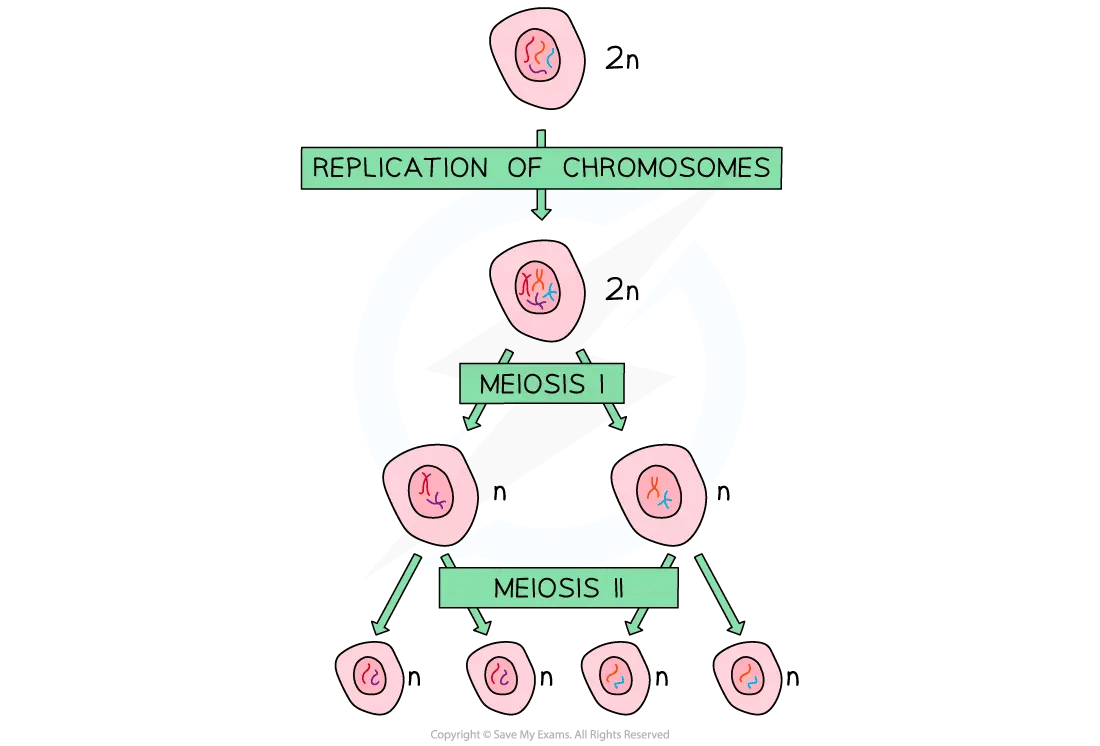
Diagram showing meiosis in a diploid cell containing maternal and paternal pairs of chromosomes. 

Before meiosis, each chromosome is duplicated to form a replicated chromosome consisting of two chromatids, and the nuclear membrane breaks down. Maternal and paternal homologous chromosomes pair up along the centre of the cell (which is different to how chromosomes organise themselves during mitosis). Sections of DNA are exchanged between homologous chromosome pairs by crossing over, producing recombinant chromosomes. 

During the first meiotic division, the homologous chromosome pairs separate and move to opposite sides of the cell, producing two cells with half the original number of chromosomes. 

During the second division, the chromatids separate. This produces four genetically different haploid daughter cells, each containing one chromosome from each homologous pair.
Meiosis involves two cell divisions and produces four genetically different haploid cells, with genetic variation introduced by crossing over

Use this image

  • Each chromosome is duplicated (makes identical copies of itself), forming X-shaped chromosomes

  • First division: the chromosome pairs line up along the centre of the cell and are then pulled apart so that each new cell only has one copy of each chromosome

  • Second division: the chromosomes line up along the centre of the cell and the arms of the chromosomes are pulled apart

  • A total of four haploid daughter cells will be produced

Importance

  • Produces gametes e.g. sperm cells and egg cells in animals, pollen grains and ovum cells in plants

  • Increases genetic variation of offspring

  • Meiosis produces variation by forming new combinations of maternal and paternal chromosomes every time a gamete is made, meaning that when gametes fuse randomly at fertilisation, each offspring will be different from any others

Fertilisation

  • Gametes join at fertilisation to restore the normal number of chromosomes

  • When the male and female gametes fuse, they become a zygote (fertilised egg cell)

  • This contains the full number of chromosomes, half of which came from the male gamete and half from the female gamete

  • The zygote divides by mitosis to form two new cells, which then continue to divide and after a few days form an embryo

  • Cell division continues and eventually many of the new cells produced become specialised (the cells differentiate) to perform particular functions and form all the body tissues of the offspring

  • The process of cells becoming specialised is known as cell differentiation

Unlock more, it's free!

Join the 100,000+ Students that ❤️ Save My Exams

the (exam) results speak for themselves:

Build on this topic

Lára Marie McIvor

Author: Lára Marie McIvor

Expertise: Content Creator

Lára graduated from Oxford University in Biological Sciences and has now been a science tutor working in the UK for several years. Lára has a particular interest in the area of infectious disease and epidemiology, and enjoys creating original educational materials that develop confidence and facilitate learning.

Dr Natalie Lawrence

Reviewer: Dr Natalie Lawrence

Expertise: Content Writer

Natalie has a MCantab, Masters and PhD from the University of Cambridge and has tutored biosciences for 14 years. She has written two internationally-published nonfiction books, produced articles for academic journals and magazines, and spoken for TEDX and radio.