Transpiration (AQA GCSE Biology): Revision Note
Exam code: 8461

Transpiration: Principles
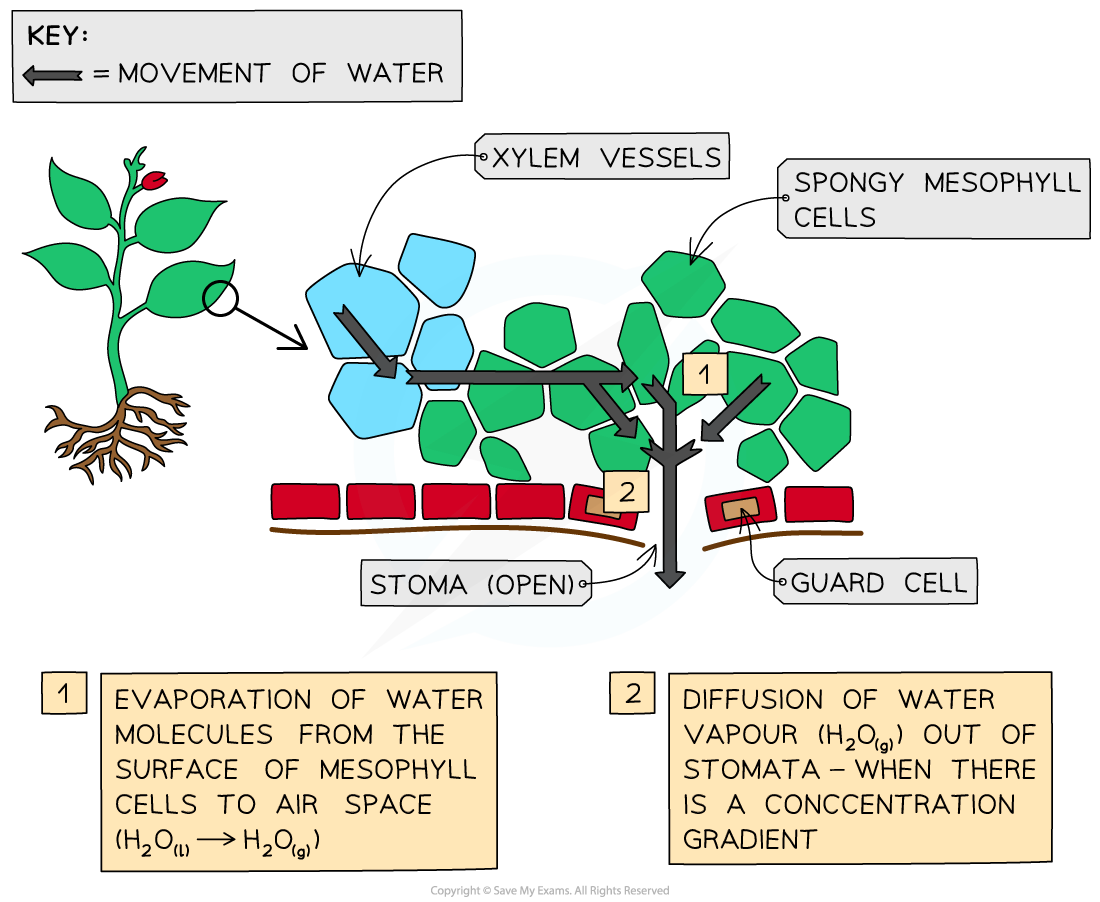
Transpiration can be defined as:
the loss of water vapour from the leaves of plants via the stomata
In order for transpiration to occur, water:
exits the xylem in the leaf
evaporates from the internal surfaces of the leaf into the air spaces
diffuses out of the stomata in the form of water vapour
The flow of water from the roots, up the xylem, to the leaves and out into the air is called the transpiration stream. It is driven by evaporation from the leaves and does not need energy from respiration
Transpiration: Factors
Air movement, humidity, temperature and light intensity all affect the rate at which transpiration occurs
Factor | Condition | Effect |
|---|---|---|
Air movement | High | Transpiration rate increases Wind removes water vapour from the air surrounding the leaf, which increases the concentration gradient between the leaf and the air; this increases diffusion rate of water vapour |
Humidity | High | Transpiration rate decreases When the air is saturated with water vapour the concentration gradient between the inside of the leaf and its surrounding is reduced, decreasing the rate of diffusion of water vapour out of the leaf |
Light intensity | High | Transpiration rate increases The rate of photosynthesis increases, so stomata open to allow gas exchange to occur; this allows more water vapour to diffuse out |
Temperature | High | Transpiration rate increases At higher temperatures water molecules have more kinetic energy, so water evaporates from the cell surfaces faster and the water vapour diffuses out of the leaf faster |
Transpiration: Investigating
Aim:
Estimate the rate of transpiration by measuring the uptake of water in a leafy shoot
This can be determined using a piece of equipment called a potometer

Method:
Cut a shoot underwater
This prevents air bubbles from entering the xylem
Set up the apparatus as shown in the diagram above and make sure it is airtight, using petroleum jelly to seal any gaps
This should also be done underwater to prevent entry of air bubbles
Dry the leaves of the shoot using a paper towel
Wet leaves will affect the results because water can block the stomata
Remove the capillary tube from the beaker of water to allow a single air bubble to form and place the tube back into the water
Set up the environmental factor that is being investigated
Allow the plant to adapt to the new environment for 5 minutes
Record the starting location of the air bubble
Leave for a set period of time
Record the end location of the air bubble
The further the bubble travels in the same time period, the faster transpiration is occurring and vice versa
Rate of water uptake = volume of water taken up ÷ time taken (e.g. cm³/min). This is used as an estimate of the rate of transpiration
Reset the bubble by opening the tap below the reservoi
Change the experimental factor being investigated: light intensity, wind speed, level of humidity or temperature
Repeat the experiment
Environmental factors can be investigated as follows:
Airflow: set up a fan or hairdryer
Humidity: spray water in a plastic bag and wrap around the plant
Light intensity: change the distance of a light source from the plant
Temperature: cold room or warm room
Examiner Tips and Tricks
Remember when designing an investigation that to ensure a fair test you must keep all factors the same other than the one you are investigating.
Transpiration: Stomata
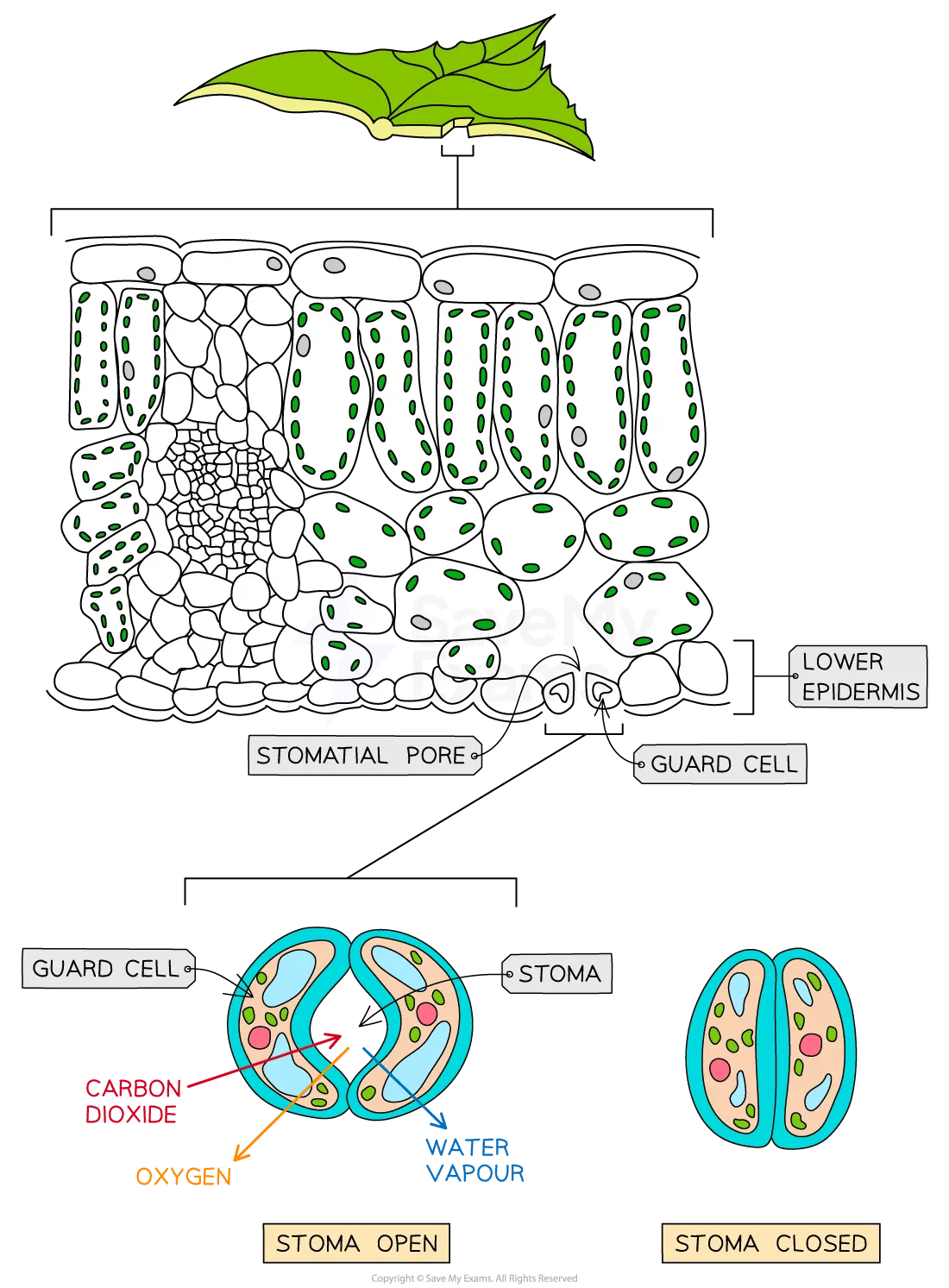
Stomata (singular: stoma) are pores located mainly on the underside of leaves
They are surrounded by specialised guard cells which control whether stomata are open or closed
Stomata open during the day to maximise gas exchange for photosynthesis
A side-effect of this is that water vapour is lost by transpiration
In dry conditions plants may keep their stomata closed to preserve water
At night there is no light, so no photosynthesis; the stomata close, which reduces water loss. As light intensity increases, the stomata open wider to take in more carbon dioxide for photosynthesis

Unlock more, it's free!
Join the 100,000+ Students that ❤️ Save My Exams
the (exam) results speak for themselves:

Was this revision note helpful?
Build on this topic