Required Practical: Food Tests (AQA GCSE Biology): Revision Note
Exam code: 8461

Food tests
Aim: To use qualitative reagents to test for a range of carbohydrates, lipids and proteins.
Process:
To include: Benedict’s test for sugars, iodine test for starch and Biuret reagent for protein
Safely use appropriate heating devices and techniques including the use of a Bunsen burner and a water bath
A qualitative food test indicates if a substance is present or absent in a sample (it doesn’t indicate how much is present)
Observations are essential in this practical: colour changes indicate if a substance is present or absent:
Food test colour changes
Food Test | Colour of Reagent | Positive Test Result | Negative Test Result |
|---|---|---|---|
Iodine for starch | Orange-brown | Blue-black | Orange-brown (no change) |
Benedict's for sugar | Light blue | green to brick-red | Light blue (no change) |
Ethanol for lipids (not required by AQA) | Colourless | Cloudy emulsion | Colourless (no change) |
Biuret for protein | Blue | Lilac-purple | Blue (no change) |
Preparing a food sample
Food samples must be prepared before carrying out the tests (especially for solid foods)
To do this:
Break up the food using a pestle and mortar
Transfer to a test tube and add distilled water
Mix the food with the water by stirring with a glass rod
Filter the mixture using a funnel and filter paper, collecting the solution
Benedict's test for sugars
Prepare a food sample
Set up a water bath at 80-90 °C
This can be achieved using a Bunsen burner and a beaker, or with an electronic water bath
Add food sample to a test tube with a few drops of Benedict's solution
Place the test tube in the water bath until it reaches the same temperature as the surrounding water
Note down the resulting colour
A change from blue to brick-red indicates the presence of sugar

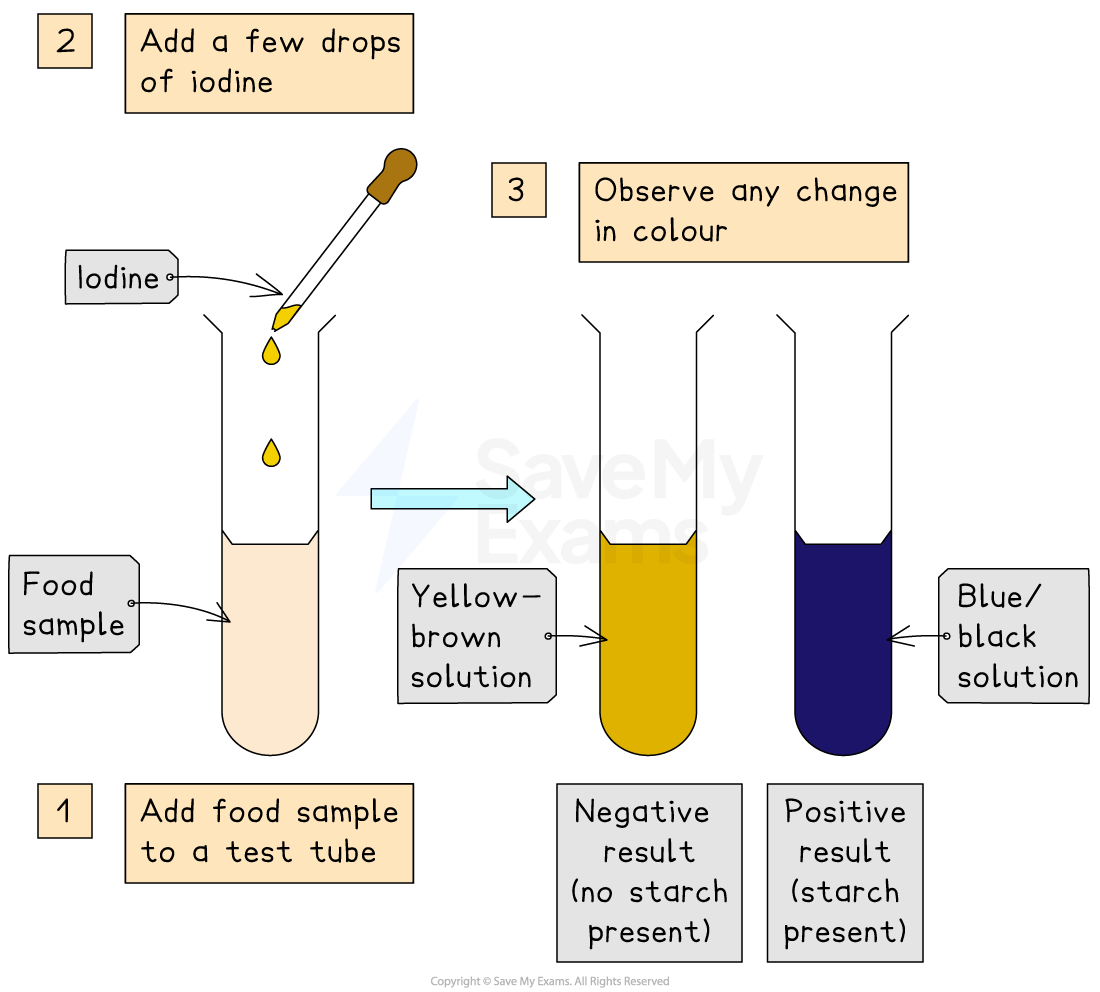
Iodine test for starch
Prepare a food sample
Add food sample to a test tube with a few drops of iodine solution
Note down the resulting colour
A change from yellow-brown to blue-black indicates the presence of starch
Emulsion test for lipids (not required by AQA)
AQA only requires the Benedict’s test, iodine test and Biuret test. The emulsion test is included for interest only.
Prepare a food sample
Add food sample to a test tube with a few drops of ethanol
Pour into a tube of distilled water
Shake the test tube gently
Note down the resulting appearance
The formation of a milky/cloudy emulsion indicates the presence of lipids

Biuret test for proteins
Prepare a food sample
Add food sample to a test tube with a few drops of Biuret solution
Note down the resulting colour
A change from blue to purple/lilac indicates the presence of protein

Important hazards
The main hazards in this practical are:
Biuret solution contains copper (II) sulfate which is dangerous particularly if it gets in the eyes, so goggles must be worn
Iodine is also an irritant to eyes (wear goggles)
Sodium hydroxide in Biuret solution is corrosive, so if any chemicals get onto the skin it must be washed off immediately
Ethanol is highly flammable so it must be kept away from the Bunsen burner used in the Benedict’s test (emulsion test only, not required by AQA)
The Bunsen should be turned off completely when not in use
Heating in the Benedict's test brings a risk of burns or scalds from the flame, hot glassware or boiling water, and of the reagent spitting out of the tube – use a water bath, point the tube away from people, wear eye protection and let equipment cool before touching it
Worked Example
State what can be concluded about the food groups present in the apple samples tested below. Include an explanation as to how you know this.
Food tested | Colour produced with Benedict's solution | Colour produced with iodine solution | Cloudy emulsion produced with ethanol (not required by AQA) | Colour produced with biuret solution |
|---|---|---|---|---|
Potato | Blue | Black | No | Blue |
Olive oil | Blue | Orange | Yes | Blue |
Egg yolk | Blue | Orange | Yes | Purple |
Apple | Orange | Dark blue | No | Blue |
Tofu | Blue | Orange | No | Purple |
Biscuit | Yellow | Orange | Yes | Blue |
Answer
"The apple contains both starch and sugar as it tested positive for both the iodine test (blue-black) and the Benedict's test (orange), but did not contain protein or lipid as the biuret and emulsion tests were both negative"

Unlock more, it's free!
Join the 100,000+ Students that ❤️ Save My Exams
the (exam) results speak for themselves:

Was this revision note helpful?
Build on this topic