Cloning (AQA GCSE Biology): Revision Note
Exam code: 8461

Tissue culture
Clones are genetically identical individuals
Tissue culture is a process by which plants can be cloned
During tissue culture:
a small group of cells is scraped from the parent plant
the cells are allowed to grow into new individual plants on nutrient agar
growth occurs in sterile conditions to prevent bacterial or fungal growth from outcompeting the plant cells
Hormones (e.g. auxins) are added to the nutrient medium to encourage cell growth and division

Tissue culture is a commercially valuable technique because it allows plant with desirable characteristics to be produced:
cheaply
with a high yield (a large number of plants can be produced)
quickly
at any time of the year
in a disease-free way
it avoids importing plants that may carry disease
Tissue culture can be a way of preserving rare plant species
E.g. a single rare individual can be cloned and many new plants cultivated in a safe environment before being planted out in the wild
Cuttings
An older and more simple method to clone plants (mainly used by gardeners) is by taking cuttings
Gardeners take cuttings from good parent plants (e.g. those that are healthiest and best-looking) – a section of the parent plant with a new bud is cut off
These cuttings are then planted and grow into genetically identical versions of the original plant
This is asexual reproduction: no gametes fuse and the new cells are made by mitosis, so every cutting has the same alleles as the parent
Plants grown from seed vary because they come from sexual reproduction (meiosis, and mixing of alleles from two parents through cross-pollination)
Plants cloned by taking cuttings can be produced cheaply and quickly
Embryo cloning
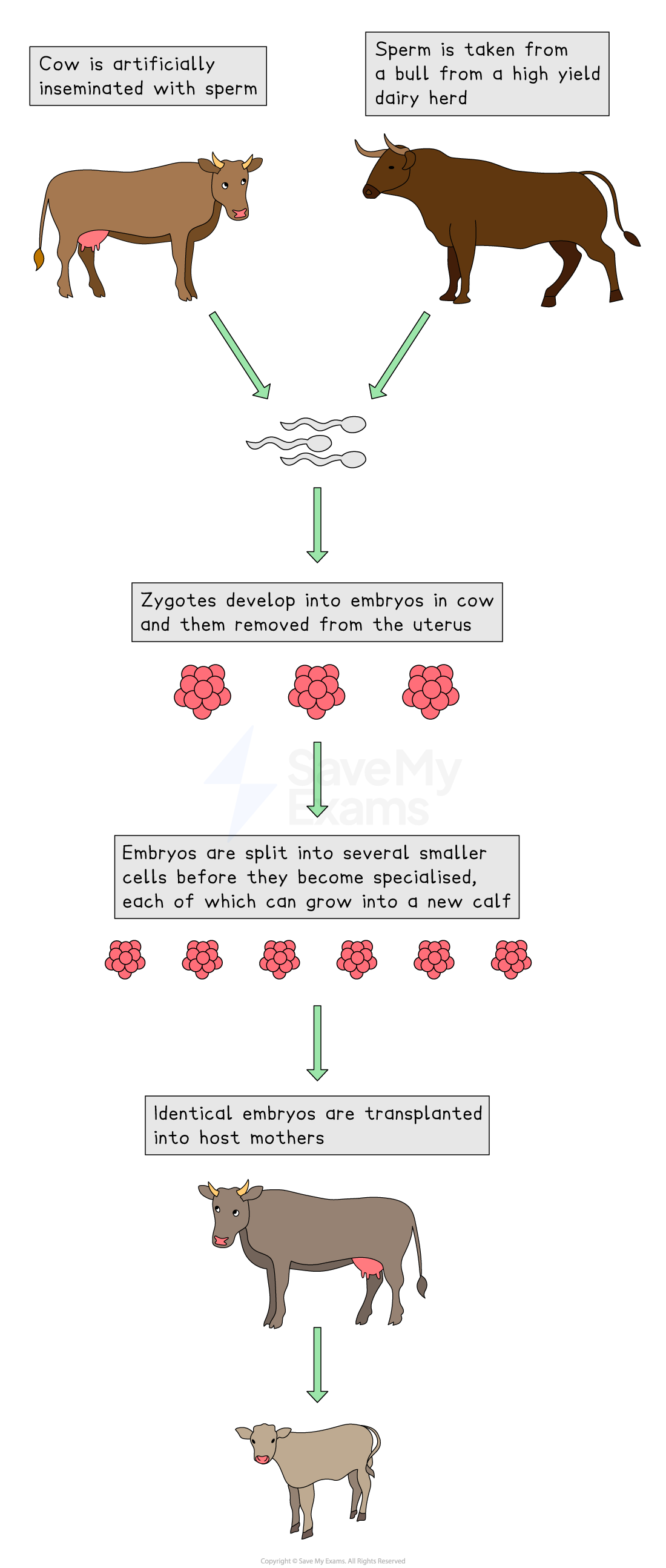
It is possible to clone animals using embryo transplants
For example, if a farmer wants the best cattle, they must first create an offspring from the best bull and best cow, and then clone this offspring to create many genetically identical copies (clones)
This process is known as embryo cloning and is achieved as follows:
Egg cells from the desired cow are artificially fertilised using sperm cells taken from the desired bull
The resulting zygote develops into an embryo
The embryo is then split apart into serval individual cells
This is done before the cells of the embryo become specialised
Each cell forms a separate embryos; all embryos developed from the divided cells are genetically identical
The cloned embryos are transplanted into host mothers
The calves born from these host mothers are all genetically identical
Adult cell cloning
Adult cell cloning is achieved in the following way:
The nucleus is removed from an unfertilised egg cell
The nucleus from an adult body cell, such as a skin cell, is inserted into the egg cell
A very small electric shock stimulates the egg cell to divide (by mitosis) to form an embryo
These embryo cells contain the same genetic information as the adult skin cell
When the embryo has developed into a ball of cells, it is inserted into the womb of an adult female (known as the surrogate mother) to continue its development until birth
This process was used to create the first clone (exact genetic copy) of a mammal in 1996
Scientists in Scotland successfully cloned an adult female sheep
The clone was called Dolly


Benefits and risks of cloning
Benefits:
Cloning could be used to help preserve endangered species of plants and animals
Cloning makes it possible to quickly and cheaply produce commercial quantities of consistently high quality plants at any time of the year
Cloning allows farmers to ensure consistently high quality livestock
Risks:
Cloning can result in a reduced gene pool (similarly to selective breeding). This means there are fewer different alleles in a population, leaving the population with a smaller chance of having resistance to new diseases
There is some evidence that cloned animals may not be as healthy as normal ones
Some people worry that humans might be cloned in the future. This is considered deeply unethical by the vast majority of people. In addition, early attempts might be unsuccessful (eg. they could result in children born with severe disabilities)

Unlock more, it's free!
Join the 100,000+ Students that ❤️ Save My Exams
the (exam) results speak for themselves:

Was this revision note helpful?
Build on this topic